

What surfaced quietly inside a Northern California police chiefs’ meeting recently should have sent shockwaves through Los Angeles County leadership, because it revealed just how dire the staffing collapse inside the Los Angeles County Sheriff’s Department has become.
According to multiple law enforcement sources, the department has begun reaching out to agencies in Northern California asking officers and deputies to sign short-term contract commitments, some as brief as two weeks, to come south and assist with routine staffing as preparations for the 2028 Olympics accelerate.
This outreach was not framed as a strategic public safety collaboration but was immediately recognized as a warning sign, reflecting the deep dysfunction and operational turmoil now gripping the Los Angeles County Sheriff’s Department.
The reaction from law enforcement was not hesitation but alarm. The chaotic and increasingly unstable policing environment in Los Angeles has reached a breaking point, and this outreach made that reality impossible to ignore. It is now openly acknowledged within law enforcement circles that the LASD, the largest sheriff’s department in the nation, can no longer staff itself. What the Olympics are revealing is not a temporary strain, but a systemic collapse years in the making.
That collapse traces directly back to the Defund the Police movement of 2020, which has since evolved into a full-scale Demonize the Police agenda, fueled by sustained attacks on federal immigration enforcement and policies repeatedly advanced by the LA County Board of Supervisors. Morale has cratered. Attrition has surged. Operational capacity has been hollowed out.
And as the consequences mount, leadership has vanished from the battlefield.

During critical Board of Supervisors meetings where new, and legally questionable, immigration directives were advanced, Sheriff Luna failed to appear and publicly warn of the real dangers those policies create for deputies on the street. Instead of defending his department, he allowed political narratives to replace operational reality, leaving rank-and-file personnel to absorb the fallout alone.
What deputies are witnessing is not reform. It is institutional abandonment, and the steady unraveling of public safety in the nation’s largest sheriff’s department.
That collapse tracks directly with the leadership of Sheriff Robert Luna. When Luna took office, the LASD was already strained by a hiring freeze and budget cuts imposed by the Board of Supervisors, measures widely viewed as efforts to weaken the department under former Sheriff Alex Villanueva, who had openly challenged the Board throughout his tenure. Yet despite those constraints, the LASD was still functioning. Staffing levels hovered just under 10,000 deputies, and while morale had taken a hit during the pandemic-era backlash against law enforcement, the department was bruised, not broken.
Now, with staffing falling below 7,000, the warning signs are no longer theoretical. They are operational red flags.
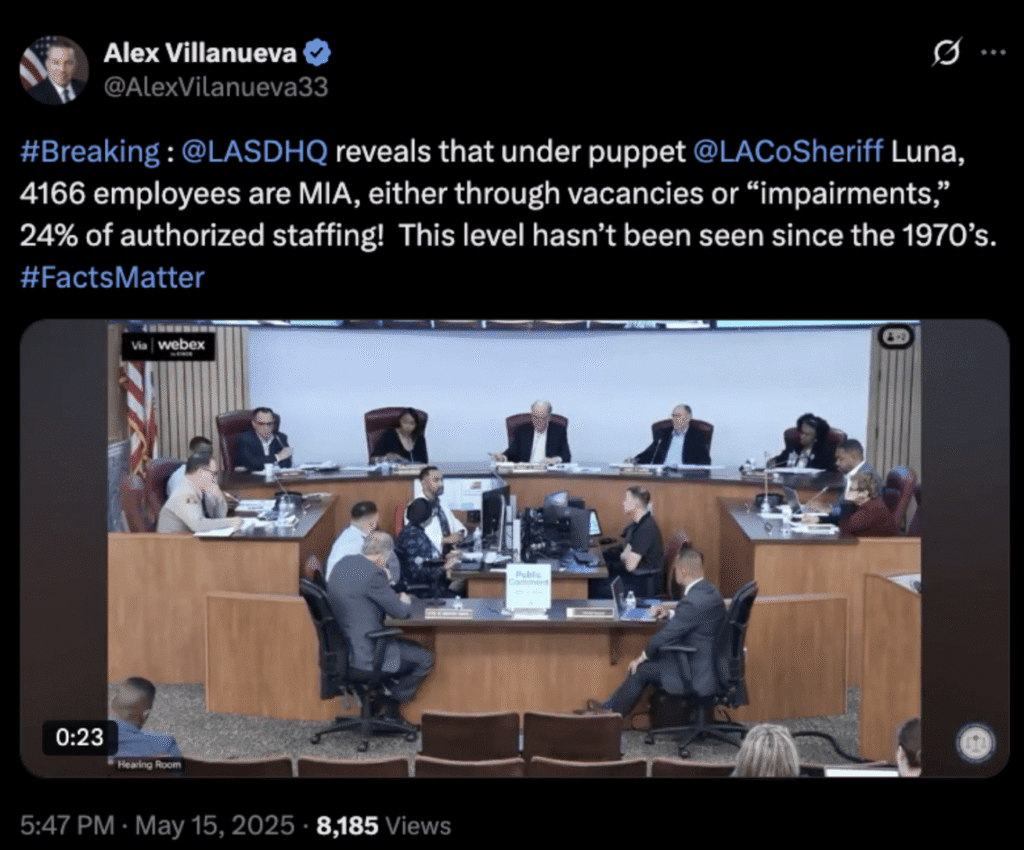
When Luna came into office, rather than stabilize the department, his early tenure was marked by political silence in moments when deputies needed leadership to advocate for their legal and operational protection.
The turning point that shattered remaining trust came with the federal prosecution of Deputy Trevor Kirk. Instead of publicly defending his deputy or challenging the legal framework being used to criminalize routine enforcement actions, Luna distanced himself and allowed the department to cooperate fully with federal prosecutors. Inside LASD, that moment was interpreted as a betrayal that sent a chilling message through the ranks: when politics collide with law enforcement reality, deputies are expendable.
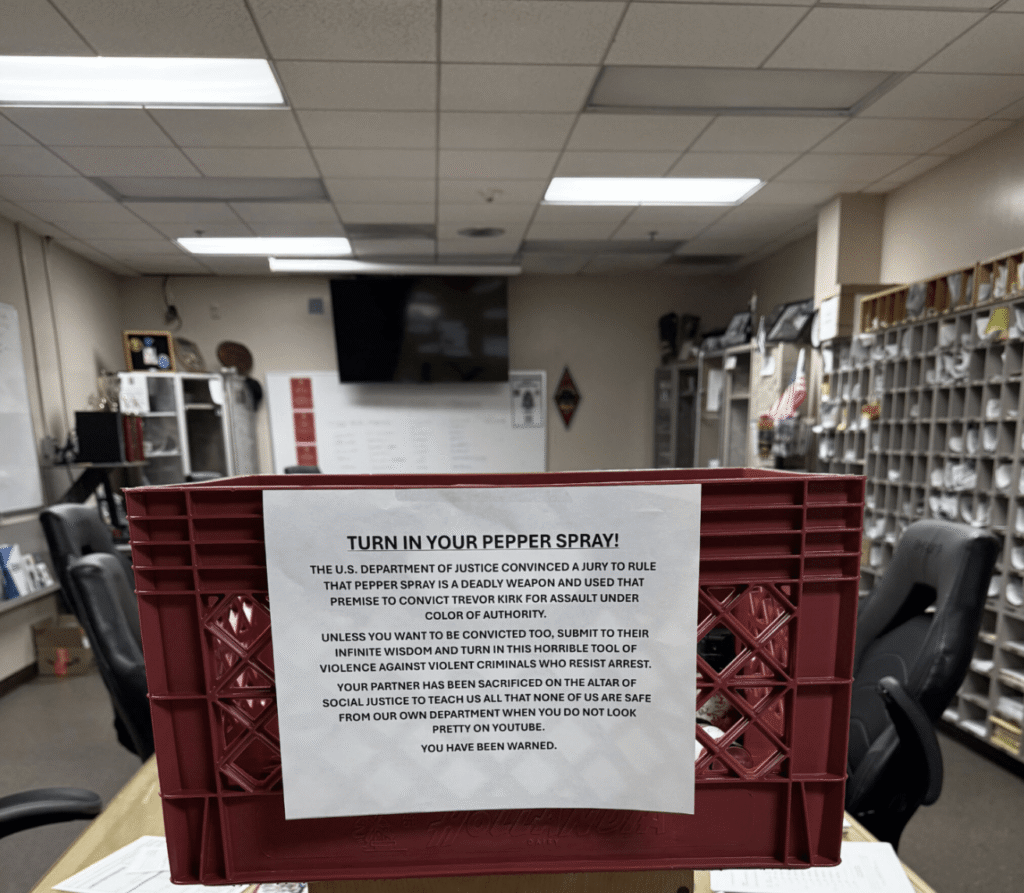
In the months that followed, attrition accelerated dramatically. Lateral transfers to neighboring agencies increased as experienced deputies sought departments where leadership would stand behind them. Early retirements surged, specialized units lost seasoned personnel, and recruitment pipelines weakened further as word spread throughout California law enforcement that LASD had become an agency where command staff would not protect its own people when pressure mounted. Morale, already fragile, collapsed completely.
Rather than confront the trust crisis driving this exodus, department leadership leaned harder on overtime to keep patrols operational. Letters authorizing back-to-back overtime periods became routine, exhaustion became normalized, patrol coverage thinned, and response times stretched. The Current Report documented this deterioration repeatedly while county officials publicly promoted narratives of reform and progress that bore little resemblance to the reality deputies were living.
By the time serious Olympic security planning entered its early stages, LASD was no longer focused on building capacity. It was focused on survival. This is how a department that once hired more than a thousand deputies in advance of the 1984 Olympics now finds itself begging outside agencies for short-term staffing help. In the early 1980s, leadership anticipated demand, stacked academy classes, boosted morale, and invested in manpower because they understood public safety requires preparation, not improvisation.
Under Luna’s leadership, the opposite has occurred. Trust has eroded, experience has walked out the door, overtime has replaced sustainable staffing, and temporary labor is now being floated as a substitute for long-term planning. Law enforcement leaders across Northern California recognize this for what it is: a department in institutional decline.
That recognition explains why police chiefs are actively discouraging their officers from taking even temporary assignments in Los Angeles, including those connected to the Olympics. When seasoned law enforcement professionals advise their people to stay away entirely, it signals far more than inconvenience. It reflects concerns about leadership, legal exposure, working conditions, and systemic dysfunction.
Publicly, county officials continue to sell a narrative of stability and progress, but privately they are scrambling for bodies to fill patrol cars. The Olympics did not create this crisis. They are simply shining a bright, unavoidable spotlight on a collapse that has been years in the making.
If LASD were healthy, academy expansions would already be underway. If it were stable, retention would be the central priority. If it were prepared, outside agencies would not be quietly filling routine staffing gaps. Instead, the nation’s largest sheriff’s department is operating in emergency mode, and law enforcement professionals across California want no part of it.
Los Angeles law enforcement has become so dysfunctional that even short-term assignments are being rejected no matter how high-profile. This is not about the work. It is about the institution itself and the leadership choices that drove it here.
The staffing crisis consuming LASD is not a mystery. It is the direct consequence of decisions made under Sheriff Luna’s watch, from political silence to the public abandonment of a deputy that shattered morale across the department. As the world prepares to descend on Los Angeles for the Olympics, the truth is finally becoming impossible to hide. Law enforcement no longer wants to work here, not full-time, not part-time, and not even temporarily – and that includes a once in a lifetime opportunity like the Olympics.