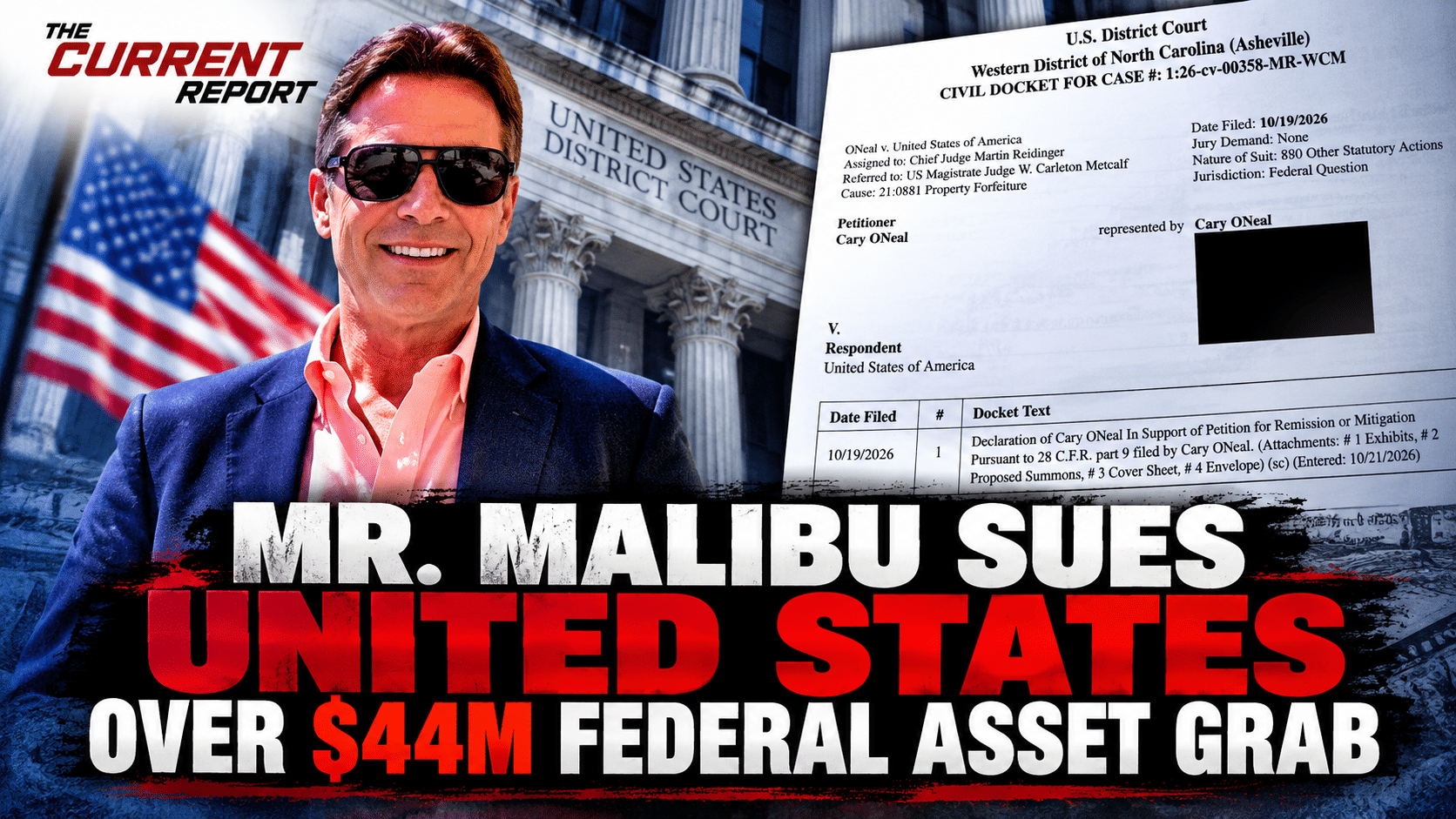
DOCKET REF: ONeal v. United States of America, U.S. District Court (WDNC), Case No. 1:26-cv-00358-MR-WCM
As criminal kingpins and corporate fraudsters make headlines when their assets are seized by the federal government, a quieter, systemic injustice takes place behind closed doors: the unconstitutional sweep of innocent third-party property into federal custody.
Now, a major federal civil action officially docketed in the U.S. District Court for the Western District of North Carolina is bringing that exact practice into the harsh light of judicial scrutiny.
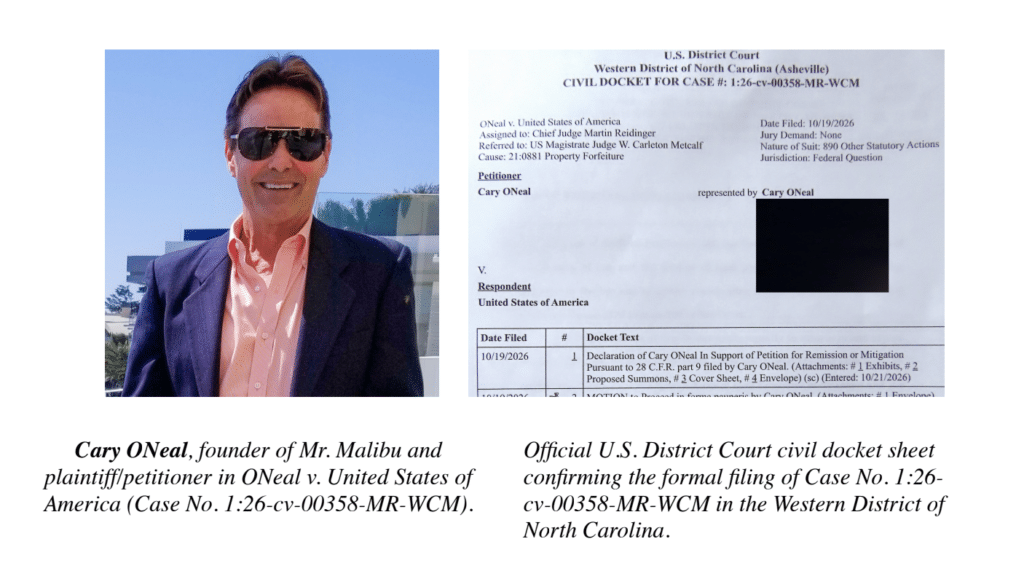
On October 19, 2026, federal court clerks formally entered Case No. 1:26-cv-00358-MR-WCM onto the federal docket. The plaintiff is Cary ONeal – known globally as Mr. Malibu – an executive, author, and fine-art photographer who spent over fifteen years building a multi-million-dollar lifestyle, broadcasting, and media brand.
The primary defendant named on the federal docket is the United States of America, directly targeting systemic administrative overreach by the U.S. Department of Justice.
The $44 Million Disparity
In early court filings, federal prosecutors attempted to minimize Cary ONeal’s role at StarClub by characterizing Mr. Malibu as merely a “receptionist and driver”—despite full knowledge that ONeal had been actively conducting high-level business development and media orchestration alongside globally recognized corporate magnates and entertainment leaders.
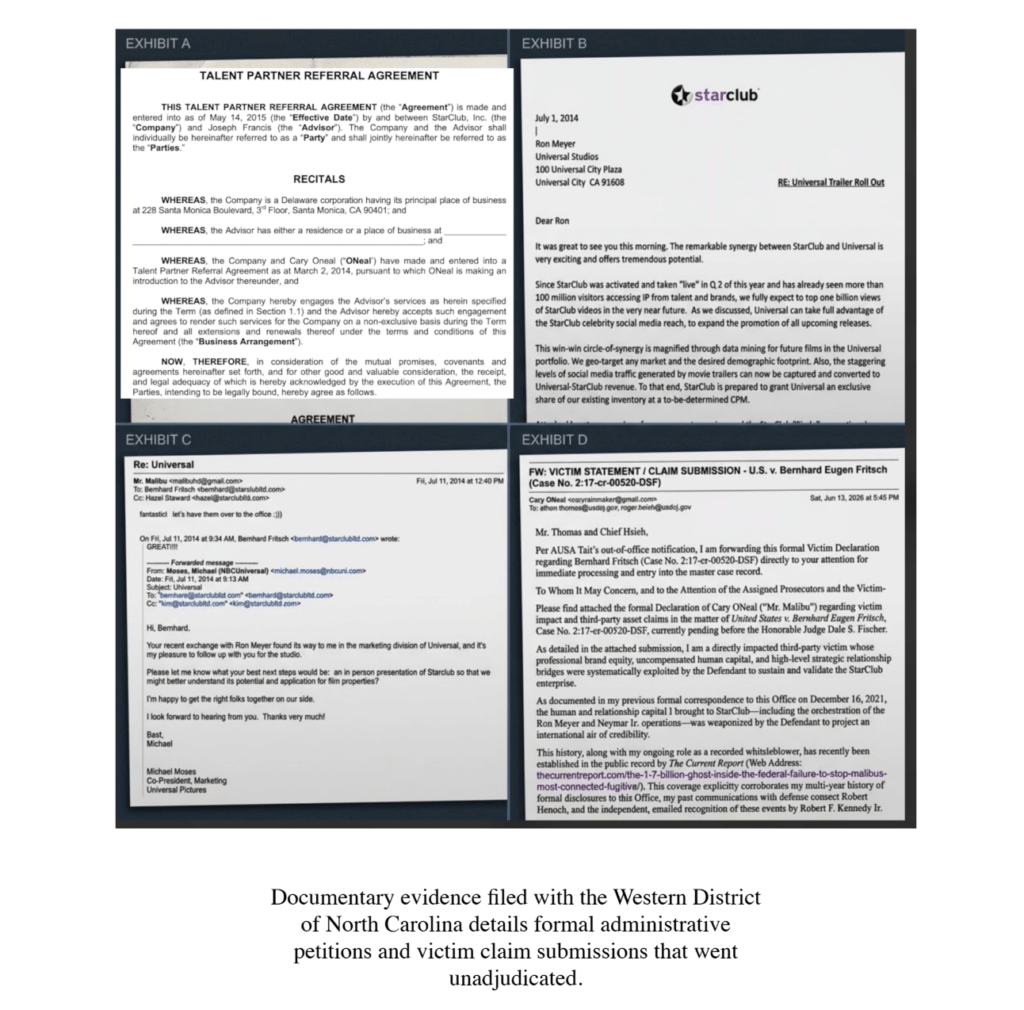
At the heart of ONeal’s federal petition is a glaring administrative irony. During the high-profile federal prosecution in U.S. v. Bernhard Fritsch (Case No. 2:17-cr-00550-DSF), federal prosecutors moving against Fritsch broad-brushed commercial contracts, referral partnerships (including StarClub and Universal Studios media ties), and enterprise assets belonging directly to ONeal’s independent Mr. Malibu operations.
To date, the government has confiscated approximately $44 million in connection with the broader enforcement actions. Yet, while the government held tight to these commercial assets, Fritsch himself fled to Germany—leaving the alleged primary wrongdoer beyond the reach of U.S. custody while innocent third-party property owners were left holding the bag.
The Stonewall: 28 C.F.R. Part 9
Under federal administrative law (specifically 28 C.F.R. Part 9), non-defendant property owners whose rights or enterprise assets are swept into federal forfeiture proceedings are entitled to file formal Petitions for Remission or Mitigation. The regulatory framework is designed to provide due process and ensure the government does not unlawfully retain third-party property.
According to court filings, ONeal did everything by the book:
- Formally submitted exhaustive administrative petitions for remission under 28 C.F.R. Part 9.
- Filed sworn victim/claimant declarations with federal authorities.
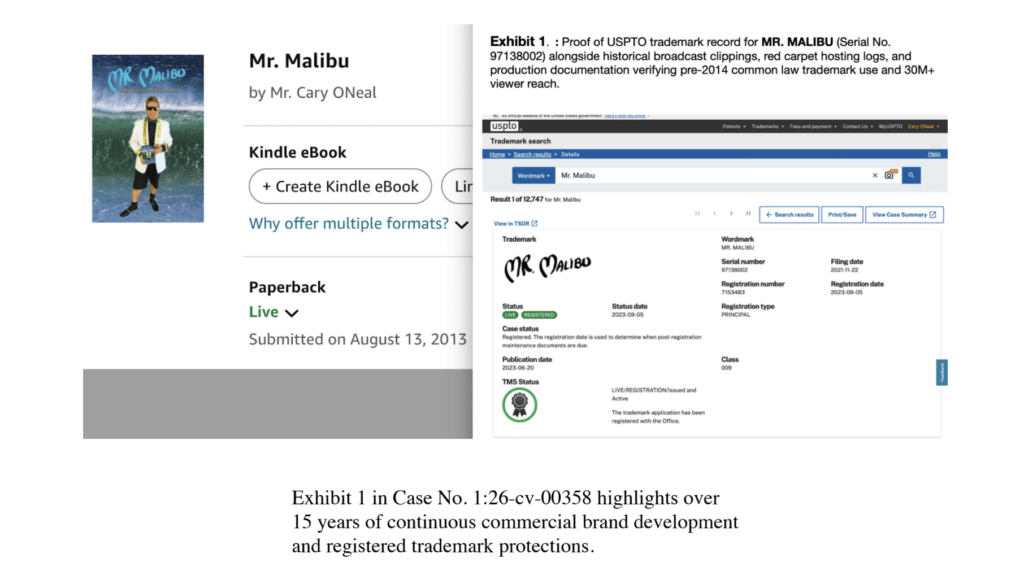
- Provided unrefuted USPTO and common-law trademark records proving independent ownership of the Mr. Malibu enterprise pre-dating federal action.
The Department of Justice’s response? Total administrative negligence.
For months, federal authorities have sat on the petitions – failing to adjudicate the claims, failing to restore clear title, and refusing to compensate ONeal for the ongoing impairment of his business assets.
High-Profile Whistleblower Disclosures: The RFK Jr. Exchange
ONeal’s relentless pursuit of administrative accountability is not new. Evidentiary records submitted in federal court document years of high-level disclosures regarding the enterprise collapse and civil asset overreach – including direct correspondence with prominent national figures.
In a direct email exchange dated December 5, 2022, ONeal pressed political figure and attorney Robert F. Kennedy Jr. regarding the mathematical improbability of repeated financial loss claims tied to the matter and the lack of regulatory enforcement.
Dec 5, 2022, 5:30 PM — Cary ONeal Wrote:
“Hi Bobby, Are you saying the more than SIXTY headline news financial claims of $400 million and $1.7 billion… are nothing? Coincidence? …No case? Expert mathematician Dr. Kevin Iga at Pepperdine University says the possibility of 40 statements of $400 million LOSSES within a two year period of being a coincidence is hideously less than one out of a trillion.”
Dec 5, 2022, 6:23 PM — F. Kennedy Jr. Wrote:
“I’m not saying it’s not a crime. I’m saying it’s not redressable under FFCA.”
Kennedy’s explicit admission – acknowledging that the conduct constituted a potential crime while noting procedural limitations under the Federal False Claims Act (FFCA) – underscores why ONeal has brought this direct action under the Fifth Amendment’s Due Process and Takings Clauses in federal court.
The Administrative Stonewall: Negligence or Concealment?
While ONeal’s federal petition strictly asserts civil Due Process and Takings violations under the Fifth Amendment, the underlying evidentiary record presents a starker reality. Under 18 U.S.C. § 4, misprision of felony occurs when officials with knowledge of felonious conduct take steps to conceal it.
By repeatedly ignoring formal 28 C.F.R. Part 9 petitions, unrefuted trademark documentation, and sworn victim declarations, the Department of Justice’s administrative inaction functions as far more than routine backlog – effectively locking away $44 million in enterprise assets while shielding the broader prosecution record from public and judicial scrutiny.
Taking the Fight to Federal Court
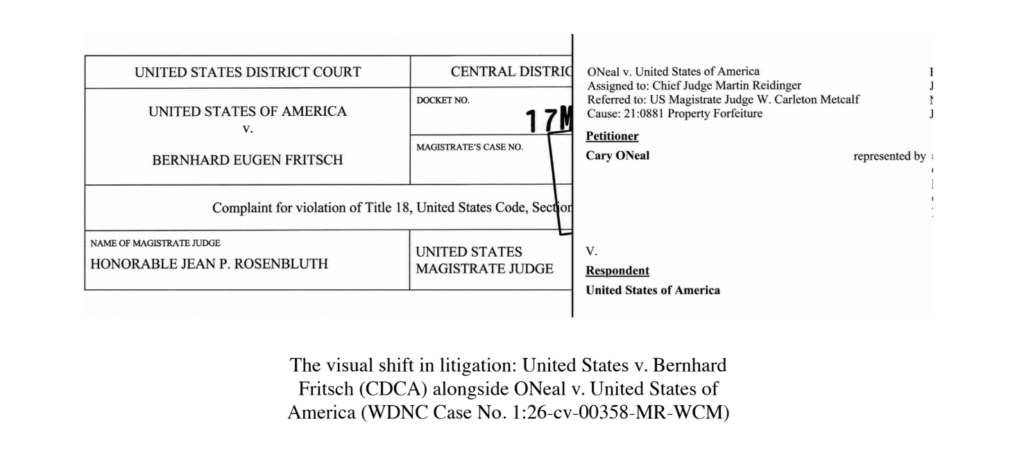
Faced with standard administrative delays, ONeal officially lodged his civil action in Asheville, asserting core constitutional claims.
The case has been assigned to Chief U.S. District Judge Martin Reidinger and U.S. Magistrate Judge W. Carleton Metcalf.
“This is not just about one brand or one enterprise,” notes ONeal in his supporting court declarations. “It is about whether the Department of Justice can use civil and criminal forfeiture as an unbridled asset grab, ignoring its own administrative rules and depriving American citizens of property without due process of law.”
A Model for Asset Forfeiture Reform
As Congress and policy advocates increasingly scrutinize executive overreach and civil asset forfeiture abuse across the nation, ONeal v. United States stands out as a stark benchmark case. It highlights the exact mechanisms through which administrative delays are weaponized to exhaust private citizens and avoid constitutional accountability.
With the case now formally docketed, all eyes turn to the U.S. Attorney’s Office and the Department of Justice as Judge Metcalf reviews initial proceedings.
EDITOR’S NOTE: The Current Report will continue to track Case No. 1:26-cv-00358-MR-WCM as formal orders and government responses are entered onto the federal docket.