
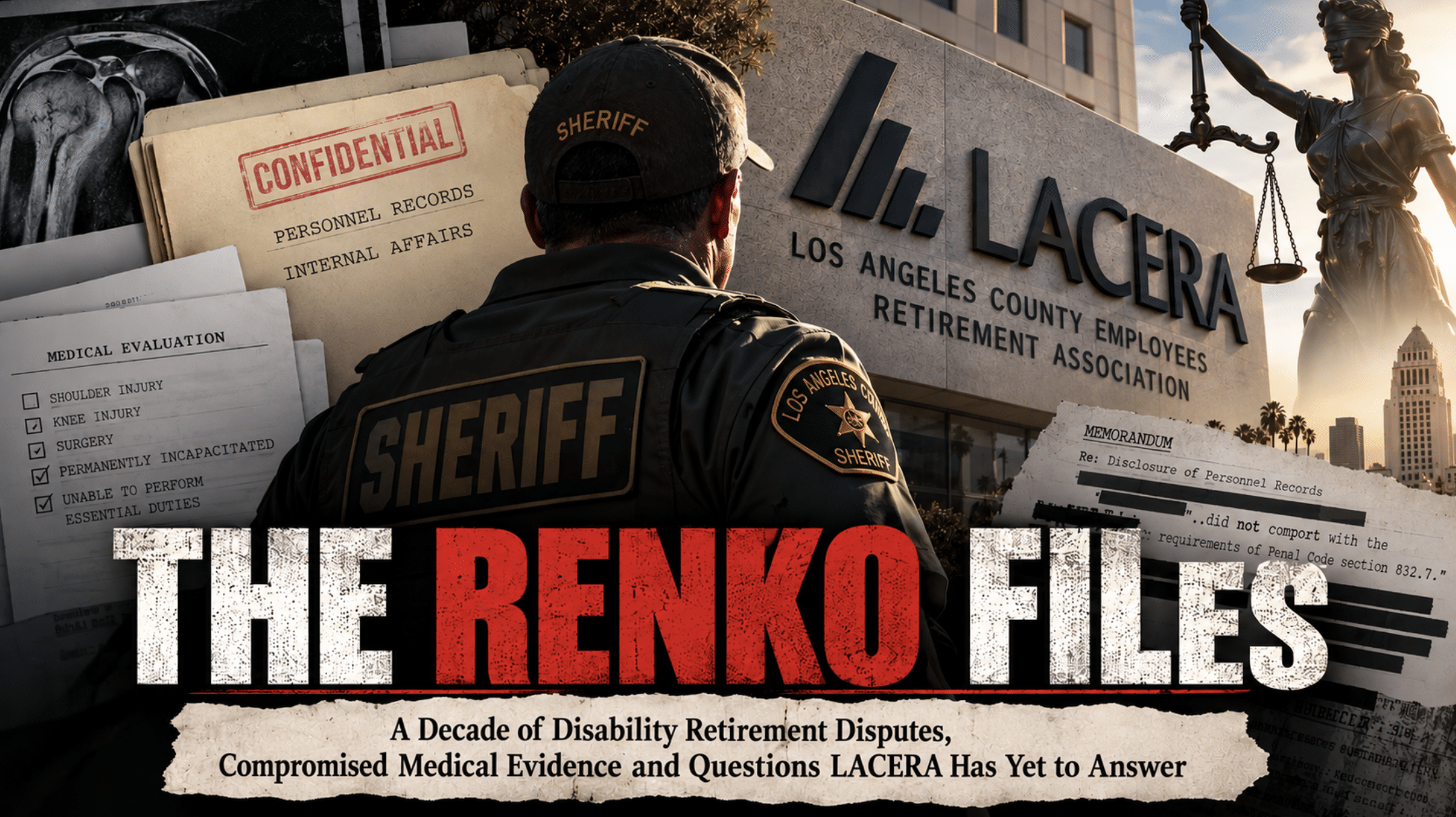
For nearly a decade, former Los Angeles County Sheriff’s Department Deputy Robert J. Renko has been fighting for disability retirement benefits in a case that has exposed serious questions about the Los Angeles County Employees Retirement Association (LACERA), its handling of confidential law enforcement personnel records, and the conduct of the attorneys responsible for overseeing the process.
At the center of the controversy is LACERA Senior Staff Counsel Francis J. Boyd, whose own memorandum acknowledges that confidential Sheriff’s Department personnel and Internal Affairs Bureau records were disclosed in violation of the requirements of California Penal Code section 832.7. The admission is particularly significant because Boyd also acknowledged that the method used to obtain those records had been the agencies’ customary practice for years, raising serious concerns about how many other LACERA members may have been subjected to the same procedures without their knowledge.
Despite that acknowledgment, LACERA continued defending its handling of Renko’s disability application, even after a medical evaluation initially supporting his claim was rendered unusable following the introduction of employment-related information. The circumstances surrounding that evaluation, and the subsequent findings of an administrative referee, have become central to Renko’s allegations that the process was fundamentally compromised.
Renko believes his case represents a much broader institutional failure involving the handling of confidential records, the integrity of independent medical evaluations, and the fiduciary obligations of a public retirement system entrusted with administering benefits for Los Angeles County employees. The documentary record raises substantial questions about whether LACERA’s internal procedures protected applicants from improper influence and whether its legal department adequately addressed problems identified during the administrative process.
Although LACERA prevailed in Los Angeles Superior Court, Renko is challenging that judgment before California’s Second District Court of Appeal. His pursuit of disability retirement benefits is now accompanied by demands for an independent examination of the conduct behind the denial, including decisions made and approved by the attorneys who subsequently defended the process.
The implications extend well beyond one former deputy’s retirement application. LACERA’s own records establish an improper disclosure, a compromised sequence of medical opinions, and a longstanding records-acquisition practice that the agency ultimately acknowledged needed correction. What remains unanswered is whether other applicants were affected and what, if anything, LACERA did to determine the extent of the problem.
THE CONFIDENTIAL RECORDS LACERA SHOULD NOT HAVE RECEIVED
Renko’s disability claim stems from injuries sustained during an on-duty pursuit collision on June 20, 2009, when he injured his right shoulder and right knee. He underwent shoulder surgery that year and knee surgery in 2010. According to Renko, his pursuit of disability retirement began in November 2016, although LACERA’s records identify January 27, 2017, as the formal filing date of his application.
What followed was a lengthy administrative process that eventually exposed serious problems with how LACERA obtained and distributed confidential Sheriff’s Department records. In a July 19, 2024 memorandum, Boyd detailed the agency’s acquisition of Renko’s personnel and Internal Affairs Bureau files. LACERA staff requested his personnel records in September 2017 and received them the following month. His Internal Affairs Bureau records were requested in February 2018 and received in March. Both sets of records were subsequently provided to orthopedic evaluator Dr. Mark Ganjianpour.
Boyd acknowledged in writing that the Sheriff’s Department custodian’s disclosure of those records “did not comport with the requirements of Penal Code section 832.7.” This was not an allegation originating solely with Renko or his attorneys. It was an acknowledgment contained in a memorandum prepared by LACERA’s own legal counsel, and it concerned the disclosure of confidential peace-officer records that are subject to specific statutory protections.
Even more significant was Boyd’s explanation that obtaining peace-officer personnel records through a LACERA authorization had been the agencies’ established practice for years. The process identified as legally deficient in Renko’s case was therefore not presented as an isolated administrative mistake, but as an institutional practice that had continued over an extended period.
Yet Boyd maintained that Renko had no remedy for the improper disclosure and recommended that the retirement appeal proceed without allowing the identified Penal Code issues to affect the merits of his disability application. He defended LACERA’s reliance on Renko’s signed authorization, rejected separate allegations involving unlawful computer access and improper disclosure of criminal-history information, and maintained that the third medical evaluator had not received personnel, internal-affairs or termination information. Boyd also directed that disputes concerning the statutory issues be pursued in Superior Court through a writ of mandate.
The memorandum was reviewed and approved by LACERA Chief Counsel Steven P. Rice, placing the agency’s legal leadership directly within the documented decision-making process. The same legal office responsible for addressing Renko’s complaints was also responsible for defending the agency’s handling of the matter, creating an obvious accountability question concerning the independence of any internal examination of those decisions.
Boyd’s memorandum further acknowledged that LACERA needed to change how it obtained peace-officer personnel records. According to the document, the Sheriff’s Department custodian had begun refusing to release those records based solely on a LACERA authorization, prompting staff to examine when such records were necessary, how they could be lawfully obtained, and what safeguards should govern their internal use.
The significance of that acknowledgment cannot be overstated. LACERA recognized a problem with the process used to obtain confidential personnel records, acknowledged that the practice had continued for years, and identified the need for corrective measures. What remains unanswered is when those changes were implemented, whether applications processed under the earlier practice were reviewed, and whether affected members were ever notified.
THE FAVORABLE MEDICAL OPINION THAT BECAME UNUSABLE
The handling of Renko’s medical evaluations raises equally serious concerns, particularly when examined alongside LACERA’s acknowledgment that confidential personnel records were improperly disclosed.
Dr. Ganjianpour concluded that Renko was permanently incapacitated as of August 2017 but determined that he could perform his usual duties before August 9, 2015. That earlier date became central to the dispute because it was associated with the incident that eventually led to Renko’s termination.
On September 5, 2018, LACERA’s Board of Retirement returned his application for another orthopedic evaluation. According to Boyd’s own account, the Board specifically instructed staff to withhold the circumstances surrounding Renko’s termination from the examining physician.
The second evaluator, Dr. Edwin Haronian, issued his initial report on October 1, 2018, concluding that Renko was permanently incapacitated, that his employment substantially contributed to his condition, and that his physical limitations were incompatible with the duties of a deputy sheriff. Those limitations included prolonged standing and walking, running, apprehending suspects, lifting, and overhead activity. Haronian also concluded that Renko had been continuously incapacitated since his last day of actual work, providing medical findings that supported his disability claim.
On October 31, 2018, LACERA staff member Russell M. Lurina sent Haronian a letter addressing Renko’s termination and requesting an assessment tied to the August 2015 benchmark. Haronian subsequently changed his historical assessment in a December supplemental report. Boyd followed up on January 25, 2019, seeking clarification, and Haronian maintained the adverse conclusion in another report dated January 29.
The circumstances surrounding that reversal became a significant issue during the administrative proceedings. Referee Stephen M. Biersmith examined what had changed between Haronian’s initial evaluation and his subsequent reports, finding that no additional medical reports had been introduced during the intervening period.
“There were no other medical reports,” Biersmith wrote.
The additional information concerned the personnel matter, not newly discovered medical evidence. Haronian attributed his revised opinion to reconsidering the timing of Renko’s disability and reviewing medical records already available to him, but Biersmith determined that the explanations tainted both the original report and the subsequent evaluations. His conclusion was that neither Renko nor LACERA should rely on them.
The consequences for Renko were substantial. A physician had initially determined that he was permanently incapacitated and unable to perform the essential functions of his job, only to change his historical assessment after employment-related information entered the process. The administrative referee then determined that the resulting medical opinions were tainted and unusable, effectively depriving Renko of the ability to rely on an initially favorable evaluation.
Biersmith also acknowledged that improper personnel disclosures contributed to delays and additional medical examinations. Nevertheless, he ultimately recommended denying Renko’s application, finding the remaining evidence insufficient, citing Renko’s continued work performance, and concluding that assuming an earlier examination would have produced a different result was speculative.
The resulting contradiction is central to Renko’s dispute. The referee determined that the medical reports had been compromised, yet the loss of that evidence did not result in approval of his disability claim. Instead, the application continued through a process in which Renko was left without the benefit of an evaluation that had initially supported his position.
BOYD’S OWN MEMORANDUM IDENTIFIED THE RISK OF PREJUDICE
One of the most revealing documents in the record is a policy memorandum Boyd prepared on March 20, 2019, addressing the potential influence of termination information on physicians conducting disability evaluations.
Two weeks earlier, on March 6, the Board had ordered a third medical examination and specifically directed that the physician receive neither the circumstances of Renko’s termination nor notice that he had been terminated.
Boyd’s subsequent memorandum explained the reason for those safeguards. According to Boyd, informing an orthopedic physician that a disability applicant had been terminated could prejudice the evaluator against the applicant, while the information itself had no probative value in determining medical incapacity or whether the disability was industrially related.
His recommendation was that the evaluating physician should not be informed that the applicant had been terminated. Rice approved that memorandum, documenting the legal office’s recognition that employment-related information could improperly influence an otherwise independent medical determination.
The significance is difficult to ignore when compared with what had already occurred in Renko’s case. LACERA’s own legal counsel recognized that termination information could prejudice an orthopedic evaluation, yet Renko’s earlier examination had already been affected by the introduction of employment-related information, resulting in a changed medical opinion that the referee subsequently found tainted.
The third evaluator, Dr. Philip H. Conwisar, documented significant orthopedic problems involving Renko’s right knee and shoulder. He acknowledged that vigorous deputy sheriff duties could aggravate Renko’s symptoms and interfere with the safe performance of those responsibilities. However, Conwisar also identified missing documentation concerning Renko’s actual physical condition on August 8, 2015, leaving a gap in the historical evidence necessary to address the disputed eligibility date.
The referee ultimately characterized Conwisar’s report as ambiguous and qualified. LACERA maintained that the examination provided an independent medical assessment, while Renko disputed whether it adequately remedied the loss of the earlier favorable opinion, particularly when the third physician identified deficiencies in the historical medical record.
Taken together, the documents establish that LACERA’s legal office understood the potential for employment information to prejudice a medical evaluation, that the Board had issued instructions intended to prevent that influence, and that Renko’s medical evidence had already been compromised through a sequence involving precisely the type of information Boyd warned against.
THE WARNING SENT BEFORE LACERA DENIED THE APPLICATION
Before the Board denied Renko’s application in June 2019, his attorney had already raised concerns about the medical evaluation process.
On April 26, 2019, attorney Thomas J. Wicke sent Boyd a two-page letter identifying several issues requiring attention before a final recommendation was made. Among them was Renko’s concern that Conwisar had received information identified as the Personal Performance Index.
Wicke expressly acknowledged that he did not know the document’s precise contents, but warned that if the material included termination-related information, the same problem affecting the earlier medical evaluation could continue. The concern was particularly relevant given the Board’s explicit instructions regarding the information that could be provided to the third physician.
The letter also challenged LACERA’s reliance on the August 2015 benchmark rather than Renko’s December 2016 separation date. Wicke documented continuing orthopedic treatment, including knee injections, shoulder treatment, and a recommendation for additional shoulder surgery, which ultimately occurred in August 2017. He specifically requested that Disability Retirement Staff evaluate the information before issuing a final recommendation to the Board.
Despite the significance of those concerns, the letter was absent from the administrative record subsequently used to review the benefits decision. Renko later attempted to introduce it during the Superior Court writ proceedings, but the court rejected that request on diligence and relevance grounds.
The correspondence establishes that Renko’s attorney raised a specific objection before the Board denied the application and requested that the concerns be evaluated. It also creates a clear documentary trail that should allow investigators to determine whether the letter was forwarded to Disability Retirement Staff, whether anyone examined the information transmitted to Conwisar, and whether Wicke received a response.
Those questions go directly to the handling of the medical evidence and the agency’s response to concerns raised before a decision affecting Renko’s retirement benefits was made.
THE DISPUTED DATES AND A POLICY ADOPTED AFTER THE DENIAL
Another significant issue concerns the date used to determine Renko’s disability eligibility and the timing of LACERA’s adoption of a written policy governing applications submitted by employees terminated for cause.
LACERA’s legal analysis focused on whether the medical evidence established qualifying incapacity before the August 2015 incident associated with Renko’s eventual termination. Wicke argued that Renko’s December 2016 separation date should govern, citing continuing treatment and the circumstances surrounding the progression of his orthopedic condition.
LACERA’s own staff report identified November 26, 2016, as the day following Renko’s last day of regular compensation. The report also concluded that Renko had continued receiving conservative treatment and did not learn that his incapacity was permanent until a physician’s statement dated January 13, 2017.
That analysis was conditional on the Board approving disability benefits and did not constitute a finding that Renko formally filed his application in November 2016. Nevertheless, it documented continuing medical treatment and uncertainty concerning when the permanence of his condition became known, circumstances central to Renko’s argument that his medical history deserved fuller consideration.
Meanwhile, LACERA was developing a written policy governing disability applications submitted by members terminated for cause. Boyd’s May 28, 2019 memorandum described discussions intended to allow staff to draft that policy, but the Board denied Renko’s application on June 5, before the policy was formally adopted.
A committee recommendation followed on June 20, and the policy was adopted on July 3. LACERA relied on existing case law, including Haywood and Smith, in its analysis of Renko’s eligibility, making the safeguards actually in effect at the time of his denial especially important.
The policy also changed during its development. Boyd’s March memorandum recommended withholding even the fact that an applicant had been terminated, while the policy adopted in July permitted nonpsychiatric evaluators to be informed that an applicant had been terminated for cause, provided the circumstances surrounding the termination were withheld.
The issue remained under consideration well after Renko’s denial. A January 2021 memorandum confirms that the Board had requested reconsideration of the policy during its December 10, 2020 meeting, demonstrating that the handling of termination information in disability evaluations remained an active concern within the agency.
BOYD’S TESTIMONY RAISES ANOTHER QUESTION
A separate discrepancy involves Boyd’s account of when he first became involved in Renko’s disability application.
During an October 9, 2025 restraining-order proceeding, Boyd testified, “I initially got the application in 2019.” He described preparing recommendations when the application returned to the Board and distinguished that work from the subsequent administrative appeal.
However, a memorandum bearing Boyd’s name dated July 20, 2018, recommended finding Renko ineligible and denying his disability-retirement application. The document places his involvement in the case before the year he identified during his sworn testimony.
The discrepancy is significant because Boyd’s involvement in the application and his recommendations concerning Renko’s eligibility are central to understanding the administrative process. His testimony identifies 2019 as the year he initially received the application, while the documentary record contains a recommendation bearing his name from July 2018.
An examination of Boyd’s role, including when he first reviewed Renko’s application and what recommendations he made before the Board’s eventual denial, is necessary to reconcile those accounts.
THE BOARD VOTE THAT DOES NOT ADD UP
The official minutes from LACERA’s June 5, 2019 Board meeting contain another inconsistency, this time involving the vote on Renko’s disability-retirement application.
Alternate Safety Trustee William Pryor moved to grant Renko service-connected disability retirement, with Les Robbins seconding the motion. Joseph Kelly then introduced a substitute motion to deny the application, seconded by Herman Santos.
According to the minutes, the substitute motion passed. However, Robbins appears in the recorded vote as both a yes and a no voter, creating an internal inconsistency in the official account of the decision.
The duplicated entry establishes an error in the written record and requires reconciliation with the contemporaneous voting documentation. The available minutes do not establish how Robbins actually voted or whether the error affected the outcome, but the accuracy of the official record is particularly important when the decision concerns a member’s eligibility for disability-retirement benefits.
There are additional details worth examining. Safety Trustee Shawn R. Kehoe was absent from the June meeting, although he had previously moved to return Renko’s application for additional information in September 2018 and again in March 2019. At the June meeting, his alternate, Pryor, moved to approve Renko’s disability retirement.
The minutes also identify Wicke as appearing on behalf of another applicant, Oscar G. Ramos, but contain no comparable appearance notation under Renko’s name. The matters were at different procedural stages, with Renko’s listed as an application and Ramos’s as an appeal, making it necessary to examine the meeting record to determine whether Wicke advocated for Renko during the proceedings.
Taken together, these issues raise questions about the completeness and accuracy of the administrative documentation surrounding the Board’s decision.
THE COURT RULING AND THE CONTINUING APPEAL
Following the June 2019 vote, Renko pursued an administrative appeal, including proceedings before a referee. The Board issued its final denial in August 2024, after which Renko challenged the decision in Los Angeles Superior Court.
Following a January 22, 2026 hearing, Judge James C. Chalfant denied Renko’s writ petition, finding that he had not demonstrated medical bias or prejudice sufficient to overturn LACERA’s decision.
Renko has appealed that ruling, and his case, B353714, is before Division Two of California’s Second District Court of Appeal. In his October 20 opening brief, he challenges the treatment of the favorable medical evidence that became unusable, the historical benchmark used to assess incapacity, and the completeness and fairness of the administrative process. He seeks approval of disability retirement, with corrective proceedings requested as alternative relief.
The legal dispute also involves LACERA’s fiduciary obligations toward its members. The agency’s own Disability Retirement Law Resource discusses the obligation of good faith and fair dealing recognized in Hittle v. Santa Barbara County Employees Retirement Association, and Boyd is identified as a coordinator of the resource’s 2018 revision.
The same resource recognizes that retirement boards have the authority to investigate and oppose disability applications they determine are unsupported. That authority exists alongside the obligations governing the fair administration of retirement benefits, making LACERA’s handling of confidential information, medical evaluations, and objections raised during the process particularly relevant.
Rice’s approval of the memoranda concerning Renko’s application also places his role within the scope of any examination of the agency’s decision-making. Determining whether the legal office properly addressed the identified disclosure failures and their consequences requires an independent review of the underlying records and the decisions made by the attorneys responsible for overseeing the process.
A NEW ETHICS OFFICER AND AN UNFINISHED ACCOUNTING
LACERA is preparing to bring in a Chief Ethics and Compliance Officer, a development that could provide an opportunity to examine the institutional practices identified in Renko’s case.
According to materials presented to its Operations Oversight Committee on October 7, 2026, recruitment has been completed, with the new officer scheduled to begin November 2. The materials identify LACERA CEO Luis Lugo, Chief Counsel Rice, and Allison Barrett as participants in the ethics-and-compliance initiative and describe ongoing work involving investigation and nonretaliation policies.
Under the published organizational structure, the officer has functional reporting responsibilities to the CEO, both retirement Boards, and the Audit, Compliance, Risk and Ethics Committee. Administrative reporting, however, runs through Chief Counsel, making the independence of investigations involving LACERA’s Legal Office a particularly important issue.
The effectiveness of that structure will depend on who selects investigators, who controls access to records, how potential conflicts are addressed, and who determines whether the resulting findings adequately resolve the complaints under examination.
In Renko’s case, the documentary record identifies several matters requiring scrutiny, including the materials transmitted to all three medical evaluators, the communications that resulted in Haronian’s reports becoming unusable, the handling of Wicke’s April 2019 warning, the discrepancy in the Board’s recorded vote, and LACERA’s promised changes to its handling of confidential peace-officer personnel records.
The larger issue involves Boyd’s acknowledgment that the records-acquisition practice had continued for years. Determining how many other members’ records were obtained through the same process, whether those records were provided to medical evaluators, and whether the information affected disability determinations requires an examination of other applications processed under those procedures.
The new ethics-and-compliance function presents an opportunity to establish whether LACERA is prepared to investigate those questions independently and account for the practices documented in its own records.
THE ACCOUNTABILITY LACERA STILL OWES ITS MEMBERS
Robert Renko has spent nearly a decade pursuing disability retirement benefits through an administrative process that has produced an extraordinary documentary record.
That record includes an acknowledged improper disclosure of confidential Sheriff’s Department records, a medical opinion initially supporting his claim that subsequently became unusable, and a referee’s finding that the handling of personnel information contributed to delays and additional examinations. It also includes inconsistencies in the administrative record, questions about the handling of an attorney’s warning, and a discrepancy between a senior attorney’s sworn testimony and an earlier memorandum bearing his name.
LACERA has defended its decision through the administrative process and in court, while Renko continues challenging the denial on appeal. But the institutional questions raised by the documents extend beyond the outcome of his individual retirement application.
LACERA’s own legal counsel acknowledged that confidential personnel records were disclosed through a process that did not comply with statutory requirements and that the same records-acquisition practice had continued for years. The agency also recognized the need to change those procedures, making it necessary to determine what corrective measures were implemented and whether applications processed under the earlier practice were ever reviewed.
The handling of Renko’s medical evidence raises equally important questions about the integrity of disability evaluations and the responsibility of a public retirement agency when information introduced during the process compromises an otherwise favorable medical opinion.
An independent investigation should establish who authorized the practices, what corrective measures followed, whether other retirement claims were affected, and whether members whose confidential records were handled in the same manner should be notified.
For an institution entrusted with administering the retirement benefits of Los Angeles County employees, accountability cannot begin and end with defending an administrative decision in court. Its members deserve an accurate accounting of how their confidential information was handled, whether the procedures governing their disability evaluations were followed, and whether identified failures were corrected.
Renko’s case has exposed serious questions about LACERA’s internal practices. The agency’s own documents provide the foundation for investigating them, and the acknowledgment that those practices continued for years makes an independent examination all the more necessary.
After nearly a decade, the issue is no longer simply whether Robert Renko receives disability retirement benefits. It is whether LACERA is prepared to account for the conduct of the officials responsible for administering those benefits and determine how many other members may have been affected.
The documents in this case available here, have already established the need for answers. What remains to be seen is whether LACERA will provide them.
Editor’s Note: The Current Report is seeking information from current and former LACERA members who have experienced similar issues involving disability-retirement applications, confidential personnel records, or independent medical evaluations. Individuals with firsthand information and supporting documentation may contact info@cecewoods.com