In a stunning revelation that could reshape the narrative around one of Los Angeles County’s most contentious law enforcement issues, the Office of Inspector General (OIG) has released its quarterly report on the Los Angeles County Sheriff’s Department (LASD), effectively confirming that no groups qualifying as “law enforcement gangs” have been identified within the department. The report, issued on February 26, 2026, comes at a politically charged moment as current Sheriff Robert Luna gears up for his reelection campaign in November 2026. Critics argue the timing is no coincidence, suggesting it undercuts years of alarmist rhetoric from Luna and his allies, who have repeatedly painted the LASD as riddled with dangerous deputy subgroups, a claim now directly contradicted by the OIG’s findings.
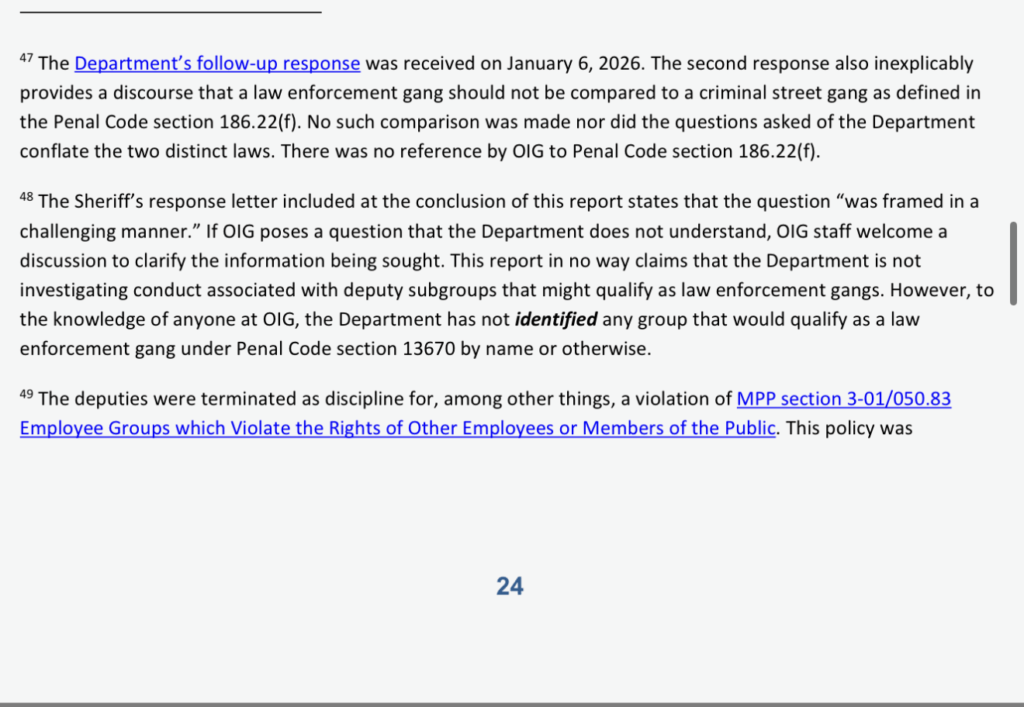
The OIG’s “Law Enforcement Gang Update” section, buried on page 23 of the 49 page document, delivers the key bombshell: “To the knowledge of anyone at OIG, the Department has not identified any group that would qualify as a law enforcement gang under Penal Code section 13670 by name or otherwise.” This statement, drawn from extensive oversight and monitoring, pours cold water on the persistent allegations of rampant “deputy gangs,” tattooed cliques accused of operating like street gangs within the LASD, engaging in misconduct, and fostering a culture of intimidation.
For more than three and a half years, since Luna’s inauguration in December 2022, the Sheriff has made eradicating these alleged gangs a cornerstone of his administration. In fiery press conferences, public statements, and campaign promises, Luna has warned of “subgroups” that “undermine public trust” and “violate the rights of citizens.” His office has touted investigations, policy overhauls, and terminations as evidence of a department in crisis. Yet the OIG report, an independent watchdog assessment covering October through December 2025, reveals no such groups have been formally identified under the legal definition established by California Penal Code section 13670, which outlines criteria for law enforcement gangs, including patterns of criminal activity and group identifiers.
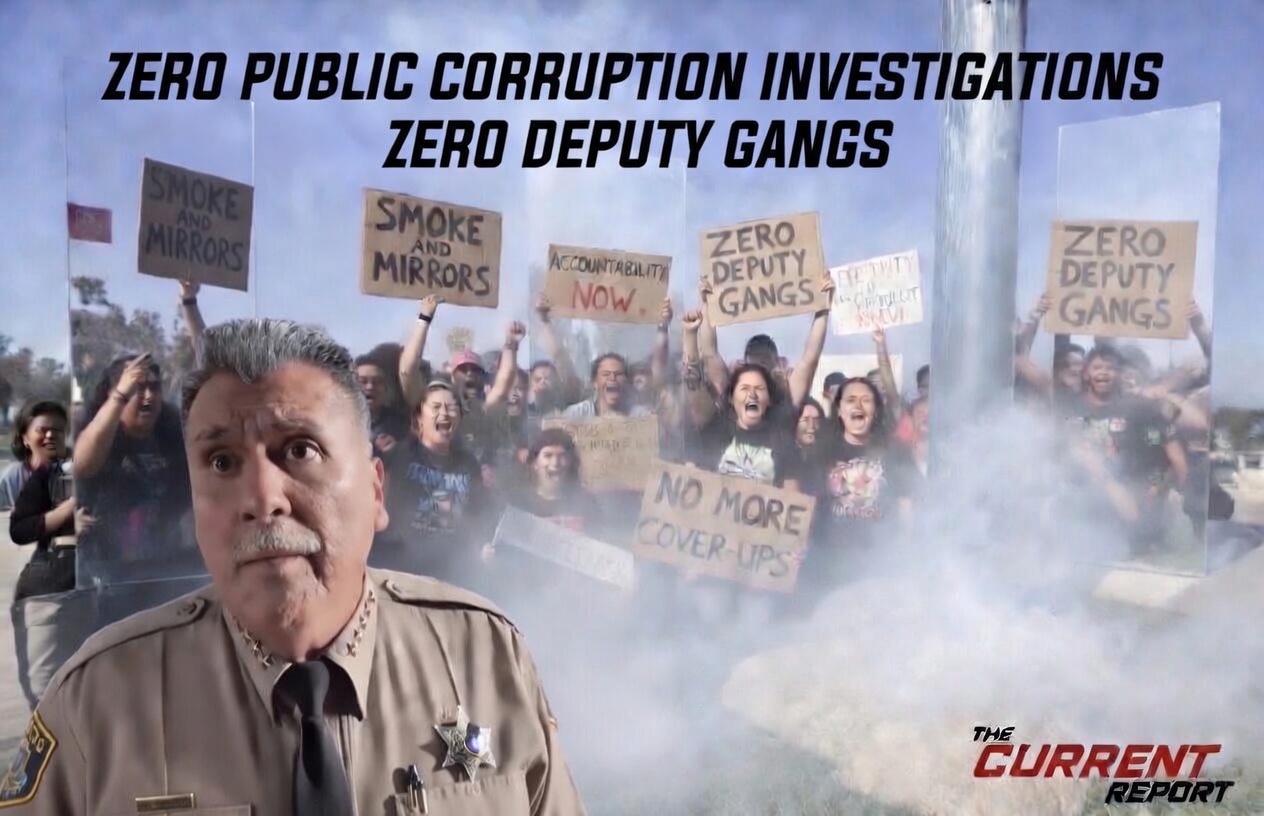
This is not just a minor detail. It is a direct repudiation of the fear mongering that has dominated headlines and public discourse. Inside sources say Luna’s emphasis on the “gang” issue was strategically amplified to “scare the living daylights out of voters,” portraying the LASD as a rogue agency overrun by tattooed thugs. “It was a political cudgel,” one former LASD insider said. “Luna needed a villain to run against, and he made the department itself the bad guy.” The strategy worked in 2022, helping Luna unseat his predecessor amid a wave of progressive reform sentiment. But with reelection looming, this OIG report could boomerang, exposing the hype as overblown and potentially alienating voters tired of divisive tactics.
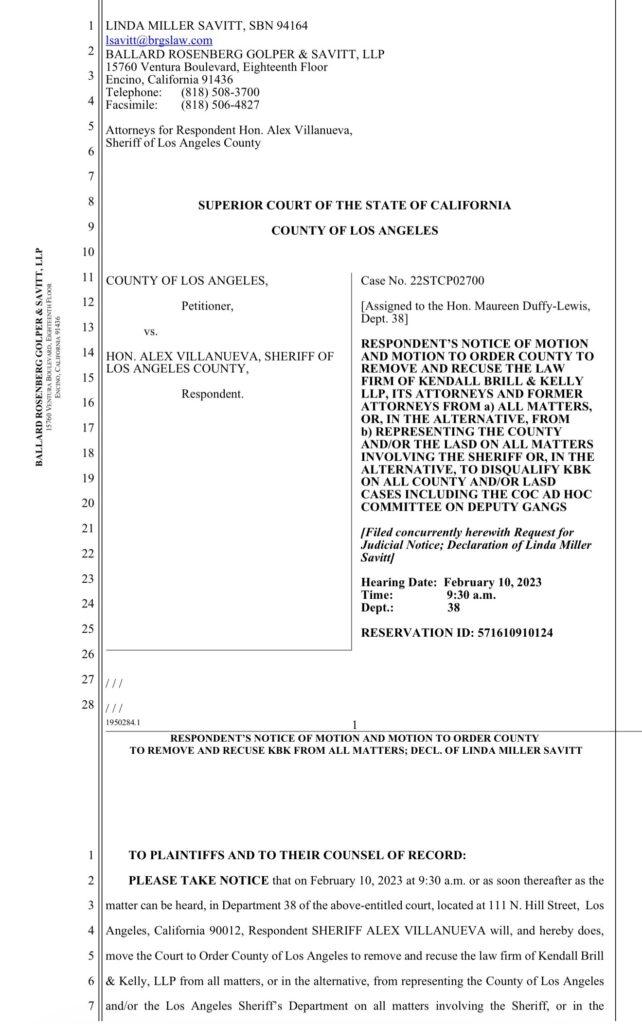
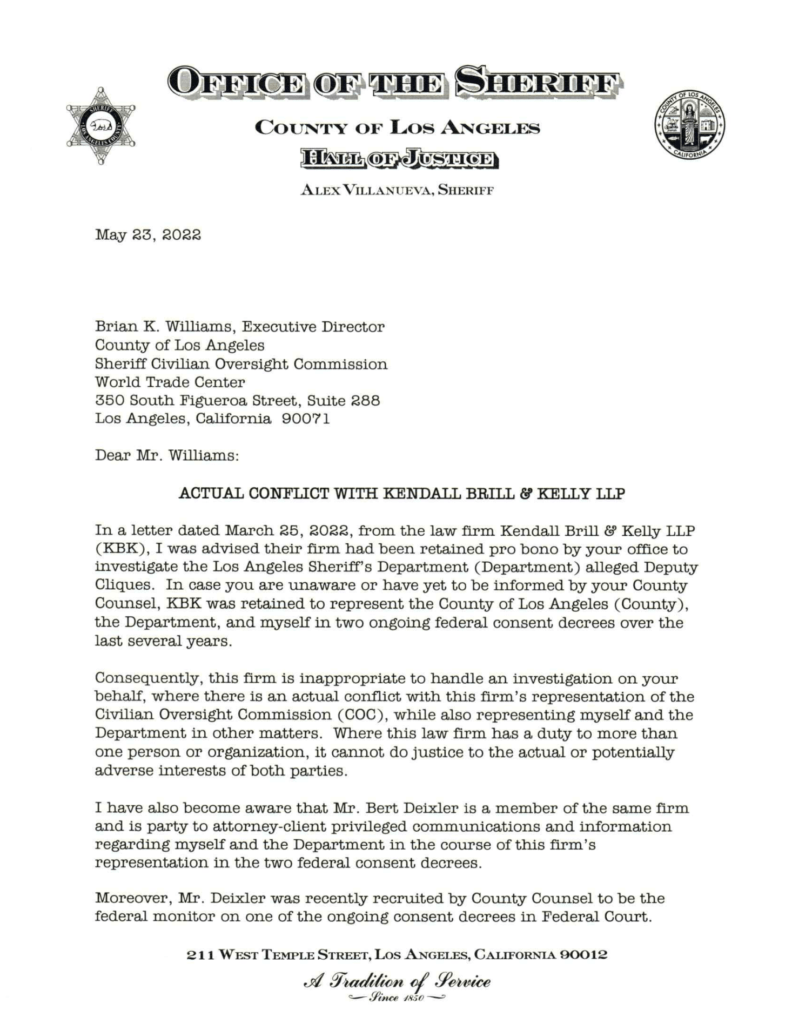
Adding fuel to the fire are revelations about the origins of the deputy gang hysteria, which trace back more than four years to actions by the Los Angeles County Board of Supervisors. In 2022, amid Sheriff Alex Villanueva’s reelection campaign, the Board orchestrated what critics call “fake” deputy gang hearings through the Civilian Oversight Commission (COC). To lead these proceedings, they hired the high profile law firm Kendall Brill and Kelly (KBK), a firm that has received millions in contracts from the County annually for various legal services. Bert Deixler, a partner at KBK, served as lead special counsel, conducting multiple hearings in July, August, and September 2022 that were broadcast across media outlets, amplifying allegations of gang activity within the LASD.
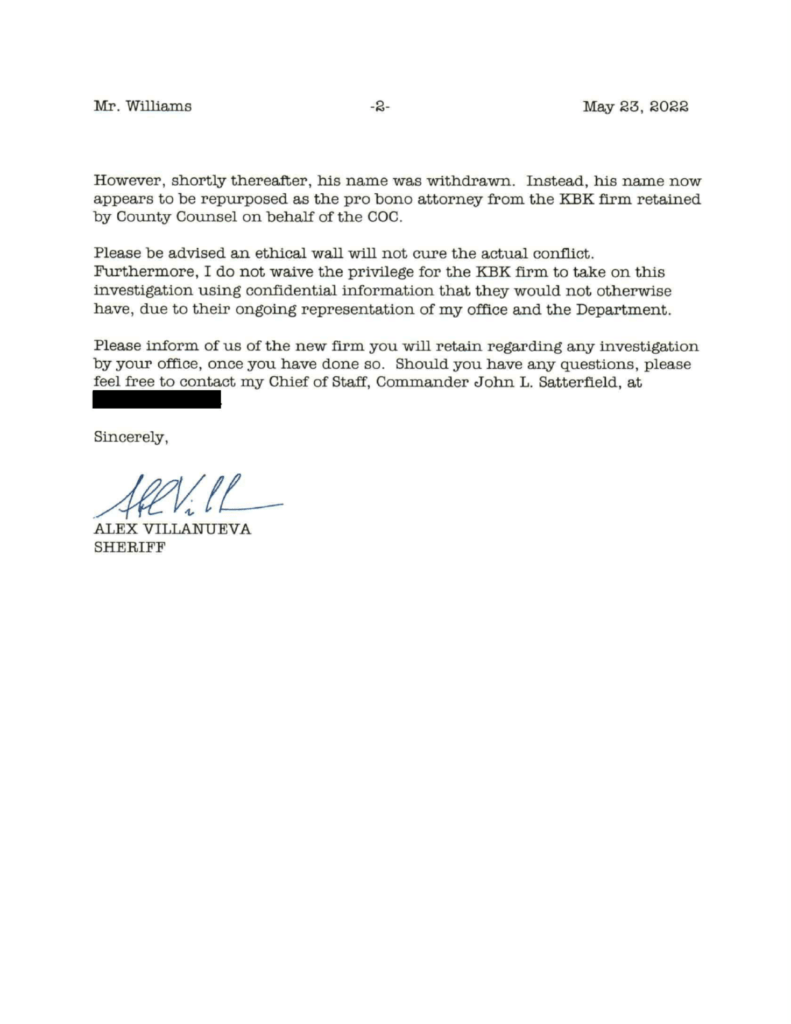
Villanueva himself raised alarms about a conflict of interest, writing a letter in August 2022 demanding KBK’s removal from the matter and citing the firm’s deep financial ties to the County. Critics, including investigative outlets such as The Current Report, have labeled these hearings a manufactured deputy gang panic, a deliberate distraction timed to sabotage Villanueva’s bid for a second term. The real motive, according to whistleblowers and ongoing federal probes, was to divert attention from the Board’s own corruption scandals, particularly involving no bid contracts and the disappearance of billions in homeless funds funneled to politically connected nonprofits.
Under former Los Angeles County Sheriff Alex Villanueva, the department established a Public Corruption Unit that focused directly on investigating government fraud, waste, abuse, and pay-to-play political relationships involving county officials and politically connected nonprofits. The unit traced concealed conflicts of interest, questionable settlements, and taxpayer funds funneled to insiders, even prompting Villanueva to formally ask the FBI to examine potential corruption involving the Los Angeles County Board of Supervisors. When Sheriff Robert Luna took office in December 2022, he dismantled that Public Corruption Unit within the first week of taking office, arguing the work was redundant with other agencies, a decision critics say effectively removed one of the few internal watchdog mechanisms focused on local government influence and misuse of public funds.
Audits have revealed that between 2020 and 2024, more than $2.3 billion in homelessness funding could not be fully accounted for, with significant lapses in oversight at agencies such as the Los Angeles Homeless Services Authority (LAHSA). In January 2026, the executive director of a South Los Angeles based charity was arrested for allegedly swindling $23 million in homelessness funds, using the money for luxury travel and personal extravagances.
This case is only the tip of the iceberg, with critics pointing to what they describe as a “homeless industrial complex” in which no bid contracts enrich nonprofits tied to Board allies while homelessness continues to worsen. “The deputy gang hearings were a smokescreen,” said a source familiar with County operations. “While the media fixated on tattoos and alleged cliques, billions vanished into unaccountable programs.”
Enter Alex Villanueva, Luna’s predecessor and a vocal critic of the current administration. Villanueva, who served as sheriff from 2018 to 2022, emerges from this report in a favorable light, not as the enabler of gangs as his detractors claimed, but as the leader who first addressed the issue directly. It was under Villanueva’s leadership that the LASD implemented the department’s first formal policy on deputy gangs and subgroups: Manual of Policy and Procedures section 3-01/050.83, titled “Employee Groups Which Violate the Rights of Other Employees or Members of the Public.” Enacted in 2021, this policy explicitly prohibits participation in groups that harass, intimidate, or violate rights, establishing a framework for accountability before Luna took office.
Indeed, the OIG report highlights terminations under Villanueva’s policy, noting that deputies were dismissed for violations of Manual of Policy and Procedures section 3-01/050.83, among other infractions. Crucially, however, it stops short of labeling any active groups as law enforcement gangs, suggesting that Villanueva’s proactive measures may have already neutralized potential problems. “Villanueva deserves credit for being the adult in the room,” said Dr. Elena Ramirez, a criminology professor and expert on police reform. “He implemented real policy without hysteria. Luna’s approach has been more about optics than outcomes.”
The report’s release, just months before Luna’s reelection campaign begins in earnest, has sparked accusations of political timing. Luna’s office has moved quickly to defend its record, pointing to ongoing investigations and a zero tolerance stance. A Luna spokesperson said, “The sheriff remains committed to rooting out any misconduct. The OIG’s update reflects our progress, not absence.” Skeptics, however, remain unconvinced. “If there were gangs everywhere, why has Luna not named them after all this time?” asked community activist Maria Gonzalez, who has followed LASD oversight for years. “This report exposes the exaggeration. It was fear tactics used to win votes.”
As Sheriff Robert Luna campaigns for a second term, the latest findings from the Office of Inspector General may force a strategic recalibration. After years of heated rhetoric surrounding allegations of deputy gangs within the Los Angeles County Sheriff’s Department, voters who have watched the controversy dominate headlines may now begin asking a more pointed question: where is the evidence? The OIG’s recent report, which states that no groups qualifying as law enforcement gangs have been identified, threatens to undercut one of the central narratives that shaped Luna’s rise to office.
At the same time, the report has the potential to dramatically reshape the political standing of former Sheriff Alex Villanueva. Once widely criticized for his handling of the deputy subgroup issue, Villanueva now appears newly vindicated by the OIG’s findings. His tenure, during which he publicly acknowledged and attempted to address deputy subgroups inside the department, now stands in sharper contrast to what critics describe as years of alarm without substantiated proof. If the report continues to gain traction with voters, Villanueva could emerge as the candidate with the strongest potential for a political comeback.
The race for Los Angeles County Sheriff will first be decided in the June 2, 2026 primary election, where voters will choose among nine candidates competing for the county’s top law enforcement post. Incumbent Robert Luna is facing a serious challenge from Villanueva, who is attempting to reclaim the position as head of the largest sheriff’s department in the country. The ballot also includes Mike Bornman, Oscar Martinez, Andre White, Eric Strong, Karla Carranza, Sonia Montejano, Brian Warren, and Brendan Corbett. If no candidate secures a majority of the vote (51 percent) in the June primary, the two candidates receiving the most votes will advance to a runoff in the November 2026 general election, setting the stage for what could become one of the most consequential law enforcement contests in Los Angeles County’s modern history.