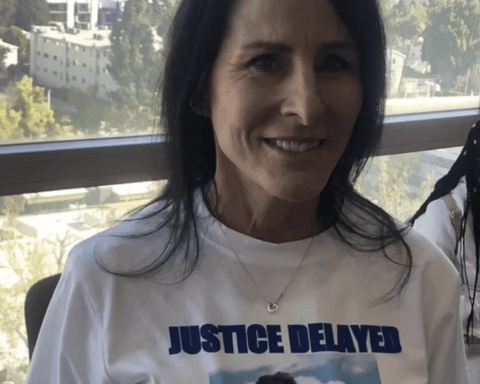

In Los Angeles Unified School District, the facts of this case are not buried in rumor or speculation. They are documented across criminal records, civil litigation, and state credentialing files. What remains unclear is not what happened, but how the system responded after it happened, and why that response appears to have prioritized continuity of leadership over accountability tied to student safety.
The timeline begins in 2007 at South East High School, where a 17-year-old student reported that she had been sexually abused by a teacher, Jesus Salvador Saenz. At the moment that disclosure was made, California law imposed a clear and immediate obligation on school administrators. Mandatory reporting statutes exist to remove hesitation and eliminate internal handling of abuse allegations. They require educators to report suspected abuse directly to law enforcement or child protective services without delay. The purpose of the law is to ensure that no student’s safety depends on the discretion, judgment, or institutional interests of school officials.
According to the criminal case that followed, that legal obligation was not fulfilled. Principal Jesus Angulo and Assistant Principal Maria I. Sotomayor were each charged with violating California’s mandatory child-abuse reporting law. In 2008, both entered no contest pleas to misdemeanor charges. The teacher accused of the abuse was later prosecuted, pleaded no contest, and was convicted of unlawful sexual conduct with a minor, confirming that the underlying report was not only credible but substantiated through the criminal justice system.
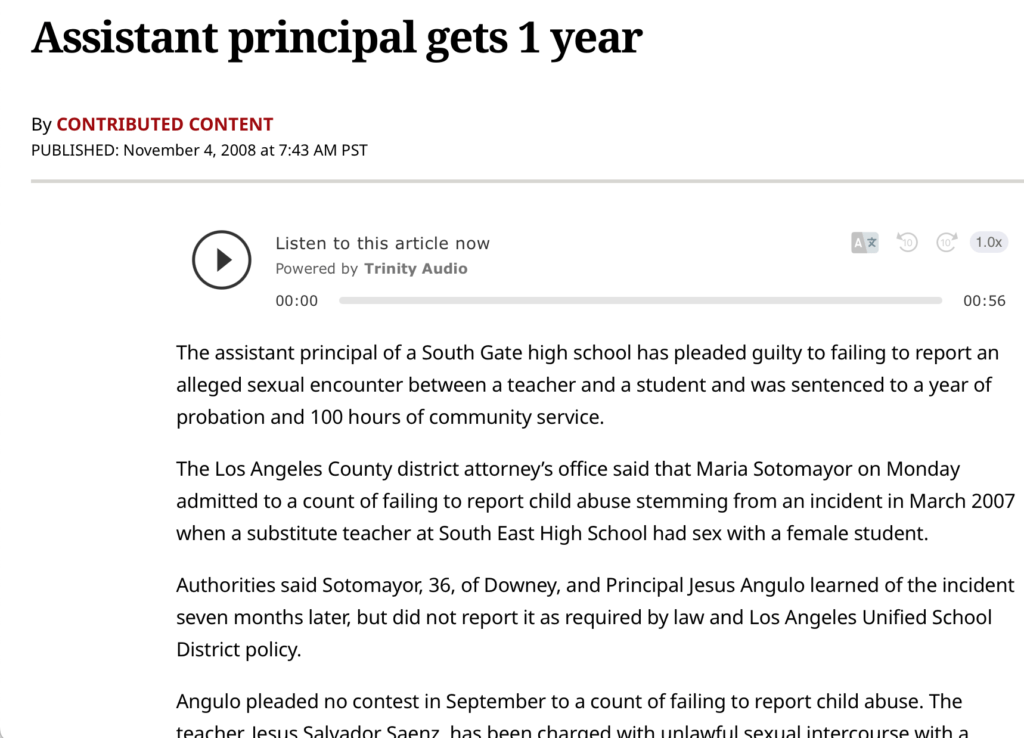
The criminal case establishes the failure to report. The civil lawsuit filed by the victim adds a layer of alleged conduct that reframes the incident from passive neglect to active suppression. According to the complaint, the student was not simply ignored after making her disclosure. She was allegedly contained within an administrative office, questioned for hours, pressured to withdraw her allegations, and warned that reporting the abuse could have consequences for her personally. The lawsuit describes a prolonged interaction lasting more than eight hours, during which the student alleges she was berated rather than protected.
The alleged response extended beyond that single interaction and into decisions that affected the student’s educational trajectory. The complaint states that she was removed from the traditional school environment and placed into a home-school program, effectively separating her from the campus where the abuse occurred. She was issued her diploma early and disinvited from participating in her graduation ceremony. These actions, as alleged, did not merely fail to protect the student; they altered her educational experience in ways that isolated her following her report.
The mechanism by which the case reached law enforcement further complicates the institutional narrative. According to lawsuit materials, sex-crimes investigators became aware of the abuse only after a LAUSD school police officer reported it. That officer later alleged that he was subjected to retaliatory transfer, commonly referred to as “freeway therapy,” and that the transfer occurred on the same day Angulo and Sotomayor were permitted to return to campus in 2008. If accurate, that sequence raises questions not only about the initial failure to report, but about how the system responded to the individual who ultimately did.
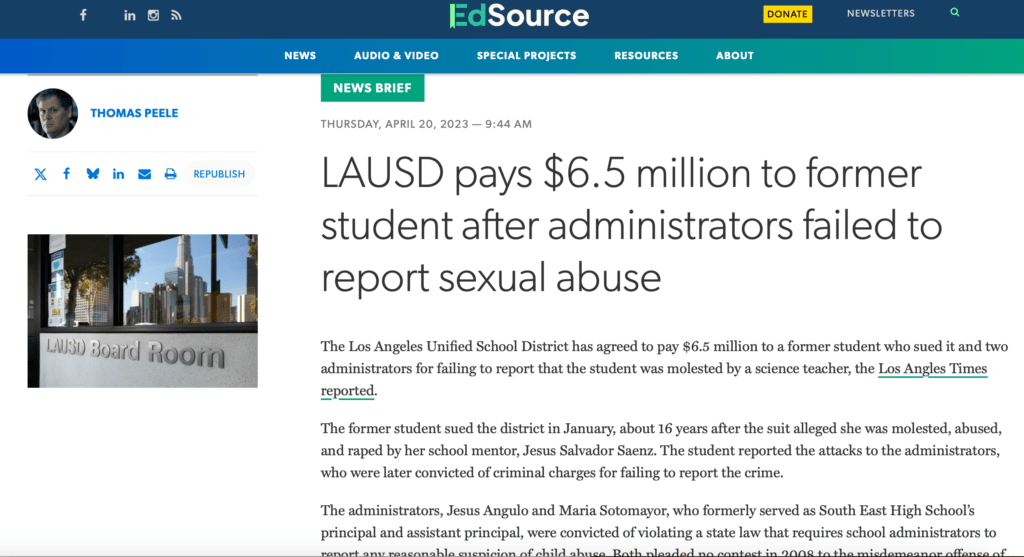
By 2023, under Alberto Carvahlo’s leadership, LAUSD agreed to pay $6.5 million to resolve the civil case. Financial settlements in cases involving institutional failure often function as both compensation and acknowledgment of risk exposure. However, they do not, on their own, provide transparency into internal decision-making or structural reform. In this instance, the settlement exists alongside a broader financial history in which LAUSD has paid nearly $400 million in sexual abuse verdicts and settlements over recent decades, suggesting that the issue is not isolated but systemic.
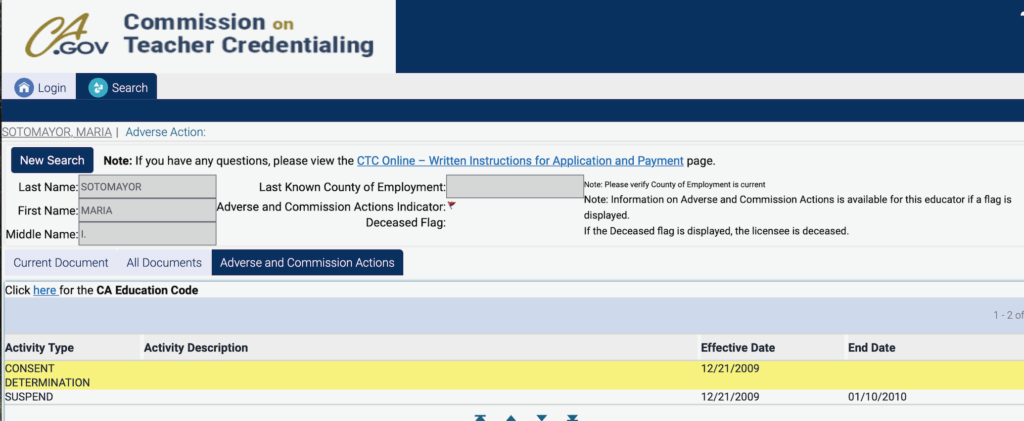
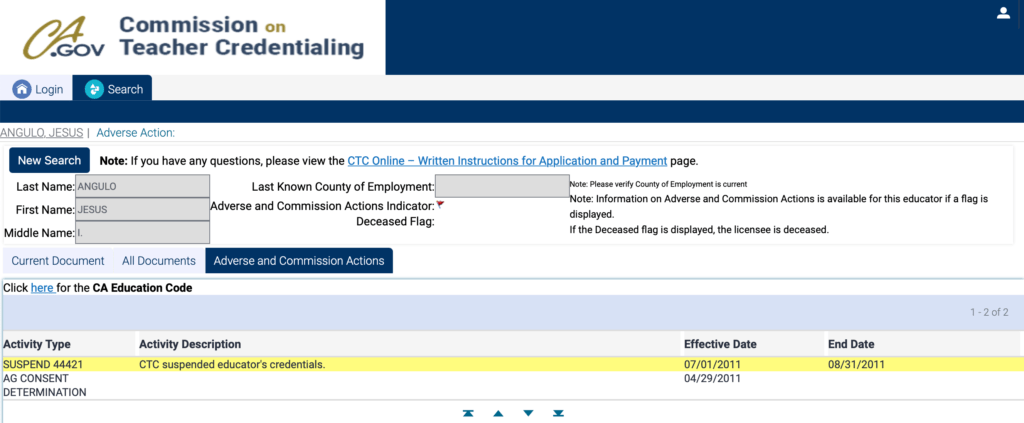
The disciplinary record of the administrators involved reinforces the seriousness of the underlying conduct. The California Commission on Teacher Credentialing imposed adverse actions on both Angulo and Sotomayor. Angulo’s credential record reflects a consent determination issued in April 2011, followed by a suspension effective July 1, 2011. Sotomayor’s record shows a consent determination effective December 21, 2009, and a suspension that remained in place through January 10, 2010. Credential discipline at this level indicates a formal determination that professional standards tied to student safety were not met.
Despite these findings, both administrators remained within LAUSD’s employment structure and progressed into higher levels of authority. This is where the case shifts from an incident to a pattern of institutional response. The question is no longer whether misconduct occurred, but how the organization evaluated that misconduct in determining future roles, responsibilities, and access to student-facing systems.
Angulo’s subsequent career trajectory is particularly consequential when viewed through the lens of system design. After the criminal case and credential discipline, he moved into central office roles that included oversight of academic programming and counseling services. These roles are embedded within the district’s infrastructure for responding to student needs, including mental health support, guidance services, and compliance with mandatory reporting requirements. They are not administrative sidelines; they are core functions that shape how disclosures are received, documented, and acted upon across the district.
His current role intensifies that contradiction. Angulo now works within LAUSD’s Options and Virtual Academy structure under Executive Director Latasha Buck, with responsibilities connected to counseling services for students in alternative and independent study programs. These programs serve students who are often removed from traditional campuses due to safety concerns, prior incidents, medical needs, or other circumstances that require a different educational environment. In many cases, these students are more vulnerable, not less, and rely heavily on counseling frameworks to navigate both academic and personal challenges.

Placing an individual with a documented failure in mandatory reporting into a role that intersects directly with counseling oversight raises operational questions that extend beyond optics. Counseling systems are one of the primary entry points for student disclosures of abuse. They are designed to identify, document, and escalate concerns in compliance with state law. The effectiveness of those systems depends on leadership that understands both the legal obligation and the ethical imperative to act without hesitation.
The structure now places Angulo within that chain of responsibility.
Sotomayor’s post-case trajectory follows a parallel pattern of retention and advancement within a different branch of the district. After her criminal case and credential discipline, she continued within LAUSD and later held a Director-level position in Adult and Career Education at district headquarters. Director roles at that level involve program oversight, personnel management, and compliance functions that extend across multiple sites and programs. While distinct from K-12 operations, these roles still operate within the broader governance framework of the district and contribute to its administrative culture.

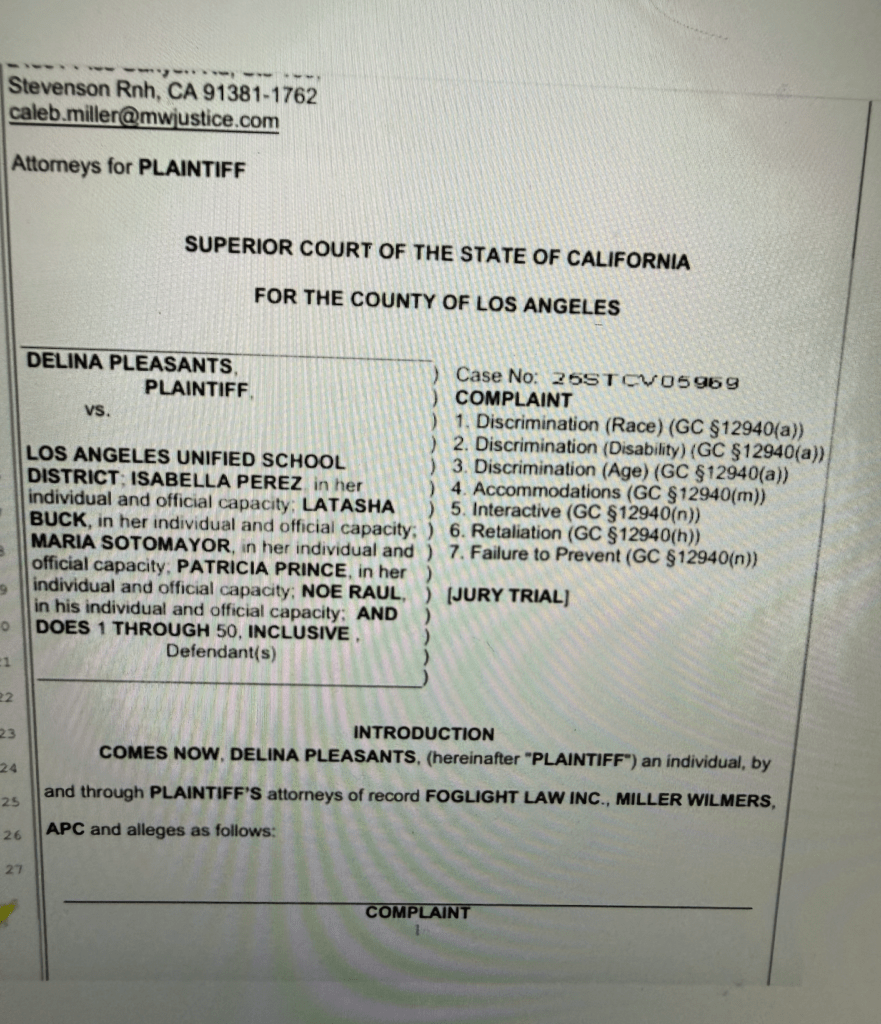
Her name reappears in 2025 in Delina Pleasants v. Los Angeles Unified School District, a lawsuit alleging employment discrimination, retaliation, and failure to prevent discrimination under California law. She is named alongside other administrators, including Latasha Buck, in both her individual and official capacities. At the time of the lawsuit, Sotomayor was serving in central administration, while Buck held executive authority over Virtual Academy and Options programs. Their inclusion in the same litigation reflects allegations tied to management decisions and workplace oversight within the district’s leadership structure.
The recurrence of administrators across separate legal matters does not, in itself, establish wrongdoing in each instance. However, it does highlight a structural continuity in which individuals involved in prior, documented failures remain embedded within systems responsible for governance, oversight, and compliance.
Large public institutions often manage controversy through internal movement rather than external separation. Reassignment can function as both a personnel strategy and a public relations mechanism, allowing organizations to respond to incidents without fully severing ties with the individuals involved. Over time, these movements can create layers of administrative history that are difficult to track, particularly when roles shift from school sites to central offices or from direct supervision to program oversight.
In this case, the administrative record does not reflect removal. It reflects absorption.
The progression from a failure to report suspected child abuse, to criminal conviction, to credential discipline, to central office leadership, to oversight of counseling-related functions within alternative education programs is not a hypothetical sequence. It is a documented one.
That sequence raises a set of governance questions that remain unanswered in the public domain.
What internal criteria does LAUSD use to determine whether an administrator who has been criminally convicted in connection with a student safety failure is eligible for continued leadership?
What review process evaluates the risk associated with placing such an individual in roles tied to counseling, student disclosures, and compliance oversight?
What documentation exists to show that these risks were assessed, mitigated, or even formally acknowledged?
Who within the district approved Angulo’s placement within the Options and Virtual Academy structure, and what factors were considered in that decision?
What oversight mechanisms are in place to ensure that individuals with prior reporting failures are not positioned in ways that could influence or oversee future reporting processes?
How does the district reconcile its legal obligations under mandatory reporting law with its internal personnel decisions when those two frameworks intersect in this way?
These questions are not rhetorical. They are operational, and they go directly to the integrity of the systems designed to protect students.
Because at its core, this case is not only about what happened to one student in 2007. It is about how a public institution processes failure, assigns consequence, and determines whether those failures disqualify individuals from positions of trust.
The documented sequence remains unchanged.
A student reported abuse. The report was not properly acted upon. The failure resulted in criminal convictions, professional discipline, and a multi-million-dollar settlement.
The administrators responsible remained within the system, advanced into leadership, and now occupy roles connected to the very structures designed to prevent that failure from happening again.