

The documents told the first part of the story. Contracts justified under urgency. Internal plans acknowledging operational breakdowns. Invoices that revealed taxpayer dollars being spent on availability rather than actual service delivery. What those records exposed was not simply inefficiency, but a system already beginning to separate itself from measurable outcomes and accountability.
But what is now unfolding inside the Los Angeles County Probation Department goes far beyond mismanagement. It is no longer confined to contracts or internal memos. It has moved into execution, openly communicated in leadership meetings and actively implemented across the department.
According to a source with direct knowledge of a recent meeting between Chief Probation Officer Guillermo Viera Rosa, union representatives, and department directors, leadership acknowledged what the public has yet to be told: the department is not meeting required staffing levels for juvenile halls and camps, and it is not close. The threshold, approximately 1,300 personnel, remains unmet, a deficit driven by years of failed hiring decisions, deteriorating working conditions, and a pattern of losing experienced staff faster than they can be replaced.
This staffing crisis did not emerge overnight. It is the product of sustained neglect at the policy level. The LA County Board of Supervisors failed to maintain a viable hiring pipeline while workloads increased and facilities became more volatile. Staff injuries inside juvenile halls have become routine, not exceptional, contributing to attrition across the department. Yet even as experienced personnel were lost, leadership compounded the problem by refusing to accommodate those who could still perform critical functions.
Inside that meeting, one example crystallized the pattern. A senior employee with a legitimate injury, fully capable of performing field supervision duties, was reportedly sent home because leadership insisted on assigning them to work inside juvenile halls rather than utilizing their remaining capacity in the field. This was not described as an isolated incident but part of a broader approach that has systematically pushed out experienced personnel instead of adapting roles to preserve operational strength. The result is not just a staffing shortage, but the erosion of institutional knowledge and functional capability.
Faced with that reality, leadership did not present a recovery plan. There was no meaningful discussion of aggressive hiring, retention incentives, or structural reform designed to rebuild capacity. Instead, directors were informed that their staff would be reassigned, effectively reducing field offices to little more than administrative shells, a shift that directly increases risk to the public by eliminating meaningful supervision in the community.
That decision marks a fundamental shift in how probation is being executed in Los Angeles County. Field supervision is not a peripheral function. It is the core mechanism through which court-ordered conditions are enforced, compliance is verified, and risk is actively managed in the community. Removing that infrastructure does not create efficiency. It eliminates oversight.
In its place, the department is moving toward a model of automated compliance. Probationers, including those under AB 109 supervision, will increasingly be directed to check in using kiosk systems – biometric terminals that function more like ATM machines than supervision tools. A palm scan replaces direct contact. Presence replaces accountability.
The scope of this shift is what makes it particularly consequential. According to the source, this system will not be limited to low-risk individuals. It will apply across supervision categories, including high-risk offenders, registered sex offenders, gang members, domestic violence offenders, and individuals with histories of crimes against children. The removal of in-person supervision for these populations fundamentally alters the department’s ability to detect violations, intervene in escalating situations, and enforce compliance with court orders.
At the same time, the department is reducing the very units designed to handle the highest-risk cases. Nearly 50 percent of the Special Enforcement Operations program, the officers responsible for conducting compliance searches, locating high-risk offenders, seizing narcotics and firearms, and making arrests in the community, is being dismantled. These are the personnel who actively prevent escalation before it turns into violence. Their removal is not an administrative adjustment; it is the elimination of proactive enforcement.
The operational consequences are immediate and predictable. Without field deputies conducting home visits, verifying living conditions, and maintaining direct oversight, the department loses visibility into the behavior of those it is tasked with supervising. Without enforcement units, violations go undetected, warrants go unissued, and illegal activity continues without interruption. What remains is a system that records compliance without verifying it.
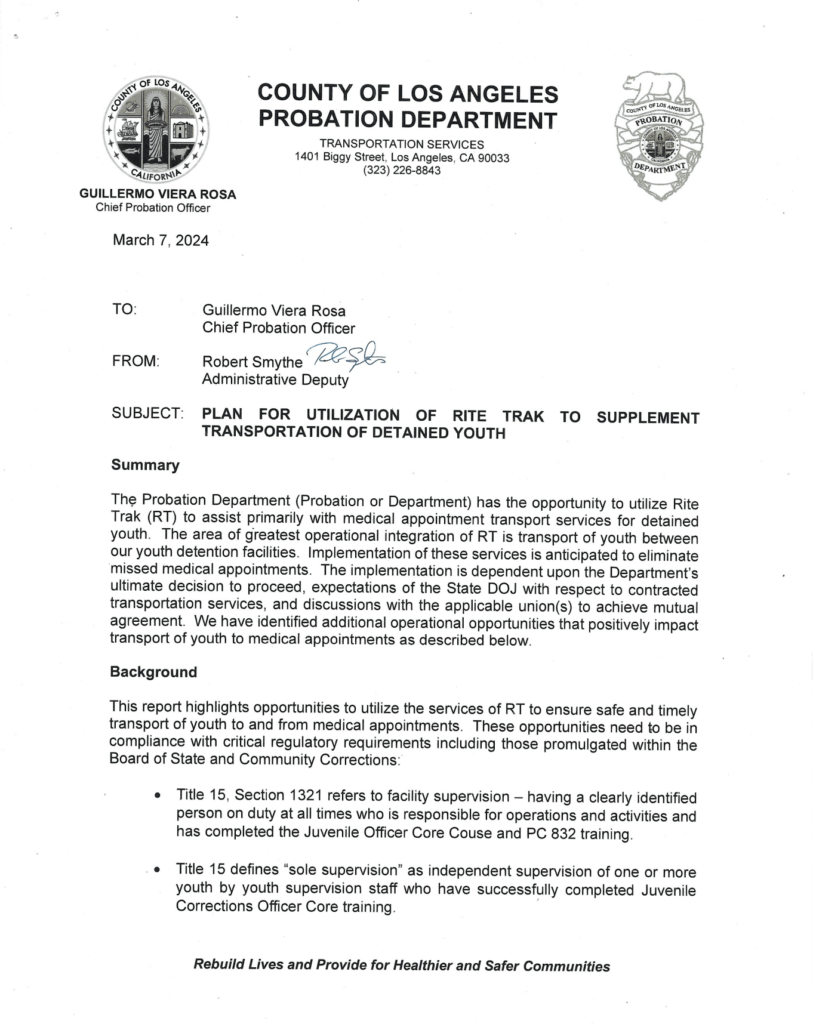
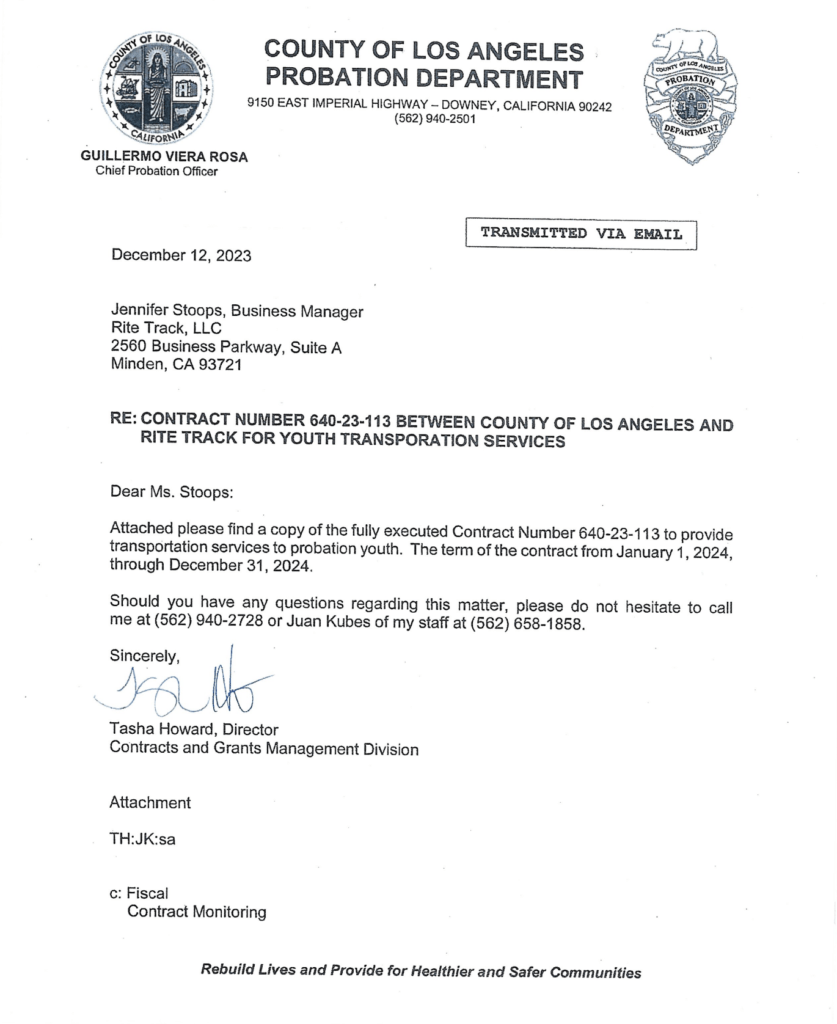
The financial decisions running parallel to these operational changes further complicate the picture. The County’s contract with Rite Track LLC, valued at up to $1.28 million, was justified as a necessary solution to transportation failures that were already impacting detained youth . Internal planning documents acknowledged that youth were missing medical appointments due to staffing shortages and logistical breakdowns, positioning the contract as a corrective measure . However, invoice records indicate that billing practices were structured around availability rather than completed transports, raising serious questions about how resources are being allocated during a period of operational strain .

The contradiction is difficult to ignore. A department citing staffing shortages as justification for dismantling field supervision continues to approve payments for outsourced services that are not clearly tied to performance outcomes. Resources are being redirected, but not necessarily in ways that restore capacity or improve public safety.
What emerges from this convergence of decisions is not a series of isolated missteps but a coordinated shift in policy direction. At its core, this is not a staffing crisis or a budget shortfall, it is a deliberate strategy. What is unfolding inside the Los Angeles County Probation Department reflects a calculated effort by the Board of Supervisors to systematically erode enforcement capacity, mirroring patterns already seen within the Los Angeles County Sheriff’s Department and the Los Angeles Police Department.
That pattern becomes even more pronounced when examining how key personnel have been positioned inside the department. Former LASD Lieutenant Eric Strong, who later held a leadership role within the Probation Department before retiring, was allegedly recruited by Supervisor Holly J. Mitchell to run in the 2022 Sheriff’s race with the intent of diluting votes and undermining incumbent Sheriff Alex Villanueva. According to multiple sources, Strong’s entry into that race was not incidental but strategic, and his subsequent placement within the Probation Department was viewed internally as a politically aligned move facilitated through county leadership.
Strong’s tenure inside Probation was tied to a series of serious allegations, including civil rights violations, unlawful detention, and internal misconduct. He was named in a $10 million lawsuit brought by Supervising Detention Services Officer Richard Ruiz, alleging false imprisonment and violations of both federal and state law. While Strong has since retired, the allegations tied to his time within the department remain emblematic of a broader structural issue, one in which authority is exercised without consistent accountability, and where internal discipline mechanisms fail to intervene even when serious violations are alleged.


This is not an isolated controversy. It is consistent with a broader structural pattern in which accountability is selectively applied, oversight is weakened, and leadership decisions are influenced by political alignment rather than operational competence.
The case of Diana Teran further underscores that reality. Her trajectory, indicted, appealed, and ultimately reinstalled within the system, highlighted how accountability mechanisms can be neutralized or reshaped when they intersect with political priorities. The issue is not confined to one individual or one case. It reflects a system in which oversight itself becomes negotiable.
Within that context, the dismantling of probation enforcement is not a response to crisis. It is the continuation of a deliberate policy direction.
At its core, this is not simply a staffing issue or a budgetary challenge, it is a calculated effort by the Los Angeles County Board of Supervisors to erode enforcement-based supervision and fundamentally reshape the role of probation. When a department charged with enforcing court orders and protecting public safety begins to dismantle its own enforcement mechanisms, the consequences extend far beyond internal operations. They reach into the communities those systems are designed to serve.
Reduced supervision does not eliminate risk; it redistributes it. It shifts the burden from the system to the public, from structured oversight to reactive response. The result is a system where enforcement diminishes, accountability weakens, and offenders operate with fewer constraints. Left unchecked, this trajectory does not produce reform, it creates conditions where criminal activity can expand with less resistance and where the public absorbs the consequences of decisions made at the highest levels of county leadership.
What is being constructed in its place is not a stronger system. It is one that relies on self-reporting, limited intervention, and reduced accountability, while the mechanisms that once enforced compliance are quietly dismantled piece by piece.
And once those systems are gone, rebuilding them is neither immediate nor guaranteed.