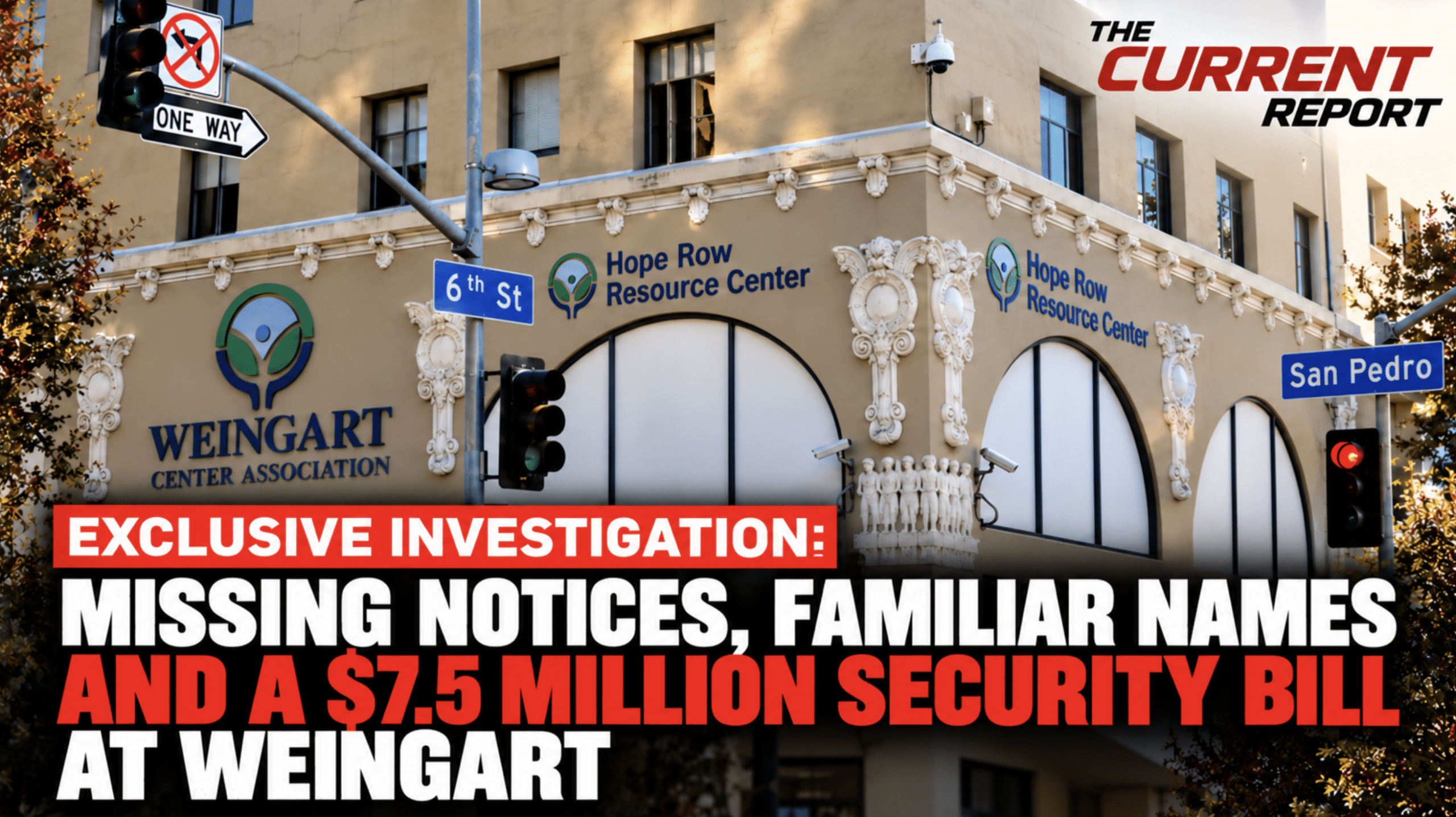
A prolonged cleanup at Shelby and a separate security-company money trail raise troubling questions about favored vendors, public disclosures and who benefits while promised housing remains unfinished.
At Weingart’s Shelby Homekey project, the renovation kept generating work for contractors while the promised housing remained unfinished. By summer 2026, asbestos abatement had reportedly stretched beyond a year, with the bill approaching $2 million.
The asbestos had already appeared in a report before the property was purchased. Management reportedly rejected a recommendation to address it upfront and instead directed a piecemeal cleanup. Later, Weingart sought more time from the state, citing “unexpected” asbestos.
Then a public-records request exposed another problem: the asbestos notices produced by South Coast AQMD stopped in June 2025, even though other contractors reportedly continued the work. Those notices are supposed to identify who is on the job.
One later contractor is headed by a man who uses the same name as a former Weingart board member. Another subcontractor reportedly has a family connection to the general contractor’s leadership.
Separate records show Weingart’s payments to a security contractor jumping from roughly $525,000 to $7.5 million in a single fiscal year, after Weingart’s facilities director moved into a senior role at a related security business. Companies in that group were emerging from bankruptcy and resolving litigation. And records from another city’s bidding process show overlapping company names competing for the same public contract.
Together, these records and reported accounts point toward a much larger investigation: whether favored vendors benefited from weak disclosure, questionable procurement and prolonged work at an organization entrusted with public money to help people experiencing homelessness.
Known in 2023. “Unexpected” When More Time Was Needed.
Page 12 of a preliminary 2023 environmental report identified approximately 140,000 square feet of asbestos-containing interior plaster and 15,000 square feet of asbestos-containing exterior stucco at 3340 Shelby Drive. The assessment was based on limited sampling and did not cover the entire building.

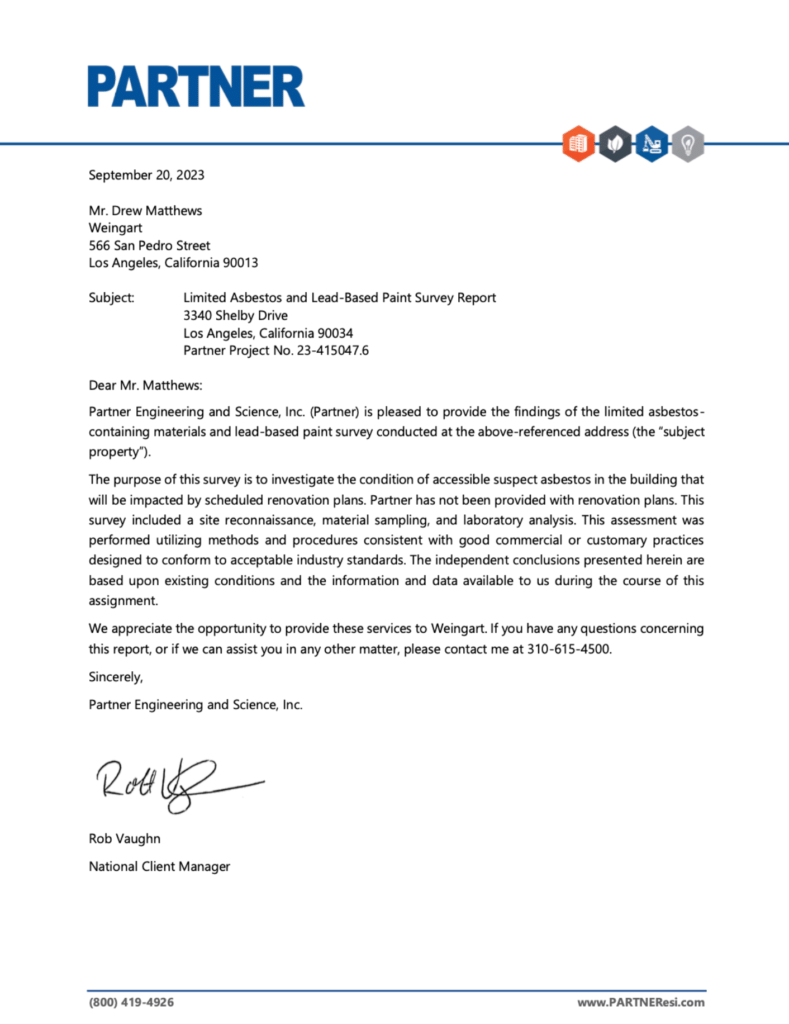
That was substantial notice of a building-wide problem before the deal closed. The Homekey award also required asbestos analysis before construction began, according to the project requirements provided for this reporting.
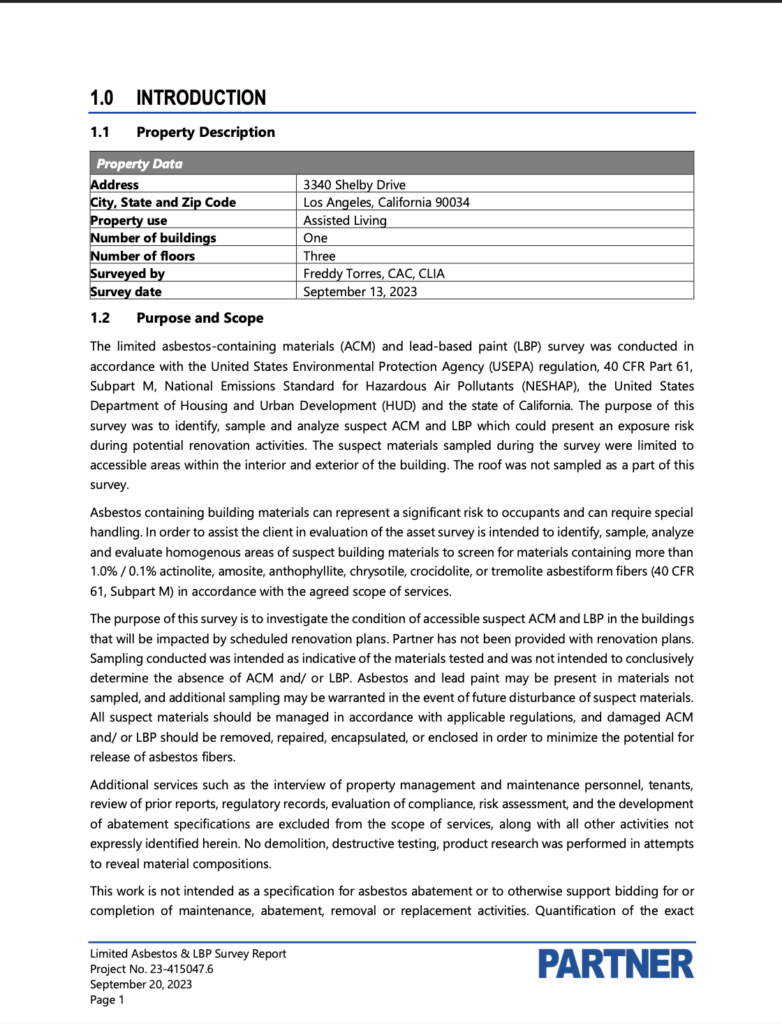
Yet when Angeles Contractor took over as general contractor, Weingart reportedly supplied an asbestos report describing very limited contamination. Workers began demolition in reliance on that report. After opening a wall and finding suspect material, they stopped and obtained their own survey. That survey reportedly found asbestos in all or most of the plaster and stucco.
According to information provided to The Current Report, Weingart management rejected the recommended full abatement and directed that the material be addressed incrementally. What followed was more than a year of asbestos work and a reported cost approaching $2 million by summer 2026.
That account places management’s decisions at the center of the delays and mounting costs. It also raises a worker-safety concern: demolition reportedly began with information that understated the asbestos workers would encounter. The material reviewed does not establish whether workers suffered an exposure or injury.
Recent extension requests attributed delays to “unforeseen” remediations, including asbestos, according to the information and documents supplied for this reporting. A preliminary report had identified roughly 155,000 square feet of affected material years earlier. What, exactly, was unexpected?
Three Filings. Then the Public Trail Goes Quiet.
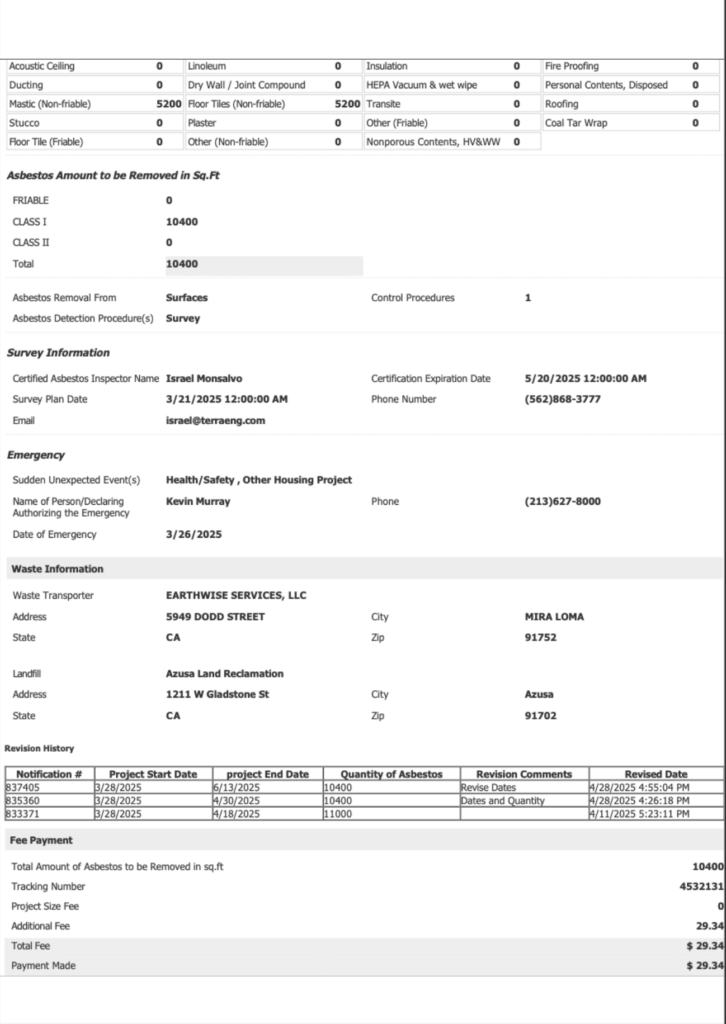
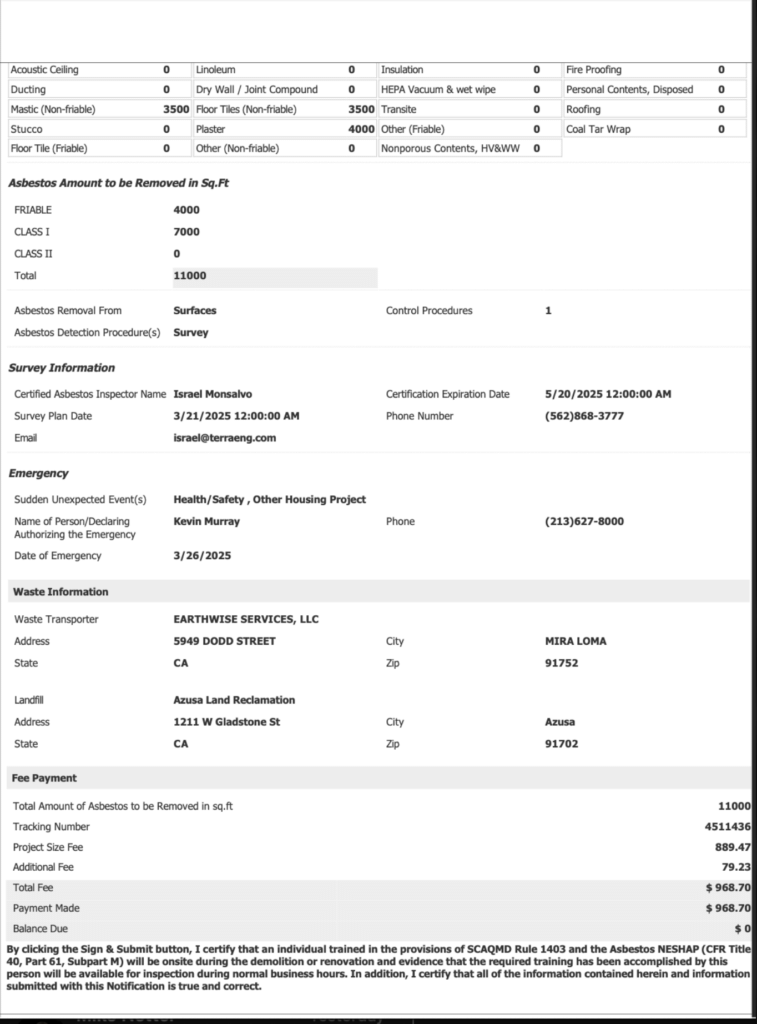
The public-records request sought every asbestos notice associated with Shelby during the preceding three years. AQMD produced only notification Nos. 833371, 835360 and 837405. They covered one Victorious R.E.D. abatement project beginning March 28, 2025 and ending June 13, 2025.
The original notice listed 11,000 square feet of material, including 4,000 square feet of plaster. Revisions reduced the total to 10,400 square feet, removed plaster from the listed scope and extended the completion date to June 13.
Nothing in the production covered work after that date. Nothing identified Unlimited Environmental Inc., L.A. Handy or American Plus, the other companies reportedly involved in later abatement.
Rule 1403 generally requires 10 working days’ advance notice for covered work. Notices identify the contractor, work dates, quantities and removal procedures. Those disclosures give regulators an opportunity to inspect and give the public a record of who performed the work.
The March 2025 filing invoked an emergency and identified Weingart CEO Kevin Murray as the person declaring it. An emergency can shorten the waiting period; it still requires notice before work begins. AQMD defines an emergency renovation by reference to a sudden, unexpected event. A known asbestos condition makes the stated basis for that emergency worth examining.
The larger gap begins after June 13. If the reported later work triggered notification requirements, where are those notices? A complaint has been filed with AQMD, and an inspector was reportedly seen at Shelby. The agency’s findings have not been established in the materials provided.
AQMD must determine which later activities required notification and whether any other filing or applicable exception covered them. What the production already shows is a missing public trail for the reported later contractors.
Did the Delays Open the Door for Favored Vendors?
The concern is that prolonged work could create opportunities to bring in preferred contractors after the initial expenditure disclosures, while missing asbestos notices removed another avenue for public scrutiny.
That concern has a factual starting point. According to the materials provided to The Current Report and public filings, Weingart’s audits have flagged missing procurement documentation for years. Confidential accounts supplied for this reporting also allege that Weingart management has directed particular vendors onto various projects in the past without the required competitive bidding.
HCD’s reporting obligations continue beyond the first year of a Homekey award: expenditure reports are required until the full award has been spent. The question is whether later vendors actually appeared in those reports and received the scrutiny required by the applicable procurement and conflict rules. The current materials do not establish that work was deliberately prolonged to evade disclosure. However, records supplied in response to public records requests only include total costs and not information on vendor bidding or the vendors themselves.
A possible board connection sharpens that question. UEI’s president is identified as William Scott Lange, who publicly uses Scott Lange or W. Scott Lange. Weingart’s Form 990 filings identify a Scott Lange as treasurer for the fiscal years ending in April 2017 and April 2018 and as a director in later records through December 2024.
UEI reportedly began work at Shelby in early 2026. Photographs supplied in connection with the investigation show a UEI vehicle outside the building.
The matching name and reported industry background are leads requiring confirmation. The materials provided do not yet establish that UEI’s president is the former Weingart director or identify his ownership interest, if any, in the company. If the identity is confirmed, the contract becomes a direct question about a possible former insider receiving business from the organization he helped govern.
Leaving a board a year earlier would not, by itself, close the issue. Federal excess-benefit rules use a five-year lookback when identifying people who held substantial influence over a nonprofit. Whether a vendor transaction violates those rules depends on the relationship, financial interests and value exchanged.
Peniel Paint presents a separate reported connection. Its owner is said to be the brother of Raymond “Ray” Yoo, a vice president of Angeles Contractor, Shelby’s general contractor. The procurement question is specific: who selected Peniel, what competing bids existed, and how was the relationship disclosed and reviewed?
The award’s environmental-compliance requirements and the applicable procurement rules are conditions attached to public funding. A proven failure to file required asbestos notices could therefore reach beyond AQMD enforcement and into compliance with the grant itself.
A Former Weingart Executive Moves. The Security Bill Explodes.
The security-company records provide another view of Weingart’s vendor relationships, separate from the Shelby construction contracts.
In approximately April 2023, Joe Faustina moved from Weingart, where he had been director of facilities, to a senior executive role at United Protective Services. A 2025 county filing identifies United as doing business as Unified Protective Services.
Weingart’s Form 990 for the fiscal year ending in April 2023 listed Unified Protective Services as receiving $524,673 for security. The following year’s return listed Unified as its highest-paid contractor, receiving $7,513,244.
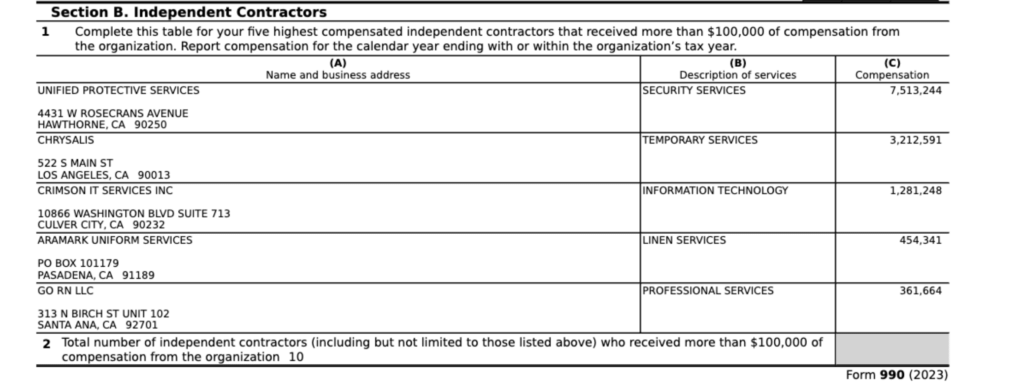
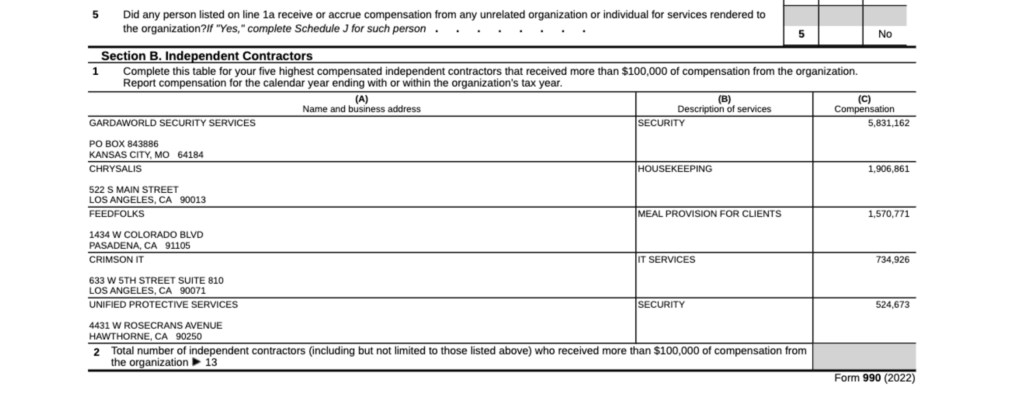
That is more than fourteen times the prior year’s payments.
What changed in the services, properties covered or contract terms to justify that increase? The timing places the surge in payments immediately after a former Weingart facilities director joined the vendor group.
The group also had a substantial bankruptcy and litigation history. Unified Protective Services filed Chapter 11 in 2019. Unified Security Services followed in November 2021. The latter company’s reorganization plan was confirmed on July 19, 2023, during the fiscal year in which Weingart reported the $7.5 million in security payments.
A wage-and-hour class action was resolved through a $1 million global settlement, including $45,000 from each of the two bankruptcy proceedings. Sherif Antoon signed the settlement on behalf of Unified Protective Services, Unified Security Services and A&A Protective Services.
The chronology puts a major Weingart payment increase in the same period as bankruptcy resolution and a litigation settlement. The information supplied does not trace Weingart payments into the settlement or establish that federal Homekey funds paid any part of it. However, it raises the question of whether revenue from Weingart helped finance those obligations, directly or indirectly, and whether the amount Weingart paid reflected the value of actual security services.
The relationship with Faustina later collapsed into competing lawsuits. Unified sued him and others in December 2025 over alleged competitive activity and use of confidential information. Faustina sued Unified for wrongful termination in January 2026.
Three Bids. How Many Independent Companies?
The company names become even more troubling in a separate public procurement.
United Protective Services and Unified Protective Services submitted separate bids for a Culver City contract. Both appeared among the top 13 finalists identified in Staff Report 24-1066.
Yet the 2025 county filing, signed by Antoon as CEO, identifies United as doing business as Unified Protective Services. United’s own website also identifies Steve Farid as Unified’s CEO and co-founder. The connection goes beyond similar names.
Then there is a third bidder: iGuard Protective Services. Its online job application reportedly warned that false information could result in dismissal “during my employment with Unified.”
Why was an applicant seeking work with iGuard being told about employment with Unified? Was that copied website language, or evidence of another operating connection?
The procurement question is how independent these bids actually were. If bidders shared ownership, control or operations, were those relationships disclosed, and did the city evaluate the bids with that knowledge? Separate corporate names can make a field look more competitive than it is when the underlying relationships remain out of view.
The Public Funded Housing. The Contractors Kept Billing.
Homekey was designed to deliver housing quickly. Its third funding round combined state money with $435 million from the federal American Rescue Plan’s Coronavirus State Fiscal Recovery Fund. The obligations attached to those dollars make contractor selection, accurate reporting and lawful work practices matters of public accountability.
At Shelby, the reported sequence is stark: extensive asbestos identified before purchase, a later report allegedly understating the problem, management-directed incremental abatement, repeated delays and a growing cost. The notices produced by AQMD identify one early contractor while the reported vendor list continued to expand.
Across the separate security records, a former Weingart executive moved to a vendor group, annual payments increased more than fourteenfold, bankruptcy and settlement obligations came due, and related or potentially related names appeared as competing bidders elsewhere.
Then came the October 8 federal drug takedown in Weingart’s own backyard. Authorities announced 23 arrests across the broader operation and identified alleged drug markets at Fifth and Crocker and Fifth and San Pedro, within the same few blocks as Weingart Tower 1, Weingart’s PSH building at 600 San Pedro, Weingart’s main campus and walk-in Access Center at Sixth and San Pedro streets, and Weingart Tower 2, now under construction. Three existing housing developments. A fourth rising nearby. And federal officials describing drug traffickers preying on the very people Weingart is funded to help. That proximity brings the spending questions down to street level: with such a concentrated presence and substantial payments to security vendors, what protection and support are vulnerable residents actually receiving?
These are specific transactions and decisions capable of being documented. The contracts, bids, invoices, disclosures and payment records should establish who benefited and what the public received in return.
For the people Shelby was supposed to house, the reported summer 2026 picture was still a construction project. For the companies working there, it was continuing business. Taxpayers deserve to know whether the delays and spending served the housing mission or favored the people and companies collecting the checks.