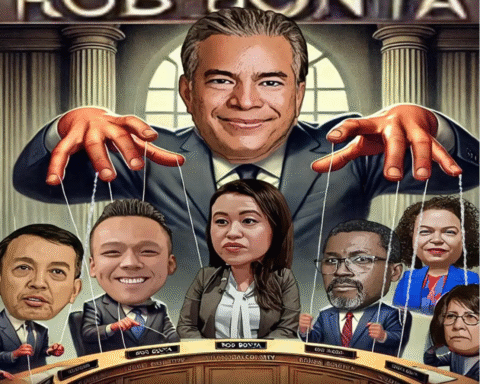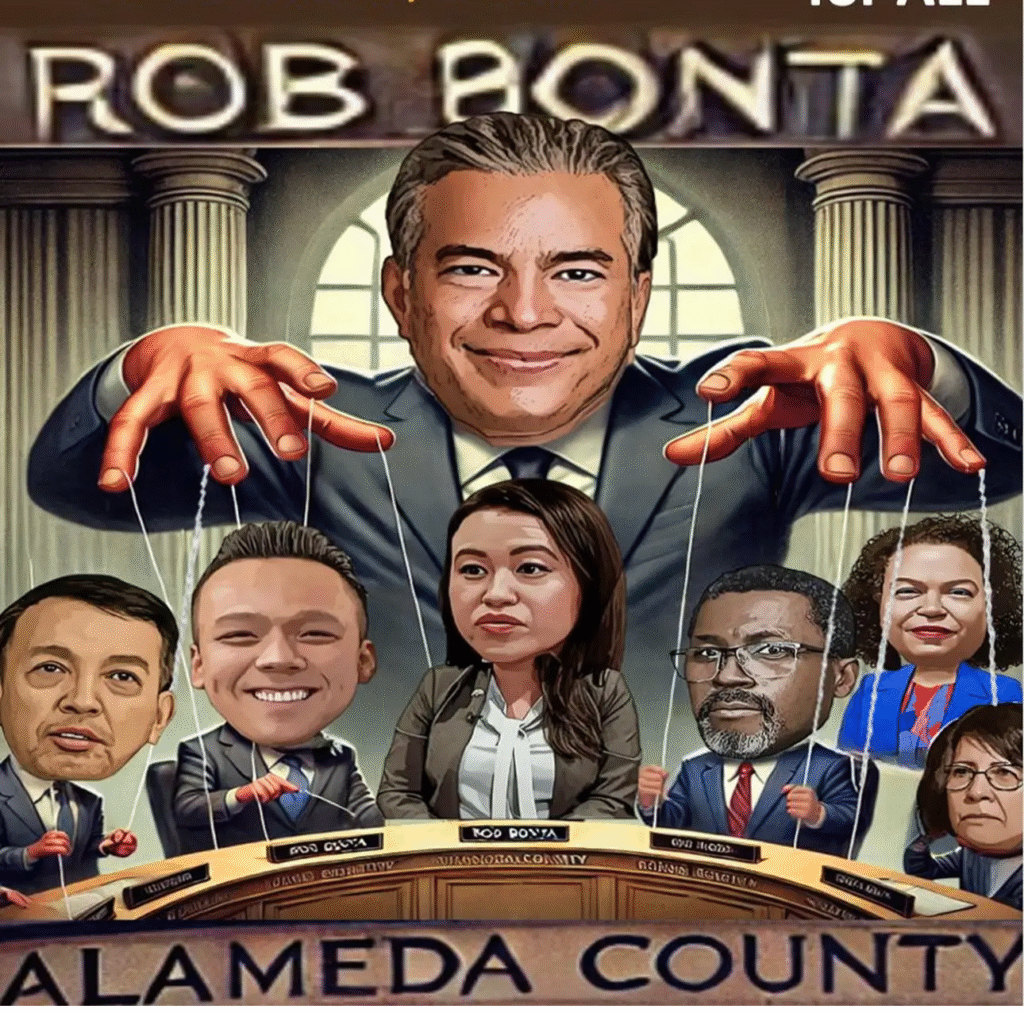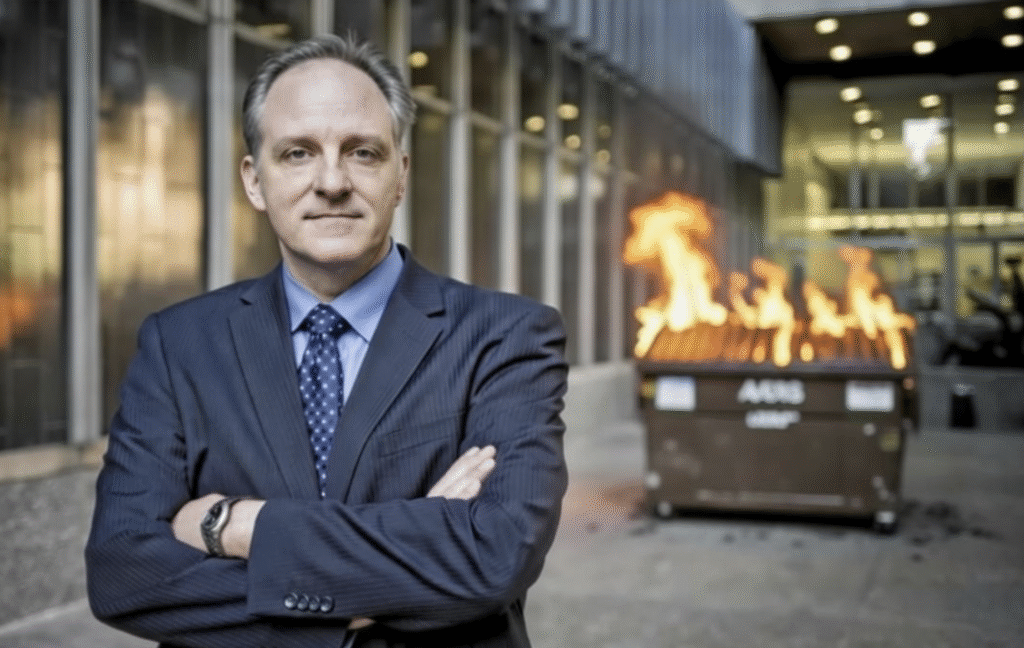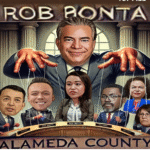
In California’s polished political arena, where every scandal is spun before the daylight ever hits it, the growing crime scene surrounding Attorney General Rob Bonta can no longer be contained by press releases, talking points, or party discipline.
And the only thing that can disinfect this crime scene is sunlight.
When Bonta’s diversion of $468,000 in campaign funds to pay his personal legal bills finally saw the light of day, just as a federal bribery probe tightened around the influential Duong family, he became the center of a corruption narrative that Sacramento’s power structure can’t tidy up with a friendly headline or a carefully worded legal statement.
A formal complaint has landed at the Fair Political Practices Commission. The allegations are damning. The money trail is unmistakable. The timeline is incriminating. And the political establishment is bracing itself.
But the FPPC, the body Californians are told exists to police political corruption, is already signaling its intent to do what it does best when a high-ranking Democrat is involved: stall, smother, and quietly bury the case until the public forgets it ever happened.
Because the truth is simple and corrosive: the FPPC was never designed to hold the powerful accountable. It was designed to shield them. The Bonta scandal merely exposes the anatomy of a watchdog that was declawed on purpose.
Let’s walk deeper into this crime scene.
A Watchdog Engineered to Protect Power
The FPPC’s structural design is a conflict-of-interest masterpiece disguised as oversight. Commissioners are appointed by the same political titans they are supposed to investigate. In a one-party-dominated state, that means Democrats hold every lever—from appointments to influence, shaping a commission that owes its existence to the very people it is asked to scrutinize.
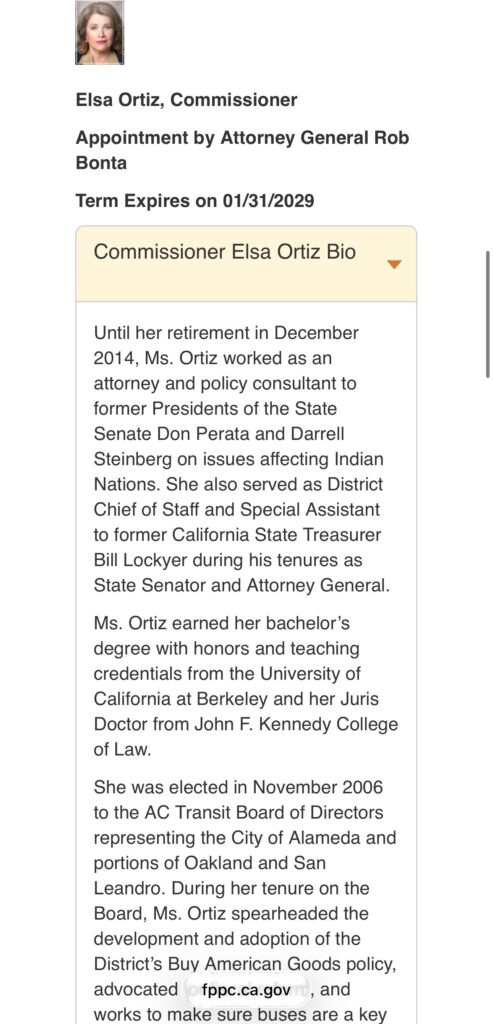
Rob Bonta personally appointed Commissioner Elsa Ortiz, a political ally with deep roots in the East Bay machine that propelled both Rob and Mia Bonta into power. She has not recused herself. She has not acknowledged the conflict. She doesn’t need to. The system was built to enable it.
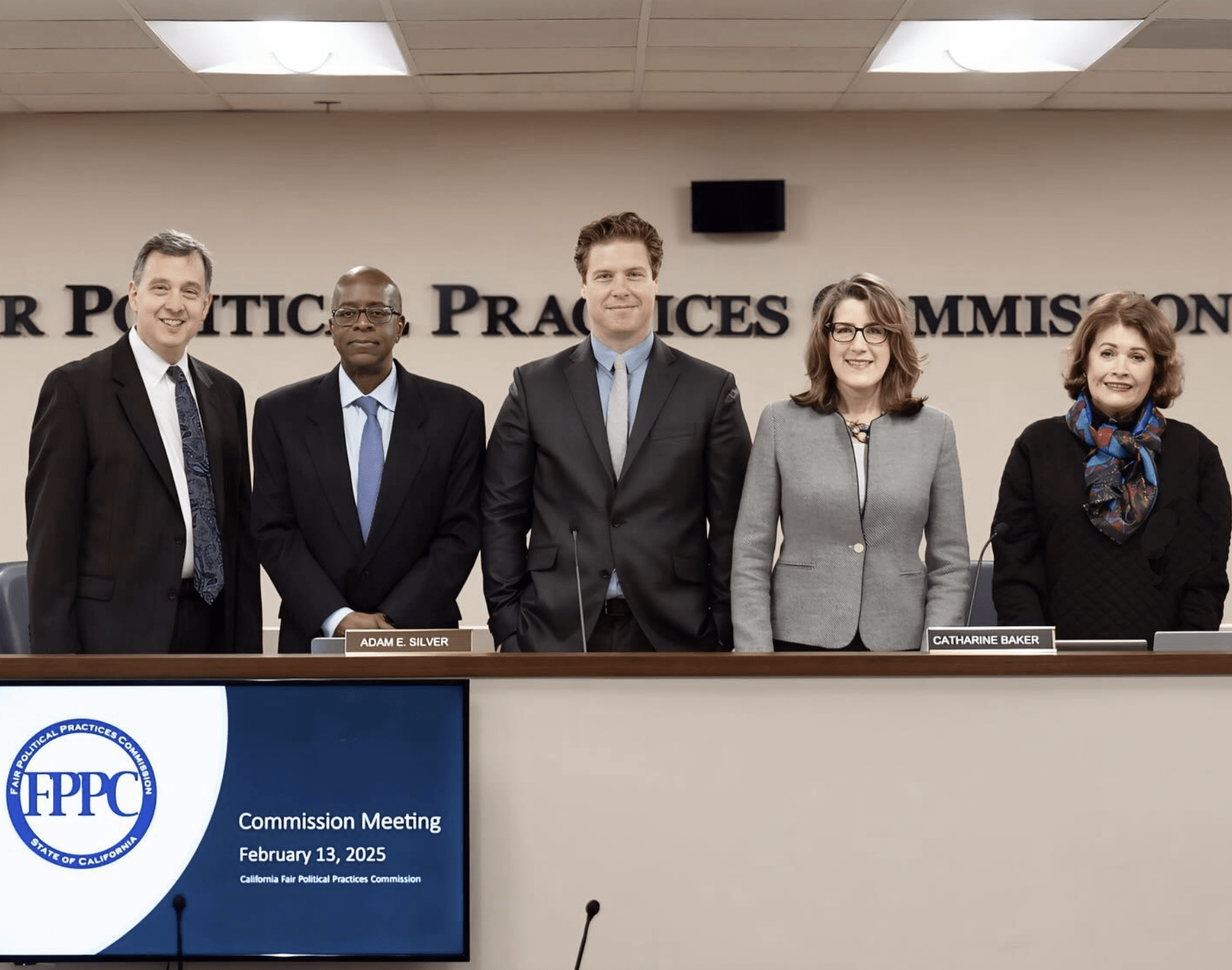
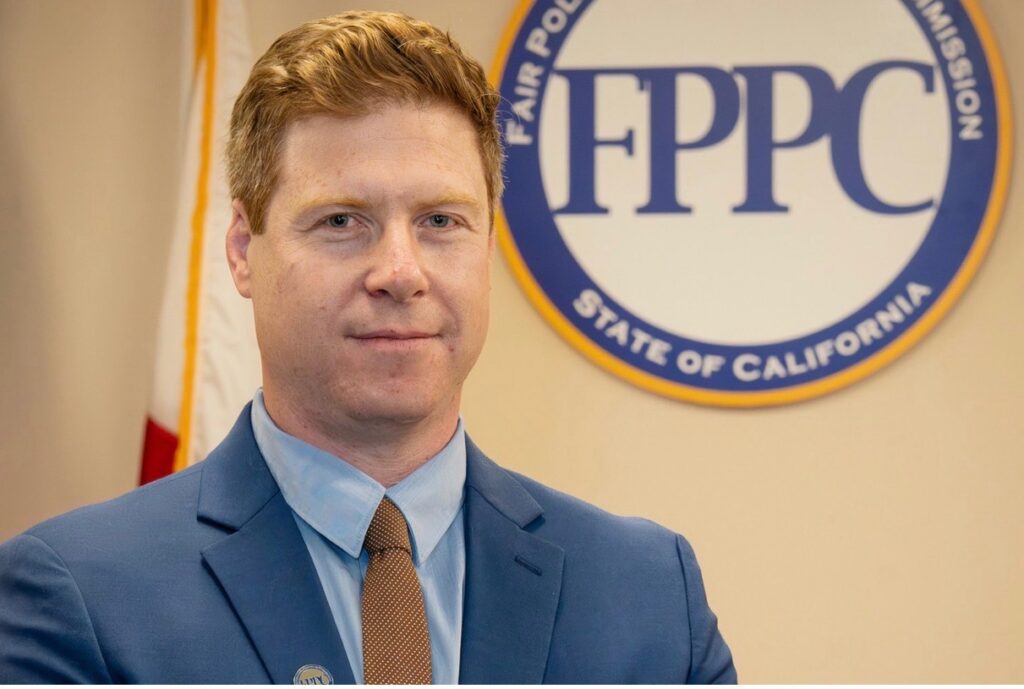
Governor Gavin Newsom, Bonta’s ally and frequent political partner, appointed FPPC Chair Adam E. Silver and Commissioner Dotson Wilson—both men steeped in decades of Sacramento Democratic insider culture. Their careers and networks are intertwined with the Bontas’ political trajectory. Their decisions will not be made in a vacuum.
This is not oversight.
This is protection.
And Bonta is the beneficiary.
The Form 700 Files: Trusts, LLCs, and Quiet Layers of Influence
Crack open the commissioners’ Form 700 disclosures and the façade collapses even further. Behind the polished titles is a thicket of trusts, LLCs, consulting partnerships, real estate holdings, and investment portfolios, structures designed for privacy, asset insulation, and influence without fingerprints.
FPPC Chair Adam E. Silver holds a lucrative partnership in General Event Co., placing him adjacent to the political fundraising ecosystem where donor money flows and alliances are cemented. His tech investments and business holdings align him with the donor class that fuels Sacramento’s machinery.
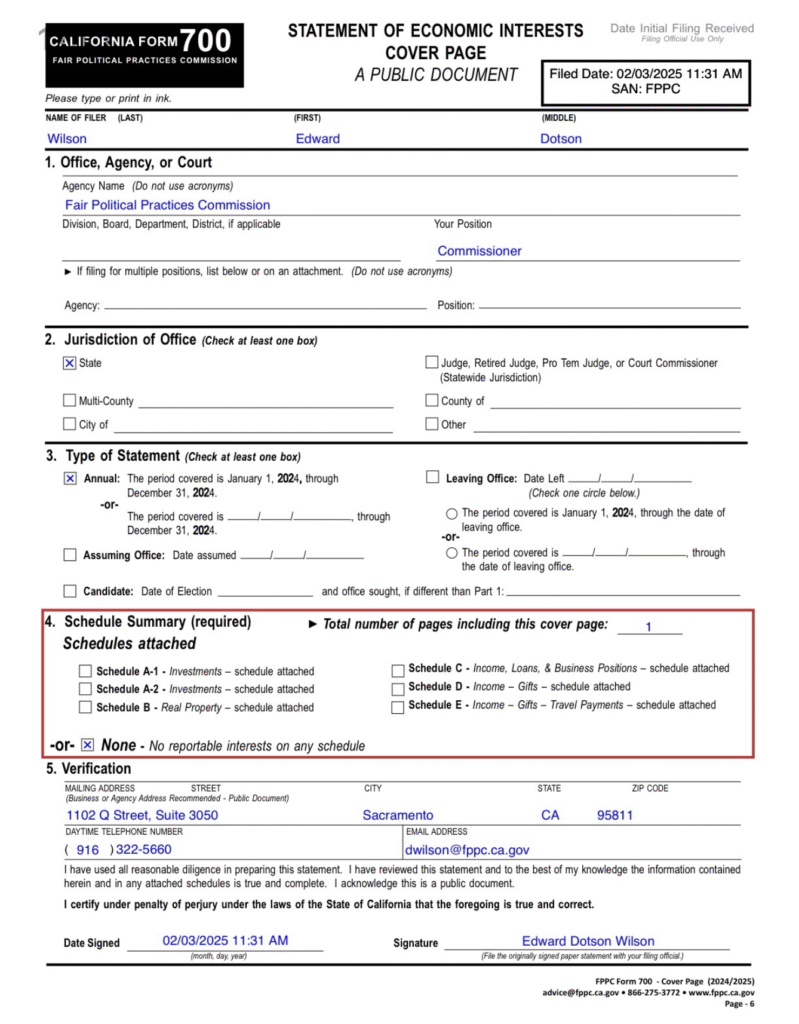
Dotson Wilson, a long-serving Assembly insider, submitted a single-page “no reportable interests” disclosure. A veteran of Capitol politics with no assets? The possibilities are two: either he is uniquely ascetic, or his wealth and interests are housed in trusts, LLCs, or family structures sitting just beyond disclosure thresholds.
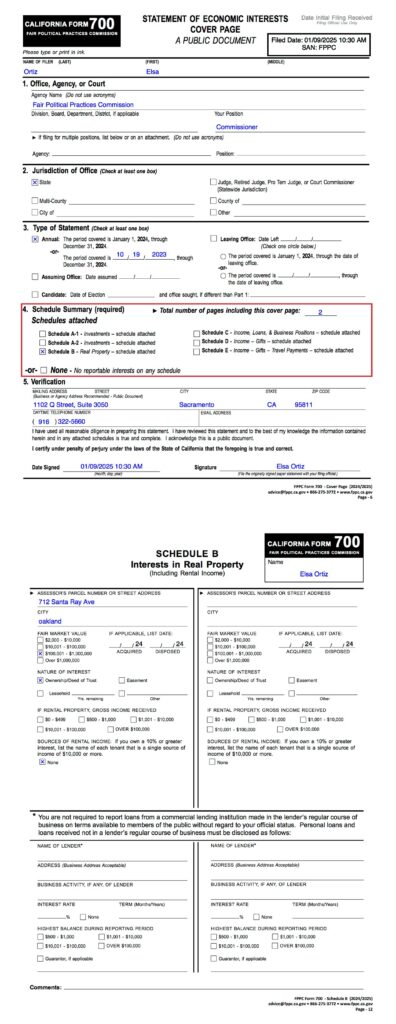
Elsa Ortiz, Bonta’s appointee, owns significant real estate in Oakland, ground zero for the Duong scandal. FBI raids rattled the same political ecosystem that nurtured Ortiz. The incentives for silence, caution, and political loyalty are baked into the geography.
Alf Brandt’s family LLC is an archetype of political consulting opacity, a vehicle for influence that thrives on relationships, not disruption. No consultant detonates a bridge they might later need to cross.
Charlene Zettel, the lone Republican, oversees a sprawling web of properties and LLCs inside the Zettel Family Trust. Her financial stability depends on predictable political conditions, not upheaval.
This commission is not financially or structurally positioned to confront a scandal of this magnitude. It is positioned to neutralize it.
Delay: The FPPC’s Most Reliable Tool of Evasion
The FPPC doesn’t need to exonerate Bonta. It only needs to wait out the news cycle.
And its playbook is already unfolding:
Extensions granted.
Reviews “ongoing.”
Timelines vague.
No urgency.
No teeth.
This is not bureaucratic drift, it is intentional paralysis.
Historically, complaints against powerful Democrats either end with trivial fines or evaporate through procedural decay. Even Bonta’s previous FPPC violation, a fundraising abuse involving donations he himself directed behind the scenes, resulted in a slap-on-the-wrist penalty so small it bordered on comedic.
Delay is how the FPPC protects power.
Delay is how scandals die.
Delay is the weapon of choice.
Partisanship: The Silent Co-Conspirator
The FPPC is mandated to remain impartial, but impartiality is impossible when the commission’s composition is engineered to tilt toward one party’s interests. Three Democrats, one Republican, one undeclared, wrapped in a culture shaped by decades of single-party rule.
Bias in Sacramento rarely announces itself loudly. It whispers through inaction.
A case placed “under advisement.”
A meeting quietly postponed.
A failure to issue subpoenas.
A complaint left to expire.
Rob Bonta isn’t just another state official. He is a valuable asset in California’s political hierarchy. Damaging him damages the machine. And the FPPC does not damage the machine.
A Watchdog Without Independence, Teeth, or Courage
Even if the FPPC miraculously decided to act, it remains structurally weak—unable to withstand political pressure, constrained by enforcement limits, and unwilling to challenge California’s upper echelon of power.
Federal investigators may yet deliver consequences.
The FPPC will not.
California Deserves Better Than This Broken System
Nearly half a million dollars in campaign cash spent on personal legal bills. Donations linked to alleged straw donors. A recycling empire under FBI investigation. A rumored compromising video. A formal ethics complaint. A public trust at stake.
And the body tasked with accountability is performing political triage to save the patient instead of diagnosing the disease.
The FPPC is not asleep.
It is not overworked.
It is not confused.
It is protecting Rob Bonta.