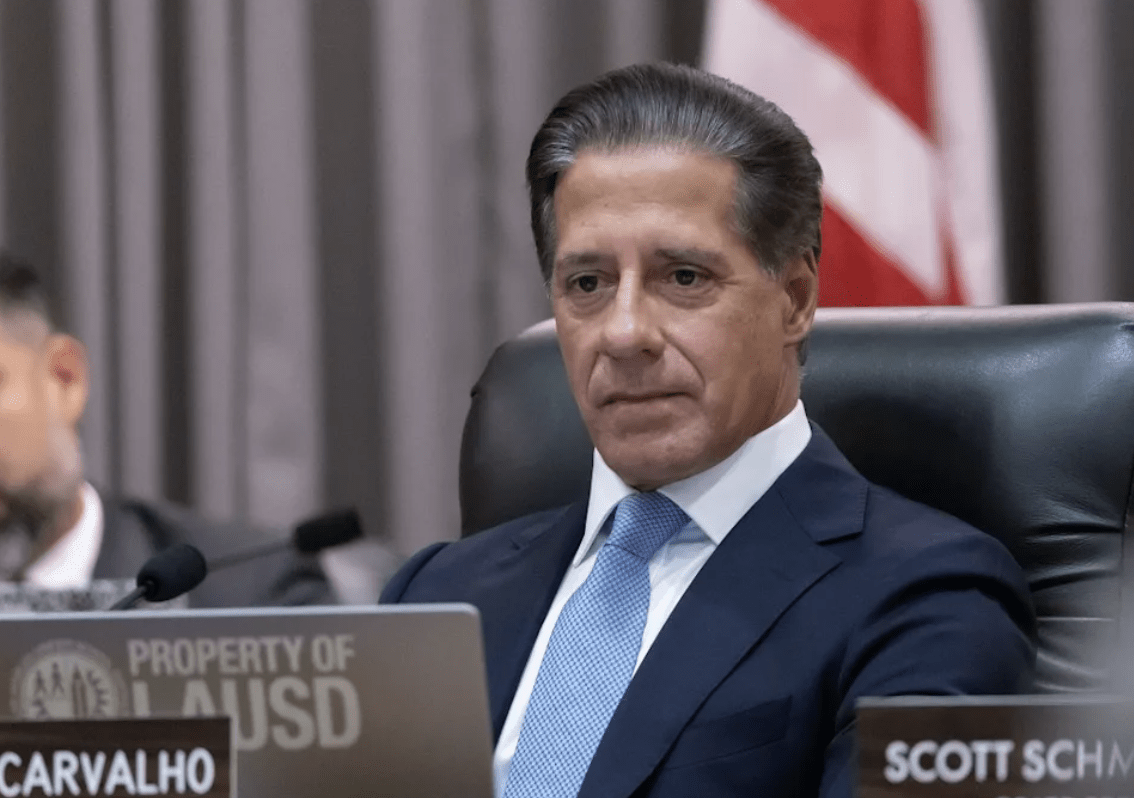
A troubling sequence of events involving a medically fragile student enrolled in Los Angeles Unified School District’s Carlson Home Hospital School is raising serious questions about whether a parent’s complaint triggered a chain of administrative actions that ultimately forced the student out of the program.
Before the conflict began, the student had been successfully receiving Home Hospital instruction through Carlson, a specialized LAUSD program designed to serve students whose medical conditions prevent them from attending traditional campuses. The student suffers from a severe medical condition requiring continuous medical accommodation and specialized instructional support. Carlson teachers had been providing those services, and the arrangement appeared to be functioning as intended.
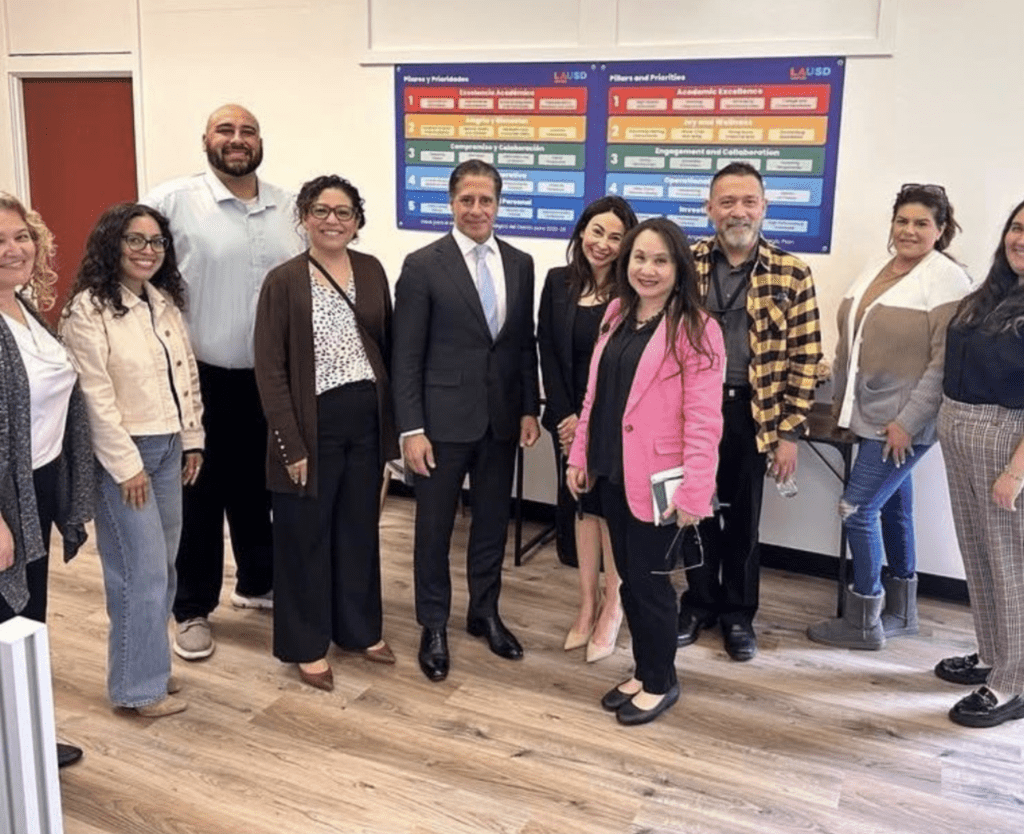
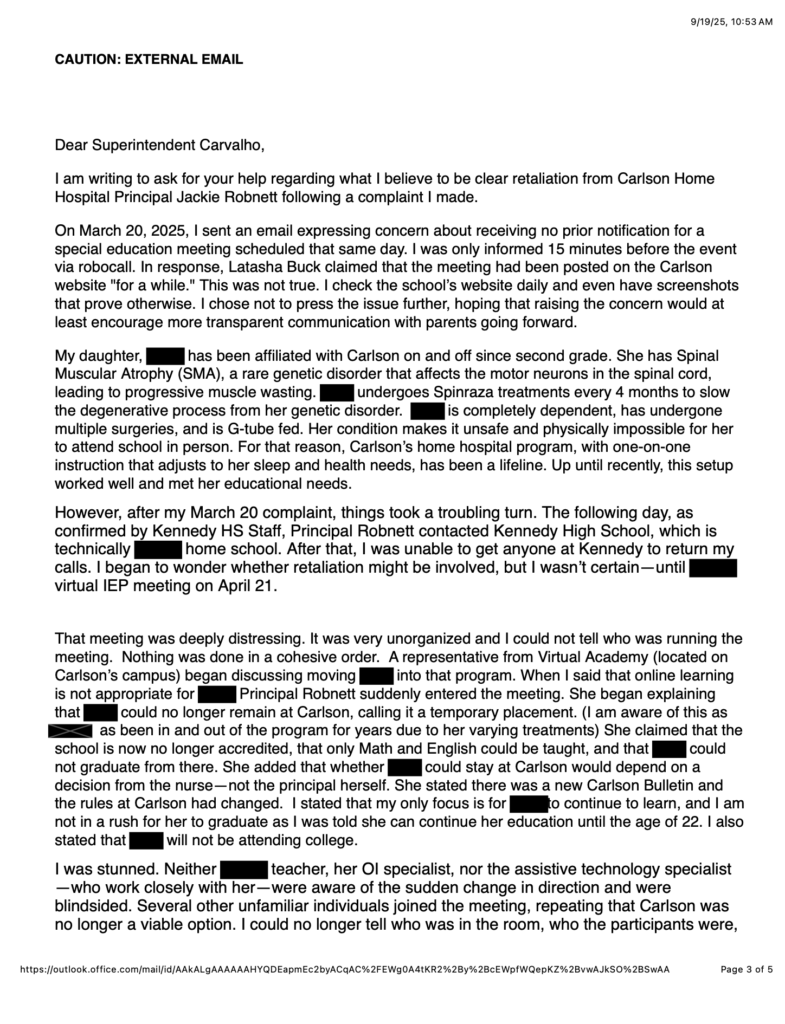
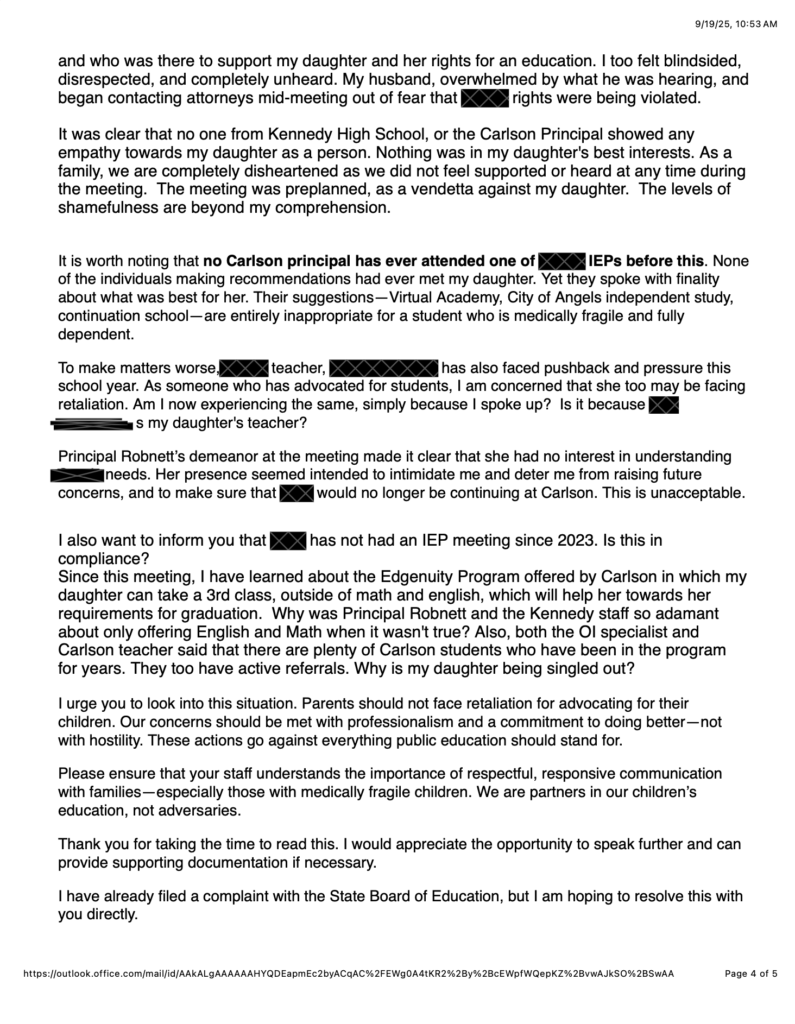
The timeline shifted in March 2025, when the student’s parent raised concerns with district leadership. According to documentation reviewed for this report, the parent reported receiving notification of a special education meeting only fifteen minutes before the meeting began. The complaint was directed to district officials.
What followed next would set off a series of developments that the family says cannot be viewed as coincidence.
The day after the parent filed the complaint, Carlson Principal Jackie Robnett contacted the student’s home school, Kennedy High School, to discuss the student. According to the parent, Kennedy staff had initially been responsive when discussing the student’s IEP, but after Robnett’s call the communication abruptly stopped. Phone calls that had previously been returned were no longer answered, leaving the parent unable to reach school staff regarding her child’s education plan.

By April 2025, the student’s placement at Carlson was suddenly being questioned by administrators. During a Zoom IEP meeting, Carlson Principal Jacqueline Robnett appeared despite never having attended any of the student’s prior IEP meetings, or, according to individuals familiar with the case, any IEP meetings since becoming principal of Carlson Home Hospital School. During that meeting, Robnett informed the family that the student could no longer remain enrolled at Carlson, contradicting earlier assurances that the program was appropriate for the student’s needs. Instead, the district attempted to move the medically dependent student to Independent Study or the district’s Virtual Academy, a proposal that immediately raised concerns given the student’s complex medical condition and reliance on specialized instructional and medical supports. As a result, the parent wrote a letter to Superintendent Alberto Carvahlo expressing her concerns.
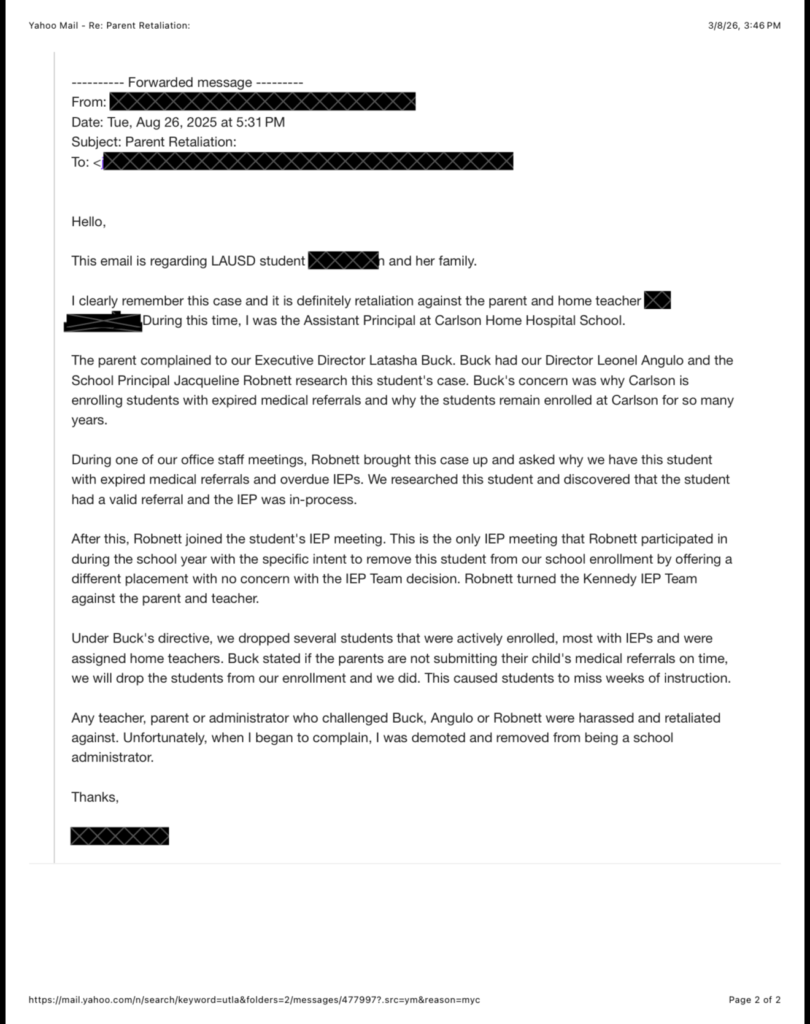
According to a former Carlson assistant principal familiar with the situation, the student’s case had been discussed during internal administrative meetings where actions were taken to remove the student from Carlson’s enrollment.
Despite those internal discussions, the student was approved for Home Hospital services for the 2025-2026 school year after the parent followed district protocols. The student was assigned to a teacher who had previously raised concerns internally about violations related to student services, effectively acting as a whistleblower within the program.
Soon after that assignment, the student’s medical referral was altered. The physician’s order had extended Home Hospital services through August 2026. However, the school nurse shortened the referral date to April 30, 2026, cutting months off the physician’s prescribed service period. The change did not reflect the doctor’s medical order.
When the first day of school arrived, the student was no longer on the whistleblower teacher’s caseload. The parent contacted the school and was informed by the nurse that the student’s referral had been denied.
The consequences were immediate. With the placement suddenly revoked, the student lost approximately two weeks of instruction.
When the student was eventually accepted back into Carlson, the whistleblower teacher had been removed and the student was reassigned to a different instructor. Students had been shuffled across caseloads, and the student was formally moved off the whistleblower teacher’s roster.
The disruption forced the student’s parent, along with an assistive technology specialist and an occupational therapist, to train the replacement teacher on how to support the student’s specialized needs. Even with those efforts, the teacher never fully mastered the complex accommodations required.
For a medically dependent student whose education depends on consistent medical and instructional coordination, that learning curve can have serious consequences.
Ultimately, the disruption proved too significant to overcome. After the loss of services and the breakdown of the program that had previously been working, the student withdrew from Carlson altogether and is now being homeschooled.
When the events are examined in sequence, the pattern raises difficult questions. A parent raises concerns about an Special Ed meeting and district transparency. Within days, a principal intervenes in the student’s case and contacts the student’s home campus. Internal administrative discussions take place. A physician’s referral is shortened. A previously approved placement is denied. A whistleblower teacher is removed from the student’s case. Instruction is interrupted, and the student ultimately leaves the program.
For the family involved, the sequence does not resemble routine administrative adjustments. It appears to reflect something far more troubling.
Whether district officials view the developments as procedural decisions or something else entirely, the outcome remains the same: a medically fragile student lost access to the specialized program that had been providing necessary educational support.
The case raises a broader question for the Los Angeles Unified School District. If a medically dependent student can lose access to Home Hospital services after a parent raises concerns about the IEP process, what protections actually exist for the families who rely on the program the most?