For months, a growing body of documentation has quietly accumulated inside the Los Angeles Unified School District and within the offices of the union that represents its educators. Emails exchanged between teachers and union representatives. Written complaints describing alleged retaliation and harassment. Audio recordings and correspondence documenting workplace confrontations. Screenshots of pay records, personnel file entries, and internal communications.
Individually, each record might appear to capture the kind of dispute that surfaces in any large institution. Viewed together, however, the documents form a far more consequential archive. They outline what multiple educators say was a pattern that began after they raised concerns about misconduct within the district and then sought protection from the very organization tasked with representing them.
Those documents now form the backbone of a formal complaint filed with the California Public Employment Relations Board, the state agency charged with overseeing labor relations between public employers and unions. The filing places the accumulated records at the center of a dispute that strikes at the core of union representation in the nation’s second largest school district, raising questions about how educators’ complaints were handled after they reported what they believed to be misconduct and retaliation within the Los Angeles Unified School District.
When educators reported retaliation tied to whistleblowing, did the United Teachers Los Angeles fail to intervene because of bureaucratic neglect, or did union leadership make a calculated decision not to challenge the district even after being alerted to the alleged retaliation?
The distinction carries enormous consequences.
A failure to act could reflect dysfunction within a large organization responsible for representing tens of thousands of employees. A deliberate decision not to act could suggest something far more consequential: that union leadership weighed the importance of maintaining relationships with district leadership and political allies against the obligation to defend the educators who pay union dues for that very protection.
According to communications referenced in the complaint, multiple educators contacted UTLA leadership and Los Angeles Unified School District officials throughout 2023 describing what they believed was a pattern of retaliation that began after they raised concerns about potential misconduct inside the district.
The concerns were not limited to interpersonal conflicts or ordinary workplace grievances. Educators reported suspected wage theft, possible misuse of federal Title I funding, violations of the collective bargaining agreement, and district practices they believed violated labor law and regulations governing compensation and working conditions.
Some teachers described being required to work through legally mandated lunch periods without compensation. Others reported being forced to attend mandatory meetings outside of their paid hours without proper pay. Educators also raised concerns about uncompensated travel time between sites and alleged irregularities involving funds intended for low income student programs.
These concerns were documented in emails, written complaints, and direct communications with union representatives.
In several cases, the educators say the retaliation began shortly after those concerns were raised.
Disciplinary investigations were opened. Administrative complaints appeared in personnel files. Supervisory scrutiny intensified. Teachers who previously had no documented performance issues suddenly found themselves under review.
The pattern described in the complaint reflects a form of retaliation that often unfolds gradually in large bureaucracies. Careers are not always damaged through a single decisive action. Instead, pressure accumulates through investigations, documentation, and reputational damage that builds slowly over time.
As the pressure increased, the educators turned to the organization designed to represent them: United Teachers Los Angeles.
One of the earliest and most detailed warnings to union leadership came in 2024 from a former assistant principal at the school. According to documentation referenced in the PERB filing, the administrator contacted UTLA leadership directly and reported a pattern of retaliation and harassment directed at educators and administrators who had raised concerns about contract violations and other misconduct within the district.
The union representative who received the communication reportedly escalated the information internally to higher level officials within UTLA. The communication described a pattern of targeting educators who had spoken out about wage practices, contract violations, and administrative conduct.
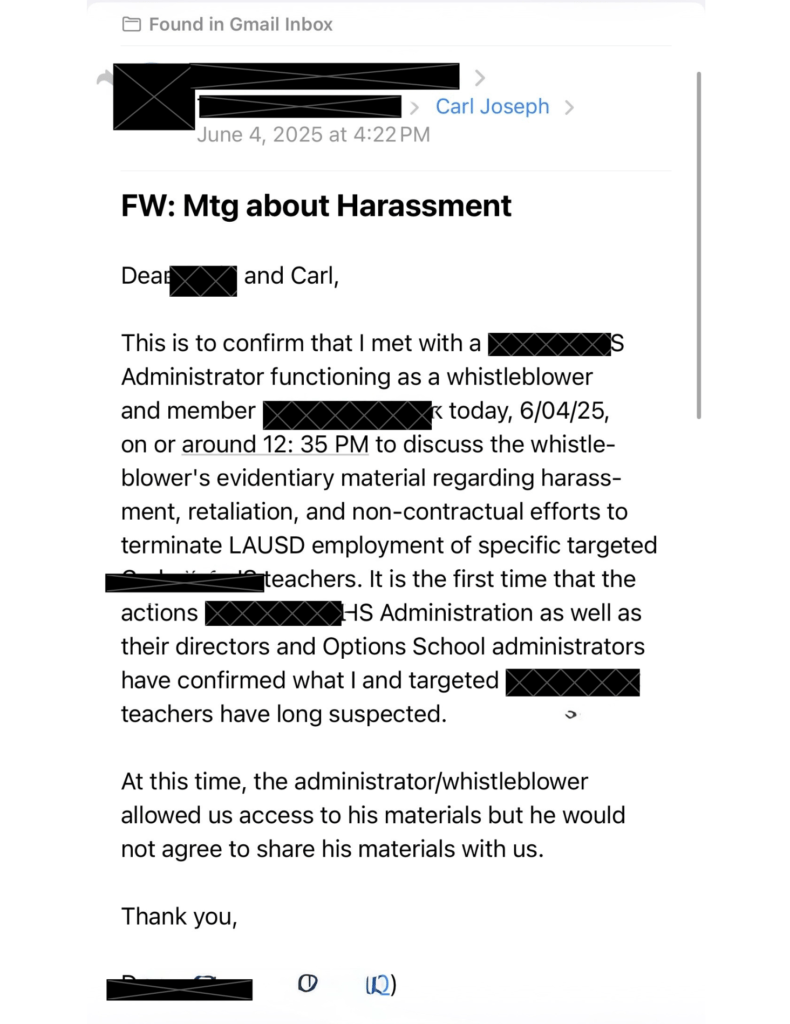
At that point, union leadership had been placed on notice.
The allegations were detailed and documented, and the union possessed the authority to pursue grievances under the collective bargaining agreement or initiate enforcement actions against the district.
According to the complaint, none of those actions occurred.
No grievance was filed on behalf of the educators who reported retaliation. No formal enforcement action was initiated under the collective bargaining agreement. Union intervention never materialized despite the documentation provided.
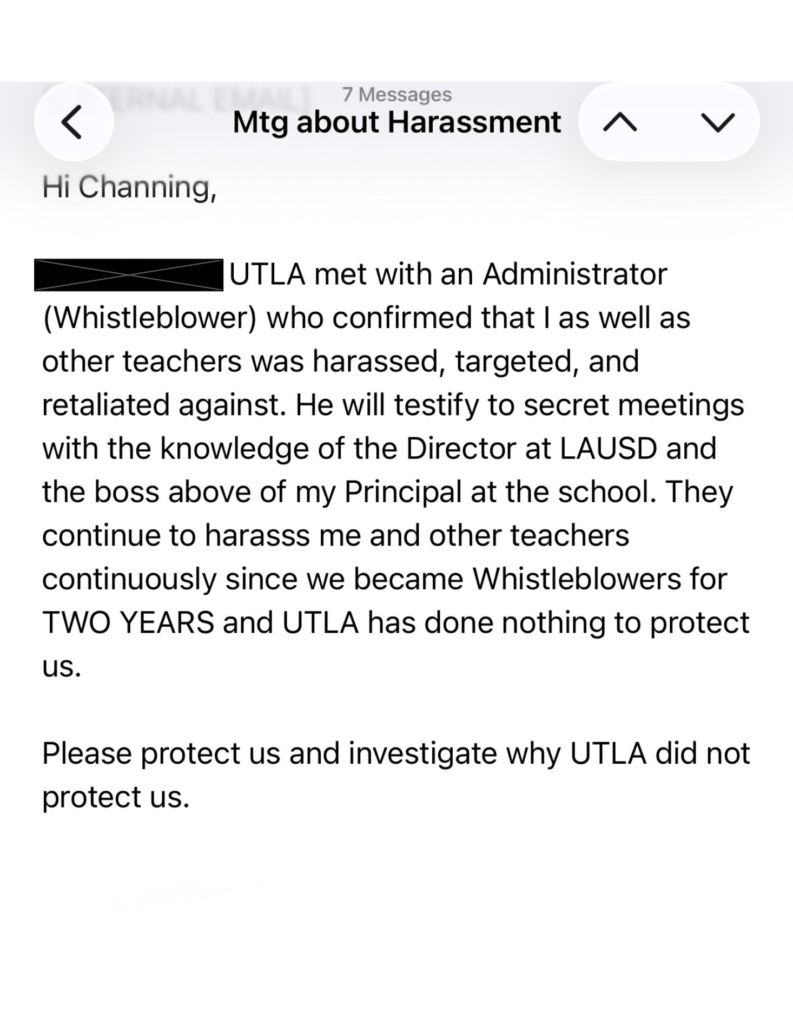
The explanation given by union leadership, according to communications referenced in the filing, was strategic.
Union officials allegedly indicated that pursuing grievances on behalf of whistleblowers could harm the union’s negotiating leverage with the district.
If that characterization of events proves accurate, the implications are significant.
Labor unions operate under what is known as the duty of fair representation, a legal obligation requiring unions to represent members honestly, in good faith, and without arbitrary discrimination. While unions retain discretion in determining how grievances are pursued, they cannot ignore credible complaints in ways that appear arbitrary or motivated by conflicts of interest.
This case was not the only instance cited in the complaint.
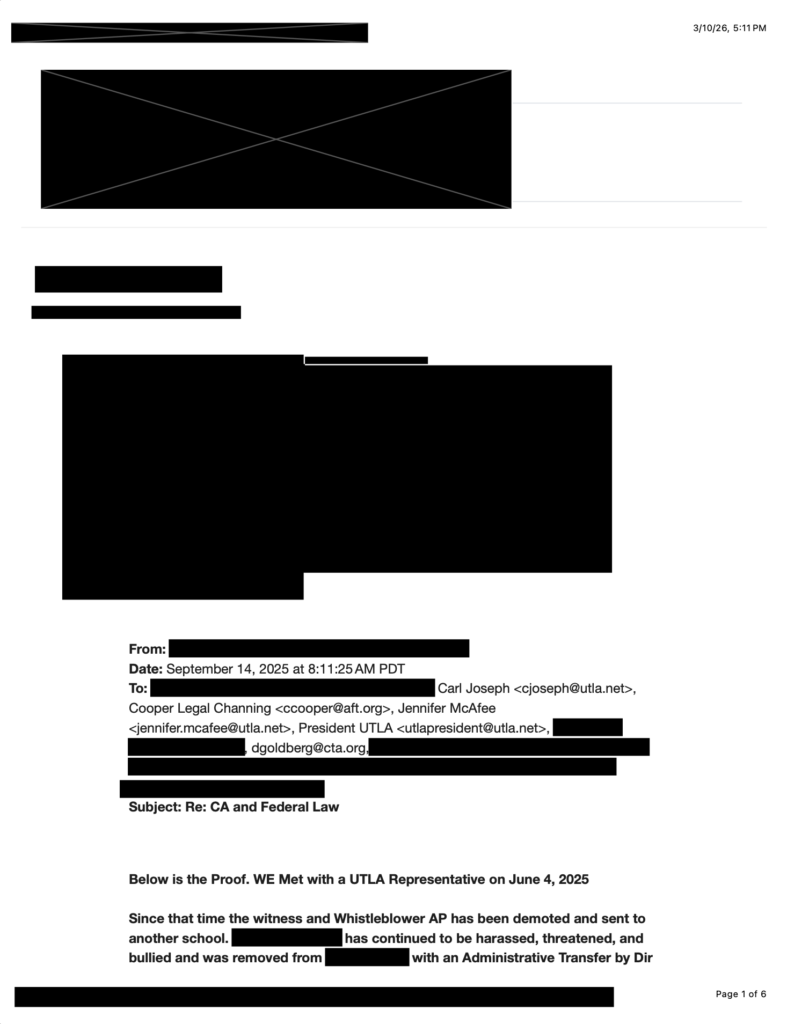
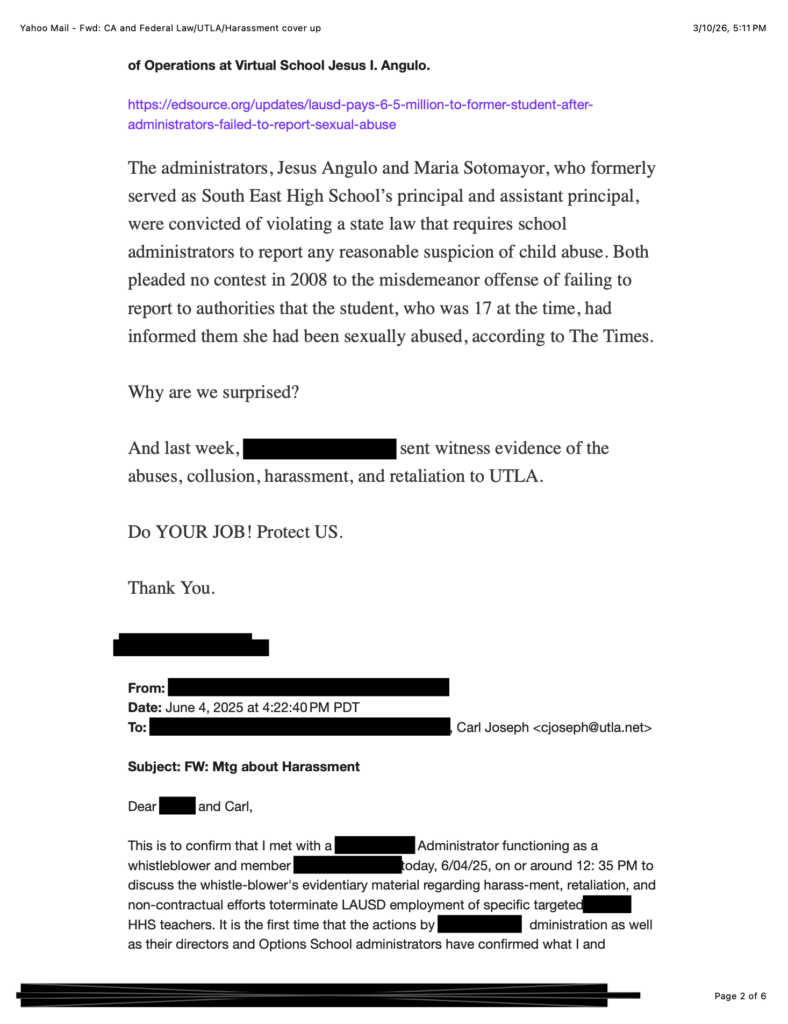
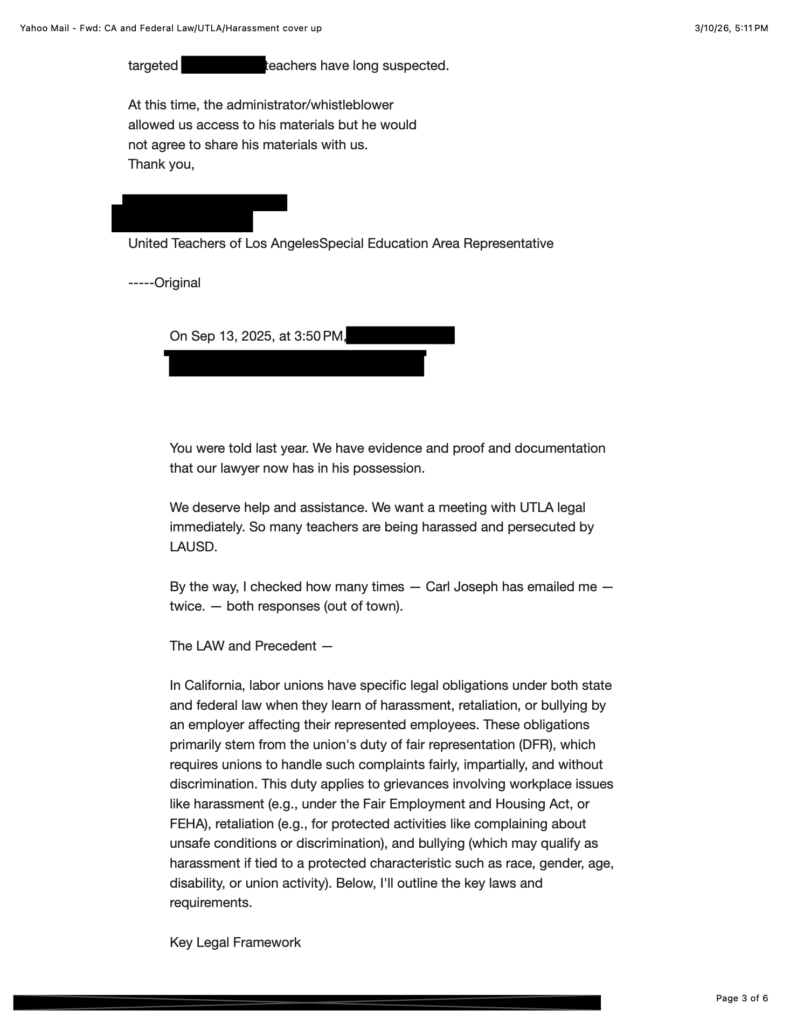
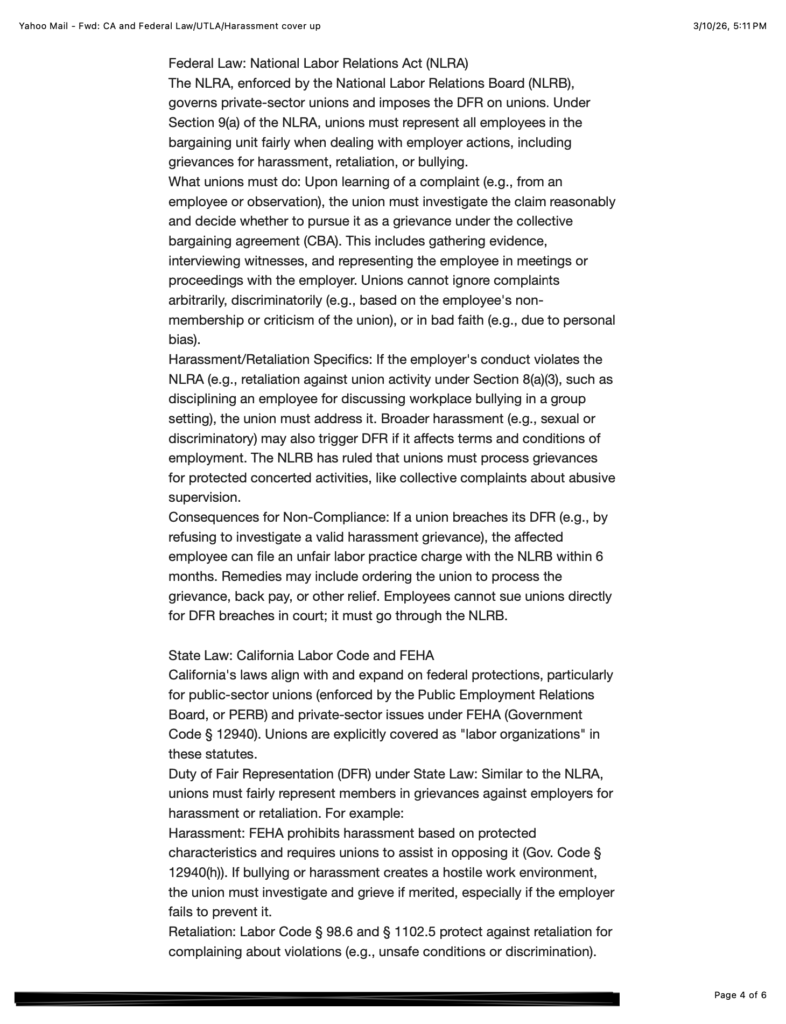
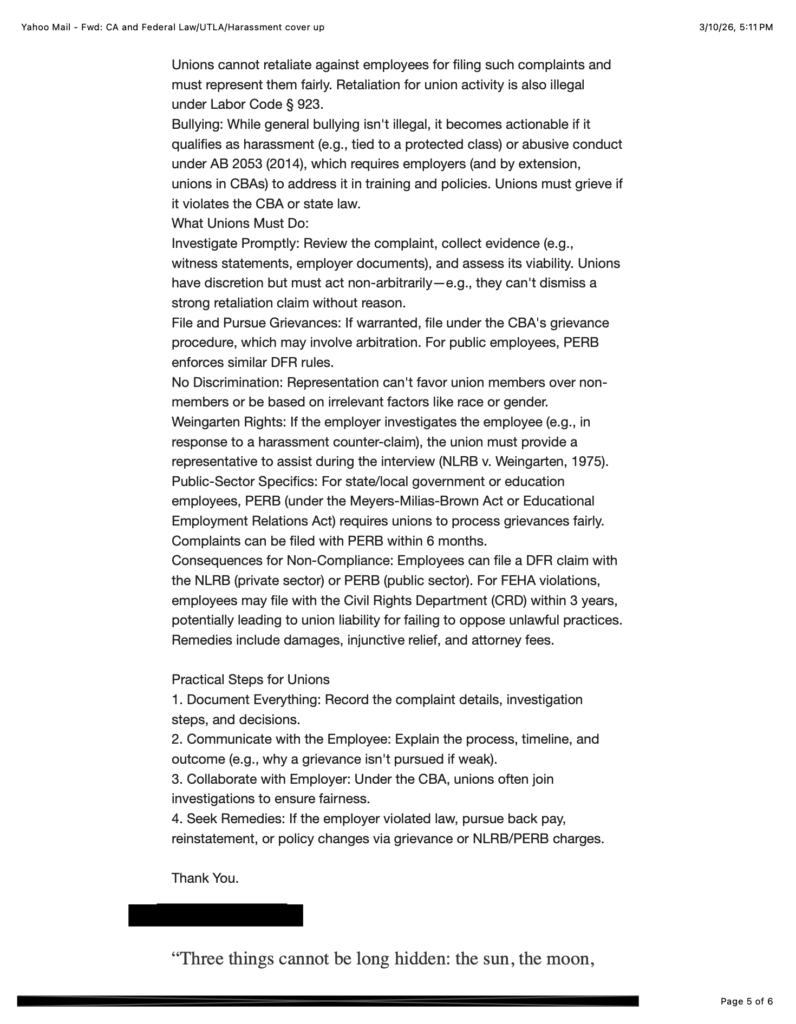
In August 2024, another LAUSD educator, a teacher with more than twenty years of experience in the district, reported what the complaint describes as more than six months of escalating harassment tied to whistleblowing activity.
According to documentation referenced in the filing, the teacher provided audio and video recordings documenting confrontations with administrators and what the educator described as persistent targeting in the workplace.
The teacher sought assistance from UTLA and requested that the union file a grievance against the school’s principal. The educator also asked the union to intervene in disciplinary actions initiated through the district’s Staff Relations division, actions the teacher believed were retaliatory.
Again, according to the complaint, the union declined to act.
UTLA did not file a formal grievance against the administrator despite the documentation provided. The union did not challenge the disciplinary process initiated by the district.
The educator also reported that confidential documents were placed into the teacher’s personnel file in violation of contractual protections governing disciplinary records. The teacher further reported pay docking and unpaid labor connected to mandatory meetings and work assignments.
Those concerns were also presented to the union as potential violations of the collective bargaining agreement and state labor law.
The complaint alleges that no back pay was pursued and no enforcement action was taken.
For the educators involved, the consequences were not theoretical.
The complaint describes financial losses, emotional stress severe enough to require counseling, and reputational harm caused by disciplinary documentation appearing in personnel files. In some cases, educators feared their employment with the district could be terminated.
The allegations also describe retaliation that extended beyond internal discipline.
A documented retaliation complaint dated March 31, 2025 references a workplace violence and harassment claim that allegedly followed whistleblower disclosures involving special education students. According to the complaint, retaliation had been ongoing for approximately two years after educators reported district violations affecting special education services.
Whistleblowers described harassment campaigns intended to damage their professional reputations. Administrators allegedly attempted to discredit teachers with parents and colleagues, undermining their credibility inside the school community.
The complaint even references reports of a so called “hit list” of educators who had spoken out about district practices.
Teachers repeatedly sought assistance from UTLA during this period. Emails show requests for union intervention, legal representation, and meetings with union leadership to address the retaliation.
According to the complaint, those requests went unanswered.
No formal grievance was filed.
No union defense was initiated.
Under California labor law, unions are required to investigate retaliation complaints and pursue grievances when appropriate. This obligation exists because union members pay monthly dues, often exceeding one hundred dollars, with the expectation that the organization will defend them against workplace retaliation, enforce the collective bargaining agreement, and provide legal representation when disputes arise.
The documents now being examined raise questions about whether those expectations were met.
The broader context surrounding these events adds another layer of complexity.
During the same period in which these complaints were circulating, UTLA and LAUSD were engaged in contract negotiations affecting thousands of educators across the district. Labor negotiations of that scale are often politically sensitive and involve significant strategic calculations by both sides.
Public disputes between union leadership and district officials during negotiations can disrupt bargaining dynamics, weaken leverage, and create political friction with allies on the school board.
The timing of the retaliation complaints has led some educators involved in the case to question whether political and negotiating considerations discouraged aggressive action by the union.
UTLA is not merely a labor organization. It is one of the most powerful political forces in Los Angeles education politics.
The union regularly endorses school board candidates, provides campaign support, and plays a significant role in shaping the political landscape surrounding public education in the city.
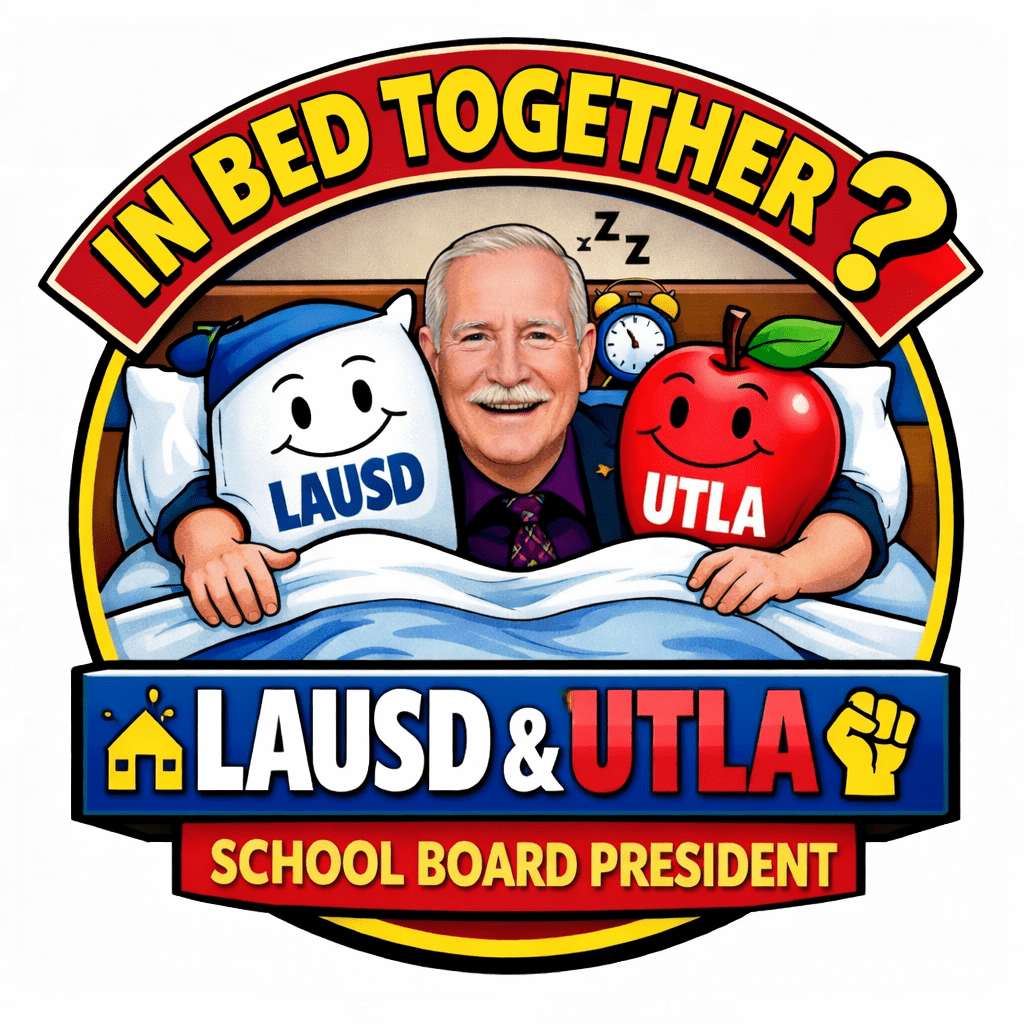
School board members, including Scott Schmerelson and Kelly Gonez, have historically received political support from UTLA during election campaigns. At the same time, district leadership including Superintendent Alberto Carvalho and senior administrators such as Latasha Buck operate within a political environment where relationships with the union and the board are closely intertwined.
Emails referenced in the complaint were reportedly sent not only to union leadership but also to district officials and school board offices.
Recipients included senior district leadership, UTLA legal representatives, and members of the school board.
That overlap between union leadership, district administration, and political leadership raises a broader investigative question.
Did political relationships between union officials, district administrators, and school board leadership influence how retaliation complaints were handled?
If the case proceeds through the PERB investigation process, internal communications within UTLA may become central evidence.
Emails between union representatives and leadership, as well as communications between union officials and district administrators, could reveal how decisions were made regarding whether to pursue grievances.
Those records may also show whether concerns about maintaining cooperative relationships with the district influenced those decisions.
The implications of the case extend well beyond the individual educators involved.
California law provides strong protections for whistleblowers, particularly for public employees.
Labor Code section 1102.5 prohibits employers from retaliating against employees who disclose suspected violations of law, misuse of public funds, or improper governmental activity. The law applies to public agencies such as school districts and protects disclosures made internally to supervisors as well as reports made to outside authorities.
Public school employees are also protected by provisions within the California Education Code that shield educators who report violations involving student safety, financial misconduct, or regulatory violations.
If retaliation occurred as described in the complaint, those statutes could come into play in legal proceedings against the district.
However, the allegations against the union fall under a different legal framework.
The California Public Employment Relations Board investigates claims that a union breached its duty of fair representation by acting arbitrarily, discriminatorily, or in bad faith when deciding whether to represent its members.
The complaint filed with PERB alleges that UTLA leadership had knowledge of retaliation affecting multiple educators and declined to pursue grievances or enforcement actions despite receiving documentation describing those allegations.
If investigators ultimately conclude that union leadership knowingly declined to intervene, the implications could ripple across the education system in Los Angeles.
The case would raise difficult questions not only about retaliation inside the district but also about whether the institution designed to protect educators chose to remain silent while that retaliation unfolded.
For the teachers who filed the complaint, the issue is not simply whether individual grievances were ignored.
The larger question they now pose is whether the political alliances, negotiating strategies, and institutional relationships inside the Los Angeles education system created a situation where whistleblowers were left without meaningful protection.
If that question is ultimately answered in the affirmative, the case could expose a deeper structural problem inside the nation’s second largest school district: a system in which the very institutions meant to protect educators may have been unwilling to confront the power structures they were built to challenge.