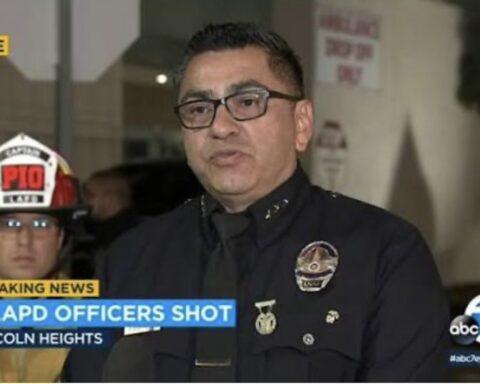

At the Los Angeles County Sheriff’s Department (LASD), new allegations of nepotism and cronyism are intensifying scrutiny of Sheriff Robert Luna’s administration, raising serious questions about whether the reform agenda he promised has instead given way to a familiar culture of favoritism and insider advantage.
Elected in November 2022, Luna assumed office the following month amid high hopes among Democrats for sweeping reform. Yet less than four years later, his leadership is increasingly clouded by scandals that mirror the very favoritism he pledged to eliminate. At the center of the this controversy are the promotions of Captain Nancy Escobedo, Captain Ryan Vienna, and Captain Michael Moen, which critics say illustrate how personal relationships and campaign loyalties can override qualifications, established policies, and fair competition.
Drawing from department memos, public records, insider accounts, and LASD’s own policy manuals, this investigation uncovers a pattern of rigged promotions that rewards allegiance over ability. Escobedo’s story mirrors the cronyism exposed in the cases of Captains Ryan Vienna and Michael Moen, where high school friendships, political endorsements, and campaign support greased the wheels for undeserved advancements. As Luna eyes re-election in 2026, these intertwined accounts reveal a department where “who you know” trumps “what you’ve done,” eroding morale, inviting lawsuits, and betraying the public’s call for transparency.

The Ascent of Nancy Escobedo: From Union Leader to Insider Favorite
Nancy Escobedo’s journey within LASD spans nearly three decades, beginning as a teenage Explorer in East Los Angeles at the age of fifteen. Publicly, her story is framed as one of inspiration: a mother of three who rose from volunteer to sergeant while patrolling the streets of her childhood neighborhood. In March 2026, LASD spotlighted her in a promotional video courtesy of NBC LA, presenting her as a role model for women in law enforcement and inviting recruits to attend a Women’s Symposium. “One Badge, Unlimited Possibilities,” the caption reads. Insiders, however, describe a different reality, one where opportunities appear limited for those without the right connections.
Escobedo, a former lieutenant and president of the Professional Peace Officers Association (PPOA), followed a complicated path to captaincy. Department sources report that she interviewed multiple times for captain positions but repeatedly failed to secure the role after contract city managers declined to select her, leaving her with a reputation for being passed over despite repeated attempts. Yet in August 2025, during a contentious election cycle in which former Sheriff Alex Villanueva was mounting a comeback bid, Escobedo was quietly elevated to captain and placed in charge of SIB, a critical unit responsible for managing the department’s public narrative regarding deputy shootings, lawsuits, and departmental crises.
What changed was not a sudden shift in qualifications but the emergence of significant familial and political leverage. Escobedo’s husband, Sergio Escobedo, serves as Luna’s Chief of Staff, a powerful position that carries direct influence over promotions at the captain level and above. According to insiders, that marital connection cleared the path for her advancement. The SIB vacancy was abruptly removed from the public list, eliminating any open competition or outside interviews. No other lieutenants were permitted to apply, transforming what should have been a merit-based process into a closed appointment.
The maneuver carries the unmistakable appearance of quid pro quo. As PPOA president leading up to Luna’s 2022 victory, Escobedo navigated turbulent union politics. She was initially aligned with Villanueva’s administration and later directed union funds to candidate Eli Vera’s PAC during the heated sheriff’s race. After the election, however, she shifted course. By January 2023, Escobedo was representing PPOA at Luna’s inaugural events, signaling alignment with the new administration. Sources describe her attending Luna fundraisers and campaign dinners while off duty, actions viewed by some as calculated lobbying. When Luna assumed office in December 2022, the promised reforms quickly gave way to patronage. Loyalists were rewarded, and Escobedo’s union influence, which helped rally support for Luna despite her earlier ties to Vera, ultimately paid dividends.
Echoes of the McDonnell Era: Promoting Former Aides and Associates
Another layer of favoritism allegations emerges through Escobedo’s history as an aide to former Sheriff Jim McDonnell, who served from 2014 to 2018 and was widely known within the department as the “shadow sheriff” because of his continued influence. Escobedo was not alone in that orbit. Jason Skeen, now an Assistant Sheriff under Luna, also served as McDonnell’s Executive Aide during that period. Skeen, a twenty-three-year veteran, was promoted to captain by McDonnell in 2016 and assigned to Carson Station before climbing higher within Luna’s administration.
Department insiders point to what they describe as a broader pattern. Luna has repeatedly promoted or reassigned individuals who previously worked closely with McDonnell, his predecessor at the Long Beach Police Department, where Luna served as chief beginning in 2014. Jason Skeen’s aide, Omar Camacho, who once served as McDonnell’s driver, has since received favorable assignments. Patty Thomas, another former driver for McDonnell, was promoted to captain under Luna. Glen Emery, who previously served as a sergeant within McDonnell’s security detail, was also elevated to captain and later worked on Luna’s security team following Luna’s inauguration as sheriff in December 2022.
To many within the department, these decisions reinforce a perception that advancement depends less on performance and more on affiliation. Personnel without ties to McDonnell or Luna often view their chances for promotion as limited. What was expected to represent a break from past cronyism instead appears, to critics, to be a continuation of the same internal alliances. The result is a department culture where allegiance carries greater weight than achievement.
Policy Breached: LASD’s Nepotism Rules Ignored
The LASD Manual of Policy and Procedures is explicit about nepotism. Section 3-02/010.05 prohibits “Qualified Personal Relationships” (QPRs), including marriages, from creating conflicts of interest, favoritism, or any impairment of departmental checks and balances. The policy specifically warns against situations in which one party may influence another’s career trajectory through promotions or assignments. The purpose is to prevent both actual and perceived preferential treatment.
Escobedo’s situation appears to fall squarely within the concerns the policy was designed to prevent. Her husband’s executive role under Luna intersects directly with her command position, potentially compromising the independence of the unit responsible for managing sensitive departmental information.
No disclosure form, identified in policy as SH-AD-758, has surfaced within public records, and department responses to inquiries have remained opaque. Critics argue that the issue goes beyond a technical oversight. Within LASD, some compare the circumstances to past scandals during the tenure of former Undersheriff Paul Tanaka, who was ultimately convicted for obstructing justice amid allegations of similar cronyism. By removing competition from the process and allowing spousal influence to shape the outcome, Escobedo’s promotion has disadvantaged qualified lieutenants who lacked insider access, fueling resentment throughout the ranks.
Parallels with Vienna and Moen: A Pattern of Rigged Rewards
Escobedo’s elevation is part of a broader pattern under Luna that closely resembles the promotions of Ryan Vienna and Michael Moen. Vienna, who serves as a San Dimas city council member, hosted an elaborate 2022 campaign event for Luna at his father’s home, bringing together local political figures and LASD personnel to support Luna’s challenge to Villanueva.
After Luna took office in December 2022, Vienna’s loyalty was rewarded. He received special assignments and even served as Luna’s temporary lieutenant aide, giving him unusually close access to the sheriff’s inner circle.
By 2025, that influence appeared to extend beyond Vienna himself. When a captain position opened at San Dimas Station, the selection process, which normally involves neutral interview panels and formal evaluation procedures, was allegedly manipulated. Vienna is said to have used his influence with city colleagues, including Mayor Emmett Badar and Mayor Pro Tem Eric Weber, both of whom had endorsed his re-election campaign, to shape the panel in favor of his high school best friend, Michael Moen.
Text messages obtained during the process reportedly show Vienna communicating with candidates during the interviews, disclosing the identities of frontrunners before the panel had completed its work. The messages suggested the outcome had effectively been decided in advance. Moen ultimately secured the captain position and assumed command within the same city where Vienna holds elected office, creating a conflict that critics say should have raised immediate alarms within LASD leadership.
Like Escobedo’s promotion, the Vienna and Moen situation raises questions under the department’s own nepotism rules. Their close personal relationship could qualify as a QPR, yet no disclosure forms appear to have been filed. In both cases, the timeline traces back to Luna’s transition into office following the 2022 election. Vienna’s political support translated into internal influence, which was then used to advance Moen’s career. Escobedo’s union maneuvering and marital connection similarly positioned her for advancement outside of standard procedures.
Across all three cases, critics argue that the pattern reflects a system in which promotions were offered to individuals who assisted Luna’s rise to power through fundraising, political backing, or personal loyalty. The result, they contend, is a department vulnerable to accusations of pay-to-play promotions.
The Cover-Up and Broader Fallout
Attempts to obtain clarity regarding these promotions have repeatedly encountered obstacles. Public Records Act requests seeking communications and panel details related to the Vienna and Moen promotion were denied as either “burdensome” or exempt under personnel privacy rules. Similar inquiries regarding Escobedo’s appointment have produced vague responses. Internal memos confirm that the SIB vacancy was quietly removed from the public list, yet provide no explanation for why the competitive process was eliminated.
Redactions and missing communications have further complicated the search for answers. Some records appear partially withheld, while others contain extensive deletions. Critics view the pattern as an effort to obscure how these decisions were made. The situation mirrors broader transparency issues that have surfaced during Luna’s tenure, including federal indictments involving individuals connected to his political donors and ongoing litigation related to deputy gangs.


Inside the department, the impact extends beyond public controversy. Many personnel describe declining morale as experienced deputies watch colleagues with political connections advance more rapidly. When leadership positions appear tied to relationships rather than demonstrated competence, critics argue that operational effectiveness inevitably suffers.
With Luna preparing to seek re-election in 2026, these controversies threaten to complicate the reform narrative that defined his original campaign.
A Demand for Reform
The stories of Escobedo, Vienna, and Moen do not appear to be isolated incidents. Instead, they illustrate a department where the transition of power in December 2022 prioritized rewarding allies and consolidating influence rather than reinforcing established policies.
Oversight advocates argue that restoring public trust will require meaningful intervention. Independent audits conducted by the California Attorney General, full transparency regarding promotional records, and strict enforcement of nepotism policies are among the steps being proposed. Until those measures are implemented, critics warn that LASD risks remaining trapped in a cycle where opportunity is determined less by merit and more by proximity to power.
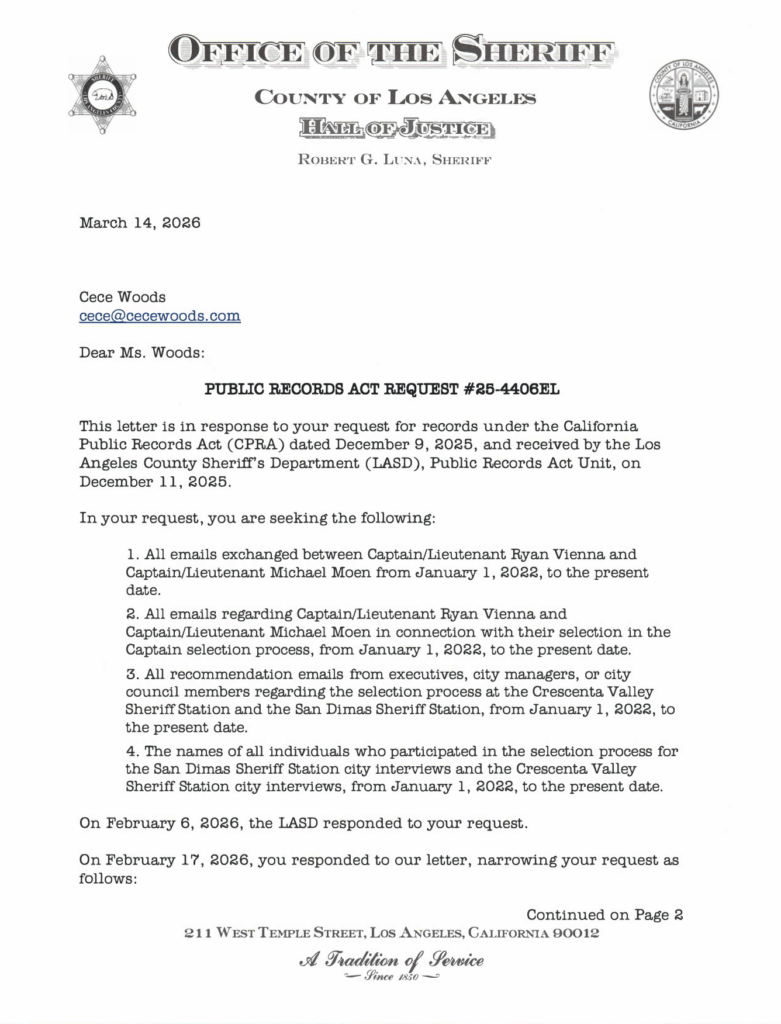
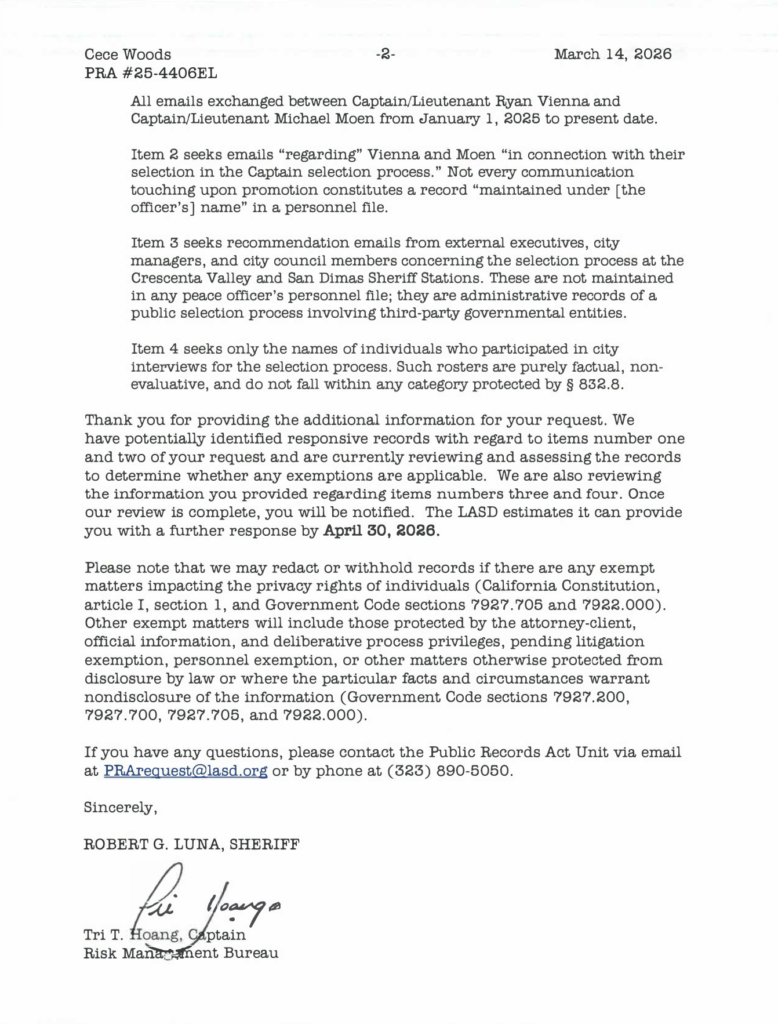
Editor’s Note: A formal complaint has been filed with the Office of Inspector General regarding these promotions. Whether Sheriff Luna’s administration chooses to investigate the allegations or allow the matter to fade into silence remains to be seen.