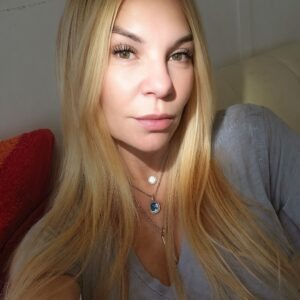
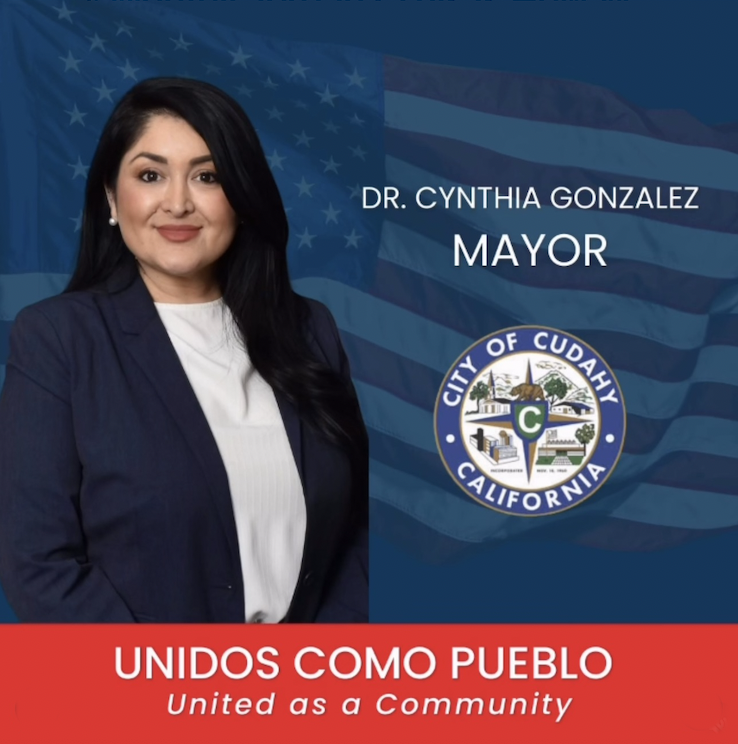
Cudahy has always been a city that promises reform while quietly breeding the next scandal. Now, the small 1.2-square-mile city in Southeast Los Angeles, one of the densest in California and home to roughly 23,000 residents, has thrust itself back into national controversy. Not because it finally cleaned up its chronic corruption. Not because accountability triumphed. But because a sitting vice mayor, now elevated to mayor despite being under federal investigation earlier this year, filmed herself calling on violent criminal street gangs to “defend” their territory against federal immigration agents.
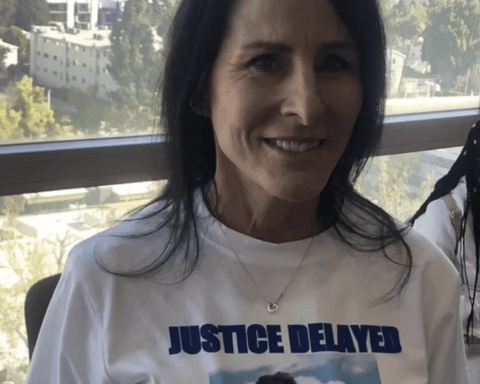
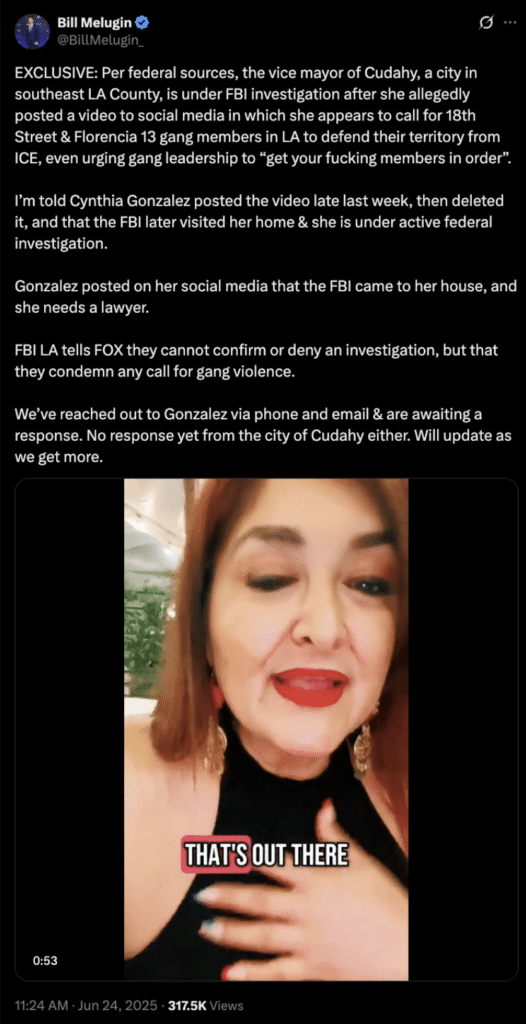
Cynthia Gonzalez didn’t just complain about ICE activity. She went far further, and far darker, directly taunting two of the most notoriously violent gangs in Los Angeles, 18th Street and Florencia 13, to mobilize and “get your f***ing members in order.”
These are not political mascots or rhetorical symbols. These are criminal syndicates with decades-long histories of murder, extortion, narcotics trafficking, and targeted violence against law enforcement, including the killings of LAPD Officer Filberto Cuesta in 1998 and Officer Fernando Arroyos in 2022. Yet Gonzalez chose to speak to them as if they were neighborhood defenders being lazy on the job.
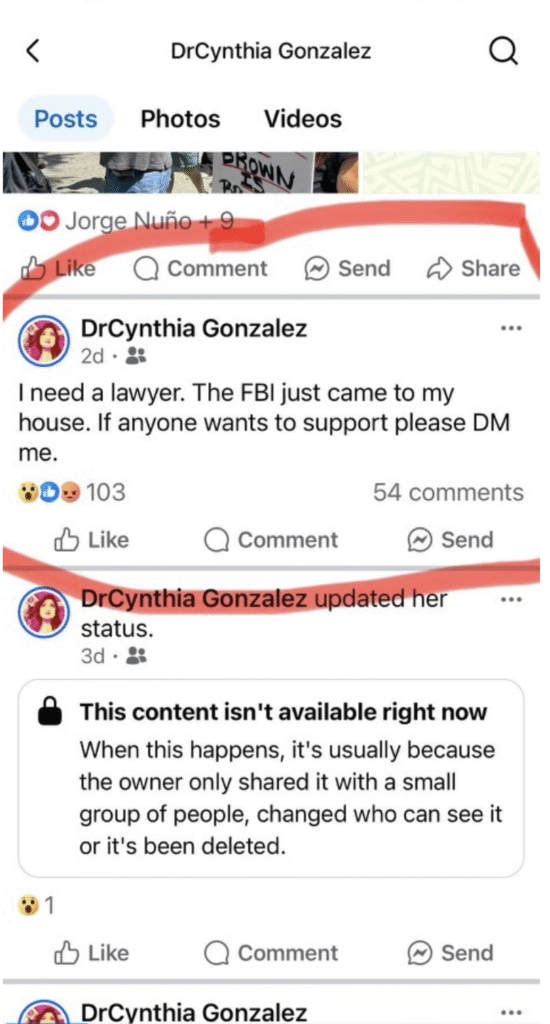
The video went viral on social media when Fox News reporter Bill Melugin shared the video on his X account prompting federal authorities to open an investigation. Gonzalez herself acknowledged agents arrived at her home, posting that she needed a lawyer before quickly scrubbing her accounts, deleting posts, reframing her words as satire, and recasting herself as misunderstood rather than dangerously irresponsible. But the damage, to credibility, public trust, and political integrity, had already been done.
What makes this more than a viral moment is the truth it exposes: Cynthia Gonzalez didn’t rise to this level of power in spite of Cudahy’s past, she rose because Cudahy has never truly broken free from it. This city hasn’t healed from its culture of corruption. It simply repackaged it.
A City Defined by Scandal Long Before Cynthia Gonzalez Ever Arrived
To understand why Gonzalez could speak the way she did and still wind up leading the city, you have to look at the decades-long political rot that shaped the environment she stepped into. Cudahy’s size has never matched the magnitude of its corruption, and long before Gonzalez recorded herself calling on gangs, the federal government had already classified Cudahy as a civic cautionary tale.
In the early 2010s, federal agents dismantled a brazen pay-to-play extortion racket operating from inside City Hall. Former Mayor David Silva and Councilman Osvaldo Conde weren’t simply ethically compromised public officials; they were acting like criminals wearing government titles, openly accepting envelopes of cash from a businessman trying to open a marijuana dispensary. Conde’s attempt to avoid facing consequences spiraled into a five-hour armed standoff with authorities. Silva ended up in federal prison in 2013. And those cases were not isolated embarrassments, they were symptoms of a deeper institutional rot.
A year later, the California State Controller’s Office quantified the crisis in blunt financial form, ordering Cudahy to repay an astounding $22.7 million in misused and mishandled public funds, confirming that abuse wasn’t incidental or administrative, it was systemic. FBI affidavits revealed city officials shaking down vendors, manipulating elections, whispering about illegal dealings on tape, and at one point casually eating fast food while essentially negotiating corruption, the image of officials so comfortable with wrongdoing that they treated it like routine business.
Residents, weary of the endless misconduct, pushed back. In 2015 they overwhelmingly passed Measure A, imposing strict term limits to break the death grip of entrenched power figures. The election of 29-year-old reformer Cristian Markovich symbolized hope and hinted that perhaps Cudahy was ready to rebuild trust, restore governance, and finally shut the door on political abuse.
But political cultures don’t transform because a ballot measure passes or because a new face takes the microphone. In Southeast L.A., where power networks are deeply intertwined and local politics operate in tightly controlled circles, old behavior rarely disappears, it merely shifts, disguises itself as progress, and eventually resurfaces.
Cynthia Gonzalez: The Polished “Reform” Candidate Who Became the Crisis
Into that context stepped Cynthia Gonzalez, Ed.D., packaged as the polished, educated, community-aligned reform figure who could represent the city’s evolution rather than its past. Born in nearby Huntington Park, a graduate of Bell High School, already successful in education and holding a doctorate, she was exactly the kind of leader Cudahy officials loved to market, emblematic of upward mobility and civic responsibility in a city that is more than 95% Latino.
Her 2022 campaign leaned hard into empowerment, immigrant protection, and community strength, themes deeply resonant in a population where mixed-status families, fear of enforcement, and distrust of government have been lived realities for generations. Voters backed her. She was elected. By 2024, she rotated into the vice mayor position, a ceremonial title that nonetheless carries symbolic and rhetorical authority.
She entered office with clean optics but into a city that had never truly shaken off its history of ugly politics, intimidation tactics, ideological posturing, and quiet backroom alliances. And eventually, the façade cracked.
The Video That Erased Any Illusion of Responsible Leadership
In June 2025, amid reports of ICE operations in Southeast Los Angeles, a moment calling for measured leadership, clear communication, and respect for public safety, Gonzalez chose spectacle over responsibility. Instead of calming her community or directing them toward legal resources, she recorded herself, not to constituents, but to gangs.
“You guys are all about territory. This is 18th Street. This is Florencia… and now that your hood is being invaded by the biggest gang there is, there isn’t a peep out of you,” she said, before escalating further, warning that they shouldn’t claim turf “if you’re not showing up right now” and ordering that gang “leadership” get their members “in order.”
There is no thoughtful interpretation that turns that into civic engagement. No academic reframing softens it. She didn’t invoke community activism. She invoked criminal organizations.
She deleted the video. She deleted the Facebook posts discussing the FBI visit. But she couldn’t delete the legal and political reality.
Holding the Blue Line
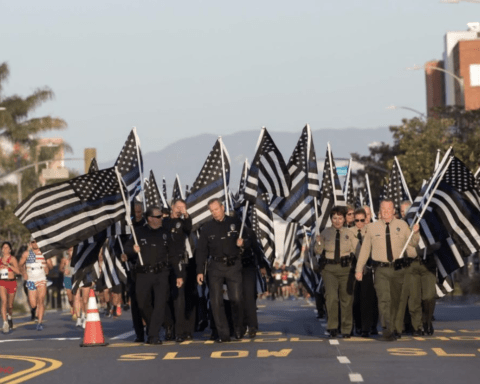
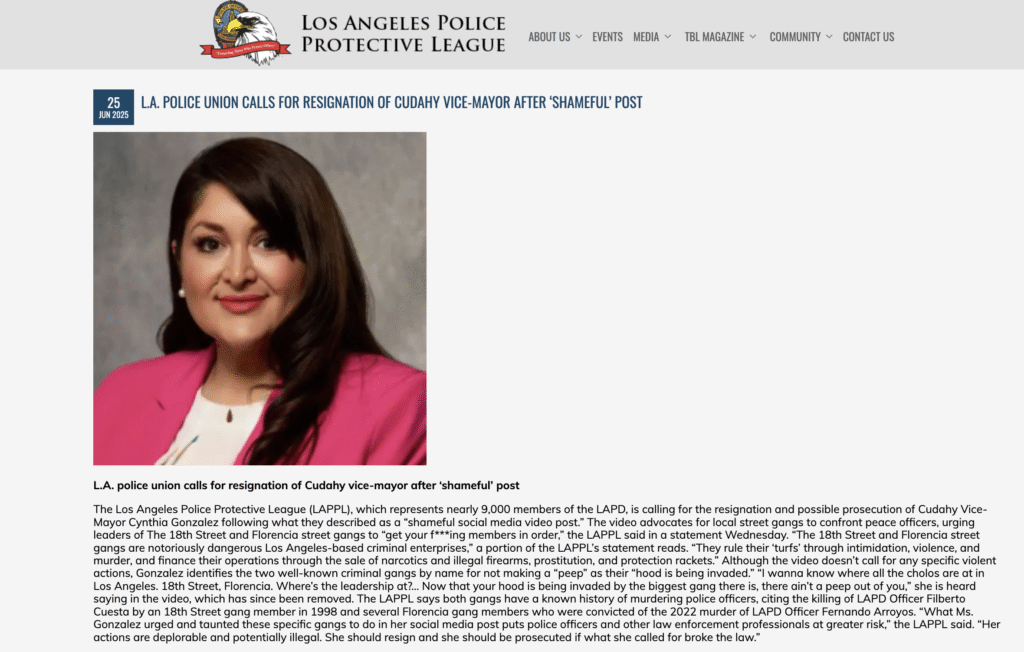
The Los Angeles Police Protective League demanded Gonzalez’s resignation and urged prosecutors to consider charges, pointing out that the gangs she invoked were responsible for real bloodshed, including the murders of LAPD Officers Filberto Cuesta and Fernando Arroyos. These were not abstract references. These were living, violent entities with lethal histories.
DHS leadership condemned the remarks, with Secretary Kristi Noem describing them as “despicable,” while also citing reports showing a staggering 500% increase in attacks on ICE officers, asserting that rhetoric like Gonzalez’s isn’t harmless, it fuels hostility and violence.
Even personal allies stepped back. Huntington Park Mayor Arturo Flores, a close friend of Gonzalez, acknowledged that elected officials must understand the gravity of their words and that her comments crossed a line.
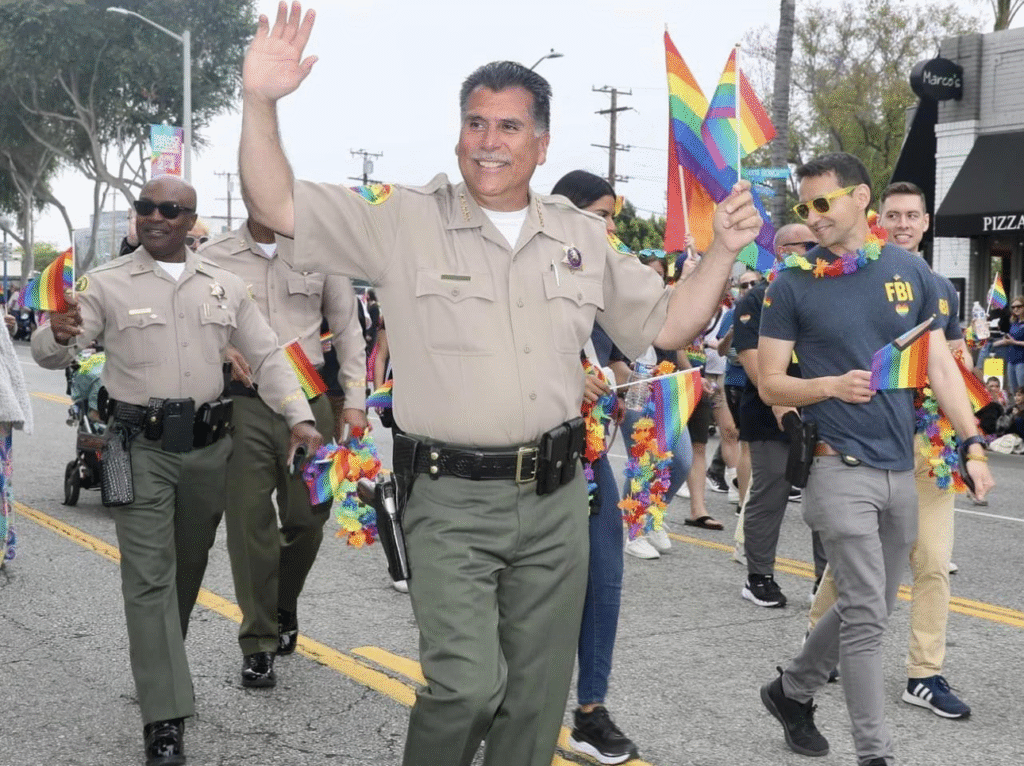
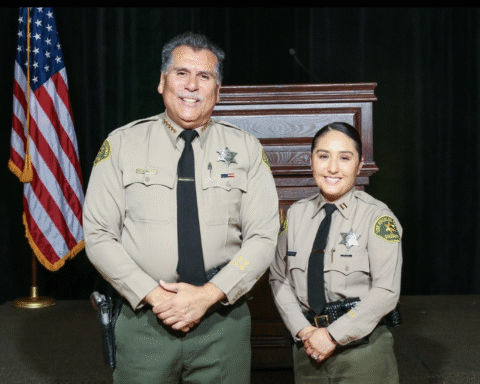
However, neither Los Angeles County Sheriff Robert Luna, whose deputies patrol Cudahy, nor the Association for Los Angeles Deputy Sheriffs (ALADS) issued a statement condemning the remarks. Their silence is striking, not only because this rhetoric directly endangers law enforcement, including their own LASD personnel, but because it sends a chilling message that even the most blatant incitement will be ignored for the sake of a politically correct narrative.
Public reaction didn’t just mirror the outrage, it amplified it. Social media users openly questioned whether Gonzalez was intoxicated when she recorded the video, mocked the irony of a highly credentialed academic behaving like an internet provocateur, and bluntly branded her as the councilwoman who “told cholos to fight ICE.” The internet documented everything. Screenshots circulated. Receipts were preserved. And while the public reacted with justified alarm, City Hall did what Cudahy leadership has perfected over decades, it simply pretended the moment, and its implications, didn’t exist.
Cudahy’s official response was exactly what anyone familiar with its history would expect: a sterile press statement labeling her comments “personal opinions,” distancing the city while steadfastly refusing to hold her accountable.
Six Months Later – Accountability Disappears and Gonzalez Gets Promoted
Six months passed without meaningful public updates on the FBI investigation, without any serious council conversation about consequences, and without any sign that the city was willing to confront the gravity of what transpired. Instead, in a decision so on-brand for Cudahy’s political DNA it almost defies parody, the council selected Cynthia Gonzalez as Mayor during its December 16, 2025 reorganization meeting. Daisy Lomeli was named vice mayor, and councilmembers Elizabeth Alcantar, Martin U. Fuentes, and Amanda Gomez remained firmly in place.
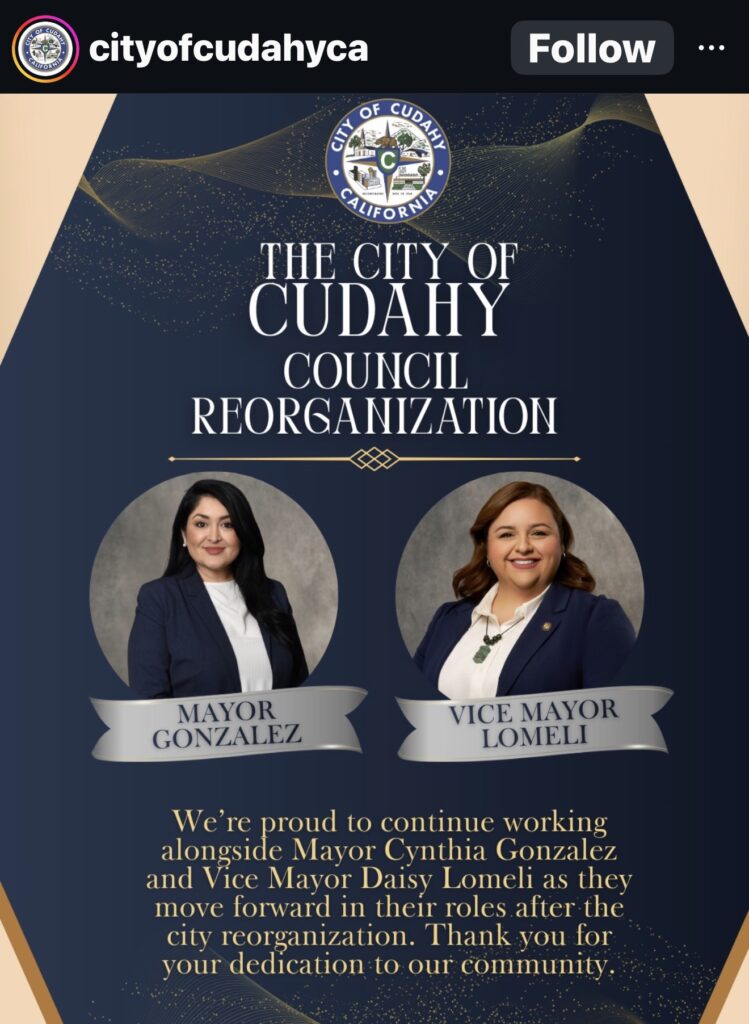
The city posted celebratory graphics and cheerful messaging about “continued leadership,” as if the last year never happened. Gonzalez posted a polished Instagram announcement thanking the community, promising leadership heading into 2026 under the slogan UNIDOS COMO PUEBLO, United as a Community, a line that reads more like a script than a sentiment in light of the divisiveness she created.
Residents did not forget. Screenshots resurfaced. Memory resurfaced. Skepticism resurfaced. The question wasn’t whether the controversy happened. It was why the city behaved as if it didn’t matter.
This Isn’t About Politics – It’s About Whether Cudahy Ever Learned Anything
No serious observer is debating whether Cynthia Gonzalez’s words were reckless. The issue now is the system that refused to hold her accountable and instead rewarded her. Did political alliances overshadow integrity? Did ideological loyalty matter more than safety? Did the investigation stall into silence because it was inconvenient? Or did Cudahy simply do what Cudahy has always done – wait out outrage and hope people move on?
The continuity is impossible to ignore. Cudahy’s historic corruption didn’t just destroy trust; it hard-wired a governing instinct to protect insiders, minimize scandal, and choose self-preservation over ethical leadership. That instinct is alive and well.
As Gonzalez now leads the city into 2026, Cudahy finds itself not in a redemption arc, but in another chapter of the same long, exhausting story: a city that keeps proving it hasn’t truly learned from its past and continues to elevate officials whose words and actions undermine credibility, safety, and public trust.
Cudahy didn’t escape its legacy. It embraced it again.