While Los Angeles County leaders continue to speak publicly about reform, transparency, and restoring trust, a far more consequential decision unfolded quietly this week, without press releases, explanation, or public scrutiny.
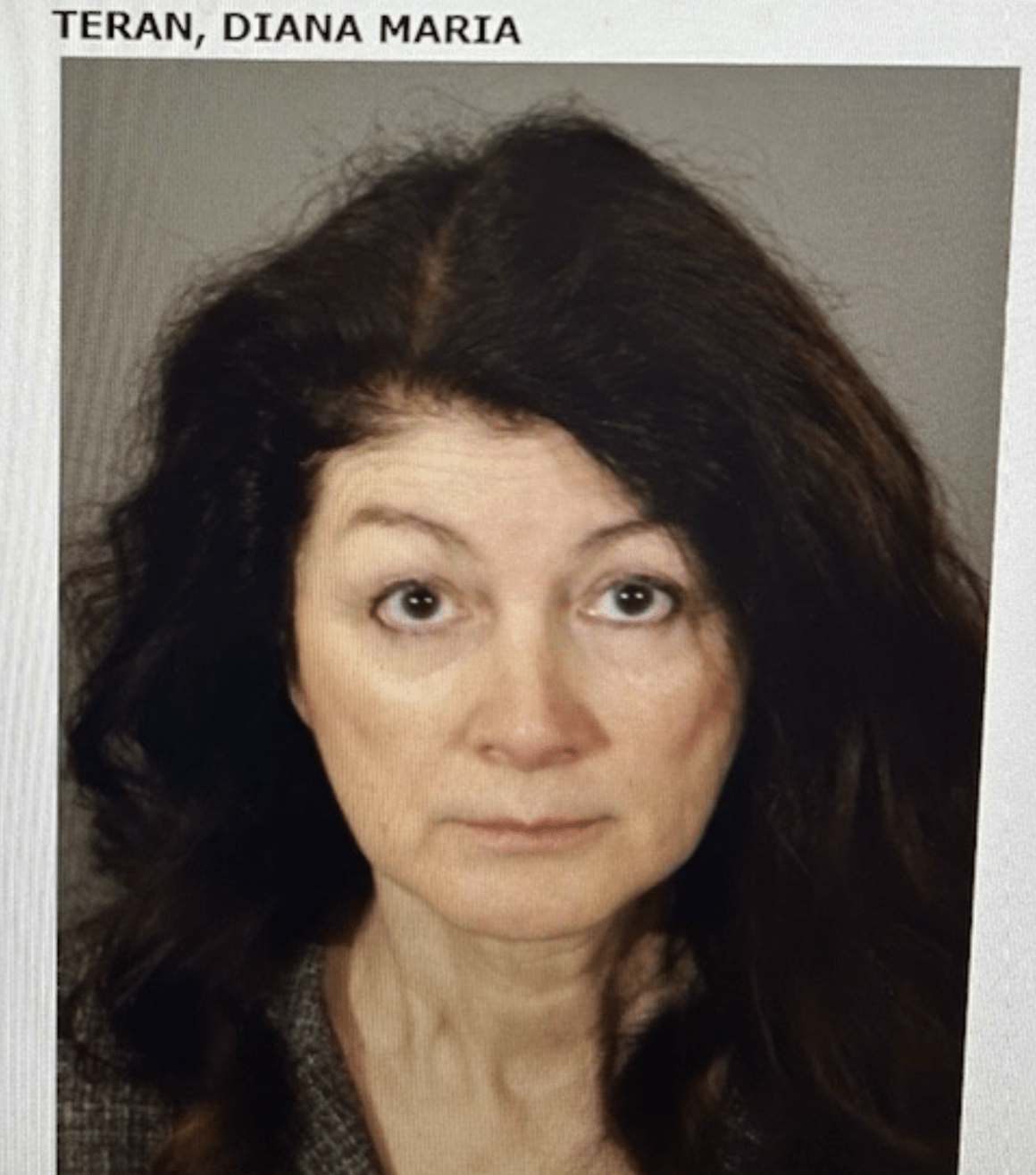
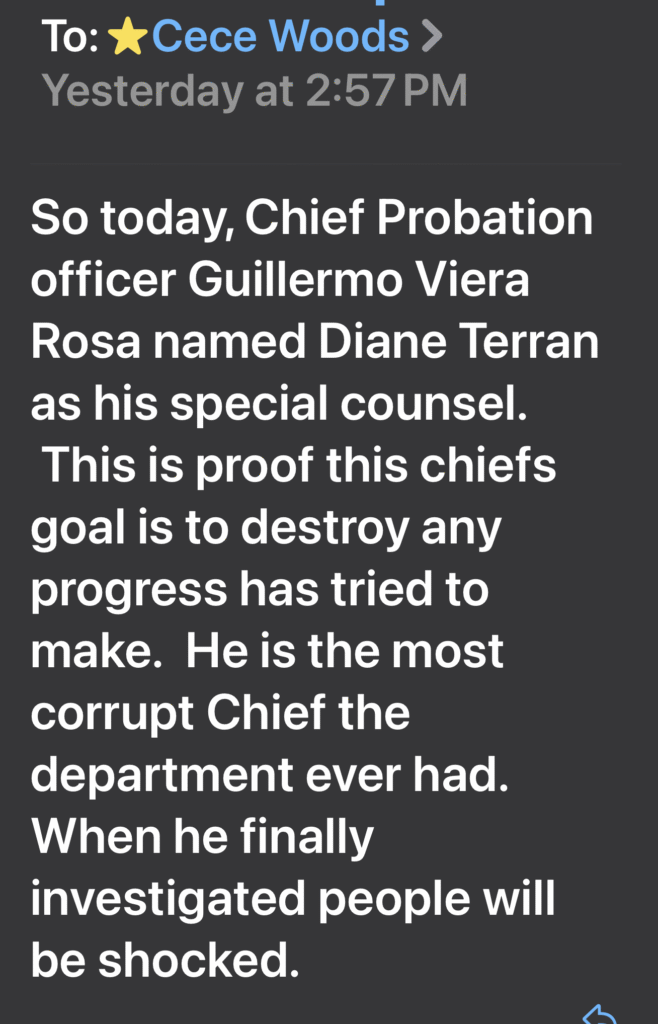
An internal message now circulating confirms that Chief Probation Officer Guillermo Viera Rosa has named Diana Teran as his special counsel. The reaction inside the department was immediate and visceral. The message did not read like routine personnel news. It read like an alarm. To many inside County government, the appointment was not a step forward, but a warning sign that whatever progress Probation had attempted to make was being deliberately reversed.
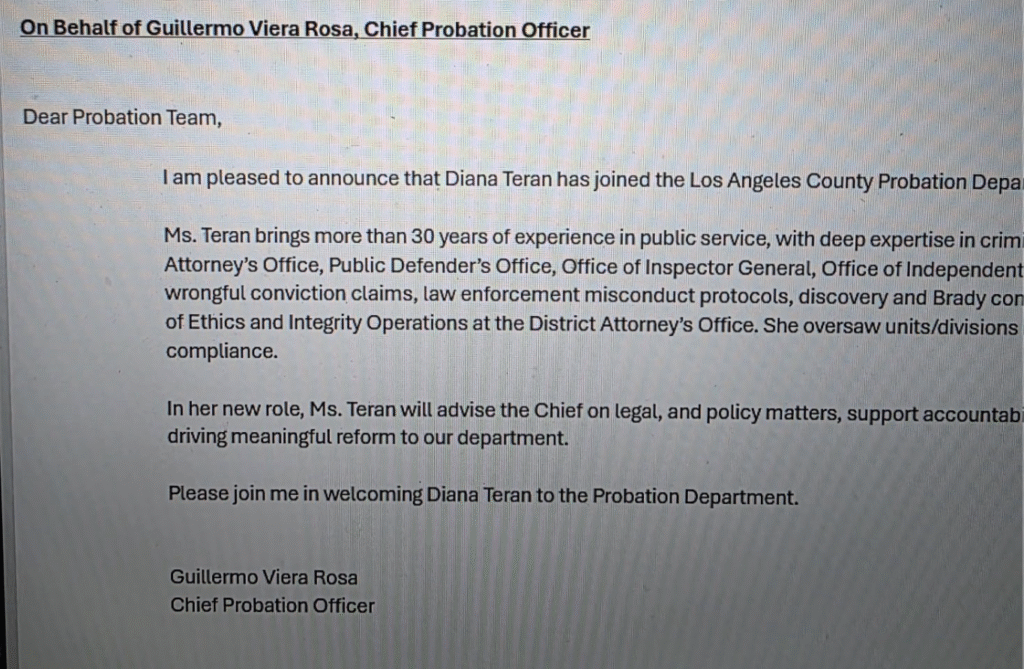
Diana Teran’s return to County power is not benign, and it is not incidental.
In LA County, where the scales of justice have long tipped under the weight of politics and personal vendettas, Teran once rose to become a formidable figure inside the District Attorney’s Office. A former senior figure tied closely to the Sheriff’s Department, she built her reputation on relentless internal accountability campaigns, launching investigations against deputies facing criminal allegations with surgical precision. “No one is above the law” was not just rhetoric, it was policy. Even whispers of misconduct triggered full internal probes, suspensions, and careers permanently derailed. Teran knew the playbook intimately. Standard procedure demanded internal review the moment charges surfaced, to contain institutional rot before it spread.
Then the tables turned.
Teran herself was charged with 11 felony counts, accused of unlawfully accessing and using confidential law-enforcement databases tied to her time working with sheriff’s department records. And suddenly, the system she once enforced so aggressively went silent. No internal investigation. No ethics committee. No quiet audit of her prior cases or decisions. The protocols she had wielded against others simply evaporated.
The silence only fueled speculation, courthouse whispers tracing a familiar pattern of favoritism and quiet institutional shielding.
Despite the indictment, Teran did not vanish from County employment. As The Current Report previously reported, it was widely rumored, and later corroborated by multiple sources, that she remained employed by the District Attorney’s Office even after charges were filed, suspended, but still drawing a paycheck. The irony was not lost on those who had watched deputies lose careers for far less. Teran, who had demanded transparency and swift consequences for others, now benefited from the leniency she had long denied.
The criminal case dragged on through procedural twists and appeals, fueling public skepticism about whether justice in Los Angeles is blind or merely selective. That chapter formally closed on June 26, 2025, when a California appeals court issued a published ruling dismissing the remaining charges against Teran. The decision did not vindicate her conduct or dispute that she accessed sensitive law-enforcement information. Instead, it rested on statutory interpretation and prosecutorial authority, concluding the laws invoked could not sustain criminal liability under the circumstances. The prosecution ended without a trial, leaving unanswered questions about judgment, ethics, and institutional accountability.
Those questions now loom larger than ever.
Rather than stepping away from public authority, Teran has resurfaced inside one of the County’s most powerful and sensitive agencies. Sources confirm that her Probation Department email account was active as of mid-September, weeks before her appointment quietly became public. This was not a last-minute hire. It was a calculated reintegration.
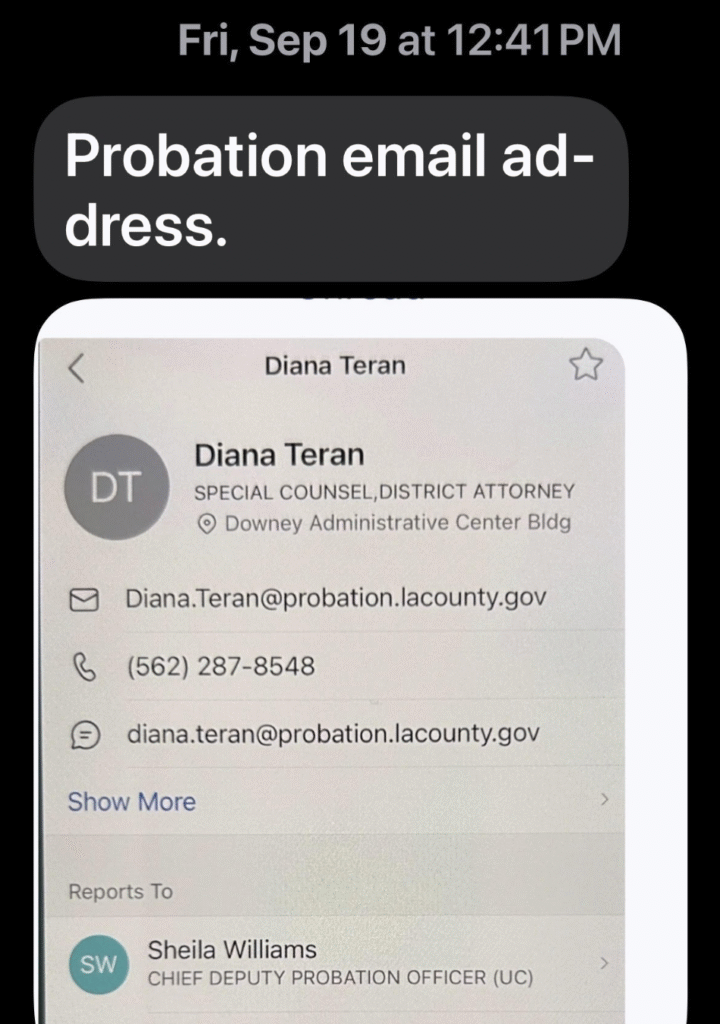
Probation is not symbolic. It controls liberty, rehabilitation pathways, youth custody decisions, and court outcomes. Installing a politically connected former prosecutor with a deeply controversial history into a senior advisory role is not reform. It is consolidation.
For those who followed Teran’s role in the coordinated takedown of former Sheriff Alex Villanueva, the move fits a familiar pattern. Prosecutorial narratives, manufactured scandals, and politically timed allegations bled into an election cycle and reshaped County power. From the deputy gang panic to the knee scandal that later collapsed under scrutiny, Teran operated at the intersection of prosecution, politics, and message control.
That history makes her placement inside Probation especially troubling.
The emails circulating this week captured what official statements would not. It reflected disbelief and fear inside the department that Chief Guillermo Viera Rosa’s leadership is steering Probation toward deeper politicization. According to insiders, morale is slipping and trust continues to erode.
County officials will likely point to the appellate ruling and declare the matter closed. They will frame the appointment as routine. They will cite procedure and move on. But the record tells a different story, one of institutional protection, quiet reassignment, and a refusal to confront how power actually functions inside Los Angeles County.
Diana Teran’s trajectory has become a cautionary tale written into the County’s underbelly. Not because of one case, but because it exposed a system where accountability is selectively enforced and power reliably protects its own, even when the person at the center knows better than anyone how the game is supposed to be played.
In Los Angeles County, accountability is always promised later. Power, however, is always reassigned immediately.
That erosion of trust does not exist in a vacuum. It sits squarely on the shoulders of the Los Angeles County Board of Supervisors, whose track record on Probation has been defined less by oversight than by a series of deeply consequential misjudgments. Time and again, the Board has elevated figures whose records raised red flags, only to retreat into silence once the fallout became unavoidable.
The appointment of Eric Strong remains a glaring example. Installed into a senior probation leadership role despite mounting concerns, Strong later became entangled in a federal civil rights lawsuit seeking $10 million in damages, a case alleging serious misconduct tied to abuse of authority. As The Current Report documented, Strong repeatedly dodged service of process, an extraordinary act for a high-ranking county official entrusted with overseeing justice-involved populations. Rather than demand accountability or transparency, the County allowed the situation to linger, reinforcing the perception that Probation leadership operates under a different set of rules.
Against that backdrop, Diana Teran’s quiet installation as special counsel does not read as an isolated decision. It reads as part of a pattern. A Board that has repeatedly failed to course-correct Probation now presides over yet another appointment that raises fundamental questions about judgment, governance, and whether lessons were ever learned. The same institution that claimed reform after scandal has continued to recycle controversy, protecting insiders while Probation itself absorbs the damage.
When County leaders insist these moves are routine, the record says otherwise. The throughline is unmistakable: questionable appointments, delayed accountability, and a governing body that responds to crisis only after exposure, never before. Teran’s return did not happen despite that history. It happened because of it.