


Los Angeles loves a shiny narrative. We are the global capital of reinvention, the city that can host the world, solve anything with a branding campaign, and produce an inspirational montage out of literal dysfunction. But behind the official messaging and carefully staged press conferences, LAPD is bracing for something far less cinematic and far more humiliating: a staffing and financial collapse that is already reshaping day-to-day policing.
Because while the city is busy polishing its Olympic halo, the department is quietly being managed like a business in pre-bankruptcy triage. This is no longer a “staffing challenge” or a “budget adjustment.” It is a historic crisis. A slow-motion breakdown that can’t be fixed with slogans, task forces, or another round of “community engagement.”
And the numbers now being discussed internally should stop every resident in their tracks.

LAPD is sitting two and a half years out from the Olympics and has already fallen off a cliff. The department is down more than 1,500 sworn officers. It is down more than 500 civilian professional staff. And even with that freefall, they are only authorized today for roughly 240 hires through the fiscal year ending June 2026, while still projected to lose 750 or more officers in that same time frame. That is not a staffing gap. That is an arterial bleed.
This is why insiders are using the phrase no city leader dares to say publicly: LAPD is bleeding out.
And it’s happening at the exact moment Los Angeles is trying to sell itself to the world as a safe, stable, global host city ready for prime time.
The warning coming through the ranks is blunt: cash overtime is projected to dry up in the next six weeks. Not tighten. Not reduce. Dry up. After that, the only overtime expected to remain is tied largely to MTA-funded assignments, meaning the ability to staff beyond bare minimum becomes dependent on transit dollars rather than public safety needs.
Overtime isn’t just extra pay in modern policing. It’s the glue holding a shrinking workforce together. It’s the pressure valve that keeps patrol coverage from snapping when staffing falls below operational reality. When overtime disappears, the city doesn’t just lose money. It loses capacity. It loses speed. It loses margin. And margin is the only thing separating “messy” from catastrophic.
Predictably, divisions are already restricting overtime and monitoring who is allowed to earn it. The ripple effects are not theoretical. They are showing up in the places the public never thinks about until it matters. Reports get held. Property booking gets delayed. Basic case work slows down. The city doesn’t announce a policing slowdown. It engineers one. It quietly starves the department of overtime and lets reality do the dirty work.

But this overtime cliff isn’t occurring in a vacuum. It’s landing on a department already collapsing under the weight of long-term staffing erosion. LAPD’s decline is being driven by the kind of dysfunction that can’t be solved with recruitment posters and a PR campaign.
Recruitment has slowed dramatically. The applicant pool has shrunk. Attrition has accelerated. Officers are leaving faster than they can be replaced, and the reasons are not mysterious. They are structural, cultural, political, and economic.
The emotional toll of policing in Los Angeles has become unbearable for many. Civil unrest didn’t just strain the department, it redefined it. Officers have operated for years in a pressure-cooker environment where scrutiny is relentless, every encounter is potentially career-ending, and leadership too often feels more concerned with optics than defense of the people doing the job. Add the city’s progressive political elite, who have spent years flirting with anti-law enforcement rhetoric as if it were a fashionable identity, and the result is predictable: morale collapses.

That morale problem is not conjecture. It has been openly acknowledged by former command staff who lived it. Former LAPD Assistant Chief Al Labrada put it plainly: “New growth requires new soil. It is essential to dismantle and update outdated policies and move beyond past leadership mistakes to restore the morale of our frontline. If our own people wouldn’t recruit for us, it indicates that we have not yet addressed the underlying issues.” In one quote, Labrada exposes the uncomfortable truth: the recruitment crisis is not simply external. It’s internal. When a department’s own people don’t encourage others to join, the problem isn’t the applicants. The problem is the institution.
At the same time, Los Angeles is one of the most expensive places in America to live, and the math is no longer working. Officers can stay in LA, absorb the chaos, pay the premium, and get treated like a villain. Or they can lateral out to smaller agencies, earn comparable pay or better, buy a home, and work in communities that don’t treat them like a political punching bag. LAPD is no longer the dream agency. In many cases, it’s the agency people leave.
Then there is the department’s own internal self-sabotage. Hiring is notoriously slow. The process drags. Applicants lose momentum. Background timelines become absurd. People move on. And when the city holds candidates in limbo without enough academy classes to bring them in, you don’t just slow recruitment. You kill it.
Because the longer recruits sit in the pipeline waiting for a class, the more likely they are to drop out, have second thoughts, accept another offer, or simply time out. Some of their test components expire. Their lives change. Their patience runs out. And that is not hypothetical. It is baked into the reality of Los Angeles City personnel, which insiders describe as one of the slowest hiring processes in the system, averaging nine to twelve months for an entry-level recruit.
A year. Just to get in the door.
That’s not recruitment. It’s bureaucratic birth control.
Now, here’s where the optics machine kicks in.
LAPD currently has six academy classes running, averaging about thirty recruits per class. The January class reportedly started with thirty-four. That sounds healthy on paper, until you realize the department is losing hundreds of experienced personnel annually and is two and a half years away from the largest international event Los Angeles will host in modern history. Thirty-person classes are a drip feed. They are not a solution.
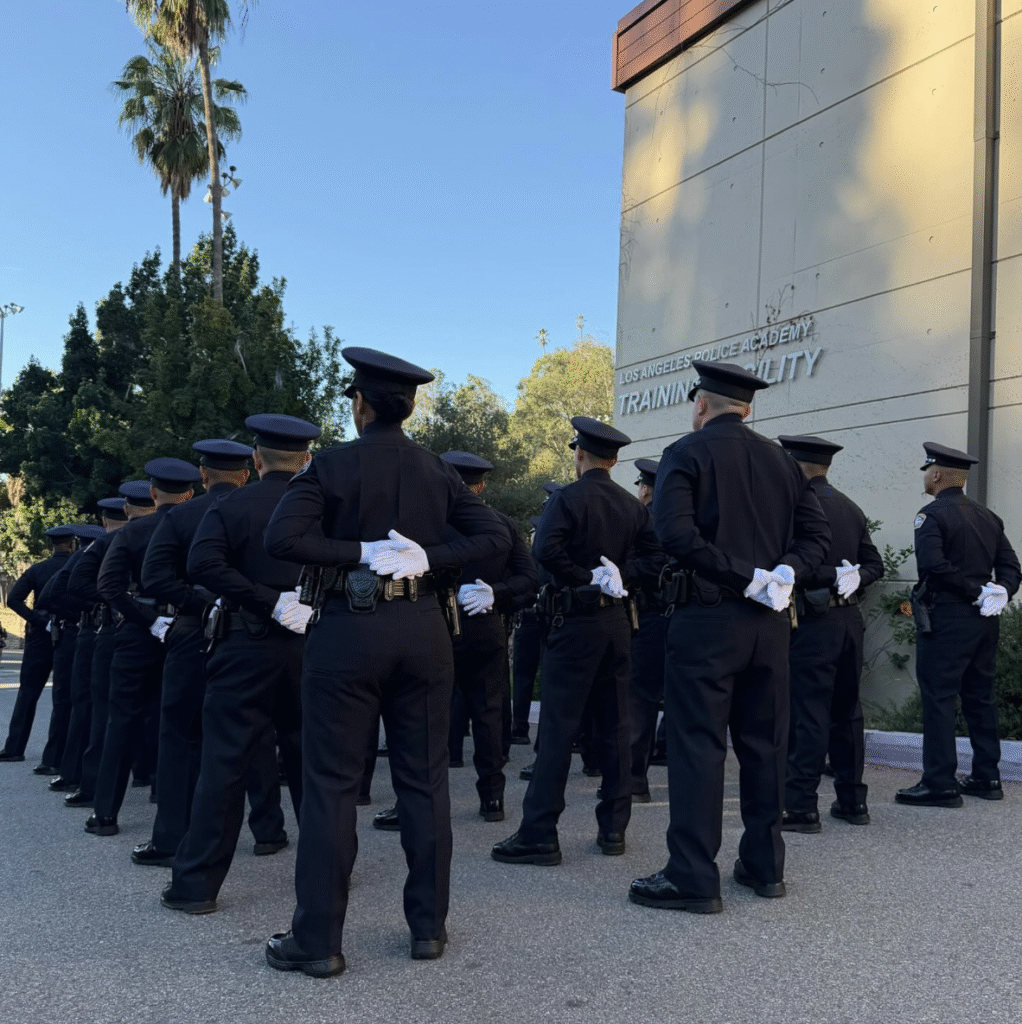
And with a recent City Council vote, LAPD is now on track for only two new academy classes this fiscal year. Two. That’s not a staffing plan. That’s a press release with a pulse. It is the bare minimum required to say “we’re hiring” while the department’s actual manpower continues to collapse.
If LAPD wants additional classes beyond that, it will have to go back to City Council and request additional funding. In other words, the city is rationing academy classes the way you ration supplies in a failing hospital, then acting confused when the patient flatlines.
And while the city stalls, the private sector is already moving in. This is the part no one in government wants discussed because it’s a quiet admission of failure: because of the staffing shortage, cities are increasingly turning to private security companies to fill gaps LAPD can’t. That’s what happens when a department loses critical mass. Public safety becomes outsourced, uneven, and dependent on who can pay. Residents get police “lite,” while institutions, businesses, and municipalities start buying their own backup plan.
That is not law enforcement. That is societal triage.
As if that weren’t enough, the financial squeeze is now spreading into every corner of the department.
Subpoena control officers and detectives are now being instructed to coordinate with DAs to determine which officers are truly needed for court appearances, with the goal of eliminating overtime exposure. That means limiting subpoenas for transporting officers. That means not automatically calling both officers involved in searches. It turns court staffing into a cost-cutting negotiation.
This is what it looks like when a city starts rationing justice.
Inside the department, restructuring is no longer being discussed like an option. It’s being discussed like a coming reality. Divisions may be forced to merge investigative tables, combining units like MAC/CAPs and folding Autos and Burg into broader “Property Crimes.” Officially, this will be described as efficiency. In reality, it is financial triage. It is elimination of table head payroll. It is reducing supervisory capacity and loading more work onto fewer people.
Even more explosive is the discussion of consolidating divisions entirely, with combinations like Wilshire and Olympic, Mission and Devonshire reportedly being floated. Leadership wants to avoid it, not necessarily because it’s operationally disastrous, but because of how it would look ahead of the Olympics.
Again, not because communities will feel it. Not because response times will suffer. Because it looks bad.
That tells you everything about the city’s priorities.
This is a city preparing a global spotlight moment while its police department is disintegrating behind the curtain.
And let’s be clear: this disintegration will not stay invisible much longer.
When staffing drops low enough, you don’t just get “slower response times.” You get unfilled patrol cars. You get fewer proactive units. You get investigations shelved. You get follow-ups dropped. You get entire categories of calls treated like background noise. You get a city where public safety becomes situational and unequal.
Insiders now believe LAPD will be in the 7,000s in the not-so-distant future. No question. And at that point, the department is no longer struggling. It is failing.
That is what “bleeding out” looks like.
Los Angeles can either confront this truth now or continue to hide behind Olympic branding and political spin until the collapse becomes too obvious to ignore. But the math isn’t going to change because City Hall doesn’t like it.
Two and a half years out from the Olympics, LAPD is down more than 1,500 officers, down more than 500 civilian staff, facing a projected loss of 750 more, and authorized to hire only a fraction of what is needed. Overtime is drying up. Promotion pipelines are freezing. Hiring is glacial. And the city’s plan appears to be hope, optics, and rationed academy classes.
The department is going to tank. There is no question about that.
And when it does, Los Angeles won’t just be unprepared for the Olympics. It will be unprepared for itself.
Follow Us