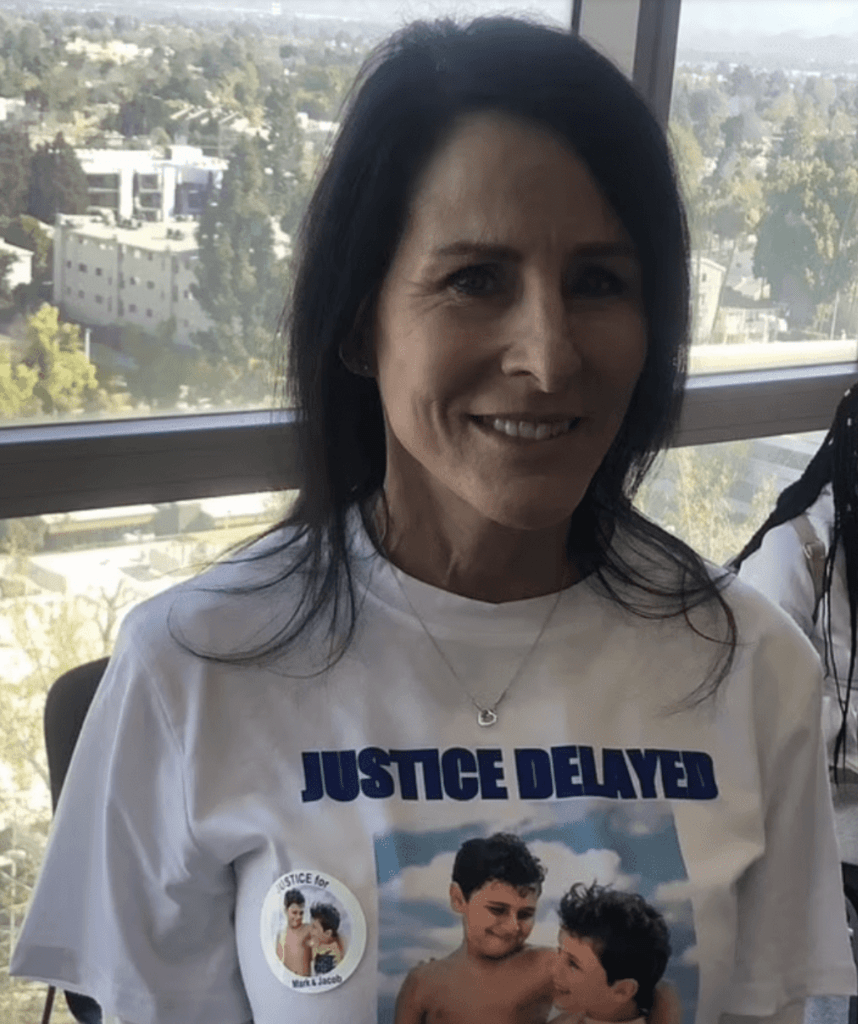

In September 2022, a team of Los Angeles County Sheriff’s Department deputies from the Public Corruption Unit executed search warrants at Supervisor Sheila Kuehl’s private residence, the home of her close ally Patti Giggans (CEO of Peace Over Violence and a sitting member of the Sheriff’s Civilian Oversight Commission), and LA Metro headquarters.
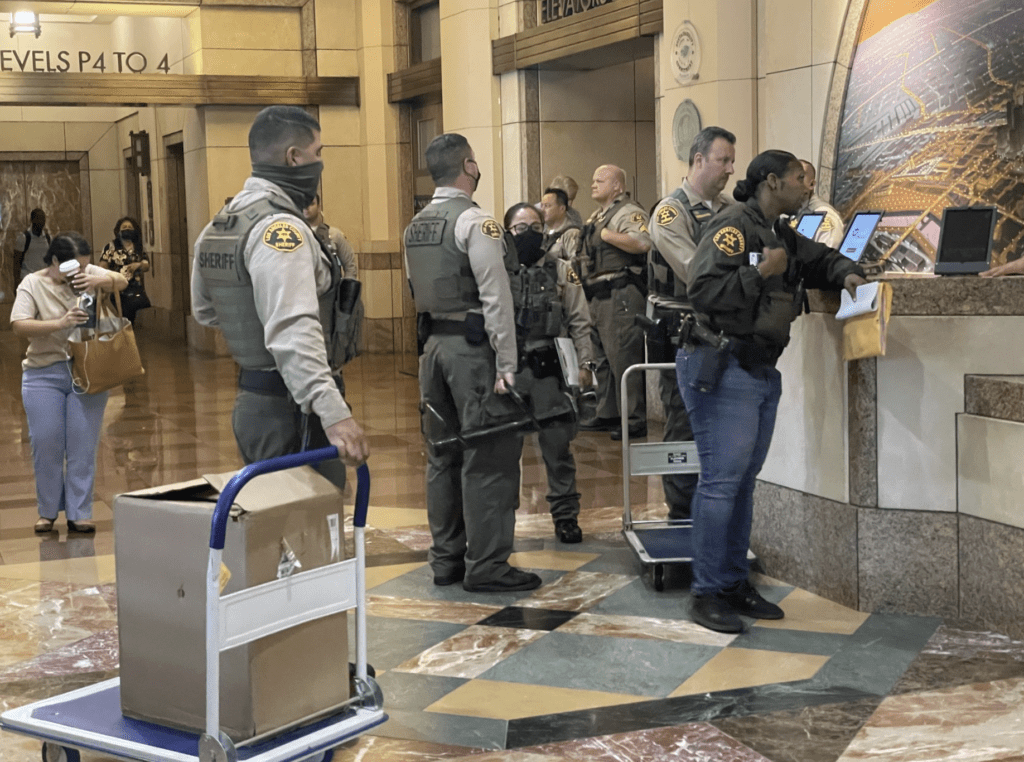
They seized computers, servers, vehicles, documents, and evidence tied to no-bid county contracts for a jail sexual-harassment hotline and PREA compliance program. Sheriff Alex Villanueva had publicly labeled the Board of Supervisors a “criminal enterprise” in letters to the FBI, pointing to secret settlements, sweetheart deals, and taxpayer dollars funneled to insiders while homelessness and violence spiraled.
The retaliation was immediate, coordinated, and decisive. The FBI was instructed to stand down on the raid due to “politics”, a timing that appears far from coincidental, as former LA Metro CEO Philip Washington, who was named in the warrant, had just been nominated by President Biden to lead the FAA despite having zero experience in the aviation industry.
The LA County Board of Supervisors screamed “political vendetta.” District Attorney George Gascón refused to cooperate. Then Attorney General Rob Bonta’s Department of Justice stepped in, ordered the LASD to turn over the seized the evidence, and, by August 2024, quietly closed the file citing “insufficient evidence.” Kuehl, the former “reformer,” walked free. The probe into one of the county’s most powerful insiders was dead. This pattern repeated across multiple fronts. Villanueva had also flagged untracked homeless spending and developer deals. Each thread led back to the same network.
This was not an anomaly. It was the state-level kill switch protecting a county-level empire that has operated with impunity for decades under unbroken one-party Democratic rule on the five-member Board of Supervisors. Billions in homeless spending, jail contracts, developer leases, union payoffs, and nonprofit pipelines, all shielded by a captured Fair Political Practices Commission (FPPC), a compliant DA, and an AG whose own family operation mirrors the very self-dealing he was supposed to police. The result: systemic fraud on a generational scale that dwarfs Minnesota’s Feeding Our Future scandal not just in raw dollars but in its entrenchment, protection, and refusal to ever face real accountability. The money trails, raid timelines, donation timestamps, audit failures, federal indictments, and sudden case closures are all documented in the public record, cross-verified through campaign filings, court documents, county audits, and mainstream reporting from the LA Times, LAist, Politico, and KCRA.
The Weingart Center, despite repeated audit failures flagged by LAHSA and the state, secured over $100 million in taxpayer contracts from 2019–2024. In April 2024, using California Homekey funds plus city and federal COVID relief, Weingart purchased a 76-unit senior housing complex in Cheviot Hills for $27.3 million. The seller? A shell entity controlled by developer Steven Taylor, who had bought the same property just four months earlier for $11.2 million with zero improvements. Net markup: $16.1 million. An appraisal conveniently ignored the prior sale price. Weingart omitted the pending transaction in its Homekey application.
Mayor Karen Bass fast-tracked $20 million in city funds anyway. Federal prosecutors are now probing the deal as part of a larger pattern mirroring the Shangri-La scandal (where another contractor received $114 million in Homekey grants, completed only two projects, and saw its CFO indicted for embezzling millions into Birkin bags, private jets, and a $46,000-a-month Beverly Hills mansion). Weingart’s CEO Kevin Murray, a former state senator, was promptly appointed by Bass to the Los Angeles County Affordable Housing Solutions Agency, which oversees billions in Measure A funding. His real-estate lieutenant handled the flip logistics before both were placed on leave amid the probe.

The donation trail is textbook pay-to-play. Weingart executives and affiliated foundations funneled $6,428.45 (and larger bundles through related entities) to Supervisors Holly Mitchell (over $5,500 between 2019–2023, clustered around votes approving $5+ million for Weingart projects and later contract extensions), Hilda Solis, Janice Hahn, and Kathryn Barger. Mitchell’s donations arrived right before she co-authored motions steering millions to Weingart’s Hilda L. Solis Care First Village, despite federal audit failures. Broader county figures show $571 million in CFCI (homeless) allocations since 2021, with $219 million in unspent funds quietly reallocated by 2025 and $2.4 billion in LA County homeless spending largely untracked per independent audits. Statewide the figure exceeds $24 billion with persistently high unsheltered counts until recent modest declines.
What some may call “mismanagement”, is actually a self-reinforcing pipeline where contractors donate, get contracts, sit on oversight boards, and repeat, while the public pays.
LAUSD to LA County: Decades of Abuse, Billions in Liability
And that same pattern, failure to intervene, delayed accountability, and institutions protecting themselves while harm continues, does not stop at the county level. It extends directly into the region’s largest public school system.
Within the Los Angeles Unified School District, documented cases have already shown how administrators failed to report credible allegations of sexual abuse, despite being legally required to do so under California’s mandatory reporting laws. In one case, a student reported abuse by a teacher, yet administrators failed to notify authorities, later resulting in criminal convictions for failure to report. The district ultimately paid a multimillion-dollar settlement to resolve the lawsuit tied to that failure.
The payouts stem from sweeping civil settlements made possible by California’s AB 218 law, which extended the statute of limitations for childhood sexual abuse claims and opened the door to thousands of cases involving alleged abuse in Los Angeles County juvenile halls, probation camps, and foster care systems. The primary settlement totals roughly $4 billion and covers thousands of claimants alleging systemic abuse dating back to the 1950s, with most claims centered in the 1980s through the 2000s, making it one of the largest sexual-abuse settlements ever imposed on a municipality in U.S. history. A second settlement of roughly $828 million covers several hundred additional claims, bringing the county’s total exposure to approximately $4.8 billion or more, with the main portion scheduled to be paid out over five years. Individual awards are not fixed and instead are determined by an independent allocator based on the severity, duration, and lasting impact of the alleged abuse, with reported payouts in the main settlement generally ranging from about $100,000 to $3 million per person, although actual amounts vary widely. Attorneys’ fees are drawn from the overall settlement pool, and some payouts have been delayed as the district attorney investigates potentially fraudulent claims, prompting the county to impose stricter anti-fraud safeguards and place certain claims under additional review.
Paused Payouts, Rising Exposure: Inside LA County’s $4 Billion Settlement Crisis
And while billions continue to move through homelessness and contracting pipelines, Los Angeles County is simultaneously confronting another financial crisis that exposes similar vulnerabilities in oversight and accountability.
In January 2026, Los Angeles County was forced to delay initial payouts on a landmark $4 billion sexual abuse settlement, the largest of its kind involving a public agency, after District Attorney Nathan Hochman raised concerns about potentially fraudulent claims. Court filings show the county moved to deposit approximately $396.4 million into a settlement trust while pausing distributions pending further review. The settlement, made possible by California’s AB 218 lookback window, was later followed by an additional $828 million agreement covering thousands more claims.
Hochman confirmed the investigation is ongoing and may extend beyond claimants to include attorneys, medical providers, and intermediaries involved in assembling the cases. County counsel acknowledged that the structure of AB 218 created exposure to exploitation at “unprecedented dollar amounts.” At the same time, officials warned the financial strain could require borrowing, reduce reserves, and impact core public services as tens of thousands of claims continue to move through the system.
The Hahn Dynasty: Straw Donors, Developer Cash, and a $154 Million Taxpayer Payoff
No family better illustrates the generational capture than the Hahns. Supervisor Janice Hahn, daughter of legendary Supervisor Kenneth Hahn and sister of former Mayor James Hahn, leveraged her seat into a family franchise. Developer Edward P. Roski Jr. and Majestic Realty network funneled more than $80,000 to her campaigns, including $50,000 in 2017 amid pending county lease renewals and $1,500 weeks before a 2019 vote on the Tejon Ranch project. In January 2025 the Board (including Hahn, Solis, and Barger) approved $154 million in no-bid leases to Majestic Realty entities.

Meanwhile, Hahn’s son Mark A. Baucum started in her office in 2017 at $93,000. By 2025 he was Chief of Staff pulling $396,000 in total compensation (pension and benefits included). His wife also holds a county post. Combined household income: over $700,000, all taxpayer-funded. The pattern echoes across the Board: straw donors, developer cash, and county power converted into personal and familial windfalls while the Levine Act’s conflict rules are treated as suggestions.
Placed alongside the shutdown of the Public Corruption Unit probe, the implications are difficult to ignore. In one instance, a politically sensitive corruption investigation is halted and absorbed at the state level. In another, billions in taxpayer liability move through a system now under active fraud review. Both involve enormous public sums, limited transparency at key stages, and oversight mechanisms that activate only after exposure reaches a critical threshold.
Bonta’s House of Cards: The State Shield, Family Business, and Captured Watchdog
Rob Bonta did not act alone, he was the enforcer. While his DOJ buried the Kuehl probe, Bonta’s own campaign diverted nearly $500,000 (precisely $468,000 in one filing) to Wilson Sonsini Goodrich & Rosati for personal legal fees amid a federal bribery probe involving Oakland Mayor Sheng Thao and the Duong family recycling empire. FBI raids hit Duong associates in 2024; Bonta returned $155,000 in linked donations only after the raids. A compromising video was rumored. Bonta insists he is merely a “witness,” but campaign funds cannot legally cover purely personal legal defense.
His wife, Assemblymember Mia Bonta, pulled in over $350,000 from tribal and card-room gaming interests since 2021, including $92,000 in her special election and $101,500 from Pechanga allies in 2023–2024, while Rob’s office oversaw gaming regulation. Rob declined to enforce against Bicycle Casino despite a $100 million suspicious-cash flow (feds fined them $500,000; state did nothing). He later banned daily fantasy sports, a move that benefited heavy tribal donors. The Bonta “first family” extended to Chief of Staff Viviana Becerra, who received a $50,000 campaign payment from Rob’s committee on November 1, 2022, while running the Department of Justice.
The FPPC, California’s supposed watchdog, is structurally captured. Commissioners include Elsa Ortiz (appointed by Bonta, East Bay ally with Oakland real-estate ties near the Duong scandal) and Newsom appointees Adam Silver and Dotson Wilson. Complaints against Bonta’s $468,000 diversion were acknowledged in November 2025; the FPPC immediately requested extensions and has produced no timeline. Historical pattern: trivial fines or endless “reviews” for powerful Democrats.
Links back to the governor’s orbit are direct. Newsom’s inner circle quietly bankrolled legal defense funds for indicted former Chief of Staff Dana Williamson (20+ federal counts for siphoning Becerra campaign money into luxury hotels and family trips). The same network of operatives, from Becerra’s ex-Chief of Staff Sean McCluskie (guilty plea, $225,000 siphoned) to lobbyist Greg Campbell (guilty plea connecting the frauds), shows a Sacramento-to-LA protection racket.
The Coordinated Ouster: Nonprofits, Measure A, and the Smear Machine
Villanueva never stood a chance once he touched the machine. The Board weaponized the Civilian Oversight Commission, budget fights, and a “Check the Sheriff” coalition of over 100 nonprofits and unions, many receiving $8-12 million each in county grants, ARPA funds, and Measure J dollars. These same groups (ACLU-SoCal, Dignity and Power Now, etc.) amplified deputy-misconduct narratives while shielding their own funding streams. Measure A (2022) gave the Board explicit power to remove the elected sheriff. Villanueva became the first LA County sheriff defeated not by scandal but by a political machine he dared investigate.
The moment Sheriff Robert Luna took office, literally within the first week, he disbanded the Public Corruption Unit. Watchdogs vanished. Secret settlements continued. The violence-over-peace irony is stark: Board allies preached “defund” and poured millions into unaccountable nonprofits while street crime and tents exploded, and the insiders kept cashing checks.
Why This Dwarfs Minnesota, and Why One-Party Rule Makes It Permanent
Minnesota’s Feeding Our Future scandal involved roughly $250 million in COVID child-nutrition fraud through fake nonprofits. It produced federal indictments and convictions. It was exposed because competitive political pressure and external oversight forced accountability.
Los Angeles County operates differently. The system is insulated. One-party dominance removes meaningful opposition. Oversight bodies are structurally dependent on the same officials they are supposed to regulate. Investigations can be redirected or shut down. Billions can move before scrutiny arrives.
The same pattern now spans corruption probes, homelessness spending, school system failures, and multibillion-dollar abuse settlements under fraud review.
This is not a broken system. It is a system functioning exactly as designed.
The evidence sits in the TRACER donation database, the closed-session minutes, the federal indictments, the audit reports, the raid affidavits, and the sudden 2024 case closures. The machine endures because no one with real power has been forced to stop it.
Only aggressive federal intervention, FBI task forces, congressional oversight, and independent special prosecutors can break it now. Until then, Los Angeles County’s leaders will continue managing crises after the fact, while the underlying structure that produces them remains firmly in place.