

Despite Sheriff Robert Luna’s repeated public condemnation of deputy gangs, station cliques and the tattoos associated with them, another reported tattooed member of a Los Angeles County Sheriff’s Department station subgroup has been elevated to the rank of captain, this time at the very station associated with the tattoo he is reported to have carried.
Omar Camacho now serves as Acting Captain of LASD’s Norwalk Station, an assignment confirmed by official department records. Multiple department sources tell The Current Report that Camacho carried the Norwalk Station subgroup tattoo: a white skull with blood-red eyes superimposed on a red numeral 4, pierced by a jagged yellow lightning bolt. The number itself is not difficult to decipher. Norwalk was the department’s fourth station, providing the obvious origin of the number 4 incorporated into the design.

The tattoo is also not an obscure piece of LASD history suddenly being raised because Camacho received the assignment. The exact logo was previously documented in a Civilian Oversight Commission memo and independently confirmed by the Los Angeles Times through five sources inside the department. Oversight officials raised concerns about the imagery because of its resemblance to neo-Nazi and white-supremacist symbols and questioned attempts to characterize the design as nothing more than an innocuous “station logo.”
That distinction is particularly important now because Luna has made department-related tattoos a central component of his public campaign to demonstrate that LASD is finally addressing the deputy subgroup culture that has plagued the department for decades. Since taking office, Luna has repeatedly represented his administration as one willing to confront a problem previous administrations were accused of ignoring, minimizing or allowing to flourish.
His own promotion policy was supposed to prove it.
Candidates seeking promotion to captain and above are specifically questioned about department-related tattoos. Luna has addressed the policy under oath in the Benjamin Torres litigation, it has been discussed in communications with the Professional Peace Officers Association during meet-and-confer sessions, and it has become part of his administration’s broader public messaging on deputy gangs and reform. Assistant Sheriff Myron Johnson and other executives have also confirmed under oath that the tattoo question is asked of every candidate seeking promotion into those ranks.
In other words, this is not an informal practice buried somewhere inside the promotional process. Luna has publicly used it as evidence that his administration is serious about preventing deputy subgroup culture from continuing its march through LASD’s command structure.
That makes the decision to elevate Camacho impossible to separate from Luna’s own stated policy.
According to department sources, when Assistant Sheriff Myron Johnson learned of the decision to install Camacho as captain at Norwalk, he objected. Luna overrode that objection and proceeded with the promotion anyway. The question is no longer simply whether Camacho has a tattoo. The question is why the standard Luna has repeatedly held out as evidence of reform apparently did not prevent Camacho from being placed in command of the station associated with that tattoo.
Camacho’s Career Path to Captain
Camacho’s career path also deserves closer examination because it illustrates another recurring concern inside LASD: whether access to the department’s inner circle has become more valuable than a genuinely transparent competitive process.
Camacho previously served as one of former Sheriff Jim McDonnell’s personal drivers at a time when Jason Skeen worked as an aide to McDonnell. Those relationships did not disappear when administrations changed. After Luna took office, Skeen elevated Camacho to the position of personal aide in the Assistant Sheriff’s office, placing him in close proximity to the department’s executive leadership before his eventual elevation to Norwalk.
Camacho is not the only former McDonnell-era insider whose career has followed that path. Nancy Escobedo, another former McDonnell-era aide, was also brought into Luna’s circle. The recurring movement of personnel with previous connections to McDonnell’s executive operation into influential positions under Luna raises legitimate questions about how much those relationships matter when coveted assignments and promotions are decided.
That issue becomes particularly relevant when the promotional process is presented to LASD personnel as competitive and merit-based. Deputies, sergeants and lieutenants are expected to build careers, gain experience, compete for assignments and enter promotional processes believing the strongest candidate has a legitimate opportunity to advance. When individuals with close relationships to the executive offices repeatedly emerge from those processes, the department owes its personnel more than the appearance of competition.
Norwalk Station and the Emmett Brock Cover-Up
The decision to place Camacho at Norwalk carries even greater significance because this is not a station removed from the deputy subgroup controversy or from allegations of coordinated misconduct. Norwalk is the station at the center of one of LASD’s most disturbing recent civil-rights cases – a case that ultimately resulted in a federal conviction, admissions of falsified evidence and lies to federal investigators, allegations of a broader cover-up involving department personnel and a $3 million settlement.
On February 10, 2023, Deputy Joseph Benza III retaliated against Emmett Brock, a 23-year-old transgender teacher, after Brock flipped him off. Benza followed Brock nearly two miles without activating his lights or sirens before confronting him in a 7-Eleven parking lot, where he body-slammed Brock and repeatedly punched him in the head while Brock screamed that he was being killed.
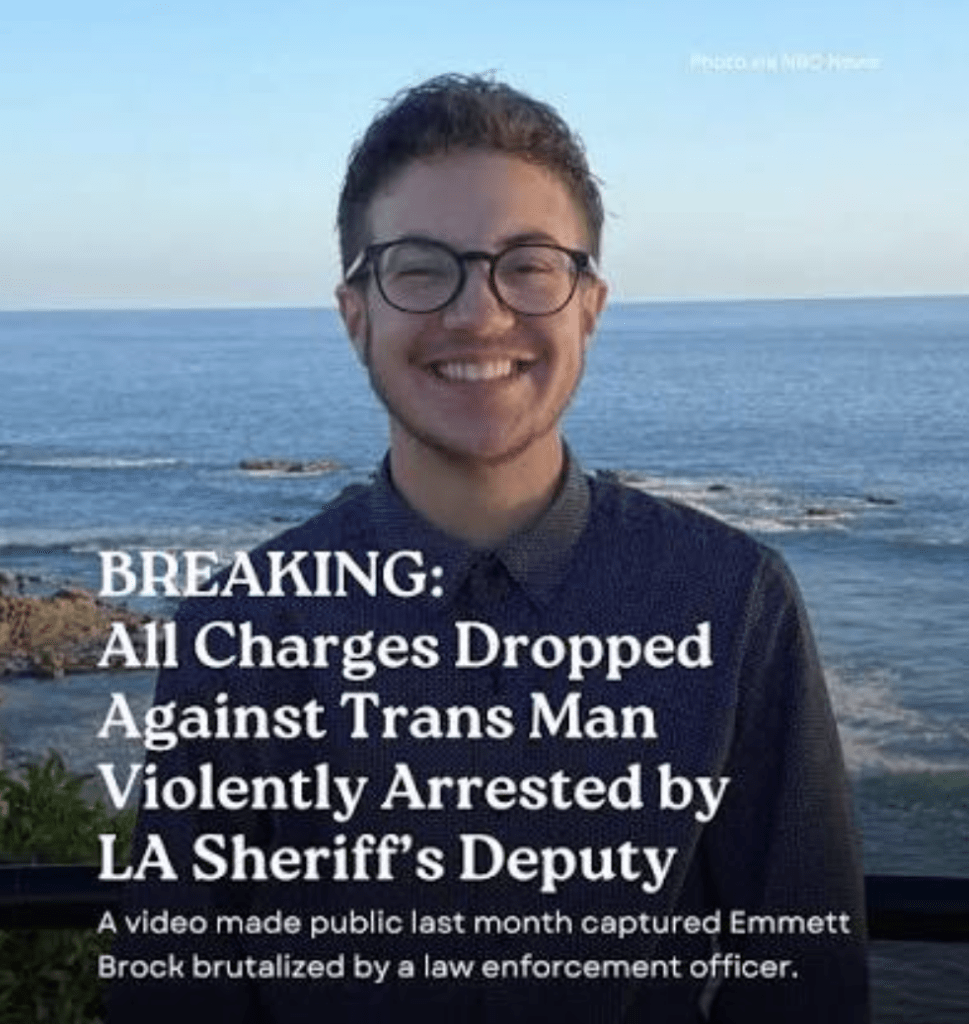
What happened afterward transformed an excessive-force incident into something much larger.
Brock was taken to Norwalk Station and booked on fabricated felony charges. Benza claimed in his report that Brock had bitten him, an allegation contradicted by medical records. Instead of the incident ending with scrutiny of the deputy’s conduct, Brock became the criminal defendant while the account provided by Benza moved through the system.
The truth eventually caught up with him.
In December 2024, Benza pleaded guilty in federal court to deprivation of rights under color of law. He admitted retaliating against Brock, using excessive force, falsifying his report and lying to the FBI. Federal prosecutors also stated that other deputies and sergeants colluded in the cover-up, expanding the case far beyond the actions of one rogue deputy. At least eight deputies were relieved of duty, and Brock’s civil lawsuit ultimately settled for $3 million.
Department sources inside Norwalk Station now tell The Current Report that some of the deputies involved in that cover-up wear the identical skull-and-lightning-bolt tattoo associated with the Norwalk subgroup and now reported to be carried by Camacho.
That allegation gives Luna’s decision an entirely different level of significance. He has not simply elevated a lieutenant reported to have a department-related tattoo while simultaneously promoting a policy intended to scrutinize those tattoos. He has placed that individual in command of the station associated with the tattoo while questions remain about the role of the same subgroup culture among personnel implicated in a federal civil-rights cover-up.
The Records Luna’s Department Has Fought to Keep From Oversight
There is another layer to the Norwalk story that cannot be separated from Luna’s claims of transparency and reform.
The Civilian Oversight Commission has spent years fighting for access to unredacted records involving the Brock beating and related use-of-force cases. Luna’s department has produced heavily redacted documents or, in some instances, no records at all, and the dispute escalated into litigation. LASD challenged the commission, while the commission has fought back in court to enforce its subpoena authority.
The significance goes well beyond a bureaucratic dispute between LASD and its oversight body. The records being sought could provide the public and the commission charged with overseeing the department a clearer picture of what occurred inside Norwalk, who participated, what supervisors knew and how the department responded.
That is precisely the kind of scrutiny that meaningful reform is supposed to welcome.
Instead, Luna’s administration has continued resisting full disclosure while publicly presenting itself as committed to transparency and accountability. At the same time, Luna has now installed as Norwalk’s Acting Captain, a lieutenant whom multiple department sources identify as possessing the station’s subgroup tattoo.
Those decisions are not isolated. Taken together, they expose a pattern that directly contradicts Luna’s public rhetoric on deputy gangs.
Political Influence and a Captain Selection That Raises Questions
There is also a political component surrounding the Norwalk appointment that deserves scrutiny.
Norwalk Mayor Jennifer Perez is listed among Luna’s campaign endorsements. Sources close to Luna’s inner circle state that the sheriff and Norwalk political leadership maintain a close relationship and that Luna had signaled his preference for Camacho to lead the station before the selection process was completed.
If that account is accurate, it raises an obvious question about what opportunity the other candidates who interviewed for the captaincy actually had.
Luna has previously been accused of placing a favored candidate among a slate of applicants who have little realistic chance of being selected, allowing the department to create the appearance of a competitive promotional process while the desired outcome has already been determined. The concern is not merely procedural. Every time qualified personnel are brought into an interview process for a position that has effectively already been promised to someone else, the department undermines the very merit-based system it claims to operate.
In Camacho’s case, those concerns are compounded by his previous proximity to McDonnell, his subsequent relationship with Skeen, his advancement into the Assistant Sheriff’s office and now his selection to lead Norwalk. Add the reported tattoo and Johnson’s objection, and Luna’s decision deserves considerably more scrutiny than simply announcing another acting captain assignment.
Luna’s Own Standard Is Now the Issue
Luna has spent much of his administration attempting to convince the public that he represents a break from LASD’s past. Deputy gangs and station cliques have been one of the most visible parts of that message, and tattoo screening for candidates seeking captain and above has been presented as tangible evidence that his administration is changing who gets elevated into positions of authority.
The Civilian Oversight Commission has been equally clear about the seriousness of the issue. Its investigation confirmed the existence of deputy gangs and resulted in 27 recommendations aimed at eradicating them, including recommendations involving leadership, supervision and accountability. The commission has treated deputy subgroup culture not as harmless camaraderie, but as an institutional problem requiring intervention at the highest levels of the department.
Against that backdrop, the promotion of Omar Camacho becomes a test of Luna’s credibility.
Multiple department sources identify Camacho as carrying the Norwalk subgroup tattoo. The tattoo itself has previously been documented and scrutinized by county oversight officials. Department sources state that some personnel implicated in the Brock cover-up carry the same tattoo. Johnson reportedly objected to Camacho being placed at Norwalk, and Luna overrode that objection. Camacho nevertheless ended up in the captain’s chair of the very station associated with the subgroup.
Luna cannot continue pointing to tattoo screening as proof that he is dismantling deputy subgroup culture while making exceptions that appear to contradict the purpose of the policy.
If Camacho was screened and cleared despite the tattoo, the department should explain the standard used to make that determination. If the tattoo was known and deemed irrelevant, Luna should explain how that squares with the policy he has repeatedly promoted. And if the concerns raised internally were simply overridden, LASD personnel and the public deserve to know why.
Because reform cannot be a policy that exists only on paper, in testimony or when it is politically convenient.
The real measure of Luna’s commitment to dismantling LASD’s deeply entrenched subgroup culture is what happens when the policy reaches someone inside the circle of power.
The promotion of Omar Camacho raises serious questions about whether Luna is dismantling that system, or simply deciding who gets to benefit from it.