
Editor’s Note: The Current Report submitted a formal inquiry to the Sheriff’s Information Bureau. As of publication, no response was provided.
The Los Angeles County Sheriff’s Department has become synonymous with scandal under Sheriff Robert Luna, but even amid that chaos, his decision to bring Steve James into his inner labor circle may go down as one of the most reckless, self-inflicted wounds of his administration.
James isn’t just an outsider in name, he’s a presence within LASD and its union structures that many deputies find deeply troubling. The letter describes James, a former Long Beach Police Department officer who reportedly helped Sheriff Luna’s campaign, as omnipresent where he shouldn’t be, roaming the halls of the Association for Los Angeles Deputy Sheriffs (ALADS) with VIP status, participating in internal meetings, riding with deputies, and influencing discussions despite holding no formal union role.
Public records show James was introduced by an LASD undersheriff as the department’s official labor liaison and now operates as Sheriff Luna’s paid labor consultant, even working alongside the sheriff’s Constitutional Policing director on internal task forces. As reported previously by The Current Report, James has leveraged that access to shape department policy, craft messaging hostile to rank-and-file deputies, advise Luna behind closed doors, and function as an insider within ALADS, an arrangement deputies describe as a glaring conflict of interest that advances political agendas, not their own.
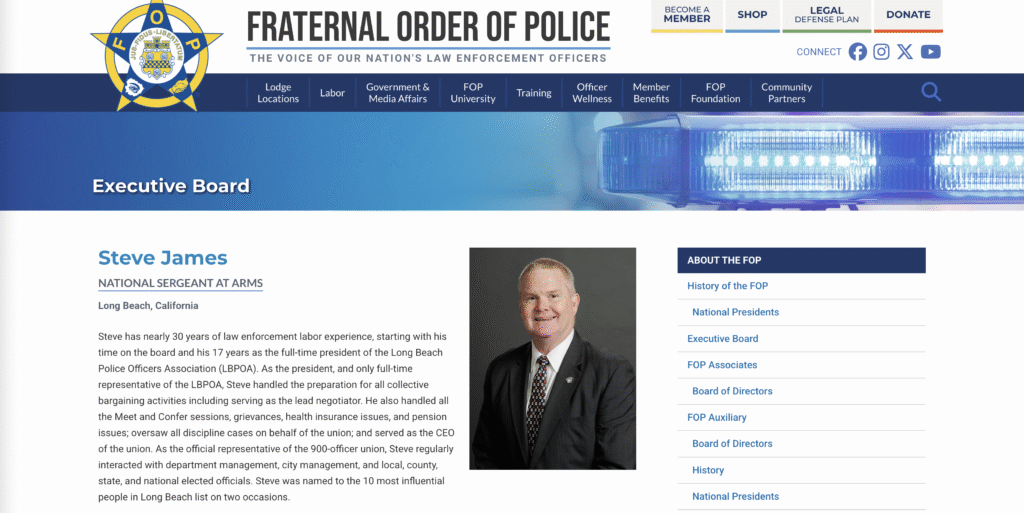
Steve James’s consulting role with the Los Angeles County Sheriff’s Department creates a stark conflict with his position on the Fraternal Order of Police’s National Executive Board, where he serves as National Sergeant at Arms, a leadership post responsible for steering the organization’s national political posture and advocacy. While the FOP does not list a specific date for when James assumed that title, his long tenure in national leadership, following nearly two decades as California’s National Trustee, positions him inside an organization that has publicly thrown its weight behind support for ICE and federal immigration enforcement, exemplified most recently by state FOP lodges issuing statements declaring “FOP Stands With ICE” and defending federal agents against local criticism related to immigration operations. The result is an inherent and explosive contradiction: James is advising LASD leadership on labor strategy and internal policy while simultaneously occupying a senior role in a national outfit whose agenda aggressively champions federal immigration enforcement tactics that Sheriff Luna has publicly rejected. This duality raises urgent questions about whose interests are being elevated inside the department and whether James’s influence serves deputies or an outside national organization with deeply divergent priorities.
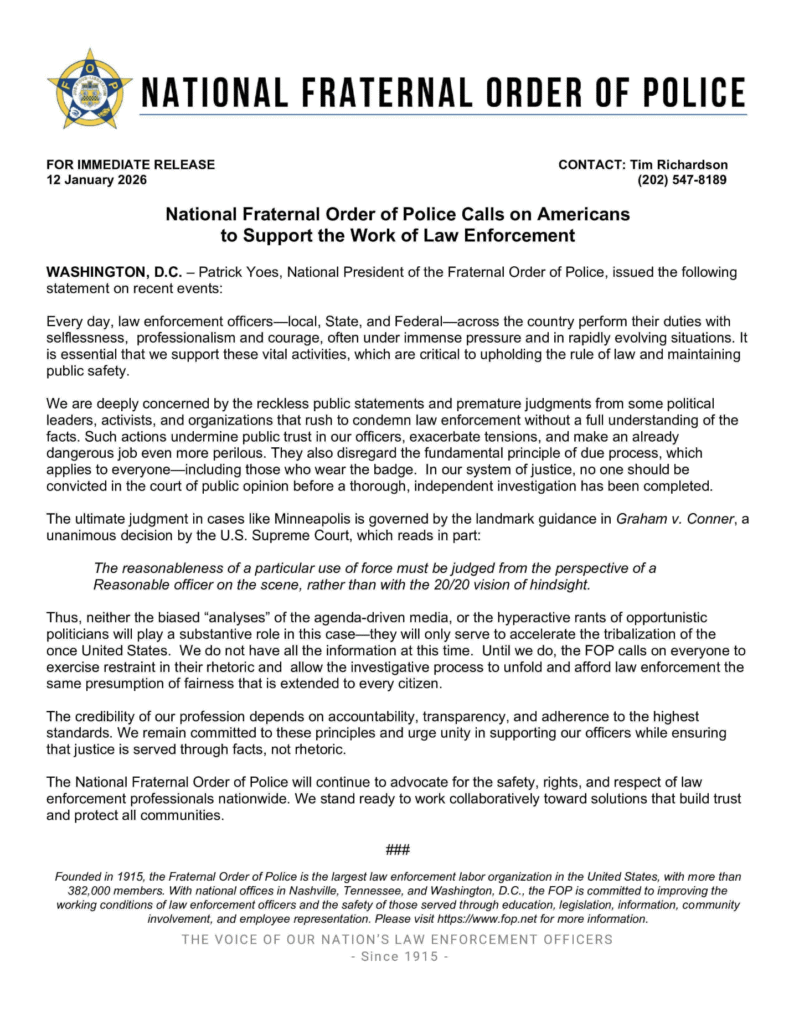
On January 8, 2026, the Minnesota FOP issued a defiant statement declaring “FOP Stands with ICE,” attacking local officials after a controversial Minneapolis incident and accusing critics of putting federal agents in danger. That rhetoric wasn’t isolated. National FOP leadership has amplified the message, calling for unconditional support of ICE, promoting expanded 287(g) agreements that entangle local law enforcement with federal immigration enforcement, and openly condemning sanctuary policies nationwide.
That position is fundamentally incompatible with Sheriff Luna’s own words, and his political identity.
Luna, the son of immigrants, has made a point of publicly distancing LASD from ICE’s broader enforcement operations. In a September 2025 interview, he described immigration raids as “difficult to watch,” acknowledging they affect him personally. He has repeatedly emphasized that immigration enforcement is a federal responsibility, not a local one, and that LASD does not participate in it.
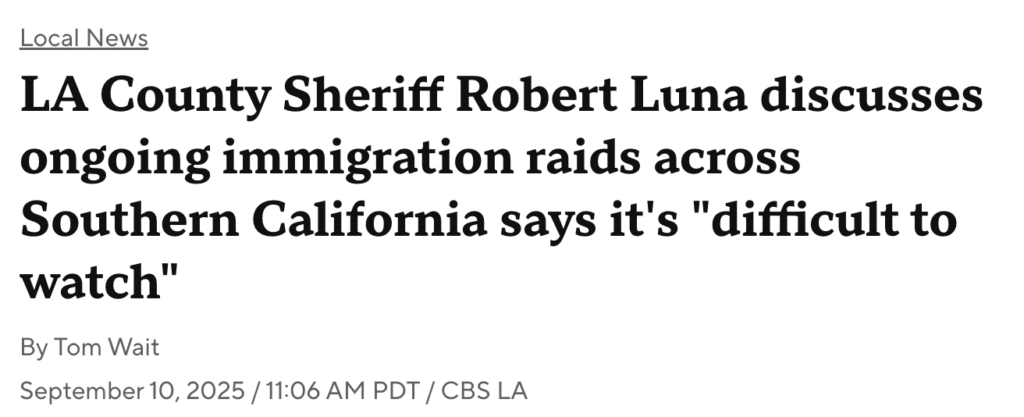
While Luna concedes that the department has “no choice” but to comply with federal judicial warrants, he has been explicit in rejecting ICE detainers and administrative holds. He has openly acknowledged the fear and anxiety these operations create in immigrant communities—and positioned himself as a sheriff unwilling to be an extension of federal immigration crackdowns.
That stance mirrors the broader Democratic consensus. From Los Angeles to Philadelphia to Minneapolis, Democratic officials have condemned ICE raids as destabilizing and harmful. In Los Angeles County, Supervisor Janice Hahn has blasted ICE for racial profiling in cities like Downey and Torrance and has pushed to rein in what she describes as federal overreach. The Board of Supervisors, the same body that controls Luna’s budget, has gone even further, declaring immigration enforcement emergencies and framing ICE actions as an “assault” on Latino communities while strengthening sanctuary protections.
And yet, standing at Luna’s side is Steve James, representing an organization that cheers the very ICE tactics Luna claims to oppose.
This is not a minor contradiction. It is a credibility crisis.
By empowering James, Luna is actively undermining his false reformist veneer and further alienating himself from the progressive coalition that helped elect him.
You cannot publicly condemn the fear ICE spreads while privately elevating a labor power broker whose national mission is to defend and expand those same operations. At some point, the math stops working.
But the most immediate damage isn’t political, it’s operational.
LASD deputies are now trapped in an impossible position. Officially, they are instructed to limit cooperation with ICE, focus on public safety, and avoid entanglement in federal immigration enforcement. Unofficially, the sheriff’s trusted advisor is tied to a national organization broadcasting an aggressive pro-ICE message. That contradiction breeds confusion, erodes trust with immigrant communities, and invites internal backlash.

How are deputies supposed to build credibility in neighborhoods terrified of deportation when the sheriff’s labor consigliere is aligned with ICE’s loudest cheerleaders? How do they interpret chain-of-command priorities when the messaging from the top is fractured? And how does this not ultimately put deputies at greater risk, both on the street and inside a department already fractured by mistrust?
Steve James is not just a bad fit. He is a wedge, driven directly between Sheriff Luna’s progressive rhetoric and his actual performance.
The question now is unavoidable. Will Luna confront this contradiction and sever ties with a figure whose influence directly conflicts with his public stance and political base? Or will he continue to say nothing, allowing the division to deepen while deputies absorb the fallout?
LA County deserves leadership that its rhetoric with actions. Luna has been found shockingly wanting.