
In Los Angeles County politics, where progressive branding often masks hard-edged power plays, one figure has consistently positioned himself at the center of the conversation: Hans Johnson.
As president of the East Area Progressive Democrats and chair of the Sheriff’s Civilian Oversight Commission, Johnson has spent years advancing a singular narrative, that the Los Angeles County Sheriff’s Department is riddled with so-called “deputy gangs,” shadowy groups of tattooed deputies driving misconduct, lawsuits, and systemic failure.
It was a narrative engineered with precision and deployed with intent. Reform wasn’t presented as an option—it was sold as an emergency. The threat wasn’t questioned, it was declared as fact. And the outcome wasn’t subtle: elect Robert Luna or accept the chaos.
But now, that narrative is colliding with sworn testimony, and the implications are significant.
In open court, under oath, a 30-year LASD veteran, Chief Laura Lecrevain, was asked directly whether deputy gangs exist. Her answer was unequivocal: no.
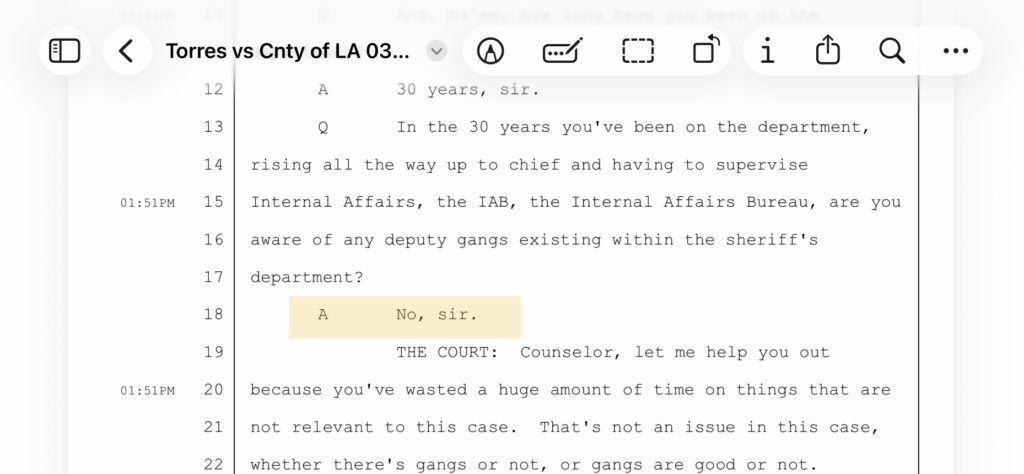
That statement alone cuts through years of political messaging and raises a fundamental question: if the central premise used to justify sweeping reform doesn’t hold up under oath, what exactly was sold to the public?
To understand the stakes, look back at 2022. As Robert Luna challenged incumbent Alex Villanueva, Hans Johnson and the East Area Progressive Democrats did not simply endorse him. They built a coordinated campaign narrative around him. Social media, public events, and grassroots organizing all moved in the same direction. Luna was positioned as the reform candidate who would dismantle a department allegedly overrun by entrenched internal gangs.
However, Luna himself avoided direct accountability in a telling way, retiring from Long Beach Police Officers Association jurisdiction before formally challenging Villanueva. In doing so, he effectively sidestepped a potential vote of no confidence that had been building within the rank and file. It is a familiar playbook. Avoid scrutiny, control the narrative, and neutralize dissent before it reaches a formal forum.
At the same time, the rhetoric surrounding so-called “deputy gangs” escalated to a level that collapses under its own weight. The Los Angeles County Civilian Oversight Commission and the Los Angeles County Office of Inspector General amplified claims that one in six deputies were gang members. That would equate to roughly 1,500 armed deputies operating as organized criminals within the department. The situation was publicly framed as an existential crisis, a term used by Sean Kennedy.
Yet when those claims were subjected to scrutiny, whether in courtrooms, internal reviews, or sworn testimony, the narrative fractured. No one could identify a single deputy as a confirmed gang member under that sweeping definition, nor point to misconduct that had not already been addressed under prior administrations, including that of Jim McDonnell. The gap between rhetoric and evidence is not just notable. It is foundational.
The reason is straightforward. The Los Angeles County Civilian Oversight Commission, the Los Angeles County Office of Inspector General, and department leadership all understand the legal threshold. Labeling a deputy a gang member without substantiated evidence is defamation at its most basic level and exposes the County to immediate legal liability. That is why the rhetoric expands in public forums but collapses into ambiguity under oath.
This is the same environment in which selective enforcement, narrative shaping, and administrative weaponization thrive. It is also the same environment that allowed the events outlined in this report to unfold without meaningful challenge.
The messaging itself was consistent, disciplined, and effective. It transformed a complex law enforcement agency into a simplified political story defined by crisis, urgency, and the promise of correction. According to multiple sources familiar with the campaign’s inner workings, that narrative was not organic. It was strategic. The deputy gang issue became the centerpiece not because it was firmly grounded in verified evidence, but because it aligned with the political momentum that followed the national unrest of 2020. It energized a voter base, justified a leadership overhaul, and drew a clear and politically useful line in the sand.
And it worked.
Now, with Luna in office, the contradictions are harder to ignore. At the March 19, 2026 meeting of the Los Angeles County Civilian Oversight Commission, the very body Hans Johnson chairs, independent reporting introduced court testimony that directly contradicts the narrative he helped amplify. Instead of engaging with the substance, Johnson dismissed the reporting as partisan and unworthy of serious consideration.
There was no direct challenge to Luna and no acknowledgment of a false narrative. There was no reckoning with the polarizing truth delivered under oath by his own command staff. There was only calculated deflection.
That response underscores the conflict embedded in Johnson’s dual roles. As a political advocate, he helped construct the narrative. As an oversight official, he is now responsible for scrutinizing it. Those responsibilities now appear to be in direct tension.
Because if the deputy gang narrative unravels, the consequences extend far beyond rhetoric. It calls into question the foundation of a campaign, the justification for policy decisions, and the credibility of those who advanced it.
For years, the public was told the department faced an entrenched internal threat requiring aggressive reform. Oversight findings reinforced it. Campaign messaging amplified it. Advocacy groups repeated it. Yet when tested in a courtroom, where statements carry consequences and truth is not optional, the assertion fractures.
Hans Johnson has not moved to reconcile that contradiction. He has moved to contain it.
And for voters who were asked to trust the urgency of that crisis, the question is no longer theoretical. It is unavoidable. If the threat was overstated, what exactly were they voting for?
This is no longer about messaging. It is about credibility. It is about whether a narrative was constructed to win an election, and whether those who built it are now more invested in protecting it than confronting the truth.
The gap between what was promised and what can be proven is no longer subtle. It is an indictment.