
Part I: Critical event planning trips or Taxpayer funded Vacations abroad? The Personnel Staffing Panic and Executive Sightseeing
Although this investigation centers on the glaring lost preparation opportunities in the Los Angeles Police Department (LAPD) major event planning and the desperate, attritional measures proposed to support staffing—such as shutting down the recruit academy—it is equally critical to address the severe missed opportunities regarding vital planning lessons from other agencies that were instead co-opted into tourism, luxury sightseeing escapades, and personal convenience details for Chief Michel Moore’s loyal inner circle. A prime illustration of this administrative excess is why former Chief Moore felt entitled to travel to Paris on the taxpayer’s dollar accompanied by a dedicated two-man security detail. Objective operational necessity dictated zero active threats or actionable safety justifications for this overseas entourage; rather, the detail’s functional footprint was demoted to performing menial domestic tasks—opening doors, driving, and carrying luggage for Moore and his wife during leisure-heavy tourist excursions. The explicit purpose of the 2021 Paris visit—which included bringing spouses supposedly at their own expense—was ostensibly to help draft an agreement allowing Interim Chief Dominic Choi and wealthy reserve officers to walk a symbolic foot beat for visibility, despite the undeniable reality that American municipal police officers hold zero lawful police powers or jurisdiction on foreign soil in Paris. One must seriously ask: how did drafting an agreement for ceremonial foot beats benefit in any way the gritty, tactical realities of preparing Los Angeles for a multi-billion-dollar Olympic security footprint? The inclusion of Assistant Chief Robert Marino long time personal friend and associate of Moore on these overseas junkets, further unmasked the patronage-driven nature of the command staff’s itinerary. Marino attended these high-profile deployments despite knowing he was on the verge of retirement, bringing zero operational value, best practices experience, or major event planning background back to the agency, effectively converting official travel authorizations into an unwarranted farewell vacation.
At the end of the day, the department will pull it off -IT HAS TO AND WILL—but in the process, the raw, unvarnished reality of a deeply flawed and reactive planning framework will be brutally exposed on the asphalt. Having personally sat in on planning sessions with the LA28 host committee, a glaring truth dictates the entire trajectory of the Games: LA28 operates strictly as a business designed to protect its capital and squeeze margins wherever possible, prioritizing public relations optics and corporate image vastly over the gritty realities of physical security.
This bottom-line fixation is aggressively mirrored in the stalled negotiations surrounding the Enhanced City Resources Master Agreement (ECRMA). Although a tentative draft of the ECRMA emerged in mid-2026, its delayed progression—months past its original October 2025 deadline—highlights an ongoing battle over financial exposure. LA28’s multi-billion-dollar budget explicitly excludes public safety operations, and earlier iterations of their draft agreement brazenly attempted to allow organizers to disburse private legacy funds before fully reimbursing the city for extraordinary municipal and security expenses. Compounding this exposure is the widespread delusion surrounding the $1 billion allocated by the federal government for Olympic security. This figure is not a direct lumpsum check for the City of Los Angeles; it is a shared pool distributed across all participating local, state, and federal law enforcement co-chairs. Internal calculations demonstrate that LAPD and regional personnel salaries and overtime alone will easily outpace the entire federal allocation, leaving local taxpayers holding an uncapped financial bag unless reimbursement guarantees are legally and transparently ironclad.
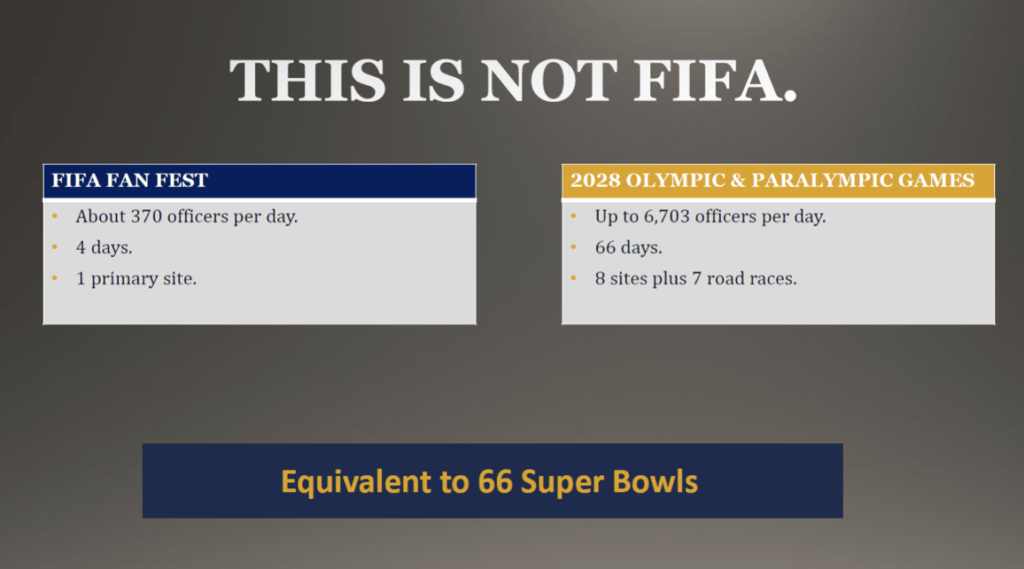
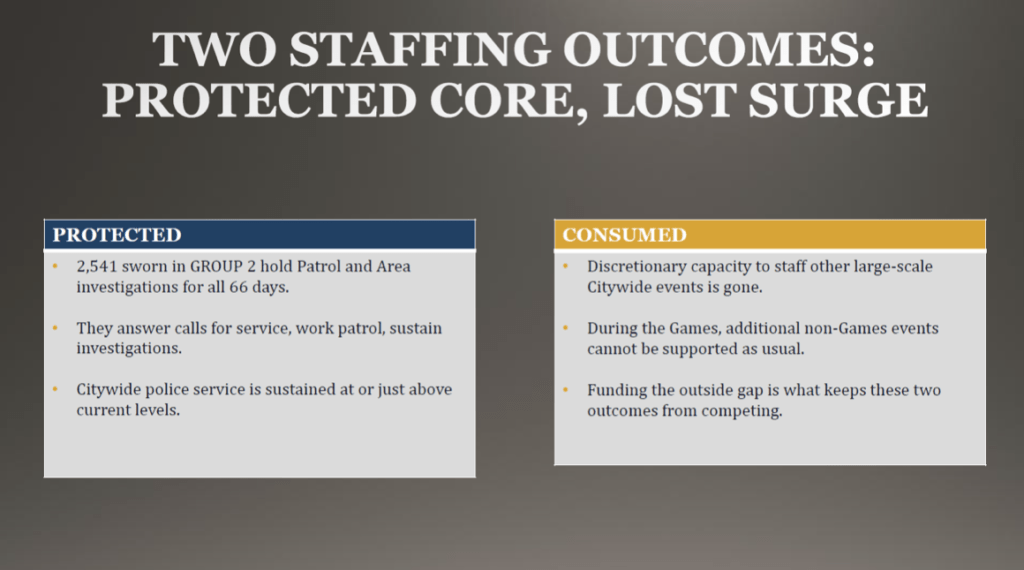
The mathematical impossibilities of the security footprint are staggering, as securing the 66-day operational period requires a peak daily demand of 6,703 personnel. Due to a grueling 3/12 rotational schedule (twelve-hour shifts, four days on and two days off), the dedicated Group 1 workforce pool of 4,713 yields a maximum daily deployment of just 2,245 officers on post, while holding back 2,541 personnel in Group 2 to maintain basic 911 response and Area investigations leaves an unfulfilled daily deficit of 4,458 posts that must be sourced from outside agencies.
Frontline experience during past Mobilization/Unusual Occurrence Deployment (MUD) days demonstrated that these rotational units frequently abandoned perimeters when they hit their designated “end of watch” (EOW) time, displaying a profound frontline detachment and retreating to coffee shops to evade public contacts, court responsibilities or potential internal complaints. Under the compounding psychological and physical strain of a continuous 66-day deployment, we can almost certainly count on waves of headquarters and academy personnel calling in sick or going off on Injury on Duty (IOD) status—fueled by an enablement and entitlement culture cultivated at the highest command levels.
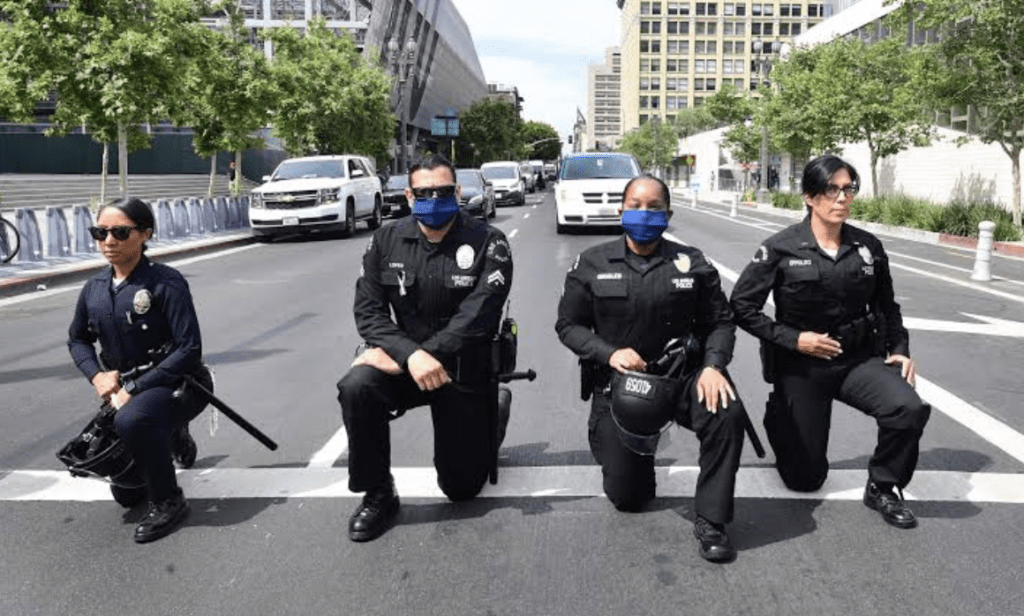
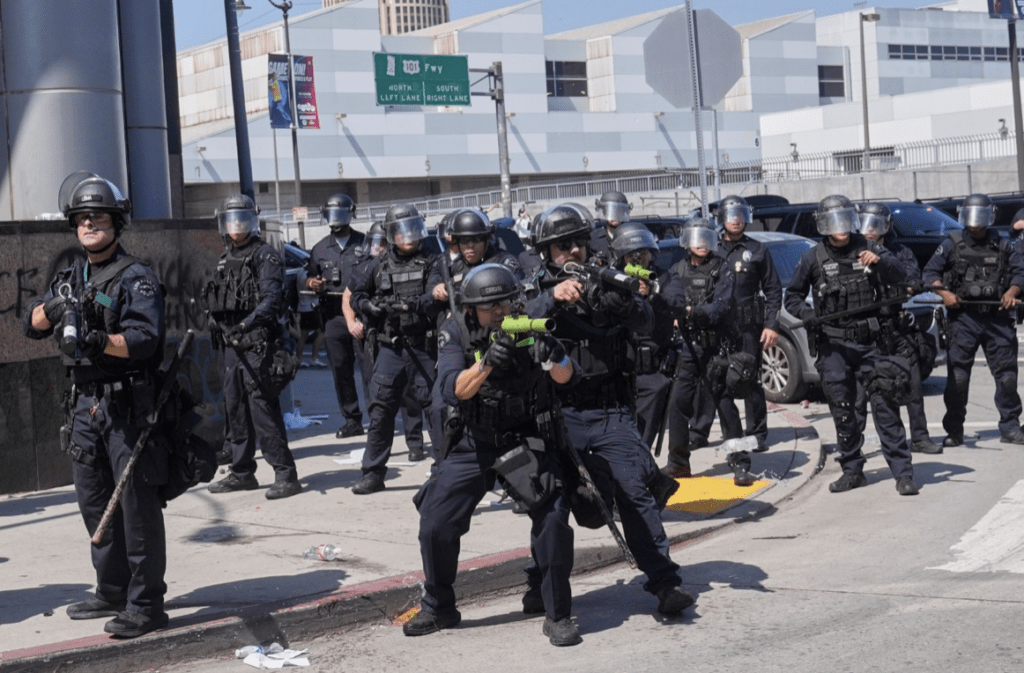
A chilling historical preview of this behavioral breakdown unfolded in 2020, when academy staff thrust into mobile field forces were documented ordering officers to kneel, while motor cop supervisors refused to initiate large-scale looter traffic stops out of fear for “officer safety”. Conversely, overzealous Metro TSE elements were observed aggressively deploying 40mm less-lethal rounds directly at agitators’ faces and head area, leading to the preventable loss of valuable tactical tools. While strict term limits on specialized units remain critical to equitably distribute advanced training across patrol resources, police labor unions have consistently blocked these structural safeguards. We will address the entitlement of LAPD specialized units in future articles.
Beyond general patrol, the squeeze that will occur for specialized units is an acute reality. The major events will attract transnational organized crime, trafficking rings, and specialized threats to an event of this scale. During the 14-day 2022 Super Bowl, the region already faced shortages of regional K9 explosive-detection teams, this resulted in the US Marshals moving heaven and earth to deputize federal and state teams to help in critical screenings. As the Olympics approaches the resource drain will make it mathematically impossible to scale specialized investigative, bomb response, and tactical details across eight Olympic zones, seven road racecourses, and 40-plus competition venues for 66 continuous days. Attempting to bridge this gap via legislative stopgaps—such as Mayor Bass’s backing of Assemblywoman Tina McKinn’s bill to import out-of-state officers—creates immense civil liability and accountability risks, as rightly opposed by PORAC over training disparities and unfamiliarity with local use-of-force laws. At the same time, securing mutual aid from regional California agencies is severely compromised because outside leadership refuses to expose their personnel to a hostile Los Angeles political climate that routinely abandons officers. The cross training needs, communications plans and various other logistical concerns such as getting personnel to countless sites throughout the area of operation will create significant obstacles.
The event will be heavy reliant on federal resources, yet local political hostility toward agencies like the Department of Homeland Security (DHS) under sanctuary city policies paralyzes inter-agency coordination, with local politicians displaying greater anxiety over immigration enforcement than active counter-terrorism mitigation. These operational failures trace directly back to a Headquarters-centric leadership culture, where most individuals holding top command ranks today rose through an insulated administrative bubble and were absent during historical systemic crises like the major riots and earthquakes of decades past. I witnessed this firsthand during the 2020 civil unrest when I was pulled from South Bureau as a commander to run operations in the field, while upper-tier chiefs and commanders remained hunkered down inside headquarters. This entitlement was mirrored during 2022 Super Bowl planning, where an assistant chief accepted VIP perks and host-committee travel, only to return home and claim he was “too busy” with Internal Affairs disciplinary matters to assist frontline security. That same individual now oversees major events strategy with minimal operational background or interest in learning. When I pushed in 2021 to professionalize Incident Management Teams (IMTs) under standardized ICS-300 and ICS-400 criteria, many within command dismissed the curriculum and commitment as an unnecessary burden. Former Chief Michel Moore was repeatedly presented with these explicit red flags following downtown deployment fiascos after the George Floyd protests, but institutional priorities and political grandstanding consistently favored public optics over tactical reality.
Ongoing resistance to establishing dedicated Incident Management Teams (IMTs) leaves the agency without a stable, full-time response cadre. Treating tactical frameworks as an ancillary burden—coupled with a failure to enforce standardized ICS-300 and ICS-400 curricula—fatally weakens frontline preparedness for major incidents and civil unrest.
Diverting vital municipal real estate for sanitation parking instead of preserving a state-of-the-art Command Operations Center forces command elements into compromised, improvised operational trailers. Relying on legacy administrative records rather than interoperable threat detection and modern surveillance creates a severe situational awareness void across a sprawling venue footprint.
Operating without a formally executed Enhanced City Resources Master Agreement (ECRMA) leaves the city dangerously exposed to uncapped financial risk, as event budgets routinely omit frontline public safety costs and drain surplus funds before municipal reimbursement. Without a legally mandated taxpayer protection guarantee, unrecovered operational overruns fall squarely on local taxpayers.
Suspending academy classes to plug immediate field deficits halts the hiring pipeline entirely, colliding directly with ongoing sworn attrition and accelerating the department’s downward staffing spiral.
Stopping academy classes creates a devastating domino effect across the entire department, directly colliding with the LAPD’s ongoing sworn attrition crisis and shrinking staffing numbers.
When the department halts recruit training to temporarily push instructors into the field, it completely cuts off the pipeline used to replenish personnel losses. Because current hiring efforts are already caught on a difficult “treadmill” trying to offset a continuous wave of retirements and resignations, suspending the academy causes the department to fall off that treadmill entirely. This deepens the long-term retirement void and accelerates force contraction.
With active sworn strength lingering near multi-decade lows of roughly 8,600 personnel, losing the inflow of new classes guarantees that overall deployment numbers will continue to spiral downward, stretching remaining patrol units thin, driving up exhausting mandatory overtime, and severely degrading response capabilities for the public.
We saw a clear preview of this institutional and operational strain during the civil unrest and deployments of 2020. Pulling personnel straight out of controlled environments like the academy and thrusting them into rushed field mobilizations meant deploying officers who lacked modern, everyday patrol familiarity. On the front lines, these disconnects manifested as operational passivity—such as rotational staff abandoning posts the moment they hit their designated end-of-watch time—alongside severe tactical missteps on the street, as unpracticed instructors and supervisors struggled with crowd control and operational enforcement under intense pressure. When an agency stops training pipelines while managing an already collapsing staffing ecosystem, the resulting operational rust and deep-seated institutional fatigue make systemic failure a mathematical certainty.
The concept of artificially inflating recruit class sizes both before and after a complete operational shutdown is entirely unsustainable and fundamentally misunderstands the bottlenecks governing the LAPD pipeline.

Attempting to cram larger numbers into the academy before a planned suspension or trying to hyper-inflate class sizes afterward creates an impossible logistical and administrative strain. As highlighted in organizational assessments, the bottleneck is not merely a lack of interest—applications rose significantly between 2022 and 2024 yet completed background investigations and psychological evaluations dropped. The City Personnel Department’s Public Safety Bureau and the understaffed Background Investigation Section already face chronic processing delays, with an average processing timeline stretching to nearly a year (349 days) per applicant.
When the department attempts to force through inflated class sizes without fixing the underlying vetting capacity, it either leads to rushed, compromised background checks that invite severe institutional liability or results in massive applicant drop-off as candidates defect to neighboring municipal agencies with faster onboarding. Furthermore, the physical infrastructure of the academy sites—which leadership intends to repurpose for operational deployment during the Games—cannot simultaneously function as high-volume training hubs and consolidated tactical staging areas. When you combine an already overburdened hiring mechanism with artificial pre- and post-shutdown surges, the system breaks down, proving that you cannot mathematically out-maneuver a 25-year staffing low with administrative sleight of hand
A Headquarters-centric leadership culture characterized by inexperience in major events and a resistance to active oversight compromises command integrity, necessitating the urgent integration of battle-tested, street-experienced commanders.
To be crystal clear, this unvarnished critique is neither a blame game nor an effort to diminish the extraordinary sacrifice and grit of the hard-working men and women wearing the badge on the asphalt every single day. The operational crisis we face is a stark reality that former Chief Michel Moore knew was coming. These profound structural concerns were brought directly to his attention, yet I personally witnessed him double down on archaic policies, stubbornly refusing to fix the onboarding bottlenecks or modernize the department, while enabling agitators to weaponize frivolous complaints that kept the LAPD anchored in the dark ages. His absolute unwillingness to listen or adapt has unfairly shifted an unbearable burden directly onto the rank-and-file.
Tragically, in the wake of Moore’s expedited removal, nothing has fundamentally changed; the exact same counter-productive policies remain firmly in effect, and little if anything has been done to break away from the institutionalized “good old boys” way of doing business. No, the blame does not land on the dedicated men and women of the LAPD; rather, it rests squarely on the shoulders of the former chief and those remaining in the upper command tiers who continue to perpetuate an institutional “nothing to see here” mindset of superficial, cosmetic “lipstick on a pig” leadership. One might conveniently ask why LAPD Internal Affairs isn’t simply shut down to staff all of the venues, but that is probably because people like Captain Johnny Smith and his associate recording cops and peeking over station fences, alongside an unemployed barbecue cook with multiple property tax liens, have created such a massive backlog of anonymous and pseudo-name complaints that the division remains hopelessly tied down.
Ultimately, you cannot secure a global event by emptying an academy full of out-of-practice instructors, ignoring tactical command training, fighting with federal agencies, and bowing to a corporate committee that prioritizes balance sheets and public relations over human life. Until City Hall and command staff fundamentally change how they operate and involve battle-tested leadership to ask the tough operational questions, the 2028 Olympic security plan remains a disaster waiting to happen.
Let’s dive into the alleged preparation trips to France for Olympics preparation. To quantify the high-level command and observation delegations dispatched to France during the multi-year audit period analyzed by the Office of the Inspector General (OIG), the itemized breakdown of known Paris/France planning and observer delegations illustrates a distinct pattern of executive optics over tangible municipal return:
|
Name / Roster Group |
Primary Departmental Rank |
Primary Mission Assignment in France |
Core Tactical and Planning Contribution / Known Operational Benefit |
Funding Source / Total Cost |
Reference |
|
Interim Chief Dominic Choi |
Chief of Police (Interim) |
Executive Oversight & Diplomatic Liaison |
Walked active foot beats alongside deployment teams; conducted bilateral coordination meetings with Pierre-Edouard Colliex. |
Department-funded commercial flight ($1,722.20) and lodging ($2,613.10). |
|
|
Assistant Chief Robert Marino |
Assistant Chief |
High-Level Security Planning (Nov 2021) |
Participated in the November 2021 diplomatic trip; involved in the Marseille phone-theft mix-up with zero major event portfolio output. |
Department Travel Allocation |
|
|
Former Chief Michel Moore |
Former Chief of Police / Departmental Consultant |
Legal and Intergovernmental Negotiation |
Initiated bilateral negotiations in 2021; brought 2 personal security detail members whose functional value was opening doors and carrying luggage. |
Authorized departmental funds ($2,475.00) plus security detail per diems. |
|
|
Cmdr. Hamed Mohammadi |
Commander (LA28 Planning Team) |
Strategic Infrastructure Observation |
Evaluated French security command structures and venue perimeter zoning before being removed for questioning command trajectory. |
Standard Travel Allocation |
|
|
36 Observation Tour Employees |
Various Ranks / Personnel |
Paris Law Enforcement Security Observer Tour |
Conducted symbolic and high-visibility foot patrols; questioned for yielding near-zero operational value for local patrol integration. |
French National Government baseline airfare/lodging; meals out-of-pocket. |
Prioritizing optics over operational utility raises a glaring question regarding the actual value of conducting symbolic foot beats in Paris: how does walking a high-profile Parisian boulevard assist in engineering a complex, car-congested 66-day security apparatus back in Los Angeles? In truth, these high-end deployments functioned largely as a personal PR event and luxury networking circuit for wealthy LAPD reserve officers and foundation donors to maintain social currency and personal connections with foreign governments, while the operational planners who actually manage division-level resource allocation were left entirely out of the loop.
The tenure of former Chief Michel Moore has increasingly been viewed as an era of strategic patronage rather than objective oversight, characterized by a sophisticated system of weaponized internal investigations designed to protect a loyal inner circle while dismantling the careers of perceived rivals. Moore cultivated a protected class within Internal Affairs (IA) by shielding individuals with significant personal liabilities, thereby creating a cycle of indebtedness that bought lifelong loyalty. For instance, during a tumultuous domestic incident investigation involving the current Assistant Chief and former head of IA, Rimkunas, where Santa Clarita Sheriffs responded to a home, Moore reportedly directed the allegations as “withdrawn by the Chief of Police” to keep the conclusion hidden and secure personal allegiance.
Similarly, Captain Shah strategically guided complaints to promote his advancement, joining Rimkunas in using the “Rampart” label to describe Mission Area gang misconduct—a tactical comparison used to justify an aggressive administrative response while conveniently insulating false statements to benefit unethical and POBR violations in personnel investigations. While supporting allies like Captain Johnny Smith from retroactive scrutiny regarding the origins of camera deactivation practices in the Foothill Division to unethical partnership with street terrorists to paying unemployed BBQ cooks to read a weekly script at Police Commission.
As the brass enjoyed the pageantry of Parisian boulevards and leveraged diplomatic junkets for personal optics, the real work of protecting Los Angeles was left to fend for themselves and pray for the best. But a luxury passport is a poor shield against a crumbling foundation, and the bill for this culture of executive patronage is finally coming due. As we turn to Part II, we will strip away the polished public relations spin to examine the hard math of 2028: the devastating academy shutdowns, the hollowed-out staffing numbers, and the open-ended travel ledger that traded the future of the department for the comfort of the old guard.