
On Triunfo Canyon Road just after dusk on September 29, 2020, two brothers were crossing the street in a marked crosswalk, one on a skateboard and the other on rollerblades. Within moments, eleven year old Mark Iskander and eight year old Jacob Iskander were struck by vehicles moving through the intersection in close succession. Both boys suffered fatal injuries as a result of the collision. Their deaths immediately triggered a high profile criminal investigation that would ultimately become one of the most controversial vehicular homicide prosecutions in Los Angeles County history.
What followed was not the comprehensive, evidence driven reconstruction typically required in complex multi vehicle roadway fatalities. Instead, investigators rapidly narrowed their focus to a single driver, Rebecca Grossman, and structured the case as though no other vehicles played a meaningful role in the collision. From the earliest hours of the investigation forward, the working theory centered on Grossman as the sole cause, shaping every subsequent evidentiary decision and prosecutorial strategy.
Yet from the beginning, witness accounts pointed to a far more complex sequence of events. Multiple individuals described more than one vehicle traveling at high speed through the intersection in close succession. Several witnesses specifically recalled a lead SUV crossing the intersection first, followed within seconds by Grossman’s Mercedes. In high speed pedestrian collisions, vehicle sequencing is critical because the initial impact often produces the fatal trauma, while subsequent vehicles may exacerbate injuries but are not necessarily the primary cause of death. This foundational principle of collision reconstruction was never meaningfully explored.
Physical evidence at the scene supported the involvement of another vehicle. Investigators documented a fog light cover that did not match Grossman’s Mercedes and a license plate frame inconsistent with her vehicle. Both items were photographed and logged into evidence, indicating the presence of an additional car involved in the collision sequence. Yet neither item was ever subjected to forensic testing, and both later mysteriously disappeared from the evidence chain entirely. No explanation for their loss was provided in court, and the jury never learned of their existence.
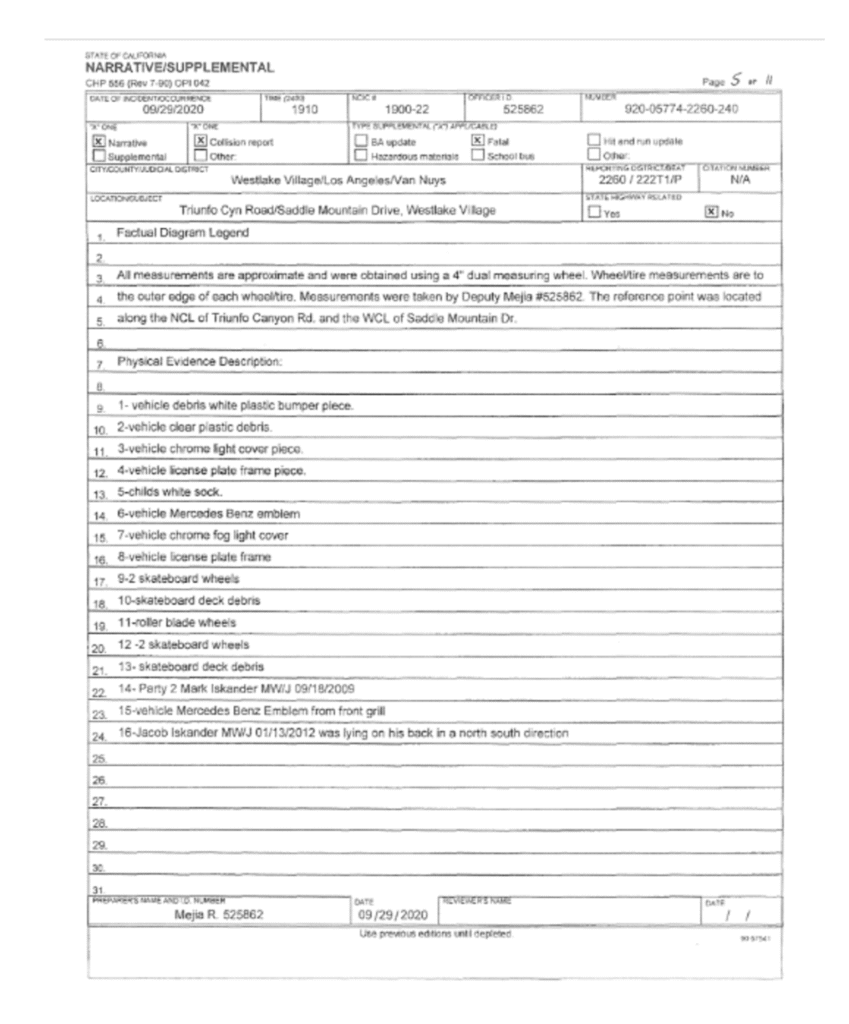
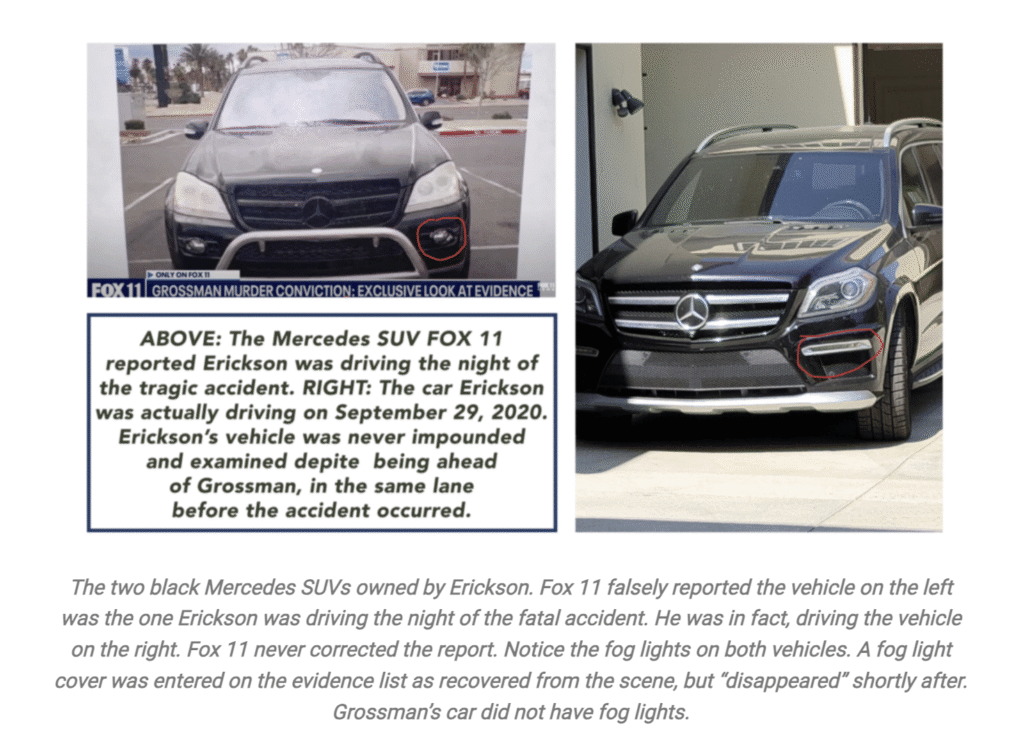
The lead vehicle repeatedly referenced in witness statements belonged to former Major League Baseball player Scott Erickson.
Erickson was driving an SUV just seconds ahead of Grossman in the same lane of travel when the boys were struck. Timeline analysis placed his vehicle in the immediate impact zone at the moment the children entered the crosswalk. Multiple witnesses indicated his SUV passed through first, followed almost immediately by Grossman’s Mercedes. This positioning placed Erickson’s vehicle as the likely first point of contact, a fact that should have made his SUV the primary focus of forensic investigation.
Erickson did not pull over after the collision. Instead, he continued driving to Grossman’s home two blocks away, leaving Grossman at the scene. After Grossman pulled to the side of the road when her Mercedes emergency system activated, she spoke with Erickson by phone. He asked her directly, “Did you see the kids?” Grossman responded “No!”. The reason is significant: Erickson’s SUV was traveling directly in front of her at close proximity, obstructing her view of the crosswalk. This positioning places Erickson’s vehicle as the first through the intersection and the driver most likely responsible for striking the boys.
Despite these red flags, Erickson was never questioned that night, and his vehicle was never seized or forensically examined, even though debris recovered at the scene was consistent with damage from his SUV and inconsistent with Grossman’s Mercedes.
Compounding these concerns, Erickson had a documented history involving DUI and had reportedly consumed alcohol throughout the day, including shortly before the crash. Multiple witnesses confirmed his whereabouts and his alcohol consumption. Despite this, investigators did not contact or interview Erickson that evening. Under standard prosecutorial practice, such factors would demand heightened scrutiny, not indifference. Yet Erickson faced only a misdemeanor reckless driving charge. Grossman, by contrast, was charged with second degree murder, exposing her to a potential life sentence.
The disparity was extraordinary.
The contrast in treatment raised immediate questions about investigative focus, selective prosecution, and whether conclusions had been drawn long before evidence was fully gathered.
Further clarity is emerging through the civil wrongful death litigation tied to the case. Depositions, discovery, and evidentiary disclosures have exposed major gaps in the original investigation. Critical evidence was never preserved. Documentation that should exist is missing. Items logged at the scene can no longer be located. Witness statements describing multiple impacts were minimized, reframed, or in some instances altered to fit the prosecution’s narrative – and in some instances, outright fabricated. Standard protocols for multi vehicle fatal collisions were not followed, further undermining the integrity of the investigation.
Rather than an investigation that evolved with evidence, the civil proceedings suggest a process that narrowed almost immediately and then worked backward to support a predetermined narrative.
Within hours of the crash, the investigative scope had effectively closed around Grossman as the sole responsible party. Once that determination was made, alternative explanations were no longer pursued with seriousness, and evidence inconsistent with the single driver theory quietly faded from the record.
To elevate the case from vehicular manslaughter to murder, prosecutors relied on the legal doctrine of implied malice. This requires proof that a defendant consciously disregarded a known risk to human life. Such charges are typically reserved for repeat DUI offenders who have been explicitly warned of lethal consequences through prior convictions.
Grossman had no prior DUI convictions. Her blood alcohol level was below the legal limit. There was no documented history of reckless conduct establishing awareness of deadly risk.
The prosecution’s implied malice argument rested almost entirely on a single alleged statement attributed to Grossman by a hospital technician suggesting she would have been home if not for the incident, which prosecutors framed as evidence of callous indifference.
The sheriff’s deputy who escorted Grossman continuously from the crash scene to the hospital testified that he never heard any such statement. His presence with Grossman was uninterrupted. This direct contradiction was never meaningfully presented to the jury, depriving them of critical context for assessing the credibility of the prosecution’s central malice evidence.
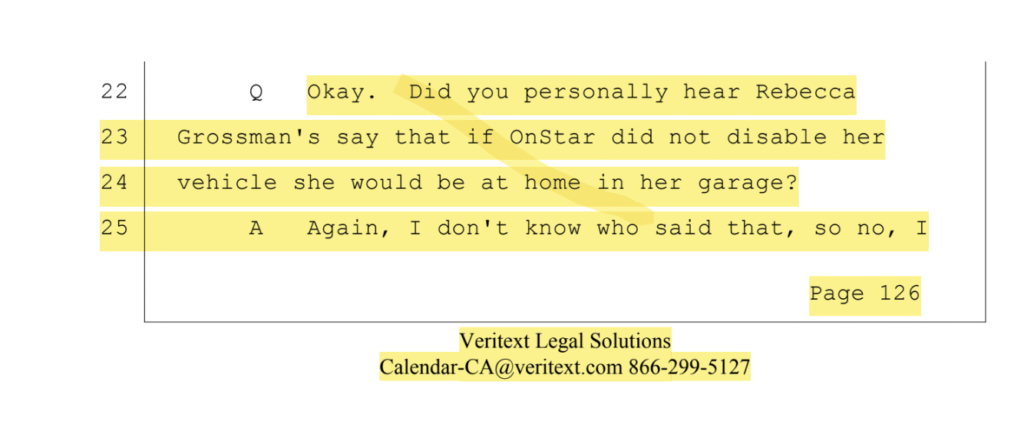
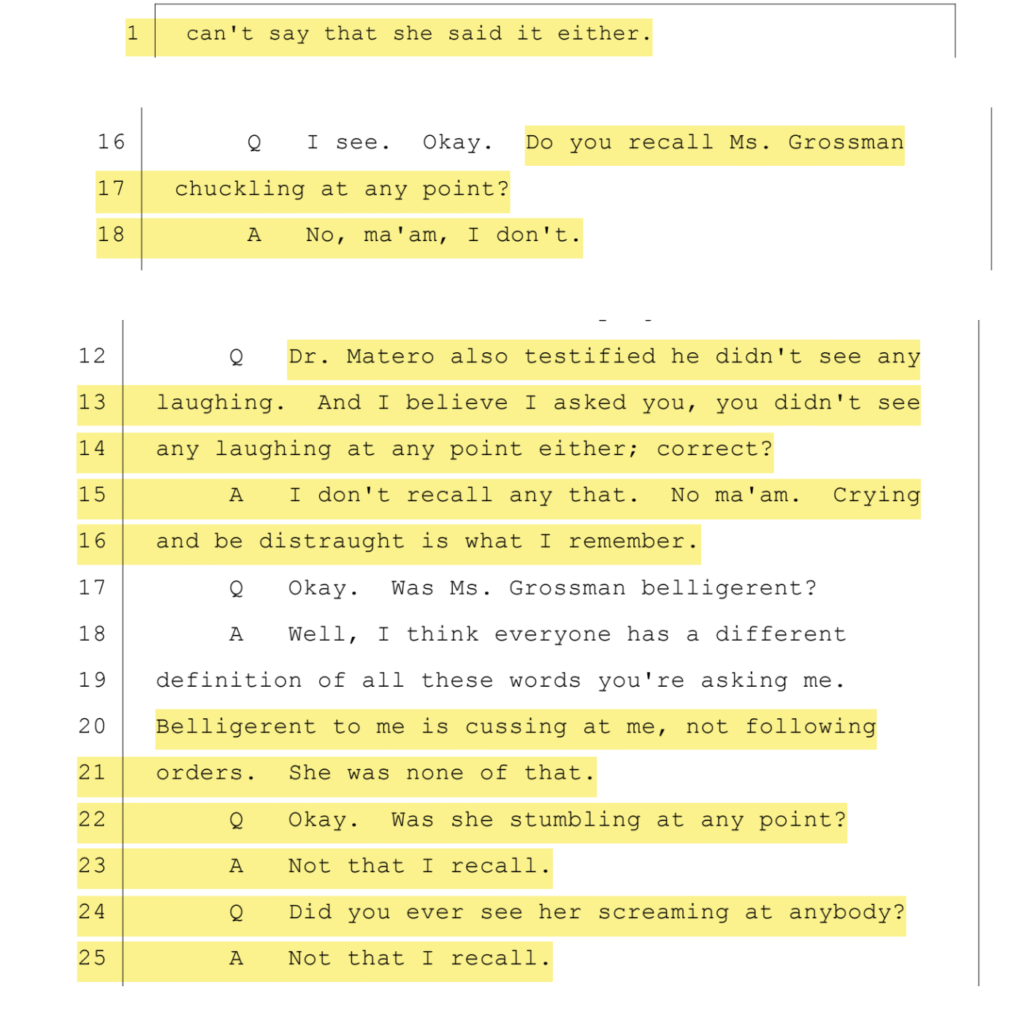
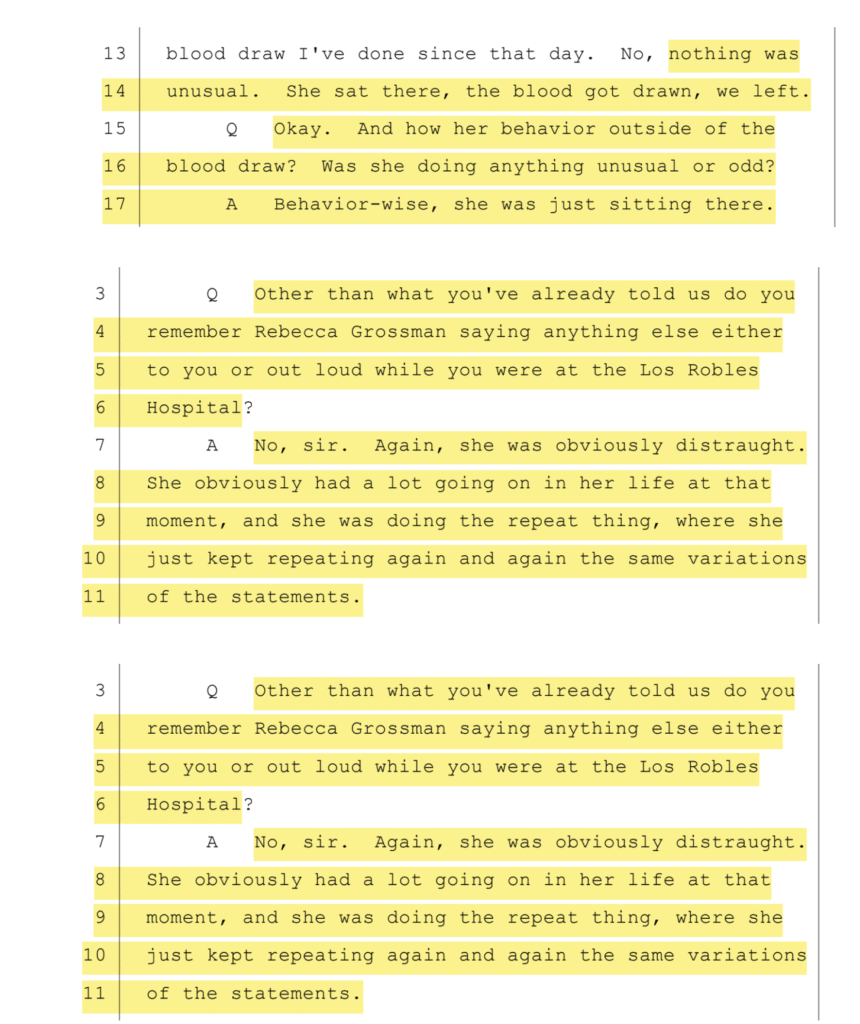
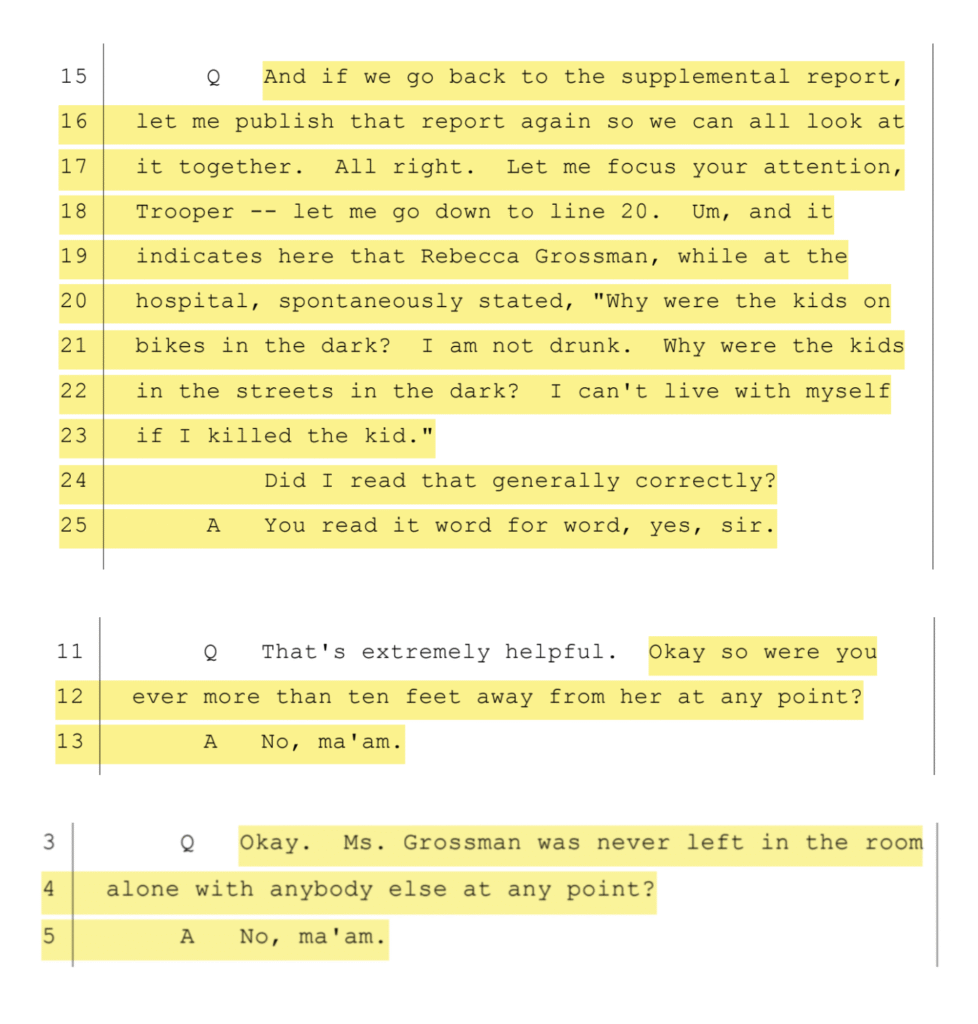
Without that statement, the legal foundation for second degree murder becomes substantially weaker.
Additionally, prosecutors attempted to convert Grossman’s post impact travel distance into “flight” to support implied malice, but California law does not define fleeing the scene by distance alone. Vehicle Code section 20001 requires a driver to stop “immediately at the scene of the accident or as close thereto as possible,” and appellate courts have repeatedly emphasized that the duty is to stop as soon as it is reasonably safe, with intent to evade responsibility or identification as the decisive element. The controlling case is People v. Scheer (1998) 68 Cal.App.4th 1009, which rejects the theory that continued movement, without evasive intent, constitutes flight. Scheer holds that stopping at the first reasonable opportunity satisfies the statute and that distance without intent is not fleeing. Applied here, the evidence described in the record shows Grossman pulled over and remained with her disabled vehicle and complied with instructions while awaiting law enforcement, conduct that aligns with statutory compliance rather than evasion under Scheer.
The forensic handling of chemical testing introduced further problems. Grossman declined an on scene blood draw for medical reasons, a legally permissible decision. A subsequent hospital blood draw violated established chain of custody standards, including improper labeling and handling. Despite these procedural failures, the sample was admitted and relied upon as evidence.
Meanwhile, physical evidence pointing toward another vehicle’s involvement continued to vanish from the case record.
No internal investigation publicly addressed the missing debris. No forensic explanation was provided. No accountability followed.
Public perception of the case was shaped largely by a media narrative that reinforced the single driver theory. Coverage emphasized wealth, speed, and tragedy while rarely examining the multi vehicle dynamics, missing evidence, or uneven treatment of involved drivers. Complexity gave way to moral simplicity.
The broader political context further illuminates prosecutorial decisions. At the time, law enforcement officials faced intense pressure to demonstrate toughness on violent crime amid public criticism over reform policies. The Grossman case offered a highly visible platform for aggressive charging. Elevating the case to murder transformed a tragic collision into a symbolic prosecution of accountability.
The jury ultimately received a streamlined version of events in which Grossman alone caused the deaths, contradictory evidence was excluded or minimized, and forensic uncertainty was largely absent.
She was convicted and sentenced to fifteen years to life.
Erickson faced no serious criminal consequences.
Civil litigation continues to surface evidence suggesting the outcome was shaped long before trial by investigative decisions that limited the scope of inquiry. Missing evidence, suppressed contradictions, and disparate treatment of involved drivers now form a pattern that is increasingly difficult to dismiss as coincidence.
The central question is no longer whether prosecutors pursued the case aggressively.
It is whether they pursued it honestly.
Two children lost their lives and deserved a full and transparent accounting of what happened that night. Instead, the justice system appears to have delivered a simplified narrative that allowed critical evidence to disappear and the most likely alternative cause to escape accountability.
Rebecca Grossman remains incarcerated.
Scott Erickson remains free.
As the civil case continues to unfold, it raises the disturbing possibility that the truth of what occurred on Triunfo Canyon Road was never fully presented to the jury entrusted with deciding guilt.
If that is so, this case will stand as a profound example of how wrongful convictions are not always created through fabricated evidence, but through selective investigation, narrative control, and institutional refusal to pursue facts that complicate a desired outcome.
DISCLAIMER: Investigative reporting in high-profile litigation cases published by The Current Report is non-commercial, fact-based journalism; any project fees compensate research and reporting labor only, sources participate solely in accuracy verification, and final publication is approved exclusively by The Current Report after fact-checking is confirmed.