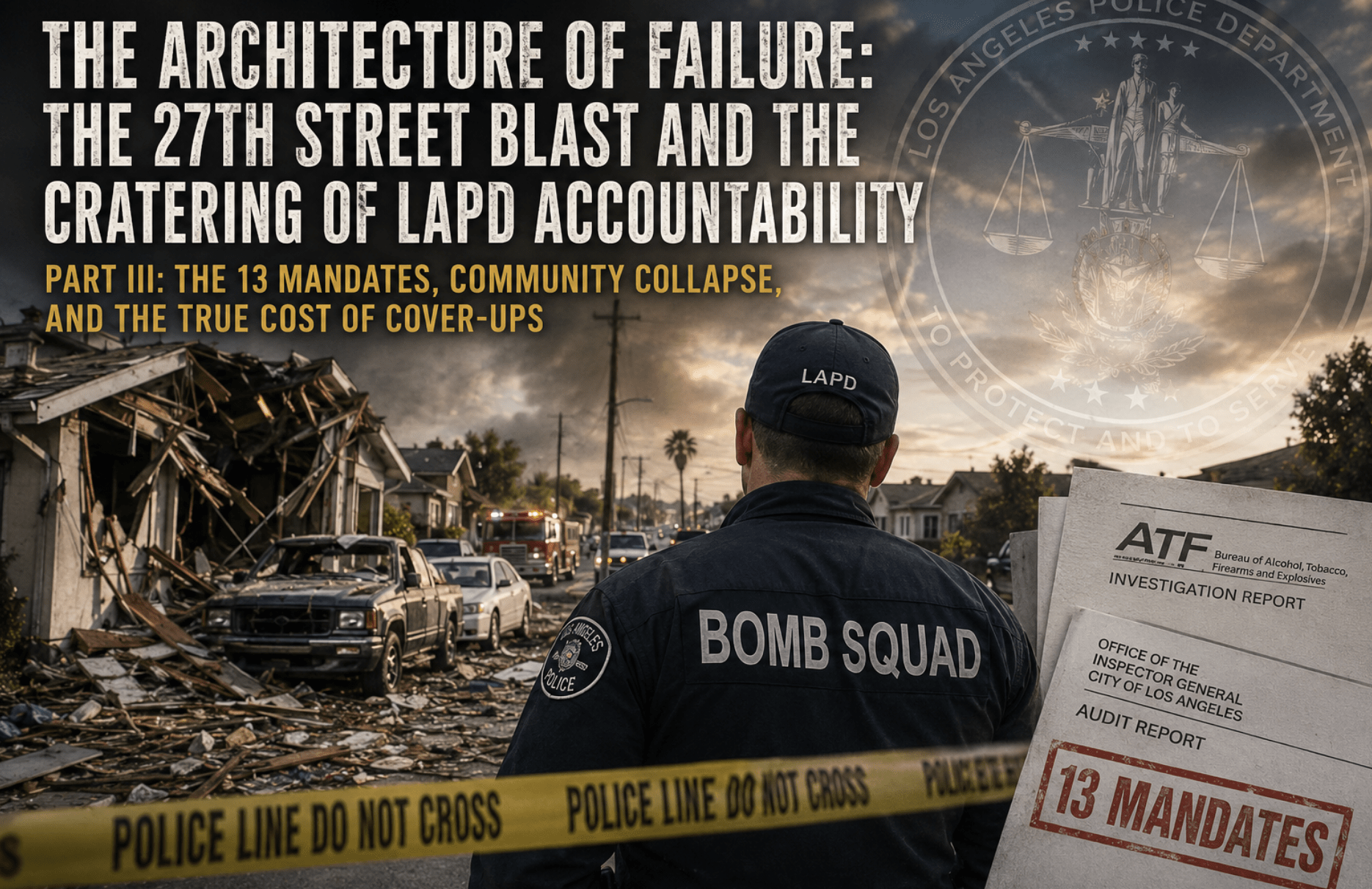
THE 13 MANDATES, COMMUNITY COLLAPSE, AND THE TRUE COST OF COVER-UPS
The course of administrative accountability shifted temporarily in April 2022, when I officially assumed oversight of the Office of Special Operations. One of my immediate and absolute priorities upon taking command was ensuring that every single one of the federal ATF and municipal Inspector General recommendations was moving forward aggressively, shifting the unit from a legacy of visual guesswork to a culture of strict empirical safety.
Soon after my appointment, I demanded a full tactical demonstration and detailed operational briefing from the Bomb Squad. Rather than receiving a polished presentation in a comfortable downtown conference room, I forced the unit to transport their equipment to a remote range in Ventura County, where I personally attended a grueling day in the field to observe their deployment methodologies firsthand.
Although the presentation was technically exhaustive and appeared structurally sound on paper, I took the time to praise the team for their hard-earned progress while delivering an uncompromising mandate: I vowed to remain directly hands-on with their operations in understanding the process and the needs of the Bomb Squad moving forward. This commitment did not stem from a lack of internal trust, but rather from a deep, professional respect for the extreme hazards of their mission, paired with an executive necessity to fully understand the real-world risks, personnel deficits, and training constraints we desperately needed to address before Los Angeles hosted upcoming high-profile, high-security global events.
This command evaluation focused on the execution of 13 mandated corrective recommendations for full administrative accountability:
- On-Site Residential Detonation Ban: Absolute ban on detonating volatile materials in residential sectors. Tactical teams must transit explosives to remote ranges, except in rare, exhausted circumstances.
- Mandatory Certified Scale Deployment: Standardized digital field scales on all Bomb Assessment Trucks, ending visual weight guessing.
- Dual-Signature Weight Verification: Requires both the handling technician and the on-scene supervisor to independently verify and sign ICS Form 208 before sealing a containment vessel.
- TCV Engineering Limit Re-Certification: Mandatory manufacturer retraining by NABCO to enforce the strict 33-pound TNT equivalent limit of the containment sphere.
- Expanded Multi-Agency Notifications: Automated digital alerts route scene metrics to the CTSOB Commander, geographic division commands, and the impacted Council District prior to detonation.
- Dissenting Technician Safety Protocol: An official pathway allowing any squad member to halt an operation over containment concerns, completely shielded from retaliation.
- Quarterly Compliance In-Service Audits: Internal reviews of training files and equipment by the Emergency Services Division (ESD) command to prevent data manipulation.
- FBI HDS Recertification Enforcement: Strict adherence to the mandatory three-week federal recertification at Redstone Arsenal every three years to maintain active field clearance.
- Electronic Explosive Log Integration: A secure, real-time digital inventory tracking server to map all seized black-market explosives and bridge communication gaps.
- Supervisor Technical Competency Matrix: Requirements for ESD supervisors to pass technical safety assessments, ending the patronage system of placing inexperienced aides in hazardous roles.
- Mobile Safe-Site Transit Operations: Acquisition of heavy-duty transport trailers engineered to safely route volatile commercial materials through urban corridors.
- OIG Unannounced Field Inspections: Open-door authority for the Office of the Inspector General to audit active explosive scenes in real time without warning.
- Continuous Incident Command Integration: Geographic Area Captains act solely as scene and security managers, while specialized ESD command staff retain sole tactical and legal liability for engineering thresholds.
Building and maintaining an elite explosive disposal unit requires a massive taxpayer investment and a multi-year pipeline. Before handling live explosives, an officer must clear an internal selection matrix and graduate from the grueling six-week FBI Hazardous Devices School (HDS) in Huntsville, Alabama—the sole national certification standard.
Upon returning, a new technician faces a one-year internal apprenticeship under a master tech. Ultimately, it takes 3 to 5 years of specialized field service to reach operational autonomy, costing over $150,000 per technician to recruit, clear, train, insure, and equip. Maintaining this perishable skill set requires 24 hours of monthly specialized training and federal recertification at HDS every three years. When administration lets these metrics slide—as LAPD high command did for five consecutive years prior to the 27th Street blast—they aren’t just mismanaging a ledger; they are defunding the safety mechanisms that protect crowded neighborhoods from total devastation.
The political and community friction generated by this executive self-preservation peaked during a series of highly volatile, emotionally charged public meetings that pitted residents and activists against a shifting roster of police leadership. On July 11, 2021, the department participated in the Shockwave Town Hall, held at the Fred Roberts Recreation Center park shelter just eleven days after the disaster. This meeting was an absolute cauldron of neighborhood fury, as the shelter was actively housing displaced families whose homes were red-tagged.
Present at the table were me, Councilman Curren Price, Newton Area Captains, and Commander David Kowalski. Selectively absent from this volatile meeting were Chief Moore and Assistant Chief Marino, who was overseeing the Office of Special Operations at the time of the explosion.
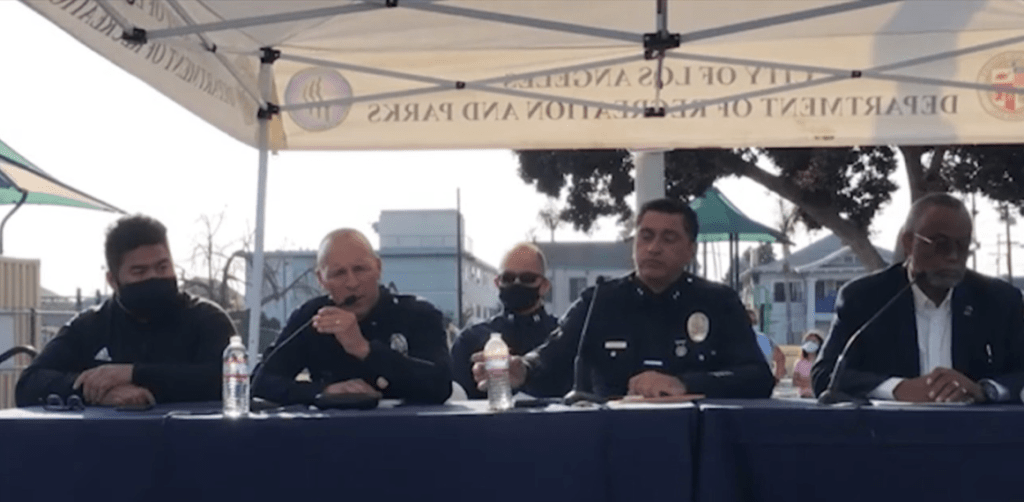
When cornered by furious residents during the town hall meeting demanding to know who signed off on detonating multi-ton explosives in a residential zone, Kowalski executed his public deflection. He shifted blame away from his specialized bureau and explicitly named the Newton Area Patrol Captain, Bratcher, as the responsible party. This meeting was not a time to point blame, but instead to take responsibility for trying to clean up the destruction and helping residents recover. I apologized to the community and assured them we would release the ATF reports when they were finalized.
Following this, on July 16, 2021, the city held the EOC Resource Transition Briefing, attended by the Emergency Management Department (EMD), the American Red Cross, and Newton and Central Bureau staff. This operational meeting was designed to transition the local area into a long-term resource center. While field officers and local command staff sat with residents coordinating necessities, downtown special operations leadership completely boycotted the forum, refusing to step foot south of the 10 Freeway.
This administrative friction culminated on September 14, 2021, during the ATF Forensic Report Release Meeting. Conducted under massive media scrutiny, this press and community briefing marked the official delivery of the federal failure analysis. I, along with Newton staff and regional ATF directors, presented the forensic data confirming the squad’s unscientific calculation errors. Moore and Assistant Chief of OSO Marino were too busy to attend. The forum confirmed the disaster was born of human error and exposed the deep operational fracture within the unit, revealing that senior bomb technicians had actively questioned the loading thresholds on-scene but were forcefully overruled by supervisors.
As the post-blast recovery continued, the isolationism of police headquarters hardened into a physical boundary. Chief Michel Moore and Assistant Chief Rob Marino were nowhere to be found. Throughout the entire crisis, they consistently refused to travel south of the 10 Freeway into the devastated Newton community to face the public or look the displaced families in the eye.
Instead, the burden fell entirely on me at the Central Bureau level and the Newton Area Captains. Week after week, we had to anchor the town halls and subsequent regular community meetings, taking the full brunt of the intense verbal beatings for a debacle we did not cause. We sat through endless public forums listening to Councilman Curren Price—who is now facing felony charges for embezzlement—continuously throw the department under a perpetual political bus to advance his own narrative, all while the individuals responsible for the technical negligence remained insulated inside police headquarters.
Even personnel dealing with severe medical recoveries were not spared from administrative pressure. Chief Michel Moore aggressively insisted that key command staff return early from Injured on Duty (IOD) status, including forcing a return immediately following the Area Captain’s invasive hernia surgery—purely to handle the exploding logistical and political fallout of the 27th Street incident. This cowardice did not go unnoticed within the upper echelons of the department. The Director of the Office of Operations at the time, Assistant Chief Beatrice Girmala, openly and sharply criticized the dynamic, expressing disgust at how the field command was being forced to clean up a catastrophic mess engineered entirely by downtown special operations personnel who were actively hiding on the 10th floor.
In the wake of the 27th Street detonation, outside political activists and professional agitators immediately swarmed the neighborhood, aggressively pushing a racially charged narrative that an incident like this “only happens in communities of color.” This rhetoric is a deliberate mischaracterization of standard hazardous-materials field realities.
The operational truth is unyielding: the Bomb Squad executes on-site emergency renderings based entirely on whether a seizure is dynamically deemed unsafe to transport—not the demographic makeup of the surrounding ZIP code. If tactical teams had discovered a multi-million-dollar mansion in Bel-Air or the Palisades packed to the rafters with thousands of pounds of highly unstable, decomposing commercial explosives mixed with volatile, raw hobby-fuse flash powder, the technicians would have deployed the exact same Total Containment Vessel and executed the exact same on-site render-safe protocol. The physical chemistry of unstable flash powder reacts to ambient heat and friction without regard for real estate values.
The primary reason these large-scale containment operations do not frequently occur in affluent residential enclaves is not due to selective policing; it is because illicit, heavy-tonnage black-market commercial distribution rings—which require massive flatbed border-smuggling operations and loose backyard neighborhood storage—are structurally non-existent in areas dominated by multi-acre luxury estates.
Furthermore, activist groups have continually weaponized the agonizing, multi-year rebuild delays on 27th Street to claim systemic institutional racism within city management. This claim falls apart under an objective examination of municipal performance citywide. The paralysis gripping South LA is not a localized racial phenomenon; it is a direct consequence of a city government entirely paralyzed by thick layers of bureaucratic red tape, risk-management cowardice, and an over-reliance on highly paid external consulting networks. One needs only to look to the current (2026) recovery landscape in the ultra-wealthy enclave of Pacific Palisades to see the exact same institutional incompetence.
Following a devastating wildfire, affluent Palisades residents attempting to rebuild their multi-million-dollar homes have found themselves locked in an identical bureaucratic nightmare. Over a year after the city billed an emergency infrastructure project, close to $20 million in taxpayer funds has been paid to corporate contractors (including AECOM and Hagerty Consulting) to generate a standard rebuilding roadmap. Yet, today, that critical infrastructure report remains completely buried and unreleased, locked inside the Los Angeles City Attorney’s Office under opaque “reviews” while the leadership of the corporate firm abruptly quit before final delivery. Palisades residents find themselves completely blocked from acquiring basic powerlines, water systems, and structural grading permits, leaving their generational properties sitting as sterile, empty lots.
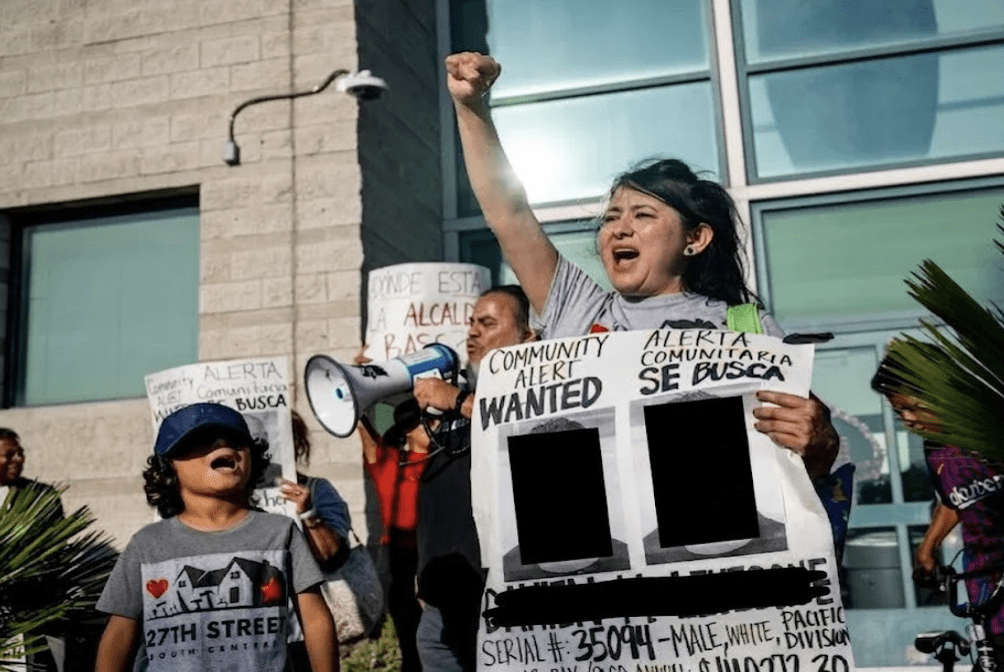
Whether it is a working-class block in the Newton footprint or a luxury hillside in the Palisades, the systemic enemy remains unchanged. The recovery of Los Angeles neighborhoods is systematically derailed by an administrative culture that values transactional optics, legal stalling tactics, and corporate buck-passing above actual ground-level execution. This is worsened by career activists with loud voices who would rather scream into megaphones to advance their own external political agendas instead of stepping onto the pavement and doing the heavy work required to get a job done.
While the 10th floor insulated itself from public fury, the rank-and-file coppers and command staff of the Newton Area Division were thrown into a brutal, double-front operational war. Newton Division was forced to simultaneously manage an active disaster recovery zone, rebuild a shattered community relationship, and continue policing a high-crime nine-square-mile territory that was experiencing a violent pandemic-era crime spike.
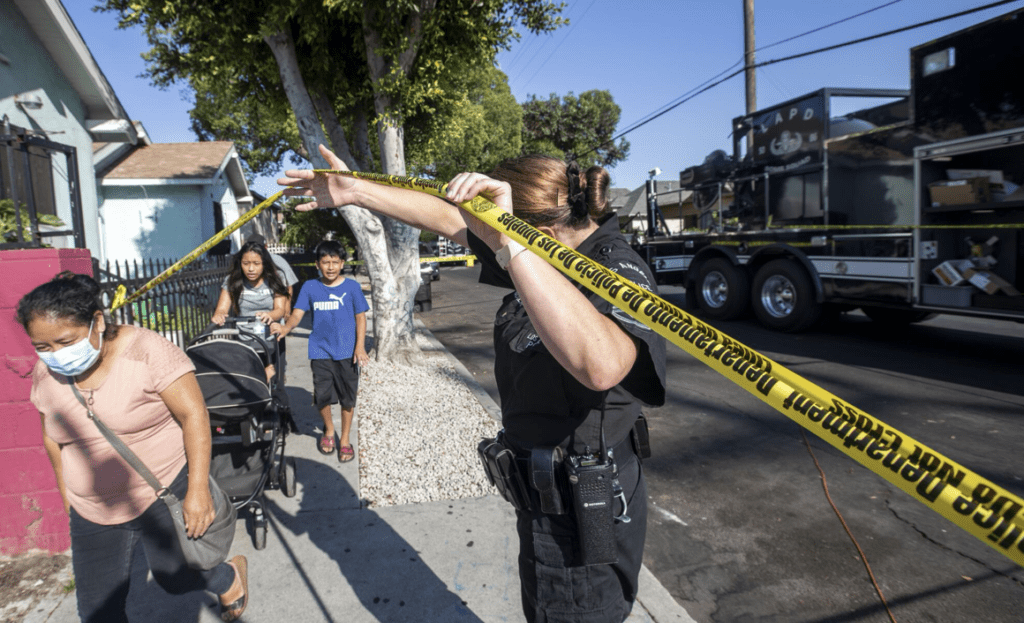
To bridge the gap left by the city’s sluggish administrative payout timeline, Newton’s Captains, Community Relations Office, and Senior Lead Officers (SLOs) established an immediate, grassroots life-support system. Operating out of makeshift shelters, Newton personnel organized, funded, and facilitated dozens of local health clinics, neighborhood resource drives, and employment fairs.
Recognizing the profound psychological trauma inflicted on the neighborhood’s children, SLOs regularly purchased and brought out ice cream carts into the 27th Street corridor, coordinating specialized social workers to provide crisis counseling inside local schools.
Newton officers personally solicited donations from within their own private ranks and local business partnerships to replace destroyed toys, clothing, specialized medical equipment, and bicycles for families stuck inside corporate hotel rooms. In one instance, after a young girl distributed desperate flyers for her cat that fled into the debris during the blast wave, Newton officers spent hours tracking down, recovering, and safely returning the pet to the child.
This intense community support had to be executed while maintaining baseline patrol and investigative resources across the rest of the division. Newton’s leadership had to carefully partition their personnel. While one segment secured the perimeter of the blast zone to prevent predatory looting, vandalism, or illegal habitation across over 35,000 documented person-hours, the rest of the division’s frontline coppers continued responding to an unrelenting influx of gang shootings, armed robberies, and domestic violence calls across the grid.
Newton coppers were actively sweating on the pavement to stabilize daily lives, even as outside political groups like Union del Barrio—an organization known for empty megaphone stunts that screams in the faces of first responders and elected officials—did nothing to actually support the community. They are known to demonize the very station officers keeping the neighborhood from collapsing, yet they fail to log any actual acts of kindness for those in need.
The sheer fortitude of the Newton Area personnel deserves unyielding praise. Frontline officers and command staff inherited a $33 million-plus tactical debacle dumped squarely on their doorsteps by a careless downtown elite. While the special operations supervisors responsible for the mathematical guesswork hid behind backroom friendships, corporate anonymity, and protective drinking-buddy deals, the boots on the ground at Newton stood tall. They held the line under a shower of public condemnation, quietly engineering a multi-year baseline of human and physical stabilization without any real structural assistance from the 10th floor. I praise the Captains particularly; after being thrown under the bus by Kowalski, they dove in and worked towards fixing a destroyed community while handling one of the busiest commands in the city.
The weaponization of the department’s opaque disciplinary apparatus exposes the ultimate double standard orchestrated by the Chief’s office to protect internal loyalists while crushing independent rank-and-file voices. When the internal investigation into the 27th Street disaster concluded, the department aggressively used state privacy statutes as an absolute shield to bury the records and conceal the identities of the leadership who engineered the blast. This administrative secrecy was framed to the public as a legal obligation under officer privacy laws, yet it was applied selectively to wrap favored insiders in anonymity while denying those same protections to personnel who spoke up against 10th-floor metrics.
When massive data dumps finally exposed the hidden disciplinary actions, the reality shattered the department’s claims of internal accountability. While the taxpayers have been left saddled with over $33 million and counting in direct municipal debt, the specific personnel responsible for technical negligence were taken care of with minor slaps on the wrist. Rather than facing termination or demotion, four primary Bomb Squad personnel were quietly insulated: three frontline bomb technicians received minimal 10-day suspensions without pay.
Meanwhile, Supervisor A, who actively overruled the on-scene warning and ordered the vessel filled, was handed a minor 18-day suspension—no demotion, and no recommended termination like the Sergeant who shared a meme. He was then quietly granted a protected lateral transfer out of the unit, completely shielding his pension and career from public blowback. All discipline was orchestrated directly from the Chief’s office, circumventing normal chain of command protocols.
This protective anonymity exposes a deep institutional hypocrisy when contrasted with the treatment of officers who challenge leadership failures. For adversaries or independent rank-and-file members, the Chief’s office frequently authorized immediate press releases that openly violated provisions of the Public Safety Officers Procedural Bill of Rights (POBR), splashing names and unproven allegations across the evening news to publicly humiliate them before a formal hearing could even convene. The department’s secretive disciplinary matrix was never about preserving legal privacy—it was a coordinated cover-up to protect drinking buddies and downtown favorites, proving that under Chief Moore, the financial and physical safety of Los Angeles taxpayers carried zero value when stacked against the career preservation of the 10th floor’s inner circle.
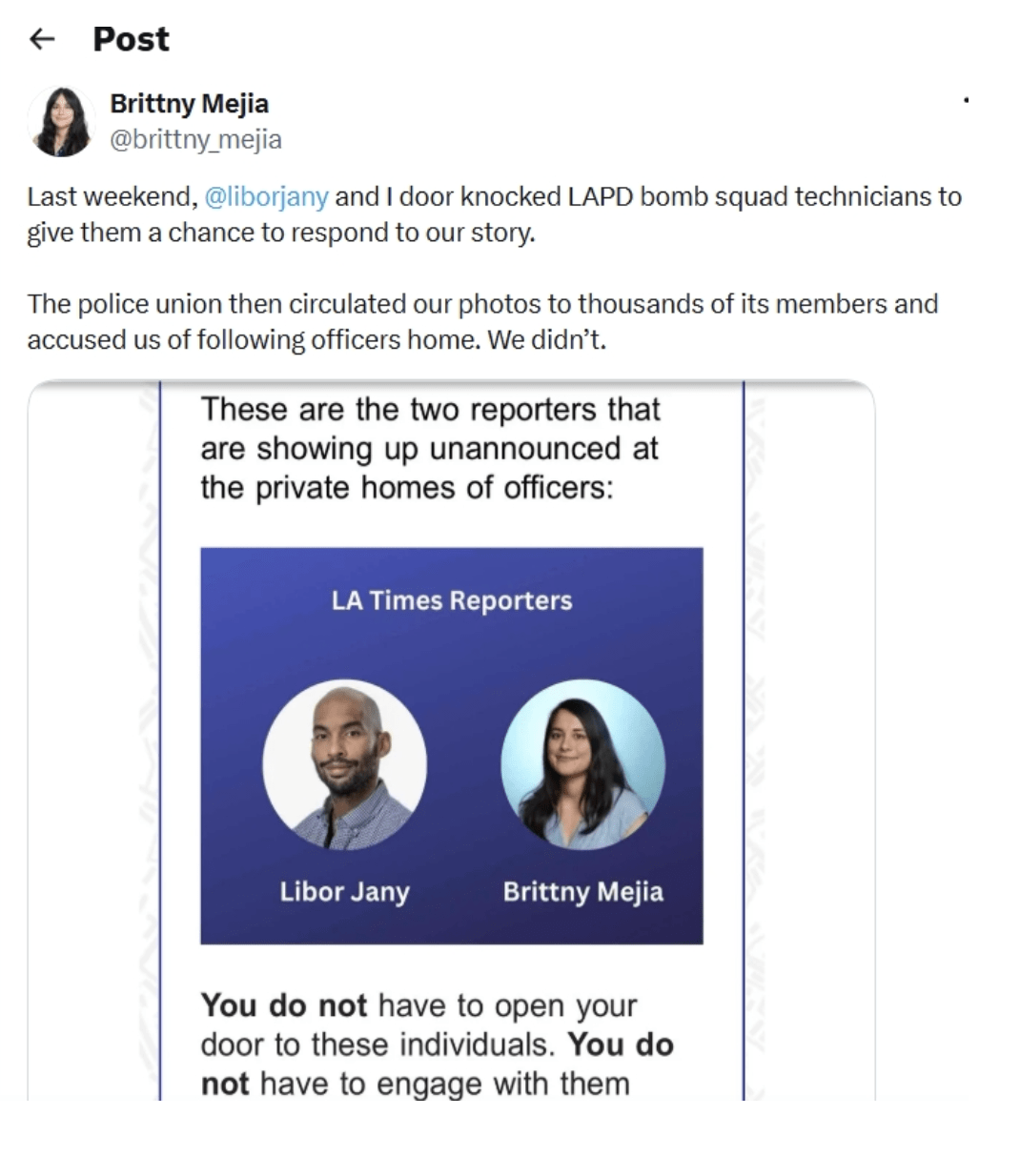
The fallout from the 2021 fireworks explosion expanded from the physical destruction in South Los Angeles to a fierce battle over accountability, media ethics, and transparency. As investigations exposed critical miscalculations by the LAPD bomb technicians regarding the weight of the explosives, the scrutiny intensified. However, the aggressive tactics used by Los Angeles Times reporters Brittney Mejia and Libor Jany ignited deep frustration when they unannouncedly approached the personal residences of the bomb technicians to secure statements.
For critics, crossing the boundary into the private lives and doorsteps of law enforcement officers went far beyond standard investigative journalism—mirroring the hostile, targeted pressure tactics typically deployed by political activists. While the publication defended the outreach under the umbrella of routine, aggressive public-interest reporting, the incident highlighted a glaring double standard for those who felt the media routinely shields its own practitioners from the same invasive scrutiny and adversarial confrontations they inflict on others. I am certain that if I showed up to Libor’s home to criticize his one-sided and biased reports, he would not be too excited about my visit. Yet when confronted by me about the unexpected and unethical visit, he condoned it as the public’s need to know the officers’ identities. There will be much more to report in the future about so-called reporters, LAPD sources, and unethical reporting.
The total collapse of institutional integrity came full circle in how privacy, ethics, and disciplinary standards were selectively weaponized by Chief Moore’s public relations apparatus. The 10th floor systematically manipulated the timing, wording, and legal framing of official news releases to craft completely different narratives for inner-circle loyalists versus independent rank-and-file officers. During his initial post-blast press conferences, Moore actively defended the actions of the Bomb Squad, proactively spinning an institutional narrative to buffer the agency before an independent federal investigation had even been initiated.
Yet, when a manufactured personal allegation was leveled against an independent employee not in the drinking buddy circles who refused to “kiss the ring,” the public relations strategy inverted overnight. The Chief’s office aggressively authorized press releases that openly named the accused adversary and featured weaponized statements condemning their “alleged” behavior—laid out on a public chopping block a mere week before any formal internal affairs investigation could even be initiated. As we will explore in future articles, it is clear and undeniable that the 2023 actions taken by Moore were not only retaliatory, but calculated to remove a threat and protect his unethical, illegal actions taken in 2018 to conceal criminal activity.
Five years after the blast, a profound disconnect remains between headquarters and the street. On paper, the LAPD has logged all 13 mandates as fully implemented: scales are standardized, signatures are cataloged, and commanders are on alert threads. Yet, due to budget realignments, a permanent local disposal range remains unbuilt, leaving the unit structurally reliant on county mutual aid and long-distance hauling. Bomb Squad staffing was augmented via lateral transfers, but retention still buckles under broader tactical attrition.
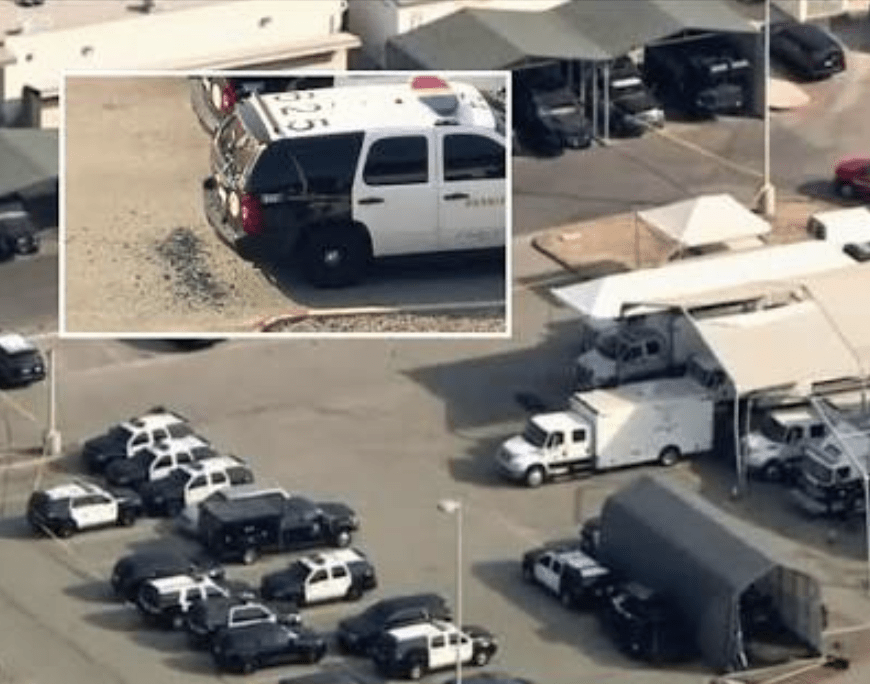
This volatile reality was underscored by a tragic July 2025 explosion at a Los Angeles County Sheriff’s Department facility in East LA, which killed three veteran detectives and highlighted the unforgiving stakes of explosive disposal.
Ultimately, the glossy corporate narrative peddled downtown does not match the landscape south of the 10 Freeway. For families who spent years stuck in hotel rooms or fighting predatory, stalling legal battles, paper fixes offer little comfort. The true resolution of the 27th Street disaster is not being written by the command staff who caused it and hid, but by the frontline Newton officers, neighborhood coalitions, and local families rebuilding their community block by block.
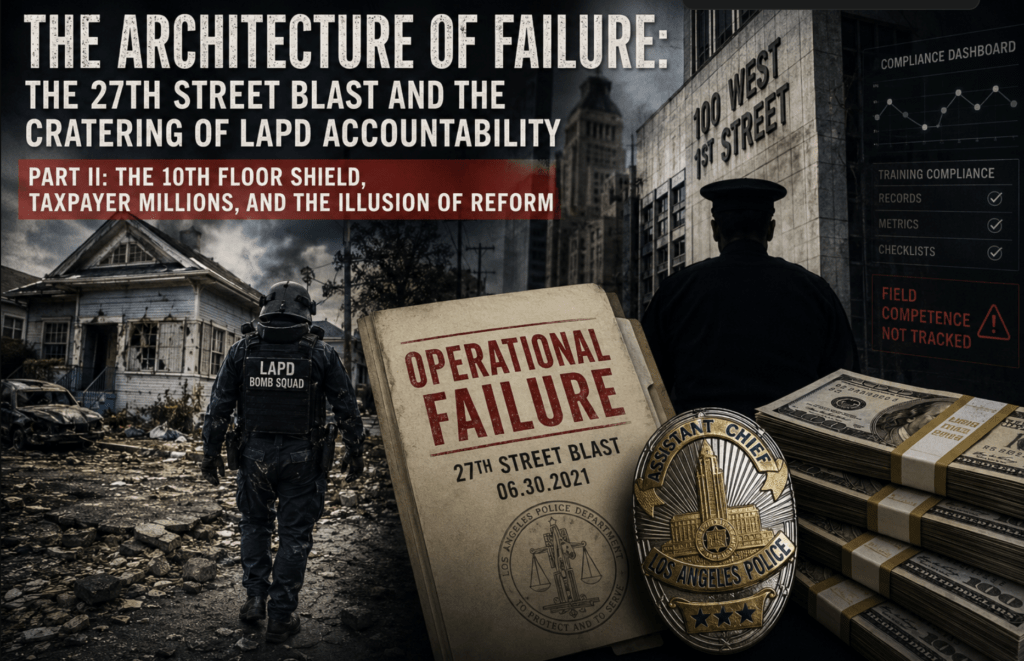
Looking back at June 30, 2021, from this five-year vantage point is to witness the absolute triumph of institutional smoke and mirrors over true systemic change. Five years ago, an elite tactical unit operating with unvetted impunity marched into a working-class South Los Angeles neighborhood, discarded physical measurement tools, ignored explicit internal warnings, and detonated an overloaded containment chamber that leveled a community block and shattered scores of innocent lives.
Five years later, the neighborhood remains physically and socially fractured—60% of its displaced generational core permanently exiled—while the department boasts of 100% paper compliance on its newly minted digital checklists. This retrospective exposes the profound hypocrisy of a double standard that wraps favored inner-circle drinking buddies in state-sanctioned anonymity and lateral transfers when they fail catastrophically, yet strips away the legal privacy and protections of independent rank-and-file members the moment they refuse to “kiss the ring” or dare to speak the truth.
The superficial policy fixes implemented under the Moore legacy were never engineered to protect the public or frontline officers; they were designed to shield the 10th floor from accountability. Today, as the taxpayer bills climb past $33 million, the core architecture remains untouched, confirming that what the department peddles as institutional reform is nothing more than a polished corporate illusion engineered to take care of downtown favorites while pushing the true doers out to pasture.
The true legacy of the 27th Street blast is not found in newly minted digital checklists or performative press conferences, but in the ruins of a working-class neighborhood and the $33 million burden strapped to the backs of Los Angeles taxpayers. By aggressively insulating the architects of this disaster while vindictively crushing the officers who dared to speak the truth, LAPD headquarters cemented a devastating reality. The department has successfully engineered an administration where corporate survival supersedes public safety, political loyalty eclipses tactical competence, and the lives of the citizens they are sworn to protect are viewed as entirely expendable. The Bomb Squad didn’t just crater a city block that day—the 10th floor cratered the foundational integrity of the badge itself.