

Instead, court filings, documentary evidence, emails, and a remarkable sequence of events are raising new questions – not simply about the StarClub fraud itself, but about what federal investigators knew, how narrowly they framed the prosecution, and whether a much larger body of evidence was left outside the courtroom.
The Timeline is Difficult to Ignore
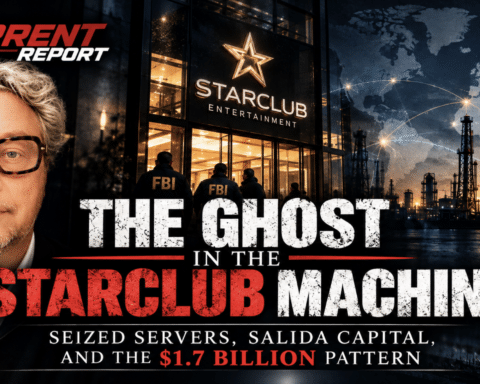
On May 14, The Current Report published an investigation examining the StarClub scheme alongside StarClub CEO Fritsch’s knowledge of a large scale recurring financial pattern involving $1.7 billion and $400 million figures repeatedly surfacing in Covid-era fraud reporting. The investigation identified more than 60 headline news articles containing those same figures and brought up obvious racketeering implications.
Just 96 hours later, Washington announced a brand-new $1.7 billion anti-fraud and “anti-weaponization” initiative. Standing alone, the timing proves nothing. But when viewed alongside the chronology that follows, it raises legitimate questions deserving of public examination.
The StarClub case did not begin inside a federal courtroom. It began in Malibu. Long before the FBI raided StarClub’s offices, Fritsch had carefully built the image of a successful technology entrepreneur. He surrounded himself with extraordinary symbols of wealth and influence, including a luxury estate overlooking Malibu’s Billionaire’s Beach, exotic vehicles such as a McLaren and Rolls-Royce, and repeated claims that he owned the global MP3 patent and had participated in transactions involving Steve Jobs and iTunes. Whether each of those representations ultimately proved accurate is only part of the story.

The larger investigative question is how those claims were used to establish credibility, attract influential relationships, and create the appearance of legitimacy surrounding StarClub before federal prosecutors dismantled the company.
One of StarClub’s greatest assets was not intellectual property. It was access. That access came through Cary ONeal, known professionally and federally trademarked as “Mr. Malibu® ”. ONeal had spent decades building relationships throughout entertainment, technology, media, and business while helping manage operations at the Malibu Performing Arts Center, a 46,000-square-foot venue that hosted artists including Sting, Tom Petty, Bob Dylan, and Pink.
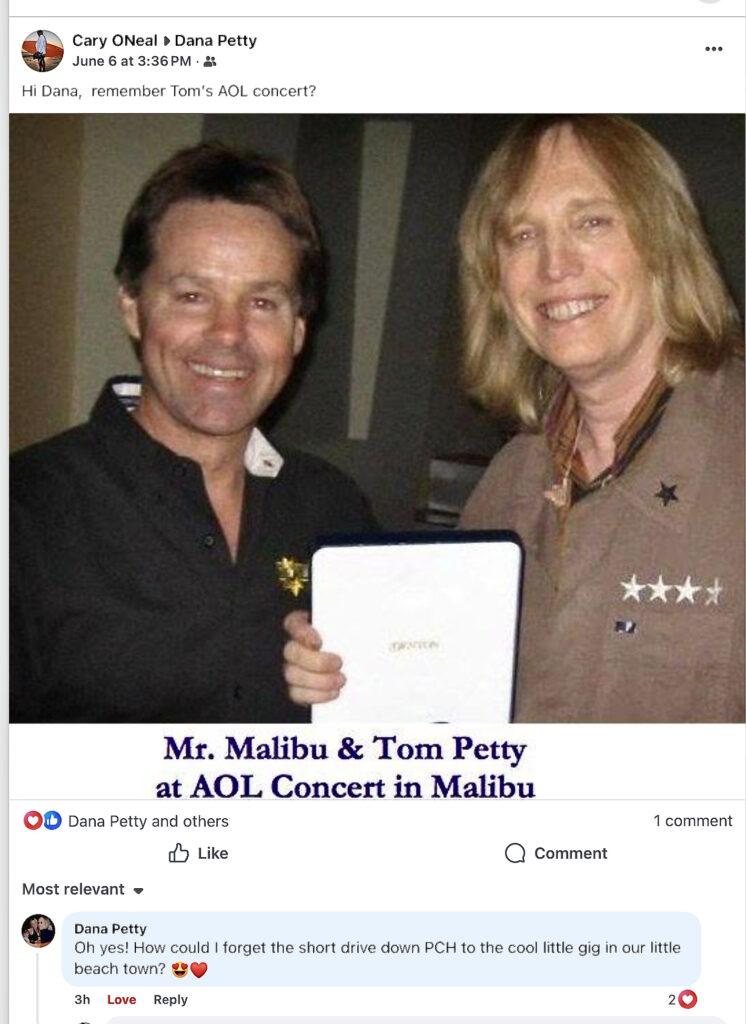
Fritsch initially sought to purchase the Malibu Performing Arts Center as the entertainment centerpiece of StarClub’s growing social media platform. When municipal intervention halted that acquisition, he pivoted, hiring ONeal as Communications Manager and business development strategist.
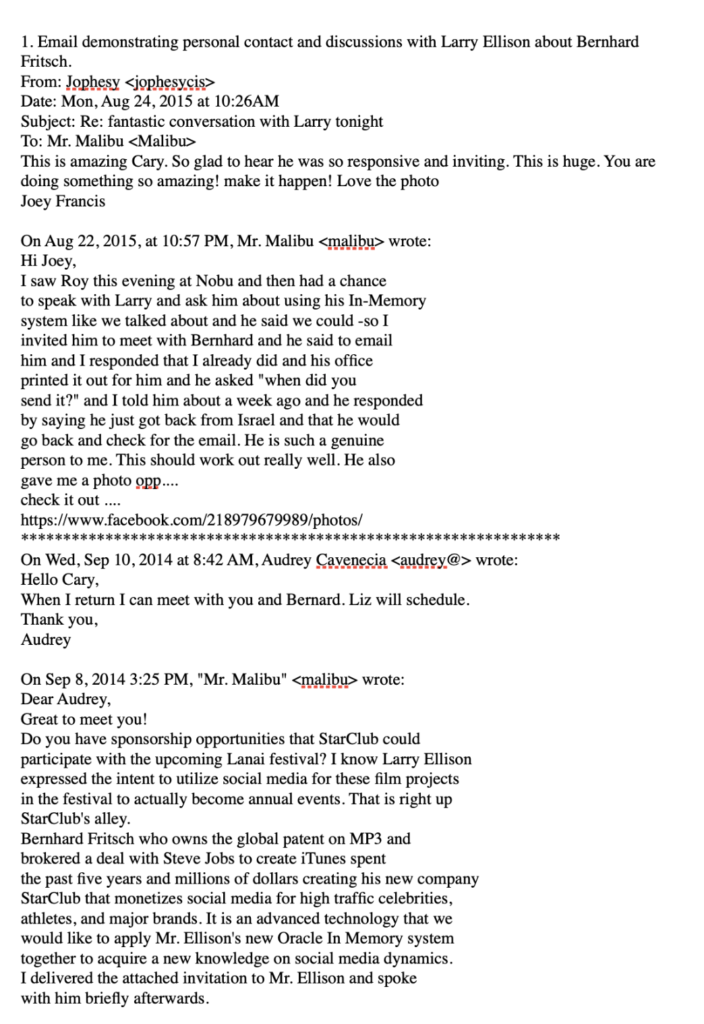
According to emails contained within the evidentiary record, ONeal immediately began leveraging decades of professional relationships to introduce StarClub to some of the most influential names in business. Those records document successful high-level meetings personally brokered by ONeal, including a strategic dialogue with Oracle founder Larry Ellison regarding Oracle’s In-Memory technology.
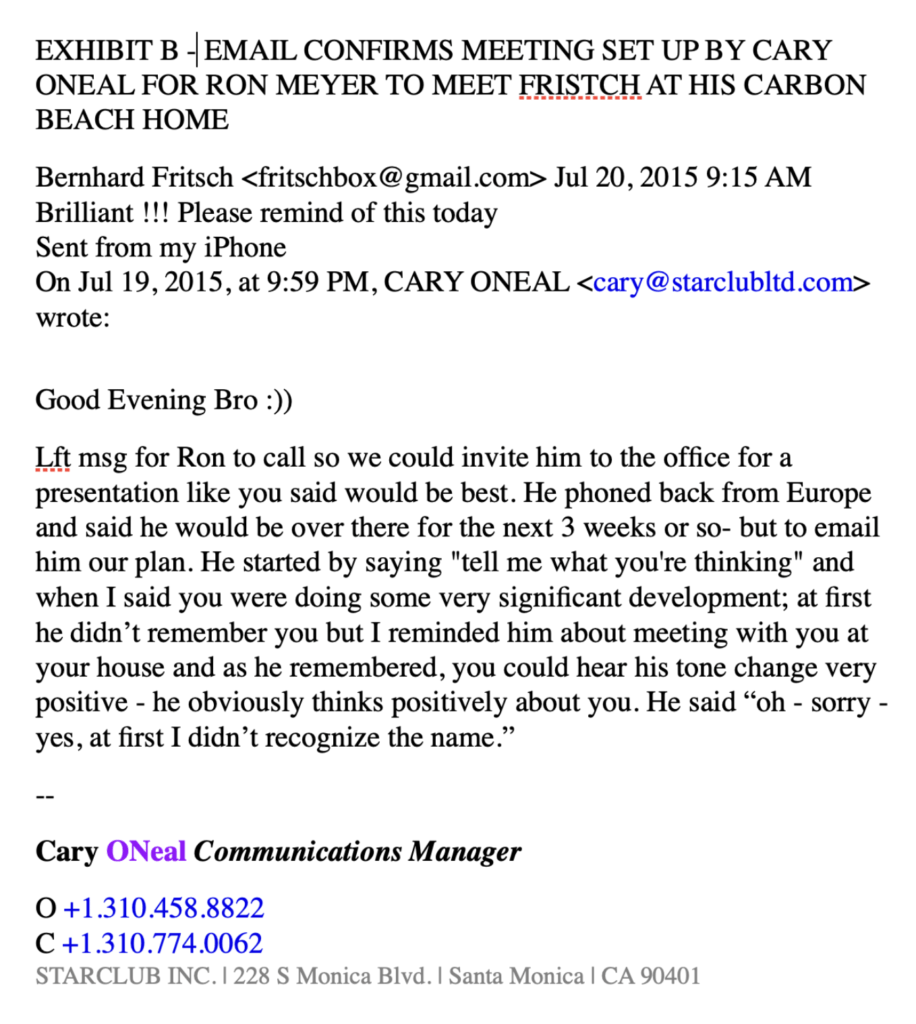
Other communications verify a face-to-face meeting ONeal arranged at Fritsch’s estate with former NBCUniversal executive Ron Meyer to explore Universal and Comcast relationships, alongside outreach connected to Scott Swift, the father of Taylor Swift, Universal Music Group, Linkin Park, and members of Roger Federer’s management team, among many others.
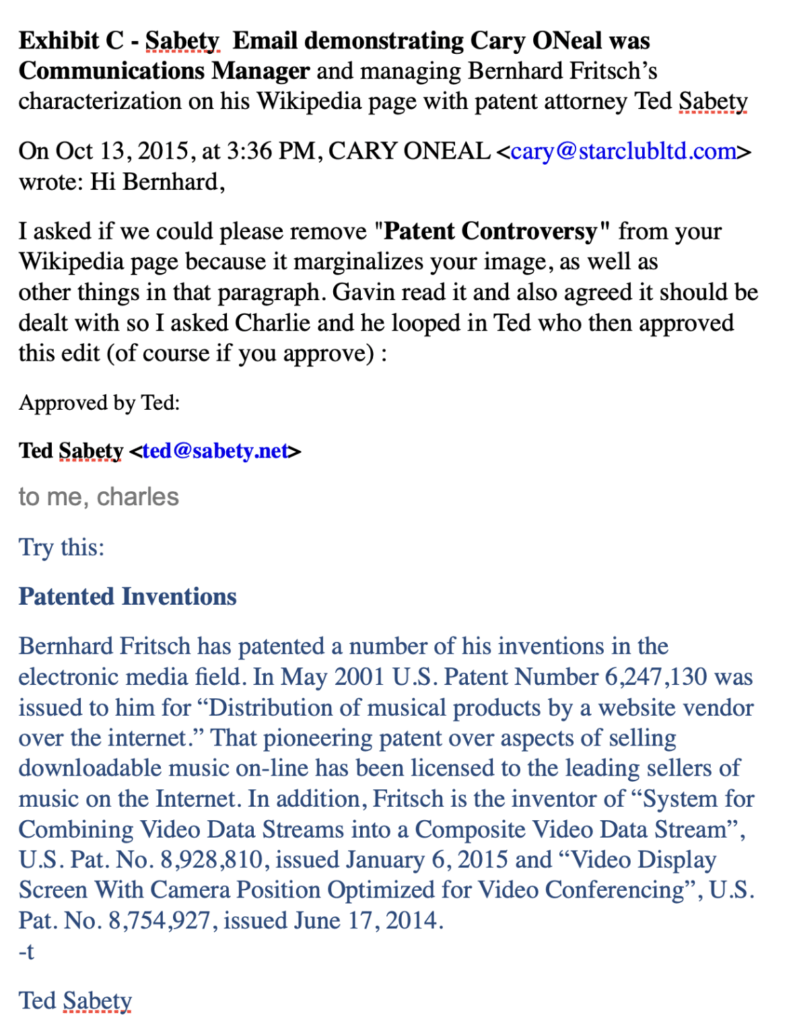
The emails paint a picture of an aggressive effort to position StarClub inside elite business circles. Additional communications reveal parallel efforts to shape Fritsch’s public image. Records reference proposed revisions to his Wikipedia biography involving prominent patent attorney Ted Sabety while continuing to describe Fritsch as the owner of the “global patent on MP3” and an individual involved in transactions with Steve Jobs and iTunes.
Whether every representation ultimately withstands scrutiny is not the only question raised by the documents.
Equally significant is the network of executives, attorneys, investors, consultants, and business associates who encountered, repeated, or relied upon those representations while StarClub expanded.
That ecosystem matters because credibility is often built through relationships rather than financial statements. Eventually, StarClub collapsed under the weight of a federal criminal prosecution.But according to ONeal, the criminal case represented only one piece of a much larger picture.
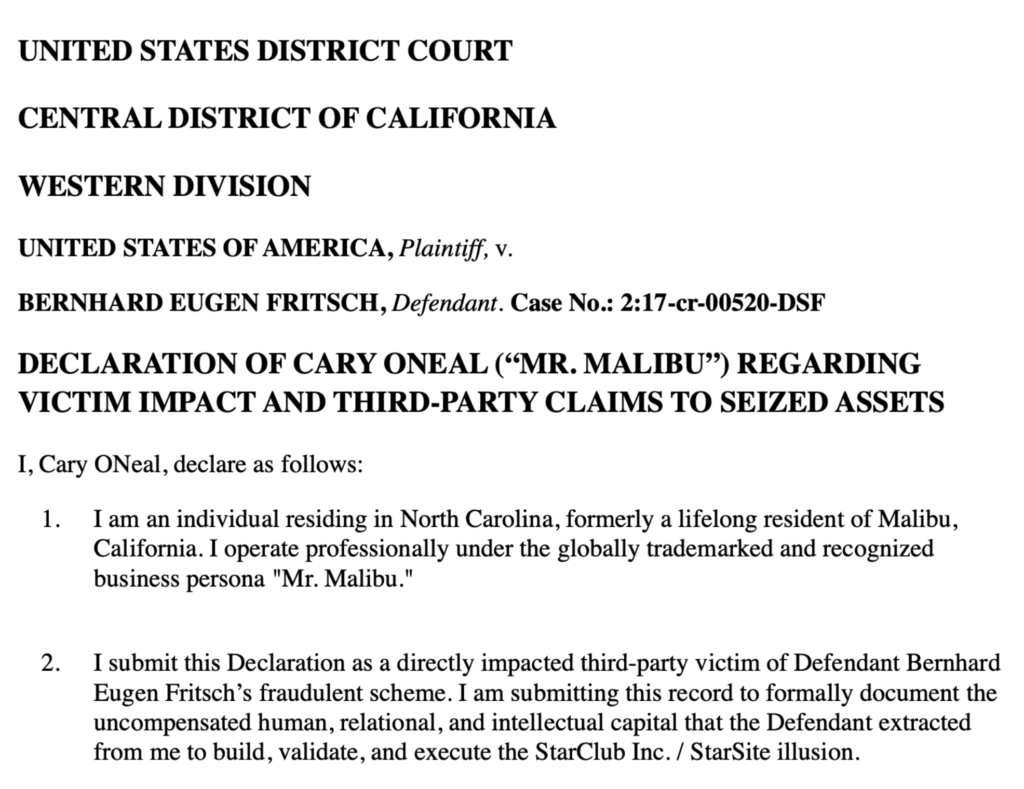
In a declaration submitted to both the Department of Justice and the United States District Court for the Central District of California, ONeal argues that federal prosecutors failed to recognize what he characterizes as the theft of his uncompensated labor, professional reputation, and decades of business relationships. “The justice system must recognize the theft of unliquidated human capital,” ONeal wrote. “The Defendant successfully sustained his scheme, projected market legitimacy, and avoided early institutional collapse by chewing up my uncompensated labor, my native brand equity, and my trusted global relationships.”As federal authorities move to liquidate Fritsch’s seized assets, ONeal argues those assets cannot be separated from the relationships and credibility that helped create them. The restitution dispute, however, is only part of the story.Another centers on what investigators allegedly recovered during the FBI’s August 2, 2017 raid.
According to ONeal, StarClub’s offices contained what became known as the “TAB 5 Asset Purchase Agreement,” a document describing a purported $77 million intellectual property transfer between StarSite, Inc. and US-Master Tec, Inc., a Bahamas-based entity operating out of Nassau.
ONeal contends the agreement represented an effort to artificially inflate the company’s valuation.
At the same time, he alleges electronic records recovered by investigators documented Fritsch’s interest in recurring $1.7 billion and $400 million financial anomalies appearing in national news reporting. According to ONeal, Fritsch repeatedly directed him to monitor those figures and forward related news coverage whenever they appeared.Whether those communications ultimately prove significant remains an open question. What is not disputed is ONeal’s claim that he repeatedly brought those issues to federal investigators following the 2017 raid. According to his filings, those warnings continued for years. He contends they were met with silence.That dispute came into sharper focus on June 23, 2026. In an email exchange, federal prosecutor Monica Tait informed ONeal that because Fritsch’s conviction was limited to Count One of the indictment, he did not qualify for victim restitution and that the criminal proceedings had concluded.
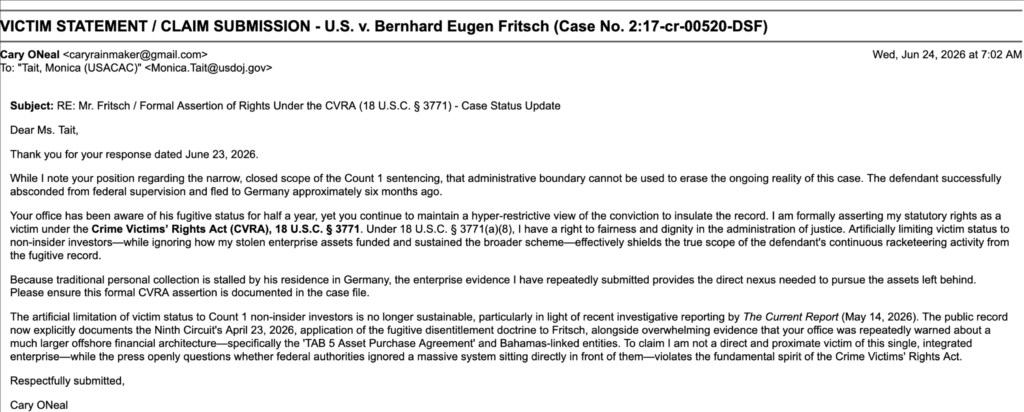
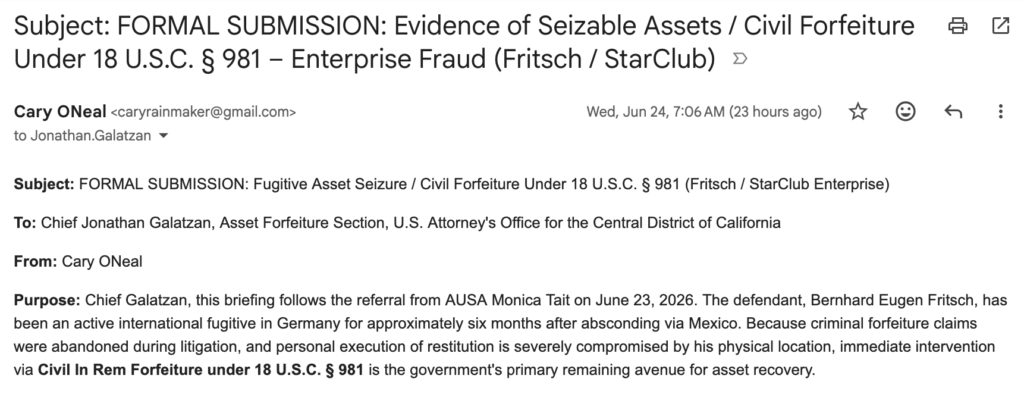
ONeal rejected that position. He responded by invoking the Crime Victims’ Rights Act, arguing that a narrow plea agreement should not prevent the government from recognizing the broader scope of the enterprise he says investigators documented years earlier.At the same time, he elevated his evidence directly to Jonathan Galatzan, Chief of the Asset Forfeiture and Recovery Section, arguing that federal forfeiture law provides independent authority to pursue additional recovery separate from the criminal conviction.
Whether those arguments ultimately prevail will be decided elsewhere.
What remains undeniable is the chronology:
*August 2, 2017: The FBI raids StarClub’s offices and seizes company records.
*May 14, 2026: The Current Report publishes its investigation identifying recurring $1.7 billion and $400 million financial patterns appearing in Covid-era fraud reporting.
*May 18, 2026: The federal government announces a new $1.7 billion anti-fraud initiative.
*June 2, 2026: Following legal challenges and public scrutiny, officials announce they are no longer moving forward with the initiative.
*June 13, 2026: ONeal files his declaration with the Department of Justice and federal court, incorporating The Current Report’s investigative findings into the judicial record.
*June 23, 2026: The restitution dispute formally unfolds between ONeal and federal prosecutors.
Each event can be viewed independently. Taken together, however, they present a chronology that invites further examination. The StarClub case may ultimately be remembered for the conviction of Bernhard Eugen Fritsch. Or it may become remembered for a different reason entirely.
Because beyond the conviction lies a larger question that remains unanswered: Did federal investigators simply prosecute a sophisticated fraud, or did they deliberately confine the case to a much narrower narrative while evidence raising broader questions remained outside public view? That question – not the conviction itself – is what continues to keep the StarClub story alive.