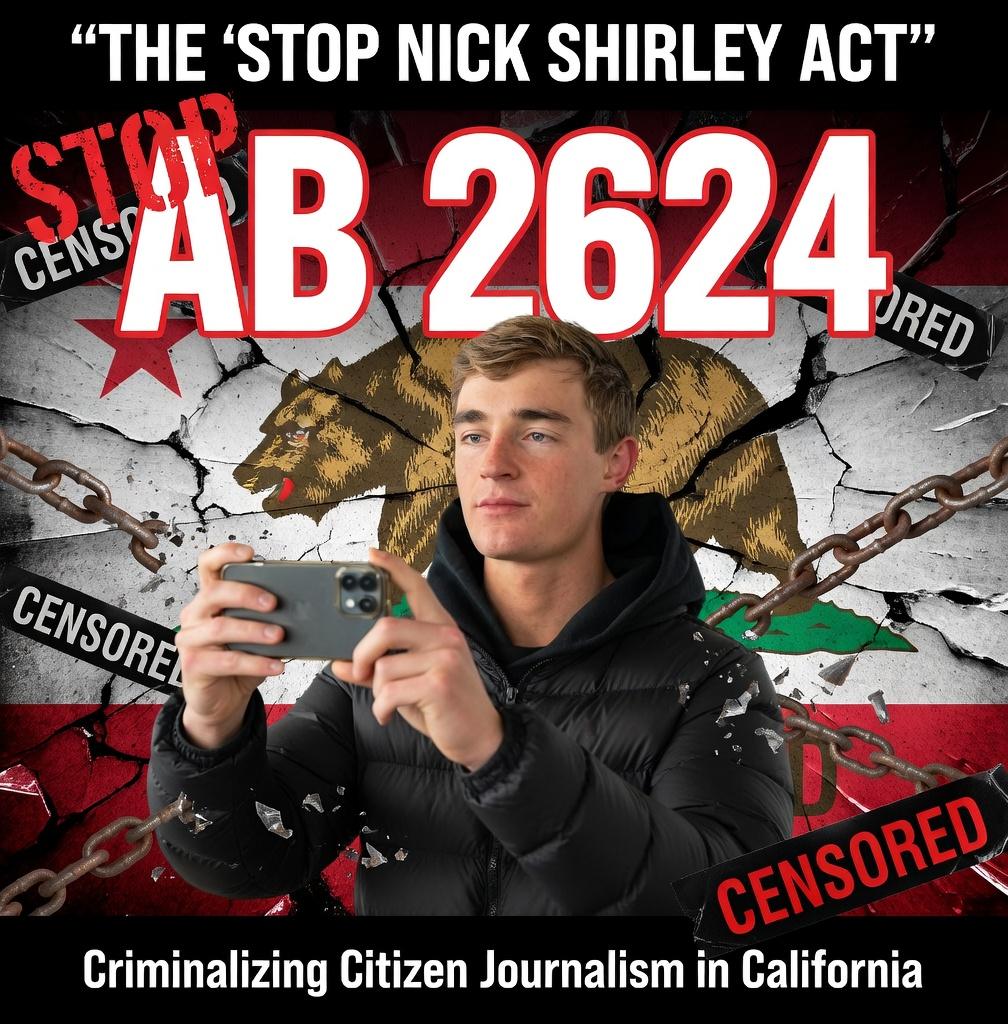
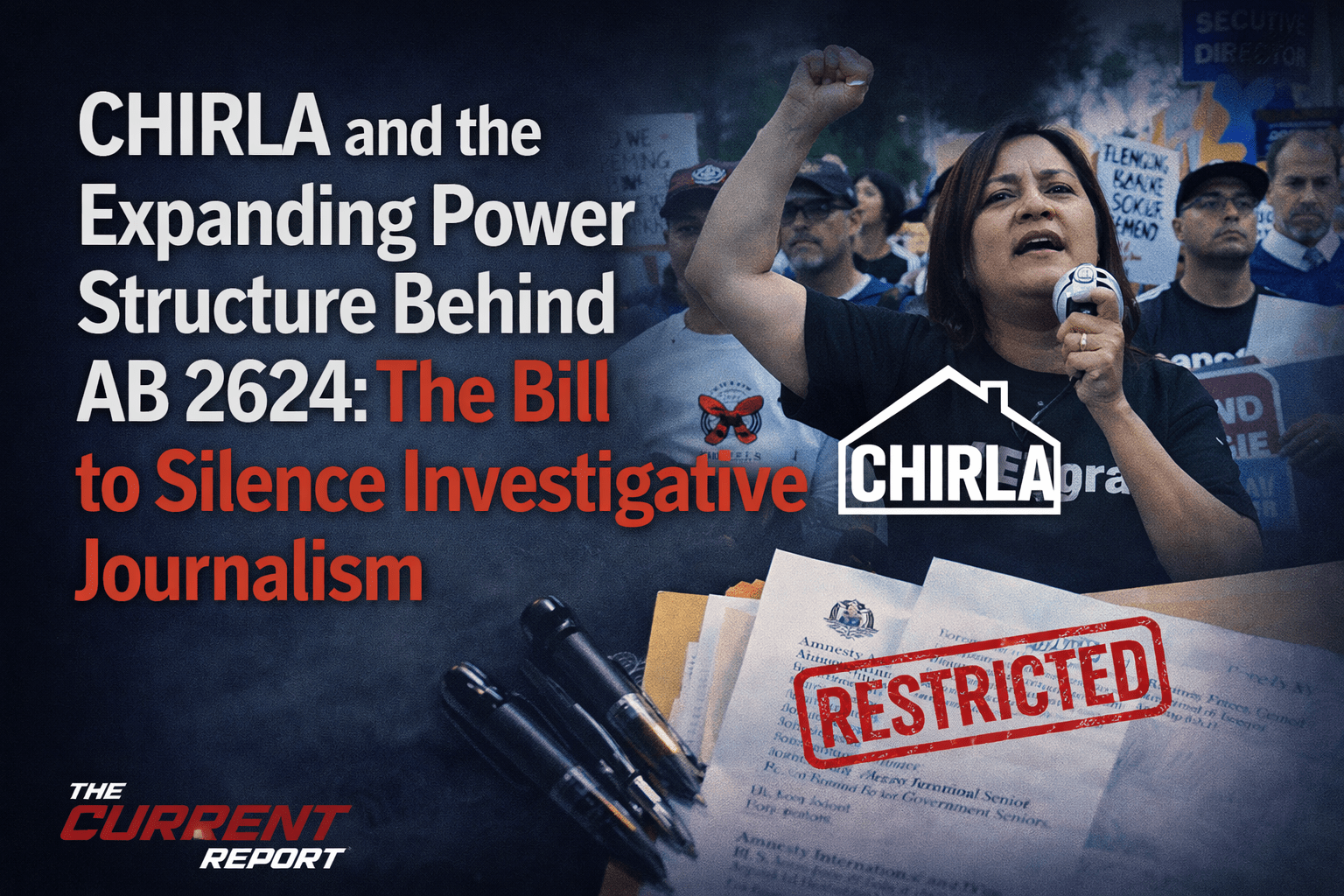
AB 2624 making headlines recently as the “Ban Nick Shirley” Act, is being presented in Sacramento as a targeted protection measure, framed as a necessary response to threats against immigration service providers. The language is deliberate and controlled, built around the concept of safety in a way that discourages deeper examination. Outside the Capitol, that framing is being challenged in real time, not through formal opposition alone but through a rapidly evolving public narrative that has taken on a life of its own.
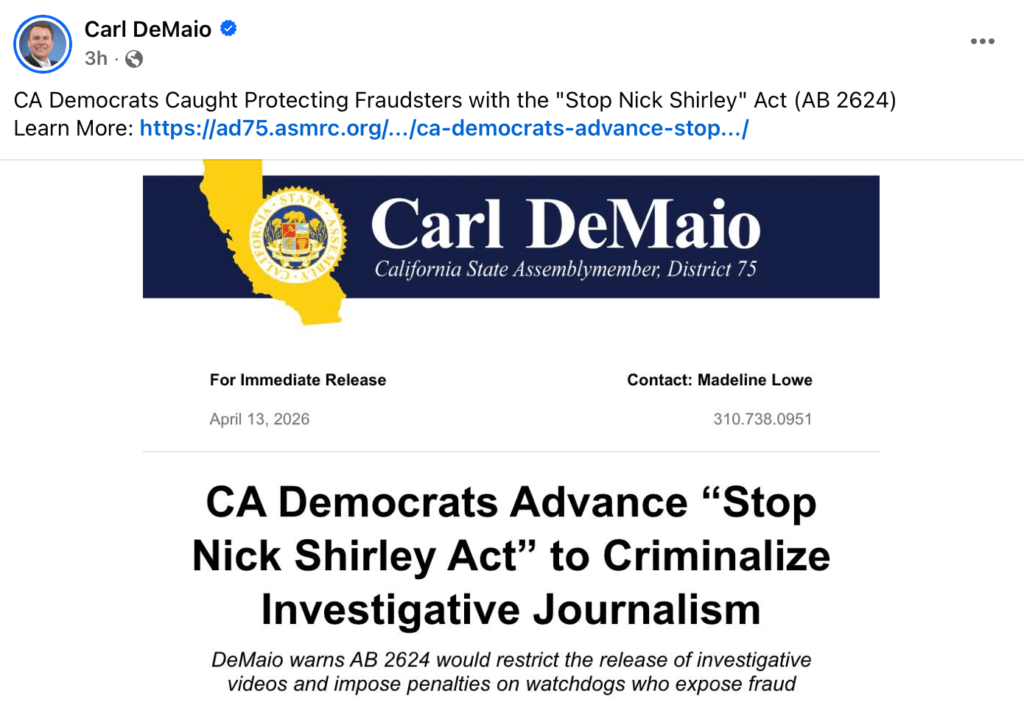
Across social media and independent reporting circles, the bill has been rebranded by critics as a ban on independent journalists, specifically those exposing government-funded fraud. That label did not originate from lawmakers or legislative analysis, but from a growing perception that the bill could have the practical effect of limiting on-the-ground documentation and investigative exposure. The speed at which that framing spread reflects a broader distrust of institutional messaging, particularly when legislation intersects with areas already under scrutiny.
At the center of that scrutiny is the Coalition for Humane Immigrant Rights, an organization that has become deeply embedded in the infrastructure surrounding immigration policy. CHIRLA’s role extends beyond advocacy into operational and logistical domains supported by public funding. It participates in a system that has expanded significantly in recent years, both in scale and in complexity.
That expansion is documented in a June 10, 2025 letter from the U.S. House Committee on Homeland Security to Angelica Salas. The letter outlines a federally supported network in which billions of taxpayer dollars have been directed to nongovernmental organizations responsible for managing key aspects of migrant services. These include transportation, temporary housing, legal coordination, and broader support mechanisms tied to immigration processing.


What emerges from that record is a system that has evolved into a standing infrastructure rather than a temporary response. As federal reliance on NGOs increased, those organizations experienced rapid growth. Congressional findings cited in the letter show that major NGOs involved in migrant services saw combined revenues rise from $597 million in 2019 to $2 billion by 2022. This level of growth reflects a structural shift in governance, where responsibilities traditionally associated with government agencies are increasingly carried out by privately operated organizations funded by public dollars.
CHIRLA is positioned within that system and is now part of a broader federal inquiry into how those funds have been managed. The same investigation raises concerns about oversight, including findings from a DHS Inspector General audit indicating that more than half of certain federal funds lacked sufficient documentation to verify their use. This gap in accountability introduces questions about transparency that extend beyond any single organization and into the system as a whole.
Lawmakers have expanded their inquiry to include more than 200 NGOs connected to migrant services, with CHIRLA among those being examined. The scope of the investigation includes not only financial accountability but also the operational role these organizations play in shaping how immigration policy is implemented on the ground. Congressional correspondence has referenced allegations, some disputed, regarding the involvement of NGOs in organizing responses to enforcement actions and coordinating community-level activity during those events. CHIRLA has denied wrongdoing and maintains that its work is lawful and focused on advocacy and support for immigrant communities.
While those federal questions continue to develop, a parallel narrative has emerged in the public sphere, driven largely by social media and independent reporting. Posts and reporting from investigative journalist Jennifer Van Laar have circulated widely, raising questions about CHIRLA’s funding, political connections, and involvement in events surrounding protests in Los Angeles. These claims have been amplified through appearances on Fox News and through continued online discussion, contributing to a broader perception that the organization operates within a network of influence that extends into both policy and practice.


Additional commentary from news journalist and host of “Uncover California” podcast Lori Mills has framed the issue in terms of intimidation and pressure directed at individuals who challenge prevailing political narratives in California. These perspectives, while not formally adjudicated, have gained traction among audiences already skeptical of institutional transparency.

The discussion has also incorporated claims regarding CHIRLA’s financial trajectory and political positioning, including references to an approximate $20 million increase in state funding during the same period that Angelica Salas was appointed to the California Racial Equity Commission. Critics have pointed to this timing as a potential area of concern, though definitive conclusions have not been publicly established.
Further claims have circulated regarding CHIRLA’s role in civic processes, including allegations that its headquarters functioned as a temporary voting center during the 2022 election cycle. Questions have been raised about voter registration practices and ballot assistance in that context. These claims remain part of an ongoing public debate and have not been conclusively resolved in official findings, but their circulation has contributed to the broader narrative surrounding the organization.
All of these elements converge in the way AB 2624 is now being perceived. The bill’s provision allowing immigration service providers to shield personal identifying information from public records is presented as a safety measure. In the context of an expanding, publicly funded system under investigation, that same provision is interpreted by critics as a step toward reducing transparency.
The connection to Nick Shirley emerges from his role in documenting and publicizing aspects of this system through on-the-ground reporting. His work has become part of the broader conversation, particularly as it relates to visibility into activities that are otherwise difficult to observe. The characterization of AB 2624 as a ban on Nick Shirley reflects a belief among critics that the bill could deter or restrict that kind of documentation, even if such an outcome is not explicitly stated in the legislative text.
This perception has been reinforced by accounts from journalists and commentators who describe increased pressure associated with reporting on these issues. Claims of harassment, intimidation, and limited institutional recourse have circulated alongside the policy debate, adding a layer of personal risk to the broader discussion of transparency and accountability.
The result is a situation in which AB 2624 is no longer evaluated solely on its stated intent. It is being interpreted through the lens of a rapidly expanding infrastructure, an active federal investigation, and a growing body of public claims that question how that infrastructure operates. The label applied to the bill in the public sphere reflects that shift in perception, capturing concerns that extend beyond the language of the legislation itself.
What remains unresolved is the balance between protection and transparency in a system where public funding, private organizations, and policy advocacy intersect. That balance is not determined solely by legislative text, but by how that text is understood and applied within the broader context in which it exists.