They don’t call it censorship anymore.
They call it protection.
Protection for communities. Protection for organizations. Protection from “threats.” The language is softer now, more strategic, designed to pass scrutiny without triggering it. But behind California’s AB 2624, the intent is harder to ignore: if you document the wrong thing, in the wrong place, involving the wrong people, the state may decide you shouldn’t be allowed to show it at all.
And this time, they’re not going after institutions. They’re going after the individuals who don’t rely on them.
In Sacramento, that effort now has a bill number.
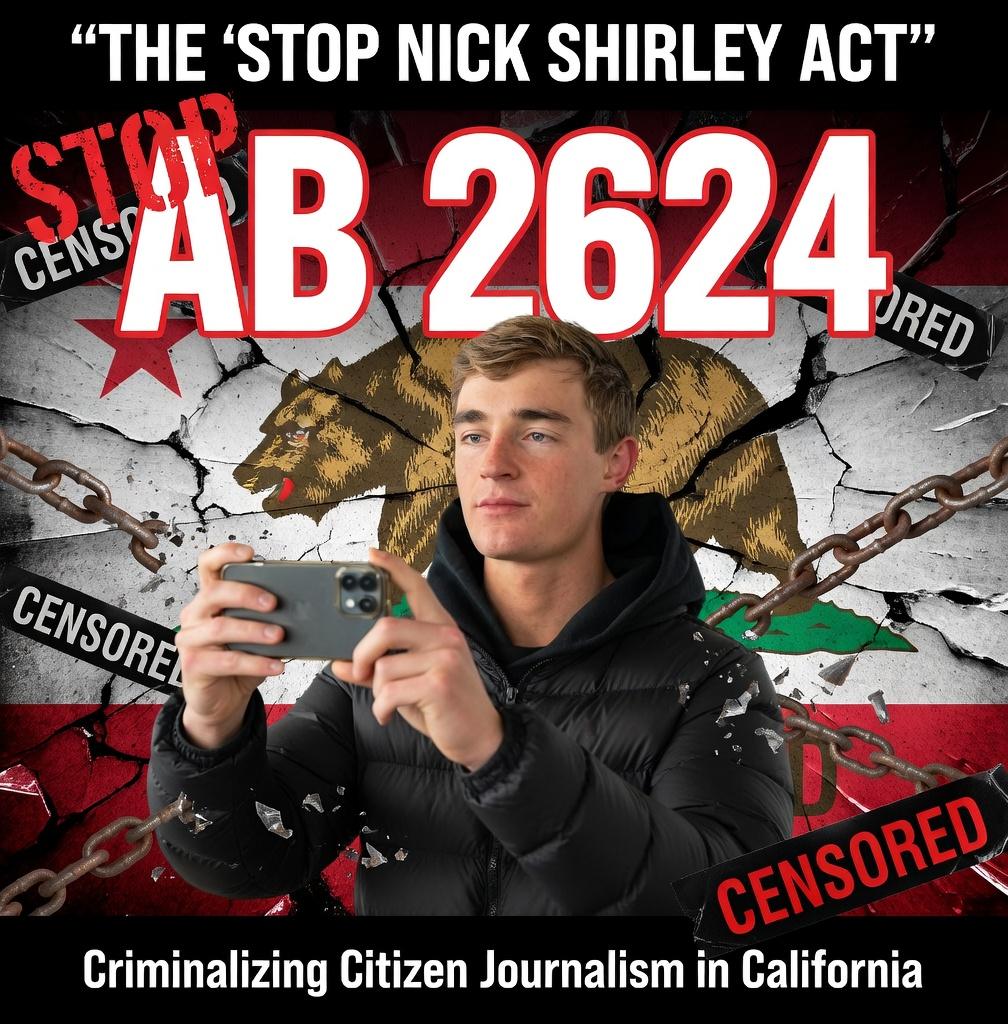
AB 2624.
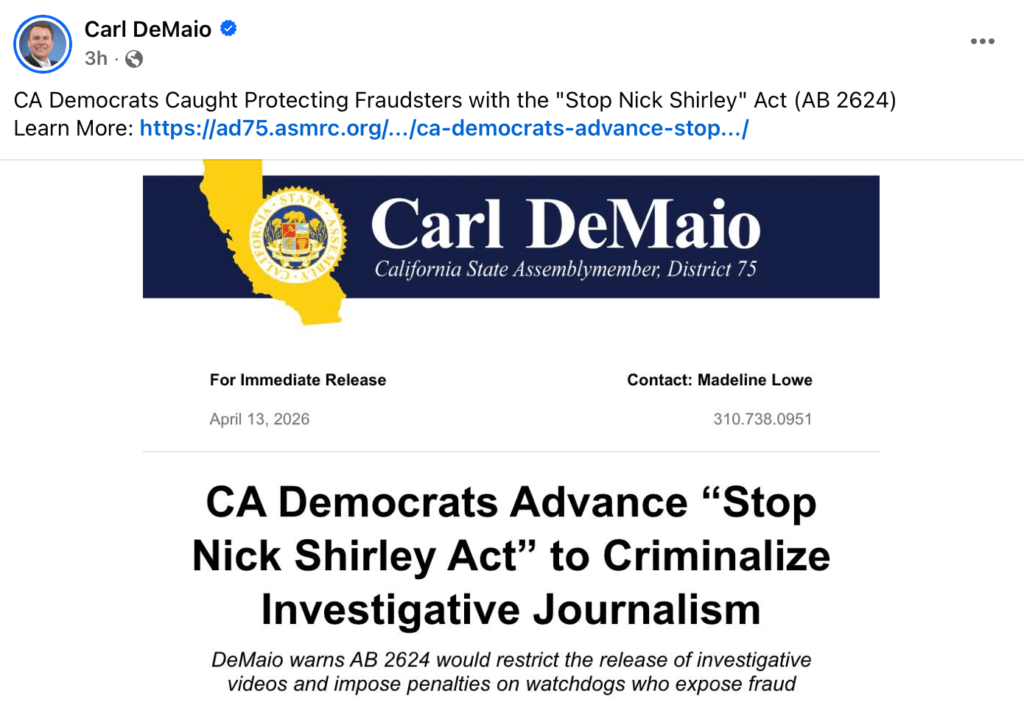
According to CA assembly member Carl DeMaio (R), it also has a far more revealing name: the “Stop Nick Shirley Act.” The label may sound provocative, but it captures the underlying shift this legislation represents, a direct challenge to the rise of independent, citizen-led investigative reporting.
Because journalists like Nick Shirley don’t operate within traditional systems. They don’t rely on institutional access or editorial gatekeeping. They show up, film what’s happening in real time, and publish it directly to the public. No filters. No delays. No permission.
That model has proven effective precisely because it bypasses control.
And now, Sacramento appears ready to regulate it.
Authored by Mia Bonta, AB 2624 is being framed as a necessary measure to protect organizations that serve immigrant communities from harassment and threats. On the surface, that framing is politically difficult to oppose. But the bill’s actual language extends far beyond its stated purpose.
During a recent Assembly committee hearing, DeMaio confronted Bonta over provisions that would allow individuals affiliated with certain organizations to demand the removal of video recordings, even if those recordings were taken in public spaces.
That distinction is not minor.
It is foundational.
Public spaces have long been the last line of defense for transparency. The ability to document what happens in plain view, whether it involves government agencies, publicly funded nonprofits, or any entity operating in the open, is central to both investigative journalism and public accountability.
AB 2624 disrupts that principle.
Under its framework, a person or organization could claim affiliation and request the removal of footage that captures them in a public setting. More than that, the bill opens the door to financial penalties against those who publish such recordings online.
The implications are immediate.
A camera becomes a liability.
A video becomes a risk.
And the act of documenting potential misconduct becomes something that can be punished after the fact.
DeMaio has been explicit in his warning: this is not about safety. Existing laws already address threats, harassment, and intimidation. Those protections are not new, and they are already enforceable. AB 2624 does not fill a legal gap, it creates a new mechanism, one that can be used to suppress exposure rather than address wrongdoing.
That mechanism becomes particularly concerning when applied to organizations receiving taxpayer funding.
Because the bill’s scope is not narrowly defined. It extends to any group that claims to provide services to immigrants, creating a broad and potentially expansive shield. Under that umbrella, entities ranging from nonprofit service providers to loosely regulated community programs could invoke protections to block the release of footage.
In practice, that means publicly funded operations could limit what the public is allowed to see.
Not by restricting access in advance, but by forcing removal after the fact, backed by the threat of financial consequences.
That is not transparency.
It is narrative control.
And it arrives at a moment when independent journalists have begun exposing fraud, mismanagement, and abuse within systems that have historically operated with limited scrutiny. Instead of addressing the substance of those findings, AB 2624 shifts the focus to the act of exposure itself.
It reframes documentation as harm.
It reframes publication as liability.
And in doing so, it places the burden not on those being exposed, but on those doing the exposing.
If the bill becomes law, the chilling effect will not require widespread enforcement to be effective. The mere existence of financial penalties and takedown provisions will be enough to deter coverage. Independent journalists, watchdog groups, and everyday citizens will be forced to weigh the cost of publishing against the risk of being targeted.
Many will choose not to take that risk.
That is how accountability erodes—not through a single sweeping restriction, but through carefully constructed policies that make transparency more dangerous than silence.
Sacramento is calling AB 2624 a protection measure.
But for those paying attention, it reads as something else entirely.
A warning.