In California politics, campaign money is supposed to be held in trust for one purpose: electing candidates and supporting legitimate political, legislative, or governmental activity. But two high-profile Democrats, Eric Swalwell and Rob Bonta, have now exposed the same uncomfortable question from different corners of the state: when does campaign cash stop being political money and start becoming a personal legal-defense fund?
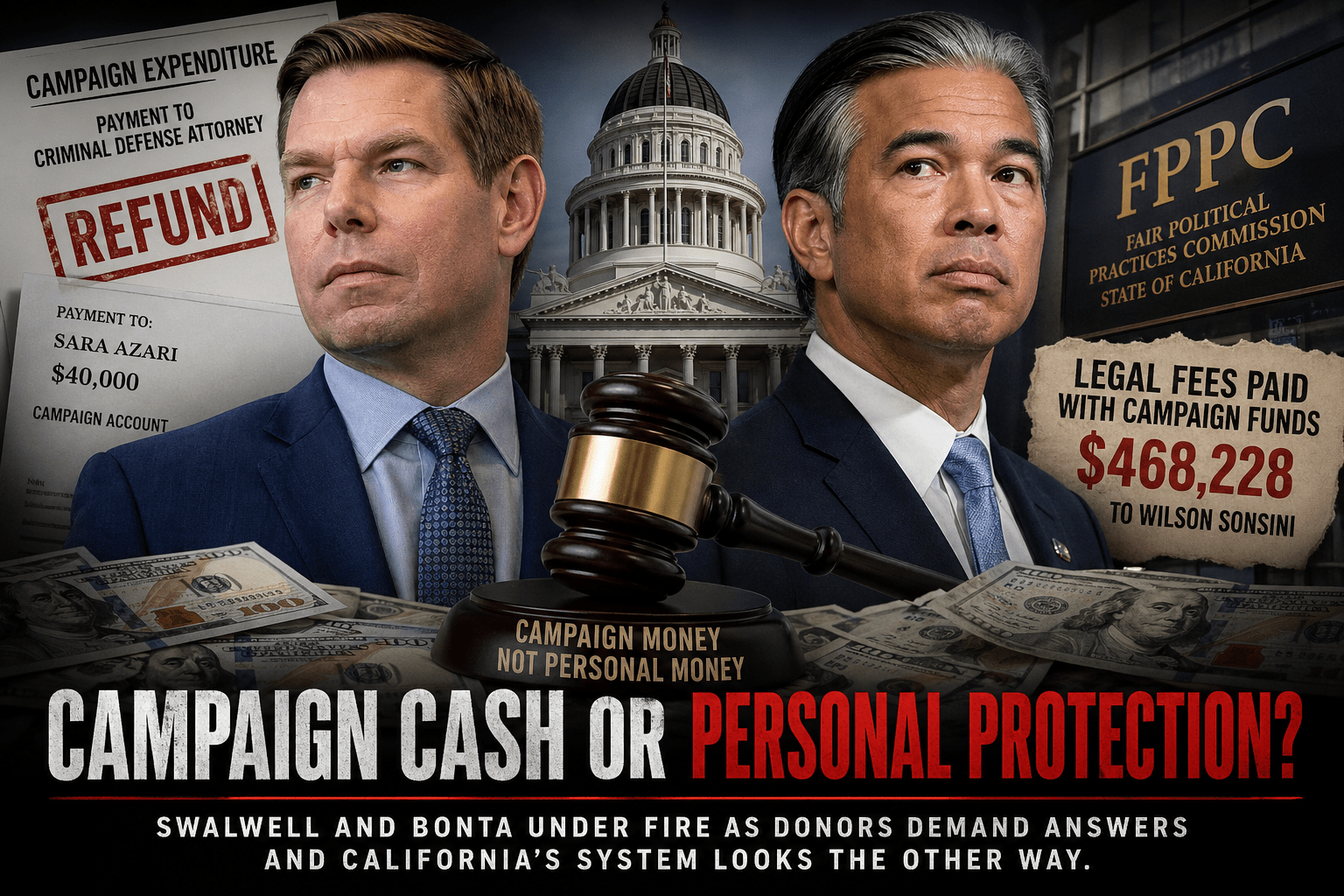
Swalwell’s collapsed gubernatorial campaign is now facing a donor revolt. According to reporting by the San Francisco Chronicle, more than 200 donors are seeking over $1.5 million in refunds after sexual assault allegations surfaced, his campaign unraveled, and disclosures showed a $40,000 payment to criminal defense attorney Sara Azari from campaign funds. The campaign reportedly retained millions on hand even as donors began asking a simple question: why was money given to elect a governor being used in connection with legal defense tied to personal allegations?
That question goes directly to California law. The California Fair Political Practices Commission requires that campaign expenditures be reasonably related to a political, legislative, or governmental purpose. Any expense that provides a substantial personal benefit must be directly tied to those purposes—not to shielding a candidate from personal legal exposure. The state even provides for separate legal defense funds precisely because not all legal expenses qualify as campaign-related.
Which brings the focus squarely to Bonta.
KCRA previously reported that five payments totaling $468,228 flowed from Bonta’s 2026 campaign account to Wilson Sonsini Goodrich & Rosati for legal services tied to a federal bribery investigation involving former Sheng Thao and the Duong family. Bonta’s adviser maintained the expenditures were appropriate, asserting the Attorney General was merely “assisting” investigators and was not a target. But that explanation raises a more fundamental question: how does “assistance” in an investigation generate nearly half a million dollars in legal fees billed to campaign donors? Multiple sources familiar with the matter have alleged that Bonta’s role may be more complex than publicly acknowledged—an assertion that has not been proven in any formal proceeding, but one that intensifies scrutiny over the use of campaign funds for legal defense.
A complaint filed with the FPPC ultimately resulted in a finding that Bonta’s use of campaign funds was legal, with no further enforcement action taken, as reported by KCRA. But that conclusion does not resolve the underlying conflict—it highlights it. As detailed in reporting by The Current Report, the FPPC itself is structured in a way that raises questions about independence: commissioners are appointed by California’s top political power centers, including the Governor, Attorney General, Secretary of State, and legislative leadership. In other words, the same ecosystem that benefits from the rules is deeply embedded in enforcing them. Against that backdrop, a “nothing to see here” determination begins to look less like a definitive legal conclusion and more like a predictable institutional outcome.
This is where the comparison between Swalwell and Bonta sharpens.
Bonta’s case was framed as falling within a broad interpretation of campaign-related legal expenses tied to his role as Attorney General. Swalwell’s situation, by contrast, appears far more personal in nature, legal defense connected to allegations that have no clear nexus to campaign, legislative, or governmental duties. If Bonta’s case tested how far the law could stretch, Swalwell’s may test whether it breaks.
The through-line is the same: donors gave money for campaigns. That money is now being used, or alleged to be used, to protect the candidate, not advance the public mission those donors were promised. And California’s regulatory framework, as currently interpreted, appears flexible enough to accommodate both scenarios.
That is not a narrow technical issue. It is a systemic one.
Because if campaign accounts can function as de facto legal defense reserves, whether under the justification of “assistance” in an investigation or under the pressure of personal scandal, then the distinction between political funds and personal protection begins to collapse. And when the body responsible for enforcing those rules is itself shaped by the political structure it oversees, the line becomes even harder to see.
Swalwell’s unfolding donor backlash may ultimately force that line into the open. But Bonta’s case already demonstrated how easily it can blur.
And if nothing changes, the message to every politician in California is unmistakable: raise the money, spend it how you need to, and let the system explain it later.