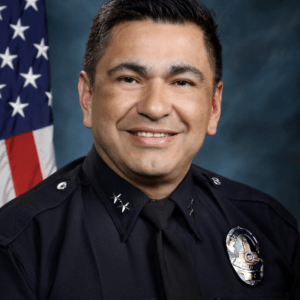

As the world turns its eyes toward Los Angeles for the 2026 World Cup, 2027 Superbowl and the 2028 Olympic Games, the Los Angeles Police Department is tasked with orchestrating a security apparatus of unprecedented scale. But behind the scenes at 1st and Main, a troubling narrative is emerging. Sources within the department are raising alarms that the team leading the Olympic planning is a classic case of the “blind leading the blind.” At the top of this dysfunctional hierarchy sits Assistant Chief Michael Rimkunas, the man currently overseeing the Office of Special Operations. Long viewed as a “Moore puppet,” Rimkunas’s reputation is one of political survival rather than operational excellence. The “disappeared” domestic violence incident in Santa Clarita— buried by Moore created a vacuum of loyalty rather than earned merit. Rimkunas’s history with major events is defined by “perks without performance.” During the 2022 Super Bowl planning, he enjoyed the trips and VIP treatment from the Miami Superbowl planning teams, only to return home and declare he was “too busy” in Internal Affairs to assist with the mission. Today, he oversees the Olympic planning from a “glass tower” with zero communication and a total lack of direction, leaving his team to drift in an operational planning vacuum.
The specific unit tasked with this monumental responsibility is the Major Events Group (MEG). While the name suggests a high-level task force of tactical experts, insiders describe the MEG as a training ground for the politically connected. Led by Rimkunas, the MEG is currently struggling to produce a coherent timeline or unified security strategy for the 2026 World Cup, let alone the 2028 Games. Directly under Rimkunas in the MEG is Commander Ryan Whiteman.
Commander Ryan Whiteman is a career-long Community Safety Partnership (CSP) devotee whose professional history suggests a preference for optics over accountability. During his last long-term tenure at CSP, Whiteman repeatedly was vocal about his dissatisfaction, complaining to anyone who will listen regarding his assignment. He is an insecure leader—capable of executing tasks but critically preoccupied with his standing among superiors and perpetually worried about their perception of his performance.
Whiteman’s recent career maneuvers highlight a focus on rank over role. After emerging as a final candidate for the South Pasadena Police Department chief position, he attempted to leverage an opportunity for an upgrade to Deputy Chief as a reward for not leaving, specifically to lead the Olympics planning team.
However, the maneuver backfired. Due to the current financial crisis, the Deputy Chief vacancy—previously held by Deputy Chief Graham—was not approved by the bureaucrats across the street at City Hall. Following this denial, Whiteman reportedly pouted, making it clear he is willing to perform the duties of the Olympic planning lead as a Deputy Chief, but not as a Commander. Consequently, he has asked to be removed from the assignment and even visited the retirement counselor. This leadership vacuum follows the recent removal of Captain Mohamadi, who was reassigned from the Olympic planning team to Operations-Valley Bureau.
Whiteman’s history is marred by significant red flags, most notably a serious breach of trust in the Southwest Area Community Relations Office. While serving as South Bureau Commander, Whiteman was notified of systematic “theft of time,” involving, a female Sergeant reportedly staying home with her children while on the clock. Also allowing Senior Lead Officers cutting time and filing for unearned overtime. Under Whiteman’s watch, no corrective action was taken, fostering a hostile work environment and triggering a whistleblower retaliation lawsuit. This “nothing to see here” mindset eventually pulled other Commanders and Captains into a cover-up to protect the misconduct. Individuals in that unit have been disciplined and some demoted but much of this could have been avoided had action been taken to address the allegations brought forward.
Beyond administrative failures, Whiteman’s temperament remains a point of concern. His volatility was on full display during the recent ICE riots, where he reportedly lost his composure and was observed yelling at officers in the field, further straining the professional standards and behavior under fire of critical incidents.
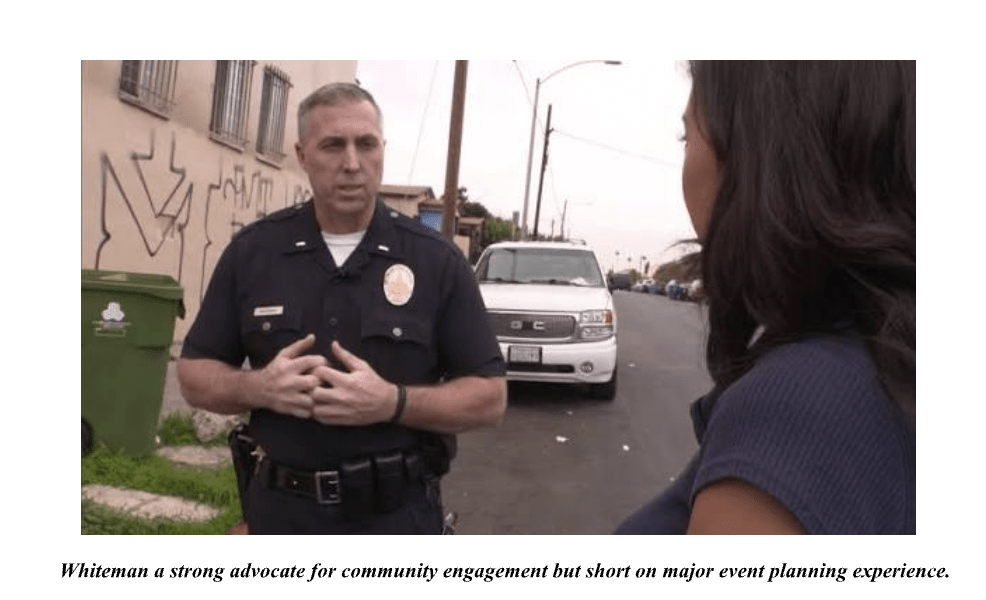
This lack of emotional intelligence is a catastrophic trait for a man at the helm of the MEG, yet rumor has it he is now taking time off over not receiving a Deputy Chief promotion before he actually had any involvement in planning for the mission.
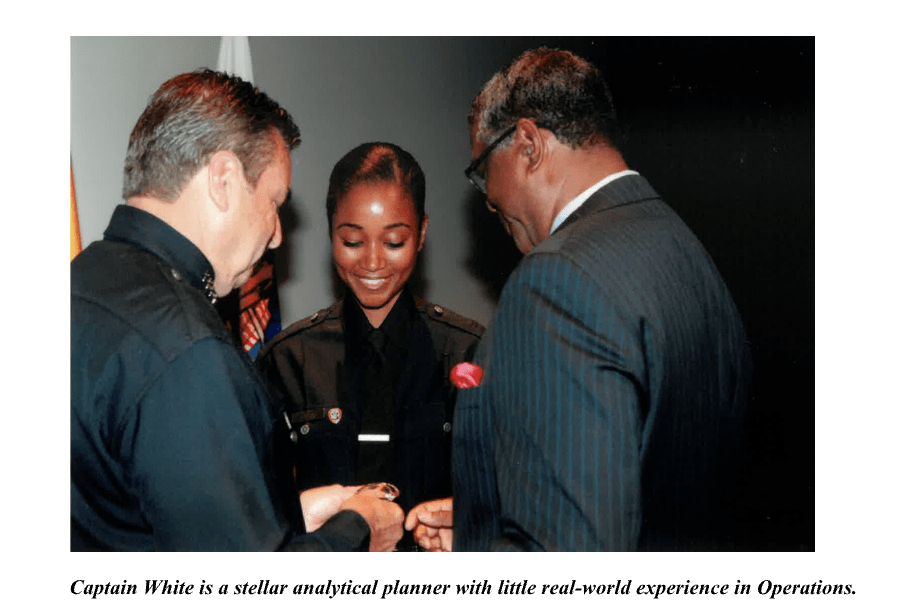
The failure of the MEG is further compounded by the inclusion of Captains Shannon White (Enox) and Mario Mota who round out a command structure presiding over the total erosion of departmental readiness. White’s career has been meticulously curated to avoid field responsibility, including her so-called assignment as a Southeast supervisor where she was loaned back to Operations South Bureau to finish a Stanford degree. She lacks the operational muscle memory required to lead in a crisis. Her roles have been administrative in nature as a lieutenant and received significantly poor ratings as a Patrol Captain. Although she supported planning for the 2022 Super Bowl, number crunching is vital but Olympics planning needed experience isn’t created by a spread sheet. Meanwhile, Mota, although a long-time detective, lacks leadership experience in ensuring help bridge the gap to operational readiness, allowing the department’s training standards to wither.
A primary failure of this group is the total abandonment of any training preparation for the inevitable wave of civil unrest, potential for terrorist threats and much needed critical Incident Management Training. Historically, the Olympics serve as a global megaphone for activists, and in a city like Los Angeles, where the political climate often embraces a level of anarchy under the guise of “expression,” mass protests are an unprecedented certainty. These events require highly specialized, planned deployment and immense staffing levels, yet the MEG has failed to initiate any department-wide training to address these contingencies.
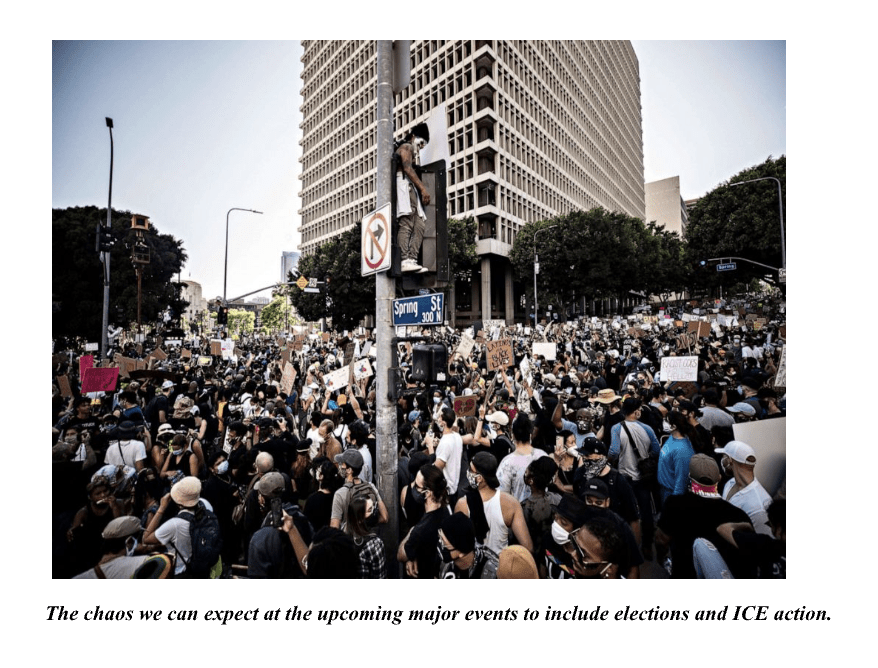
This vacuum of readiness is rooted in the hollowed-out implementation of the Incident Management Team (IMT) initiative. Originally implemented in 2021 after the LA Riots, to fulfill after-action recommendations, the IMTs were designed to create a stabilized pool of subject matter experts. Instead, the program has been crippled by administrative resistance. Command staff historically criticized the IMT plan as “overburdening” them, fighting against mandatory curriculum like ICS-300 and ICS-400 as a nuisance. The mandatory Annual IMT Symposium—a vital mechanism for debriefing large-scale incidents and updating legal and policy protocols—has never been scheduled. By failing to initiate these programs, the MEG has ensured that the department’s “muscle memory” for managing high-stakes tactical incidents is rapidly fading. Officers are expected to hold the line during a National Special Security Event (NSSE) without ever having received the specialized training that was supposed to be the departmental standard.
The logistical crisis extends to the department’s facilities and technology. Under the Mayor’s Office of Public Safety, leadership remember Brian Williams (bomb caller) who ignored the critical cries of both LAPD and LAFD for the need of a flip the switch command post to run Operations. Instead, they handed the recommended site which could have housed a state-of-the-art Command Operations Center over to Sanitation to house trash trucks.

This staggering neglect of leadership values garbage logistics over global security, potentially forcing the MEG to run command posts out of Buddhist temple parking lots, as was done during the long-term planning of the 2020 riots. Simultaneously, the technology foundation has been undermined by cronyism. Under former Chief Michel Moore, the department hired a friend rather than a technology expert, leading to an expensive overhaul that prioritized optics over critical needs.
While a Deputy Chief traveled to build a personal consulting empire, the heavy lifting of implementing an overpriced Records Management System (RMS) was dumped onto subordinates. The result is a system that does little to provide the real-time intelligence needed for 40+ competition venues. No effort was made to bring LAPD into the increased technological preparedness for major incidents and global events. Instead, Moore focused on political survival.
Beyond the specialized units, the most significant threat to the city’s safety is the unsustainable drain on the rank-and-file. The “burnout factor” will be a critical point of failure. Even with full mobilization and excessive overtime, the department cannot “overtime” its way out of a 1,400-plus officer shortage.
As of April 2026, the Los Angeles Police Department’s authorized sworn strength remains a moving target, reflecting a significant gap between budgetary goals and operational reality. While the long-standing “gold standard” authorized strength has historically been close to 9,500 officers, current data shows a department in the midst of a severe contraction.
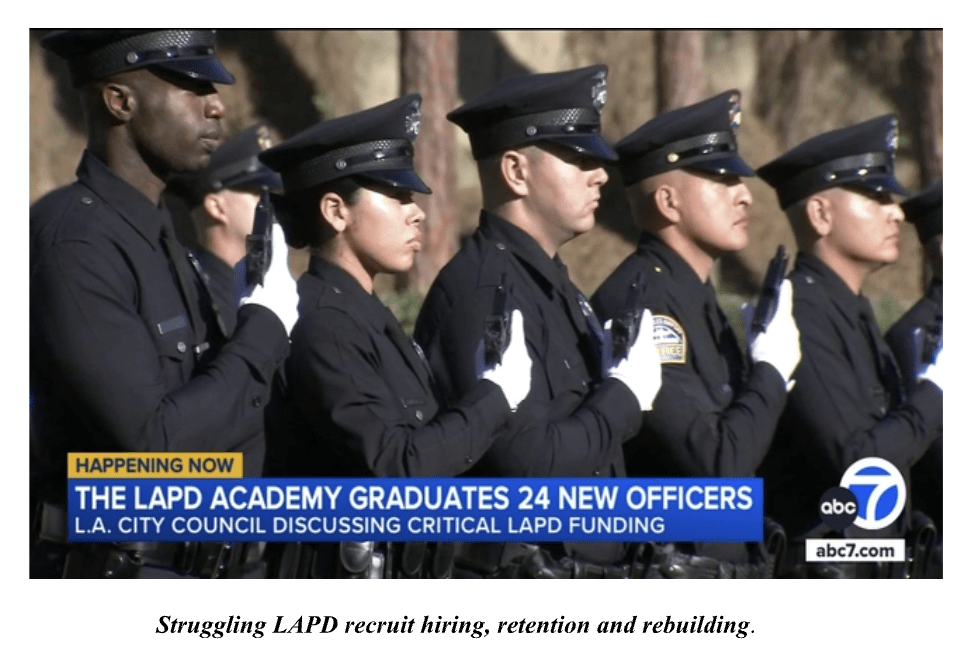
For the 2025–2026 fiscal year, the Los Angeles City Council and Mayor Karen Bass initially authorized a hiring plan for up to 410 new recruits. However, earlier this month Bass openly retracted her goal of increasing the department size, Reality is hiring is essentially a “treadmill” effect intended to offset constant attrition. As of early April 2026, the LAPD has approximately 8,677 sworn personnel.
This is the lowest staffing level the department has seen in nearly 25 years. City Administrative Officer projections indicate that by the end of the fiscal year (June 30, 2026), the total sworn deployment is expected to drop further to approximately 8,400 officers.
The figure of being over 1,400 officers short is based on the decline since 2019, when the department was closer to its full authorized capacity. This deficit is at the heart of the “burnout factor” currently impacting the rank-and-file. Other factors low morale, an archaic weaponized complaint system, over burden administrative personnel drains as well as political targeting have all factored into the downfall.
With the 2026 World Cup and 2028 Olympics looming, the city is authorizing emergency funding recently $2.7 million to boost the recruit classes—but these measures are struggling to keep pace with the number of seasoned officers retiring or leaving for other agencies.
For the Major Events Group (MEG), this means the “security apparatus of unprecedented scale” is currently being built on a foundation that is physically missing 15% to 20% of its required workforce.
Forcing a depleted workforce into 12-hour shifts for weeks on end—preceded by a World Cup and a Super Bowl—will lead to tactical errors and cognitive fatigue. While the MEG focuses on the “Green Zones,” the rest of Los Angeles becomes a target-rich environment for human trafficking, opportunistic crime, and coordinated disruption. This drain on resources will decimate regular calls for service; response times for emergencies in residential neighborhoods will skyrocket as detectives and investigators are pulled from their cases to stand on perimeter posts. If the LAPD continues to allow an insecure, “pouting” leadership team in the MEG to drift without direction or training, the department won’t just fail Los Angeles—it will fail the world.
The massive infusion of federal funding intended to secure the 2028 Games has become a central flashpoint in the growing conflict between City Controller Kenneth Mejia and the LA28 Host Committee. While the federal government has stepped in to handle the “heavy lifting” of security through a National Special Security Event (NSSE) designation, the local financial reality remains a precarious balancing act that the Controller argues is being managed with dangerous opacity.
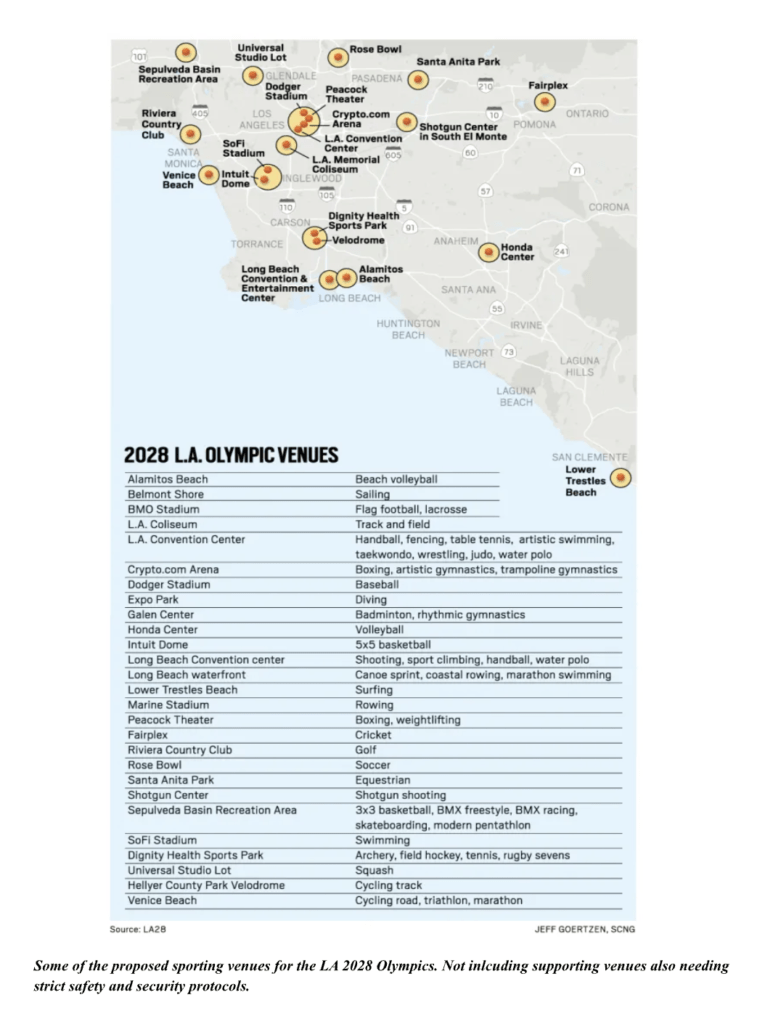
The federal government’s commitment of $1 billion for security and planning is a vital lifeline for a city that simply cannot afford to shoulder the burden alone. However, this funding primarily covers the operations of federal agencies like the Secret Service and the FBI. It does not automatically cover the indirect, “ripple-effect” costs that hit municipal departments. Controller Mejia’s primary concern is that the city is currently deploying personnel and resources for Olympic planning, including the salaries of the command staff in the Major Events Group (MEG)without a signed Enhanced City Resources Master Agreement (ECRMA) to guarantee reimbursement from the private LA28 committee.
The conflict has intensified because the ECRMA is now months overdue. The Controller has argued that without this agreement, the city is effectively providing “free consulting” and administrative support to a private entity while the municipal budget faces a $1 billion deficit.
Mejia has aligned with several City Council members to demand a “Zero-Cost” guarantee. They argue that federal grants and local expenditures must be accounted for with total transparency to ensure that taxpayers aren’t left holding the bill for “enhanced services” like sanitation, traffic control, and administrative oversight.
A major point of friction is the “Legacy Fund.” LA28 intends to use surplus funds for post-Games youth sports programs. The Controller, however, insists that no surplus can exist—and no legacy funding should be allocated—until every city department is reimbursed for every hour of overtime and every resource diverted from neighborhood services.
While federal agencies provide the high-level security perimeter, the “soft target” security—such as the 26.2 miles of the LA Marathon, Super Bowl or World Cup or the transit routes between dispersed venues—falls on local shoulders. The Controller’s office is sounding the alarm that the city is being asked to commit to a “National Special Security Event” status without a clear audit trail of where federal reimbursements end and local liabilities begin.
This lack of a finalized agreement has led to the recent push for Charter Reform, which would legally ensure that the city be paid back before any other financial commitments are made by the host committee. In a city currently short of over 1,400 officers and struggling to maintain basic services, the Controller’s conflict with the LA28 committee is a battle over the fundamental financial survival of Los Angeles. As the 2026 World Cup approaches, the demand for a signed reimbursement contract is no longer just an administrative hurdle—it is an emergency mandate to prevent a catastrophic drain on the city’s general fund.
The LA Marathon stands as a stark annual reminder of the gap between “sticker-giveaway” optics and the gritty reality of urban security. Despite the department’s celebratory social media posts, the event remains a logistical house of cards, characterized by a series of critical security failures that leave Los Angeles just one incident away from a catastrophe on the scale of the Boston Marathon bombing.
The Department currently treats major events such as the LA Marathon and Academy Awards as a routine “administrative exercise” annually dusting off the previous year’s plan, updating deployment numbers and hoping for the best. However, as major events occur you can’t dust off the plan plug in numbers that don’t exist for a Tier-1 security challenge, ignoring the fact that a route spanning 26.2 miles through dense urban corridors creates an almost infinite number of “soft target” vulnerabilities. Street intersections remain dangerously available to angry single car terrorist willing to inflict harm. Areas are unsecured and accessible to all and any pedestrians. The primary failure lies in the department’s persistent inability to secure the perimeter. Unlike a stadium event with centralized access control, the LA Marathon is a porous environment. Historically, the department has struggled to maintain “sterile zones” around the start and finish lines, with non-credential individuals frequently observed by passing security checkpoints.
This is the exact vulnerability that allowed the Tsarnaev brothers to place explosive devices at the Boston finish line. In Los Angeles, the reliance on a depleted workforce—currently short over 1,400 officers—means that many “security” posts are manned by exhausted officers working 12-hour shifts who have not received specialized training in IED detection or behavioral threat assessment. The MEG’s failure to initiate ongoing, department-wide training for these contingencies means that the personnel on the line lack the muscle memory to identify a threat before it detonates.
Furthermore, the technology infrastructure supporting the marathon is a costly mirage. While former Chief Michel Moore’s administration faced years of delays and countless errors in the implementation of the (RMS), administrative Records Management Systems, the department failed to invest in the real-time, interoperable surveillance and AI-driven threat detection necessary to monitor a 26-mile route. There is no unified, “flip the switch” Command Operations Center to coordinate between the LAPD, LAFD, and federal partners. Instead, tactical command often run out of makeshift mobile posts or parking lots throwback to the failed tactical strategies of the 2020 riots. This lack of a centralized nerve center ensures that if a coordinated attack were to occur, the response would be fractured, delayed, and plagued by the same communication breakdowns that cost lives in past national tragedies.
The “burnout factor” also plays a lethal role in this planning failure. The Olympics requires a massive mobilization that siphons resources away from every neighborhood in the city. To staff the venues, detectives and specialized investigators are pulled from high-priority cases to stand on street corners for hours on end. This creates a dangerous level of cognitive fatigue. An officer who has been standing for ten hours in the sun, following weeks of mandatory overtime, is not an effective shield against a sophisticated terrorist threat. The MEG’s refusal to professionalize the Incident Management Teams (IMTs) into a better trained cadre means that the department continues to rely on this “brute force” staffing model, which prioritizes quantity over the quality of security.
Finally, the political climate in Los Angeles further compounds the risk. In a city that often prioritizes political optics over tactical necessity, there is a palpable resistance to the “hard” security measures required to harden multiple venues, or access points on a 26-mile target. The MEG, led by “inexperienced and battled tested” commanders like Shannon White and Ryan Whiteman, often caves to administrative pressures to keep the event “accessible,” even when that accessibility creates lethal gaps in the security net. Residents are not being provided with facts about the vulnerabilities as well as the inherited danger to the city.

As long as the department is led by a “pouting” command staff that values Stanford degrees over street-tested experience, major events such as the World Cup, Super Bowl and Olympics 2028 will remain a disaster waiting to happen. The world is watching, and if the LAPD continues to ignore the lessons of the Boston bombing 2013, Mumbai multi location assault 2008, Munich 1972 massacre, London 2012 staffing failures, Atlanta 1996 bombing and South Korea 2018 cyber-attack the “catastrophe” won’t be a matter of if, but when.