By Cece Woods
The case against Commander Thomas Giandomenico ended without charges. The far more troubling question is how an unverified allegation was used to justify search warrants and a sweeping intrusion into his electronic devices in the first place.
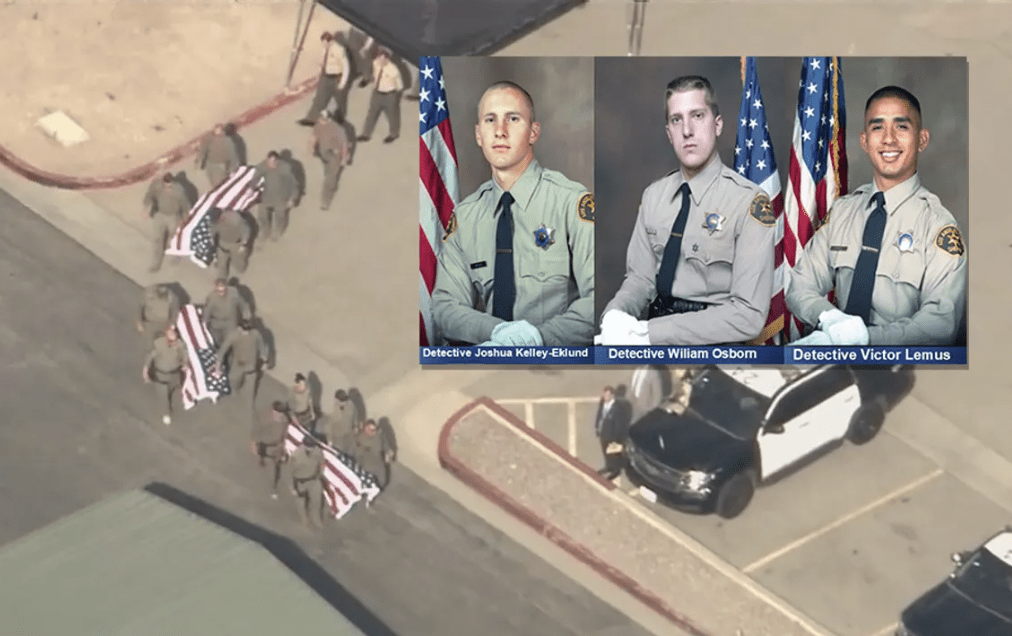
Three Los Angeles County Sheriff’s Department deputies were killed in a catastrophic explosion at the Biscailuz Training Center on July 18, 2025. Detectives Joshua Ecklund, Victor Lemus and William Osborn went to work that morning and never came home. It was the kind of tragedy that should have triggered an unrelenting examination of the explosives operation, the decisions made before the blast, the safety protocols in place and the chain of command responsible for ensuring those deputies were not placed in unnecessary danger.
Instead, another criminal investigation was quietly unfolding inside LASD. Its target was Commander Thomas Giandomenico, and the allegation was that he had improperly photographed the bodies of the three fallen deputies.
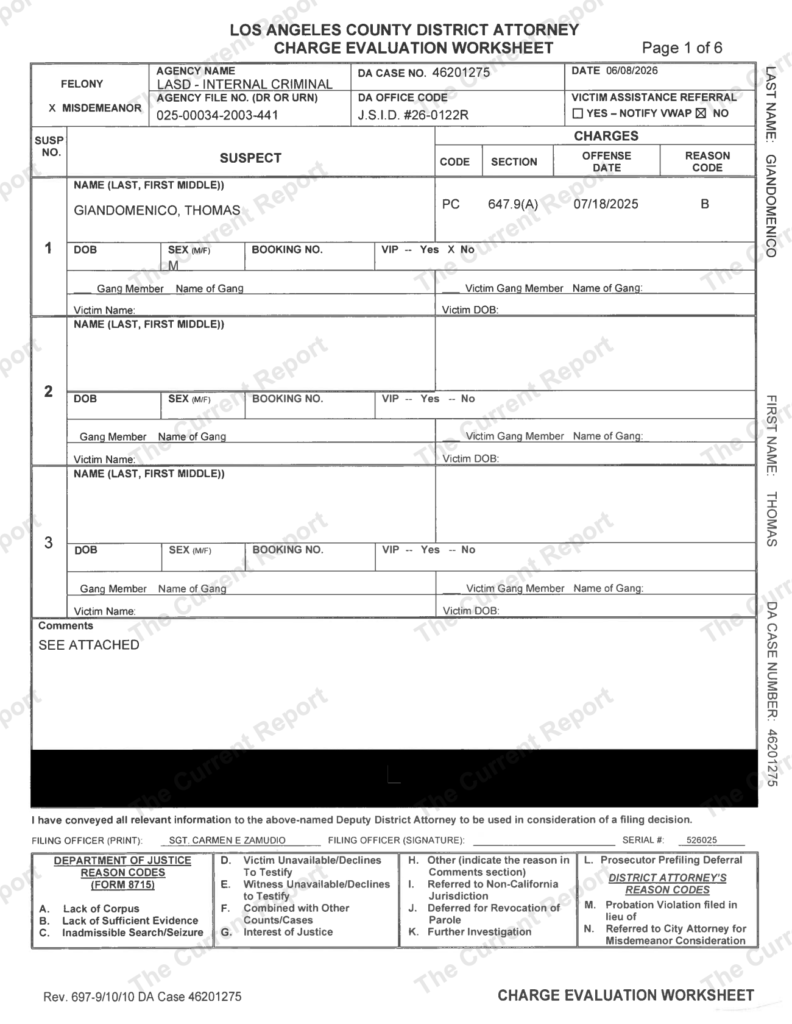
After witness interviews, reviews of security and aerial footage, search warrants, cellular-provider records and forensic examinations of Giandomenico’s electronic devices, the Los Angeles County District Attorney’s Office declined to prosecute the case. The evidence was not sufficient to prove that Giandomenico knowingly photographed a deceased person for a purpose unrelated to his official duties.
That is where the criminal case ended. But after reading the DA’s rejection memorandum, there is reason to believe the far more important investigation is just beginning, because the document raises serious questions about how an allegation rooted in an unverified rumor was elevated into a full-blown criminal investigation and ultimately used to justify a government search of a commander’s electronic devices and records.
A Rumor Becomes a Criminal Investigation
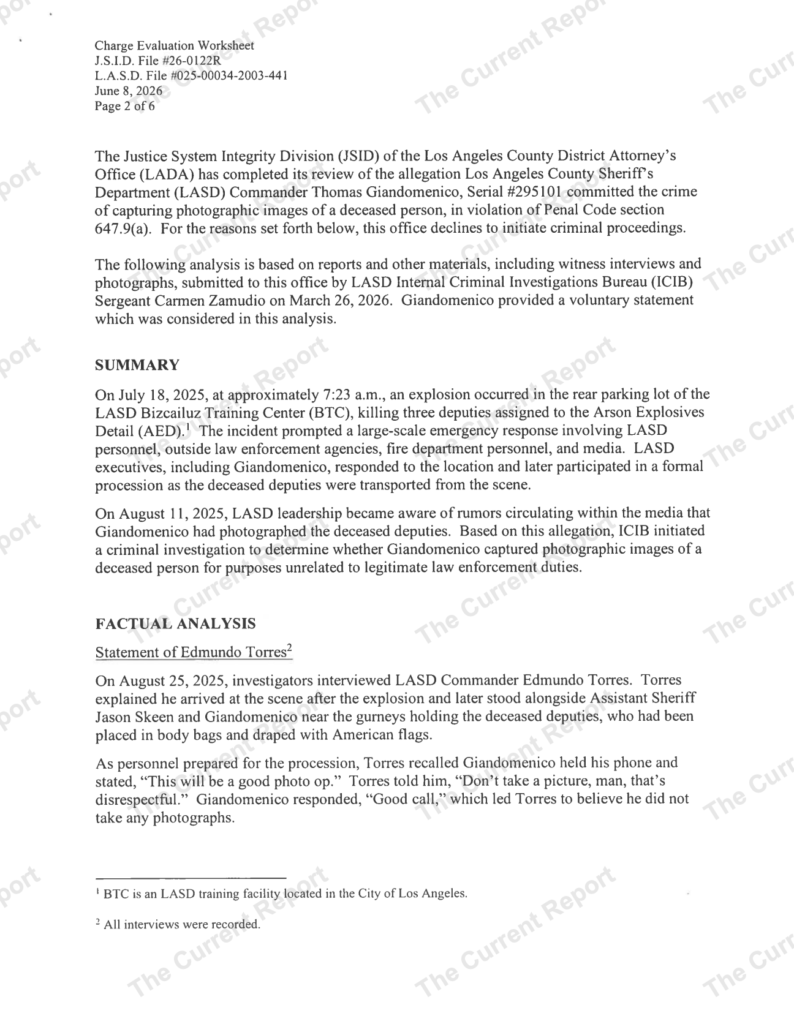
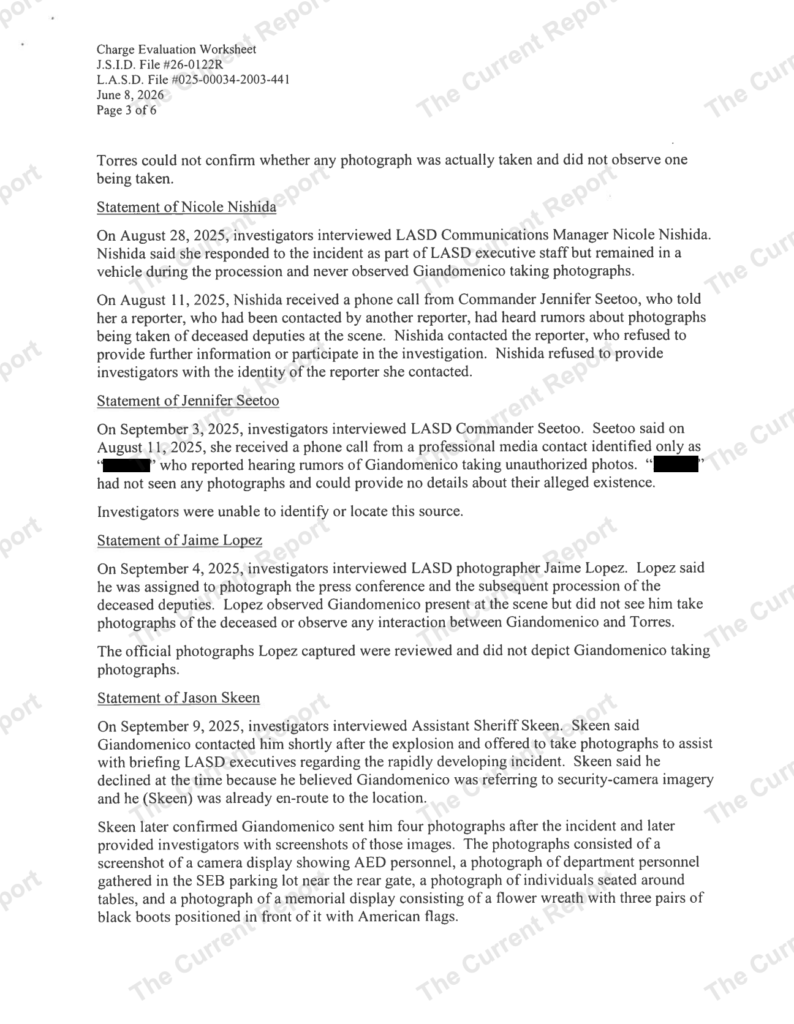
According to the DA’s analysis, LASD leadership became aware on August 11, 2025, of rumors that Giandomenico had photographed the deceased deputies. The Department’s Internal Criminal Investigations Bureau subsequently opened an investigation to determine whether he had taken photographs of a deceased person for a purpose unrelated to legitimate law-enforcement duties.
But when the information contained in the rejection memorandum is traced back to its origin, the foundation of the case becomes difficult to understand.
LASD Communications Manager Nicole Nishida told investigators that Commander Jennifer Seetoo contacted her after a reporter had apparently heard rumors about photographs being taken of the fallen deputies. Nishida contacted the reporter, but the reporter declined to provide additional information or participate in the investigation. More significantly, Nishida refused to provide investigators with the reporter’s identity.
Commander Seetoo later told investigators that her information came from a professional media contact who had heard rumors that Giandomenico took unauthorized photographs. That source had not seen the alleged photographs and could provide no details establishing that they even existed. Investigators were ultimately unable to identify or locate the source.
Strip away the titles, layers of communication and bureaucratic language, and this is what remains: someone reportedly heard a rumor about photographs that no one could produce, allegedly taken by a commander whom no witness could definitively say had taken them. The unnamed source had not seen the photographs. The reporter would not participate. Nishida would not identify the reporter. Yet the allegation still acquired enough institutional momentum to become a criminal investigation.
That is not a minor detail. It is the central issue.
Different Standards for Different Employees?
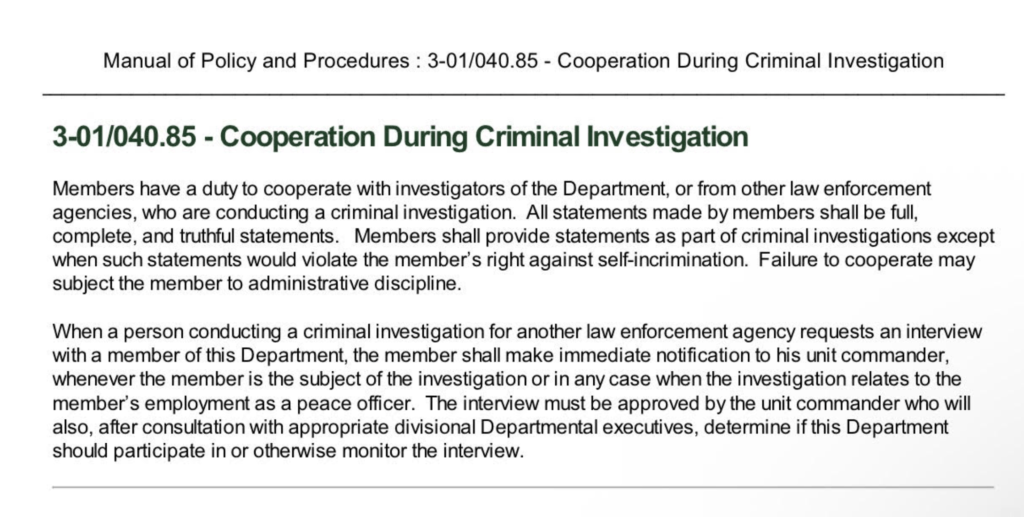
Nishida’s refusal to identify the reporter deserves far more scrutiny than the passing reference it receives in the DA’s memorandum. Nishida was not an independent journalist being asked to betray a confidential source. She was an LASD communications manager—a civilian Department employee—being questioned as part of an internal criminal investigation triggered by information that passed directly through her. Yet when investigators attempted to trace the allegation back to its source, Nishida refused to identify the reporter at the center of it.
That refusal should have raised an immediate issue inside LASD. Was Nishida ordered to cooperate fully with the investigation? Was she required under Department policy to disclose information relevant to a criminal inquiry? If so, why was she apparently permitted to withhold the one piece of information investigators needed to test the credibility, motive and origin of the rumor? Was she subjected to an administrative investigation, disciplined for refusing to cooperate or even asked to explain why she was protecting the identity of someone whose unverified information had placed a Department commander under criminal investigation?
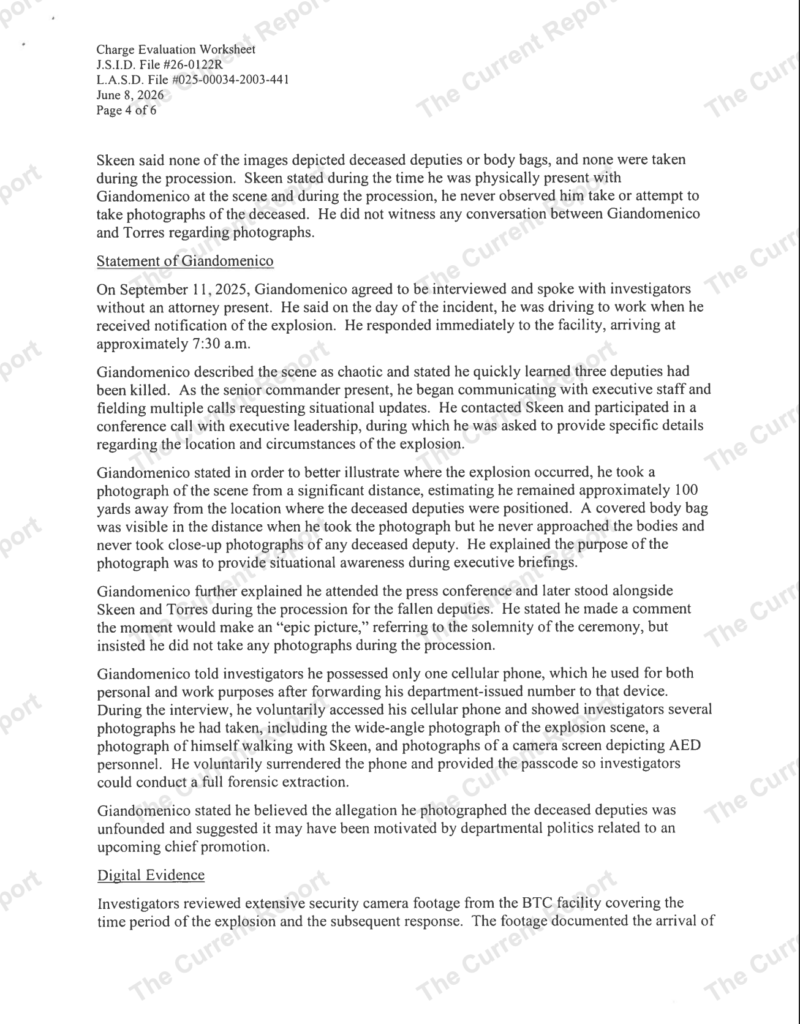
The contrast with Giandomenico could not be more glaring. According to the DA, he submitted to an interview without an attorney, voluntarily opened his cellphone and showed investigators the photographs he took on the day of the explosion. He surrendered the phone, provided his passcode and allowed investigators to perform a complete forensic extraction. When that was apparently not enough, investigators obtained search warrants for his cellphone, cellular-provider records and additional electronic devices—an extraordinary intrusion built upon an allegation whose original source they could not identify.
So one Department employee was allowed to shut down the trail leading back to the rumor, while the employee accused by that rumor was expected to surrender his phone, passcode, records and private electronic data to prove it was false. That is not merely an inconsistency. It is a glaring double standard that goes directly to the integrity of the investigation. If Nishida and Giandomenico were subject to different duties of cooperation, LASD needs to identify the policy that explains it. If they were subject to the same obligation, then the Department needs to explain why every available investigative tool was used against Giandomenico while Nishida’s refusal to provide the source of the allegation was apparently allowed to stand.
What Was Presented to the Judge?
The search warrants are where this story moves beyond an internal personnel dispute and into a legitimate Fourth Amendment concern. A judge authorized the government to search electronic devices and records belonging to a sworn LASD commander. That is an extraordinary intrusion, and it was supposed to be supported by probable cause – not Department gossip, political maneuvering or an accusation passed through several people until its origin could no longer be established.
What evidence did investigators present to the judge? Was the judge told that the allegation originated with an unidentified person who had reportedly heard a rumor? Was the judge informed that the source had never seen the alleged photographs and could provide no details about their existence? Did investigators disclose that they could not identify or locate the source? Was the judge told that the Department employee who contacted the reporter refused to disclose that reporter’s identity?
More importantly, what independent evidence existed at the time the warrant was requested that justified searching Giandomenico’s devices and cellular records?
The Photographs Investigators Actually Found
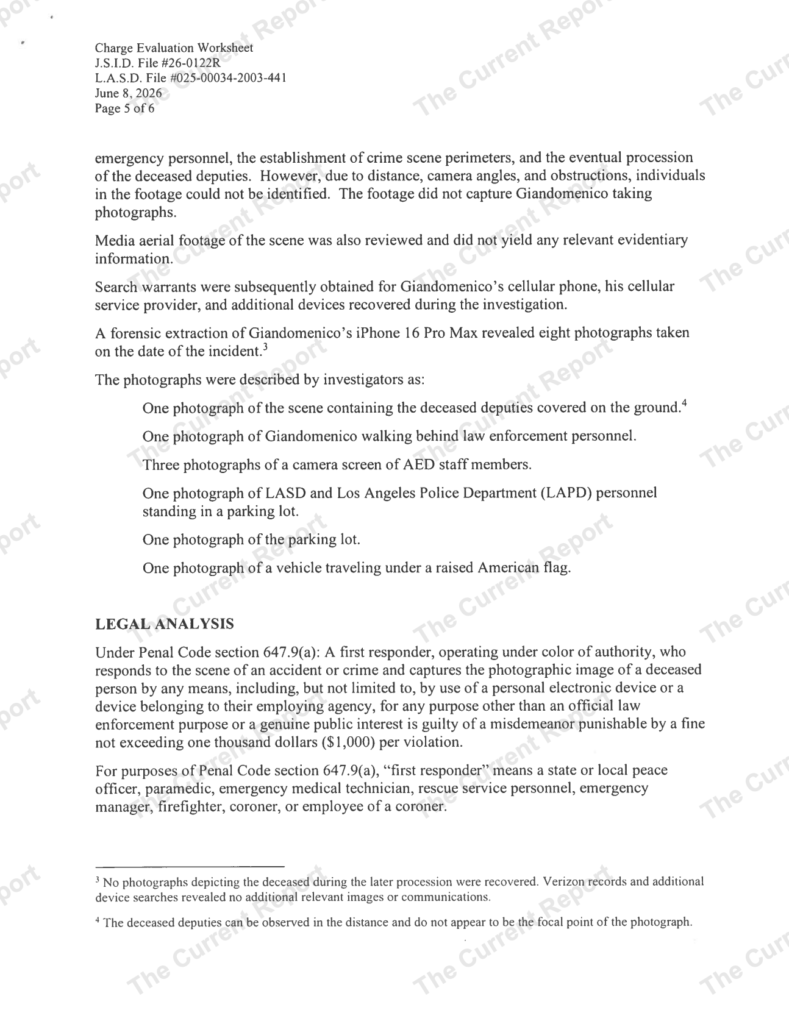
A forensic extraction of Giandomenico’s iPhone revealed eight photographs taken on the day of the explosion. One was a wide-angle image of the scene in which the covered bodies of the deputies were visible in the distance. The remaining photographs included law-enforcement personnel, AED staff appearing on a camera screen, a parking lot and a vehicle traveling beneath a raised American flag.
The DA’s own analysis contains an important clarification: the fallen deputies appeared in the distance and did not appear to be the focal point of the photograph.
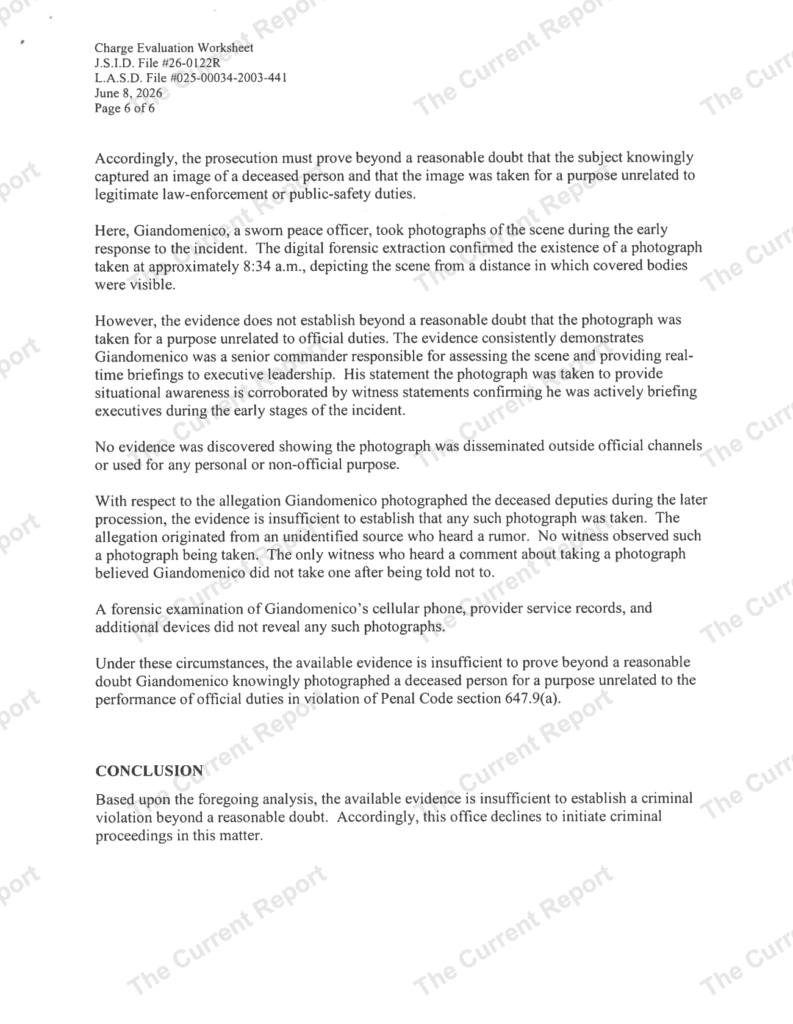
Giandomenico told investigators he took the image from approximately 100 yards away to document the location of the explosion while providing situational information to executive leadership. The DA found evidence supporting his explanation. Giandomenico was the senior commander responsible for assessing the scene and briefing executives and Sheriff Robert Luna, and witness statements corroborated that he was actively providing those briefings during the early stages of the incident.
Prosecutors also found no evidence that the photograph was disseminated outside official channels or used for a personal or otherwise improper purpose.
The more inflammatory allegation involved the later procession for the fallen deputies. Investigators found no photograph from that procession. No witness reported seeing Giandomenico take one and the forensic searches of his phone, cellular-provider records and additional devices produced no such image.
After all the interviews, warrants, records and forensic work, the evidence supported what Giandomenico had said from the beginning: the scene photograph was taken in connection with his official responsibilities, while the photograph he was accused of taking during the procession did not exist on any of the devices or records investigators searched.
Timing is Everything
But buried in the DA’s analysis is a detail that may explain why an unsubstantiated rumor was pursued with such extraordinary force. Giandomenico told investigators he believed the allegation was not only unfounded, but potentially driven by Department politics surrounding the selection of the next chief. At the time, Giandomenico was serving as acting chief – the position he was presumably in line to retain permanently – when an allegation that could threaten his career was transformed into a criminal investigation.
That does not prove the investigation was politically engineered, but it makes the timing impossible to dismiss. While Giandomenico was placed under the cloud of a criminal investigation, another candidate was positioned to advance. Commander Brandon Dean was ultimately promoted to chief. The question LASD must now answer is whether an unsupported allegation was used, or conveniently allowed, to remove Giandomenico from contention while clearing a path for Dean.
Giandomenico did not invent this concern after prosecutors rejected the case. He raised it during the investigation, while cooperating with investigators and surrendering his electronic devices for forensic examination. Now that the DA has declined to prosecute, the promotion timeline must be examined alongside the investigative timeline: who initiated the case, who authorized it, who knew about it, when Giandomenico was removed from consideration and who benefited from having the acting chief sidelined under the weight of an allegation that ultimately produced no criminal charges.
Three Deputies Were Dead – And This Was the Priority
The sheer amount of investigative power and Department resources deployed to chase this allegation while three deputies were dead and profound questions remained about the explosion that killed them.
Witnesses were interviewed. Security and media footage were examined. Giandomenico’s cellphone was forensically extracted. Cellular-provider records were obtained. Additional electronic devices were searched. Search warrants were prepared, presented to a judge and executed.
All of this was done to determine whether a commander had improperly photographed the aftermath of an explosion when the available evidence ultimately showed that one distant scene photograph was taken as part of his responsibility to brief executive leadership, while the other alleged photograph could not be found because there was no evidence it had ever been taken.
The DA concluded that the evidence was insufficient to establish beyond a reasonable doubt that Giandomenico knowingly photographed a deceased person for an unofficial purpose and declined to initiate criminal proceedings. That decision should not allow LASD to close the file and pretend this was simply an allegation that did not pan out.
Government investigators are sometimes required to examine allegations that are ultimately unsubstantiated. But that does not mean every rumor justifies search warrants, forensic extractions and access to private electronic records. The more intrusive the investigation becomes, the stronger and more reliable its factual foundation should be.
Here, the source could not be identified. The source had not seen the photographs. The reporter declined to participate. The Department’s communications manager refused to identify the reporter. No procession photograph was found. No evidence showed that the one relevant scene photograph had been used for anything other than official duties.
Yet the machinery of a criminal investigation kept moving.
It Is Time to Investigate the Investigation
LASD now needs to disclose who initiated this case, who authorized its escalation and what evidence was presented to the judge to obtain the search warrants (currently under review by The Current Report).
The Department should explain whether Nishida was required to identify the reporter during an internal criminal investigation, whether her refusal violated policy and whether she faced any consequences for withholding information central to determining the reliability of the allegation.
The timeline of the investigation should also be compared with the chief promotion process. If Giandomenico’s belief that Department politics played a role was unfounded, the records should establish that. If the investigation affected his candidacy while Brandon Dean moved forward, the public deserves to know who made those decisions and on what basis.
After more more than 15 years publishing investigative reporting, I understand the difference between an allegation worth examining and an allegation that can be responsibly presented as fact. I also understand what it means to obtain and scrutinize evidence before using the power of publication against someone. Government investigators, armed with the authority to search private devices and records, should be held to a standard at least as exacting.
The DA has told us why the criminal case against Giandomenico could not be prosecuted. Now LASD needs to explain why a case built on an unverified rumor was allowed to go this far at all.