
There are internal cultures that agencies quietly tolerate, and then there are cultures that metastasize, spreading so deeply into the fabric of an institution that they begin to define it. What a current trainee inside the Los Angeles County Sheriff’s Department describes is not a series of isolated complaints. It is a portrait of a system where degradation has been normalized, morale has collapsed, and the very people tasked with public safety are being systematically broken before they ever reach full deployment.
This is not coming from an outside critic. It is coming from within.
The trainee calls it “The Games.”
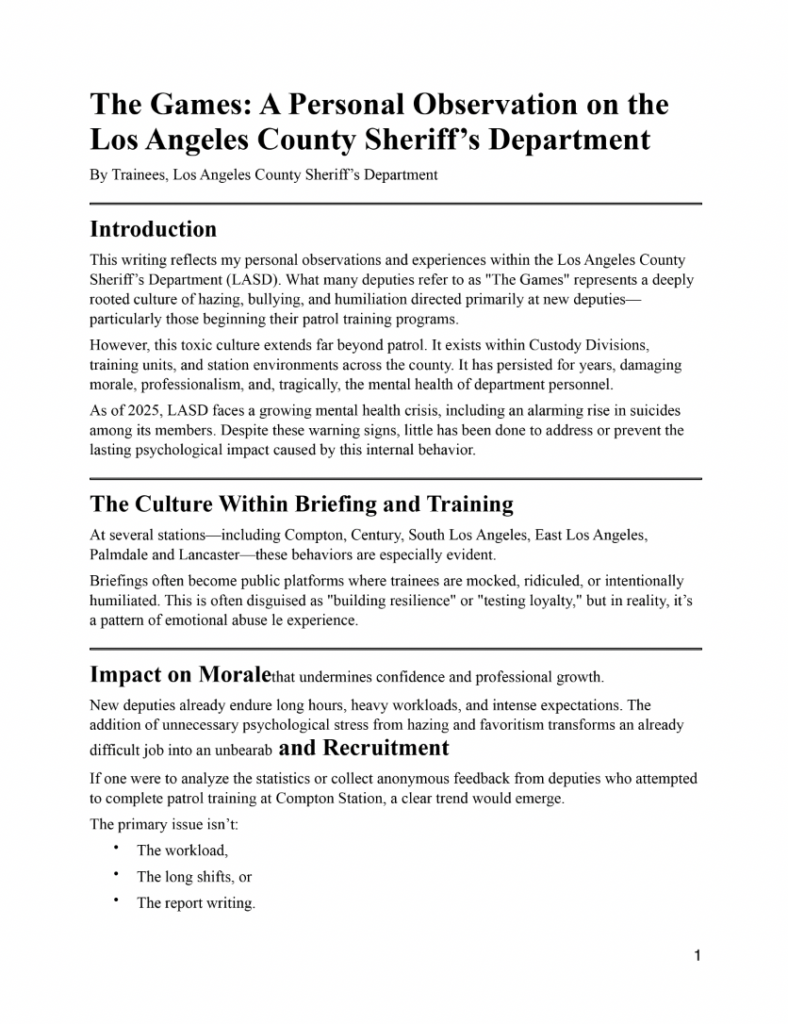
And he didn’t write it casually. By his own account, he was put through so much, psychologically, professionally, and personally, that he felt compelled to document it. Not as a complaint, but as a record. A warning. Something that could no longer be ignored.
He sent that document to oversight bodies, the Los Angeles County Office of Inspector General and the Los Angeles County Board of Supervisors, the very institutions tasked with accountability and reform.
He received no response.
That silence now sits alongside the allegations themselves.
The phrase “The Games,” passed down in quiet acknowledgment among deputies, refers to a culture of hazing, humiliation, and internal power dynamics that has embedded itself across multiple divisions, patrol, custody, and training units alike. It is not confined to one station, one supervisor, or one era. It is systemic. And it is accelerating.
Inside briefings, the operational heartbeat of any station, trainees report being publicly mocked, singled out, and humiliated under the guise of “resilience building.” In practice, it functions less like training and more like ritualized degradation. Deputies already working punishing hours are forced into an environment where performance is not the primary metric for success. Survival is.
The trainee is clear about what is actually driving people out. It is not the workload. Not the long shifts. Not even the complexity of the job.
It is the culture.
At stations like Compton, Century, East Los Angeles, and Lancaster, that culture has reached a point where deputies are actively avoiding transfers. When a department struggles to recruit, leadership often looks outward, to public perception or generational shifts. But here, the answer appears far more direct. Deputies are not rejecting the profession. They are rejecting the environment they are expected to endure once they get there.
And what they are describing goes well beyond tough training.
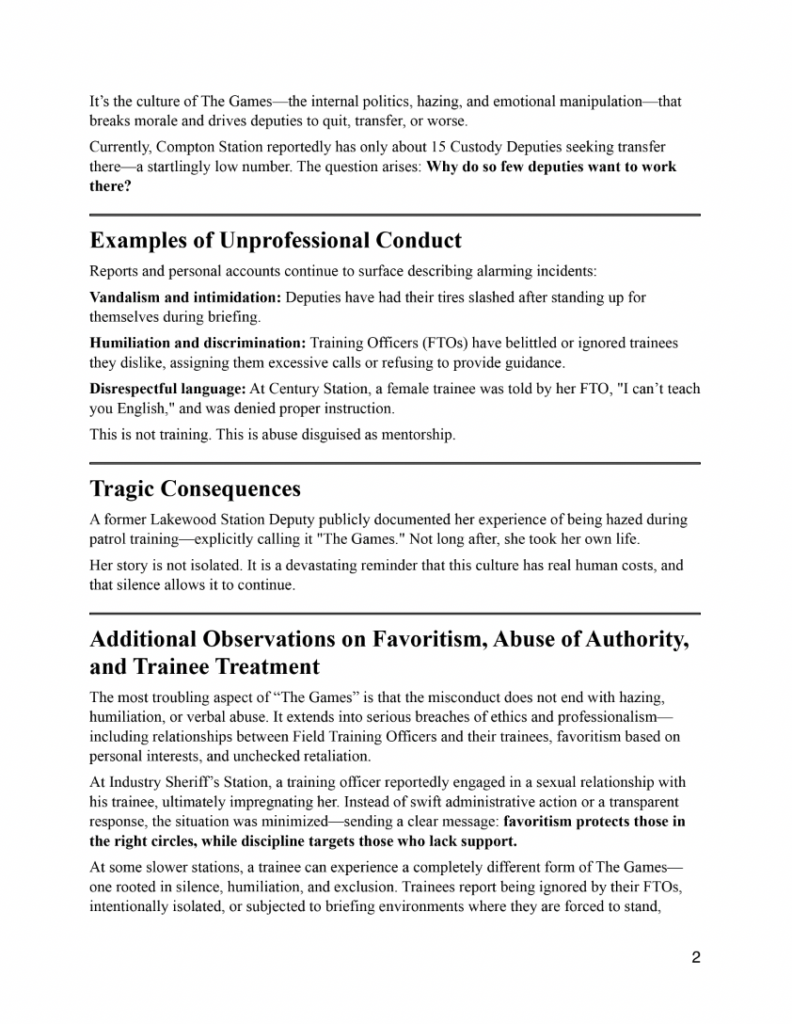
Accounts include retaliation for speaking up, deliberate overloading of calls to force failure, and outright intimidation. In one instance, a deputy’s tires were reportedly slashed after standing up during briefing. In another, a trainee was belittled by a Field Training Officer with the remark, “I can’t teach you English,” and then denied meaningful instruction. These are not isolated lapses. They are indicators of a system where authority is being misused without consequence.
Even more troubling is the way favoritism appears to shield misconduct.
The trainee outlines allegations of inappropriate relationships between training officers and subordinates, situations that would typically trigger immediate scrutiny. Instead, these incidents are described as minimized or ignored, reinforcing a perception that accountability is selective. In such an environment, advancement and survival are no longer tied to competence, but to alignment with internal networks.
For those outside law enforcement, it may be tempting to frame this as a harsh but necessary proving ground. That argument collapses under the weight of what follows.
Because the consequences are no longer theoretical.
The department is facing what the trainee describes as a growing mental health crisis, including an increase in suicides among its ranks. One former deputy, who publicly spoke about experiencing “The Games,” later took her own life. The connection is not presented as speculation. It is presented as a warning that has already been ignored.
This is where institutional failure becomes impossible to dismiss.
Since Robert Luna took office in late 2022, the Los Angeles County Sheriff’s Department has faced a worsening mental health crisis marked by a sharp rise in suicides among its ranks. In 2023 alone, at least nine current and former employees died by suicide, including a devastating cluster of four in a single 24-hour period. By 2025, reporting indicated that at least 13 suicides had occurred since 2023, and department sources say that total is more realistically hovering at 16, underscoring a sustained and alarming trend rather than isolated incidents. The exact total continues to evolve, but the trajectory is clear: the number of suicides has climbed significantly during this period, raising urgent questions about internal culture, workload, and leadership response.
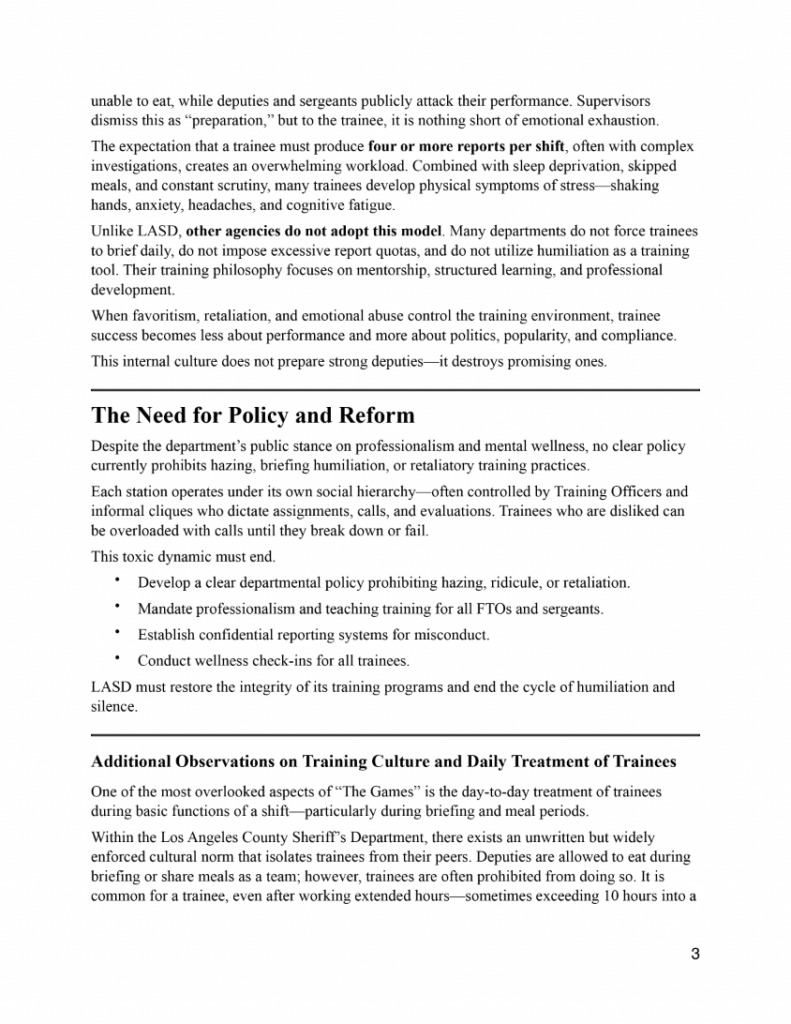
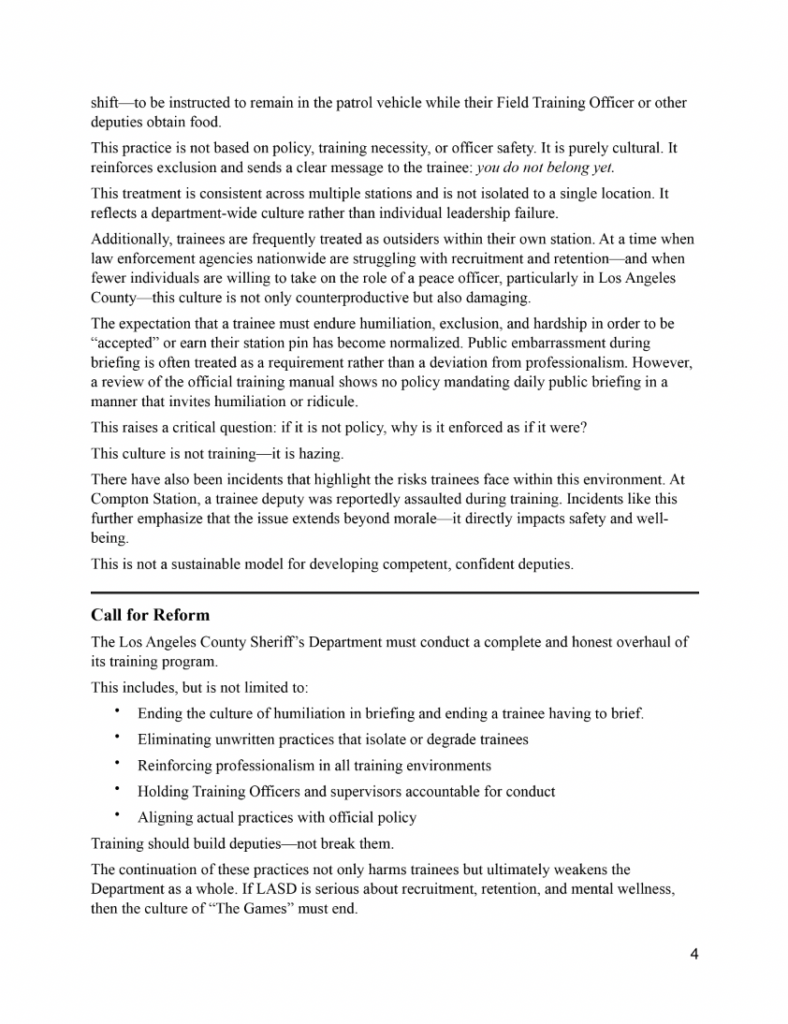
Law enforcement agencies across the country are adapting, revising training models, emphasizing mentorship, prioritizing wellness. What is being described inside LASD moves in the opposite direction. It is a system where trainees are isolated during meals, denied basic inclusion, and conditioned to accept humiliation as a prerequisite for belonging.
There is no policy mandating this.
That may be the most revealing detail of all.
The practices defining “The Games” do not originate from official doctrine. They persist because the culture enforces them – protected by silence, reinforced by hierarchy, and perpetuated by those who endured it and now replicate it.
And when someone inside finally documents it, thoroughly, clearly, and at personal risk, and sends it directly to the very offices charged with oversight, only to be met with silence, it raises a far more serious question: Who, exactly, is accountable?
Because this is where leadership enters the frame.
When Robert Luna took office, he vowed to reform the department, restore professionalism, rebuild trust, and move beyond the controversies that had long defined the LASD. But culture is not changed through statements or press conferences. It is changed through enforcement, accountability, and the willingness to confront what exists beneath the surface.
By this account, that has not happened.
What remains, according to the trainee’s firsthand experience, is a culture that still rewards those who exercise power through intimidation, while executive leadership looks the other way. A structure where retaliation is not only possible, but predictable. Where harassment is tolerated, and in some cases, enabled by those positioned to stop it.
The trainee outlined what reform could look like: clear anti-hazing policies, standardized training expectations, confidential reporting systems, and real accountability. None of it is radical. All of it is necessary.
But none of it appears to have been acknowledged.
The deeper issue is no longer just morale. It is trust, inside the department, and outside. A system that conditions its trainees to endure abuse, then ignores them when they speak, is not simply failing its people.
It is eroding itself from within.
And now, the warning has been written, delivered, and, at least for now, left unanswered.