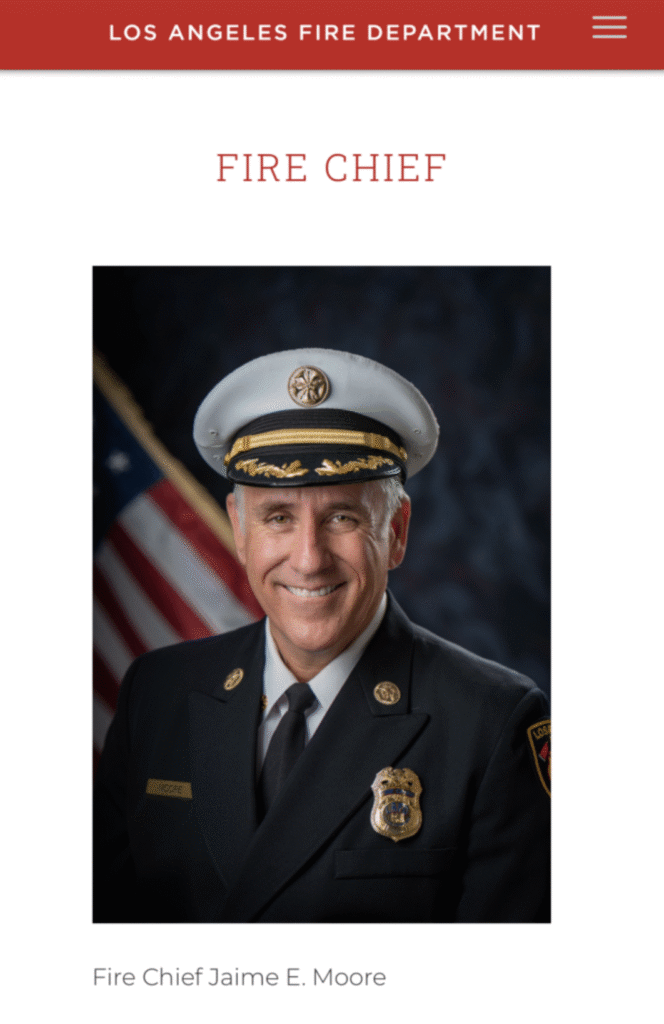
In a stunning admission that confirms what fire-ravaged communities have suspected all along, Los Angeles Fire Department Chief Jaime Moore acknowledged this week that the official after-action report on the catastrophic Palisades Fire was repeatedly edited to soften, and in some cases erase, criticism of department leadership. This wasn’t a clerical cleanup. It was narrative laundering.
The Palisades Fire, which ignited January 7th, 2025, now stands among the most destructive blazes in California history. According to CAL FIRE, it tore through thousands of acres, destroyed more than 7,000 structures, and claimed at least a dozen lives. The devastation didn’t begin with a freak act of nature. It began with a preventable failure, however, the mishandling of the earlier Lachman Fire on New Year’s Day, which LAFD leadership prematurely declared “contained.”
We now know that declaration was false.
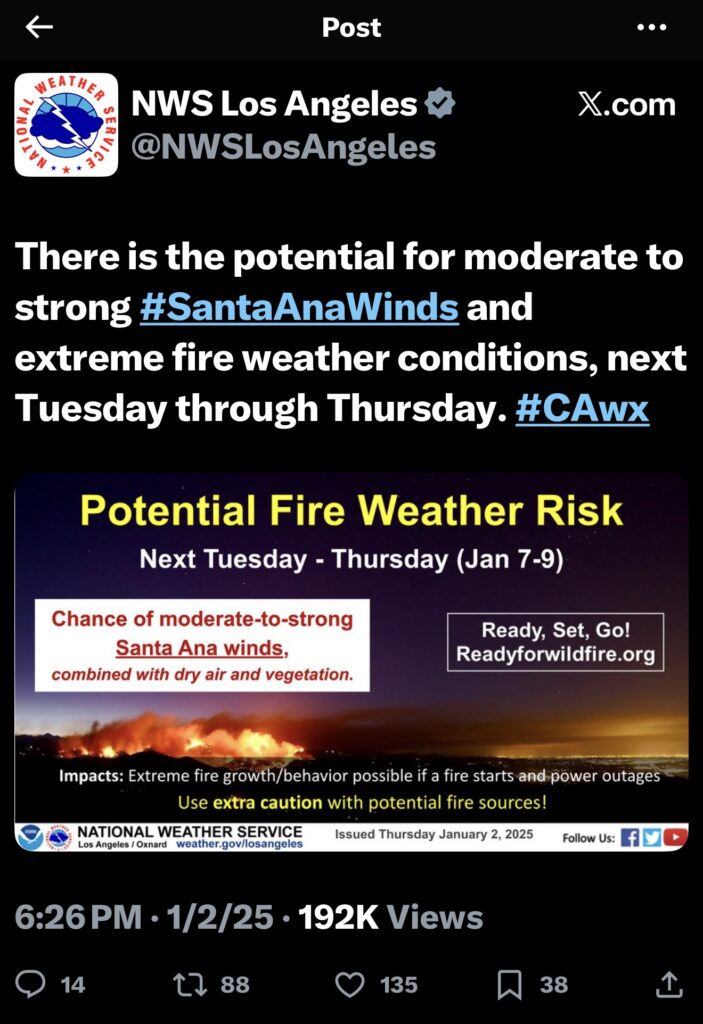
Smoldering roots and heat-retaining tree stumps were left behind. Crews were ordered to pick up hoses and stand down. The question is not whether the fire was fully extinguished – it wasn’t. The real question is why leadership ignored the risk entirely. Weather models available to state and local agencies had already flagged a significant Santa Ana wind event days in advance. The National Weather Service issued formal alerts as early as January 2, continuing right up until the Palisades Fire ignited. Yet no contingency plan was implemented. No follow-up inspection occurred. A known ignition zone was inexplicably treated as a closed case, despite extreme wind warnings saturating news coverage and social media feeds. The question isn’t whether the risk was foreseeable — it was impossible to miss. The question is why leadership chose to ignore it.
Six days later, those warnings became reality. Powerful Santa Ana winds, combined with heavy fuel loads and brush that had not been cleared by the state around Topanga State Park, reignited the abandoned embers from the Lachman Fire. What followed was a full-scale inferno that tore through the Palisades and into Malibu, overwhelming communities with terrifying speed.
That cascading failure, predictable, documented, and entirely avoidable, should have been the centerpiece of a brutally honest after-action report. Instead, it was softened, sanitized, and buried beneath edits designed to protect leadership rather than tell the truth.
Chief Moore made the admission during a public meeting of the Los Angeles Fire Commission, reported by KNBC: multiple drafts of the after-action report were altered “to soften language and reduce explicit criticism of the department leadership.” The edits occurred before Moore took command, under the previous administration, but they served a familiar purpose: protect the people at the top.
Those people include Karen Bass, whose oversight of the department coincided with the disaster, and Gavin Newsom, who has presided over a state where wildfire season has become a permanent condition. Moore has promised such editorial manipulation won’t happen again on her watch. Californians have heard that pledge before.
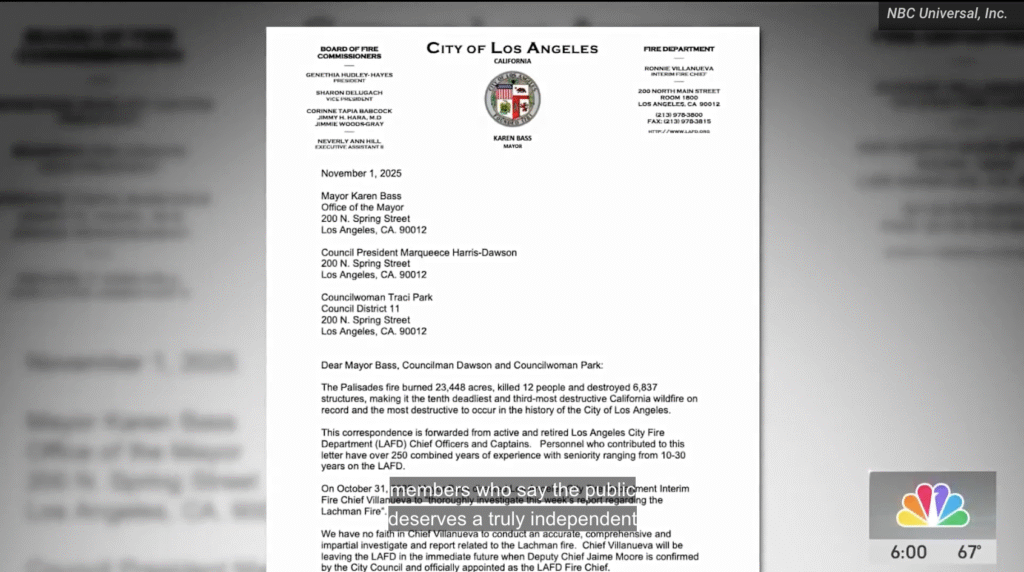
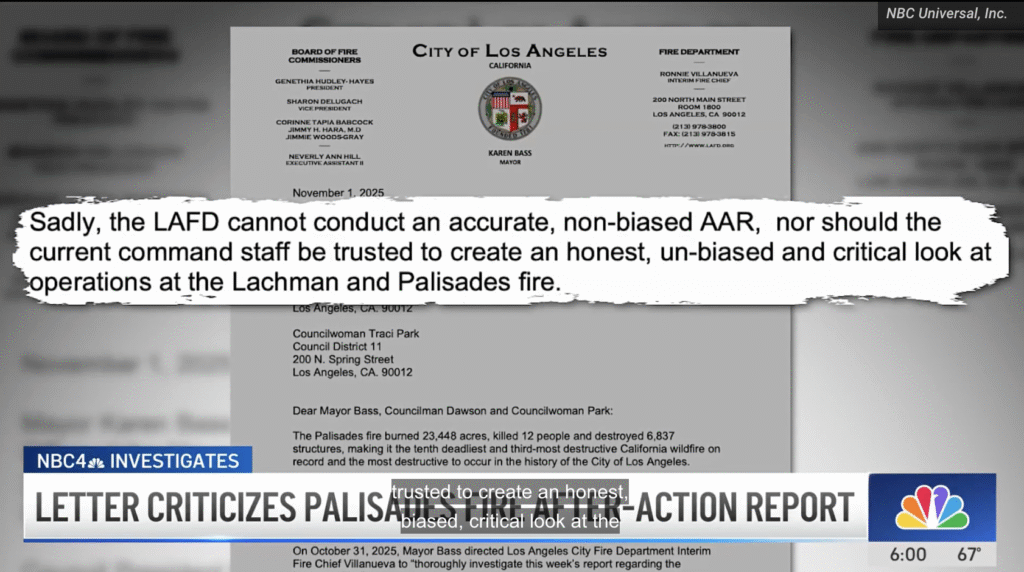
This revelation didn’t come out of nowhere. Last November, an anonymous whistleblower sent a detailed letter to the mayor’s office and city council members, warning that the Palisades report was compromised from the start. The review was supervised by officials whose decisions were under scrutiny, a glaring conflict that guaranteed the outcome. It was never designed to expose failure; it was designed to contain it.
And while residents sifted through ash, Bass was overseas. Her widely criticized trip to Ghana during the height of the emergency became a symbol of absence at the exact moment leadership was required. Later soundbites and regret-tinged slogans couldn’t undo the damage, or the perception that image management mattered more than public safety.
The governor’s office fares no better. Under Newsom, California’s wildfire response has devolved into a cycle of emergency declarations, press conferences, and policy slogans while foundational problems fester. Forest management remains politicized. Agencies remain understaffed. Bureaucracy outpaces action. Each year, the fires get worse, and each year, accountability gets thinner.
Moore also conceded what firefighters on the ground already knew: the department’s handling of the Lachman Fire was flawed. Crews were told to stand down based on outdated procedures and an assumption the fire was out. But internal messages later reviewed by Los Angeles Times showed battalion chiefs pushing evacuations despite lingering heat, a decision that proved catastrophic. Only after lives were lost did LAFD announce revamped mop-up protocols and expanded drone surveillance. Progress, perhaps, but bought at an unforgivable cost.
For communities like Pacific Palisades and Malibu, this isn’t partisan theater. It’s lived reality. Homes are gone. Families displaced. Landscapes forever altered. And now we learn that even the official record was massaged to spare reputations.
California doesn’t just have a wildfire problem. It has a records and accountability problem. When after-action reports are edited to soften criticism, when known risk factors are ignored, and when decisions made before a catastrophe are rewritten after the fact, the issue is no longer mismanagement, it is exposure. Because fires don’t just destroy homes. They generate timelines, metadata, emails, draft histories, and sworn testimony. And those records have a way of resurfacing.