
In “The Games,” one reality was laid bare about the Los Angeles County Sheriff’s Department. The system is not failing. It is operating exactly as it has been allowed to operate. Power is preserved. Optics are managed. Merit is conditional.
Part II exposes what that system looks like when control is exercised through something far more corrosive than politics or favoritism.
Inside LASD’s Field Training Officer program, particularly at Century Station, deputies describe a pattern that crosses a clear line. Influence is not just being traded through relationships. It is being leveraged through sex as a means of advancement and control.
This is not framed internally as isolated misconduct. It is described as a mechanism.
Trainees allegedly engaging in sexual relationships with those who evaluate them are not simply violating policy. They are entering into a power exchange that directly impacts their careers. In return, those in positions of authority gain influence, loyalty, and control over outcomes that are supposed to be governed by performance.
That dynamic reshapes the entire structure.
Evaluations are no longer objective. They are negotiated.
Accountability is no longer consistent. It is selective.
Authority is no longer impartial. It is compromised.
Sex becomes currency.
For those participating, advancement can be accelerated. Failures can be softened or erased. Standards can be adjusted. For those who refuse, the message is equally clear. There is no parallel path that offers the same insulation or opportunity.
This is not favoritism. It is coercive leverage embedded inside a training program.
The result is a system where power is reinforced through personal access rather than professional merit. Supervisors who engage in this conduct are no longer leading. They are managing influence, creating dependency, and deciding outcomes based on relationships they control.
And once that structure takes hold, it does not stay contained.
It spreads. It becomes normalized. It teaches new deputies that success is not tied to performance, but to what they are willing to tolerate or participate in. It creates an environment where boundaries are not just blurred, they are functionally irrelevant.
The impact on the workforce is immediate.
Deputies operating on merit recognize the imbalance. They see failures ignored for some and punished for others. Morale fractures. Credibility erodes. The message becomes unmistakable.
Performance is not the deciding factor.
Female trainees who do not engage in these dynamics are forced into a system that works against them. Their advancement is scrutinized, their credibility questioned, and their burden of proof elevated before they have even had the opportunity to establish themselves.
At the same time, those who do participate are not operating freely. They are operating within a structure of control. When advancement is tied to a relationship, that relationship does not end at promotion. It becomes leverage that can be used, revisited, or enforced.
That is where the environment shifts from inappropriate to dangerous.
Because this is not just about who passes training. It is about what is being taught.
Deputies trained in this environment learn that authority can be manipulated, that accountability can be avoided, and that outcomes can be controlled through personal leverage rather than professional conduct.
Those lessons do not stay inside the station.
They move into the field. They shape decision-making. They influence discretion. They alter how power is exercised over the public.
When internal systems allow sex to become a tool for advancement and control, it creates a broader culture where ethical boundaries are negotiable. That erosion does not stop at personnel decisions. It reaches into investigations, enforcement, and public interaction.
The damage expands outward.
Victims are affected when accountability is inconsistent.
Cases are affected when standards are compromised.
Communities are affected when trust is replaced by perception.
This is not a personnel issue. It is an institutional failure.
Sheriff Robert Luna came into office promising reform. Transparency. Accountability. A reset of a Department that had lost the confidence of both its personnel and the public.
Yet the practices being described by deputies have not been meaningfully addressed. They continue. Unchecked. Uncorrected. Embedded within the very system that is supposed to produce the next generation of deputies.
That failure carries consequences beyond internal culture.
LASD is already struggling with retention. It is experiencing a historic staffing crisis. Recruitment pipelines are thinner. Experience is walking out the door. The Department is relying on a new pool of personnel to stabilize its future.
And those new hires are entering a system where the rules are already compromised.
They are being trained inside an environment where merit is negotiable, where authority is conditional, and where advancement can be influenced by personal leverage rather than performance. That is not just a cultural problem. It is a structural risk to the future of the Department.
A workforce cannot be rebuilt on a foundation that undermines itself.
The Department continues to present an image of reform and professionalism. Internally, deputies are describing a structure where advancement can be influenced through sexual relationships, where authority is compromised, and where control is exercised through personal leverage rather than leadership.
The question is no longer whether the system is fair.
The question is how long a Department facing a staffing crisis can afford to ignore a culture that is actively driving its credibility, its retention, and its future into the ground.
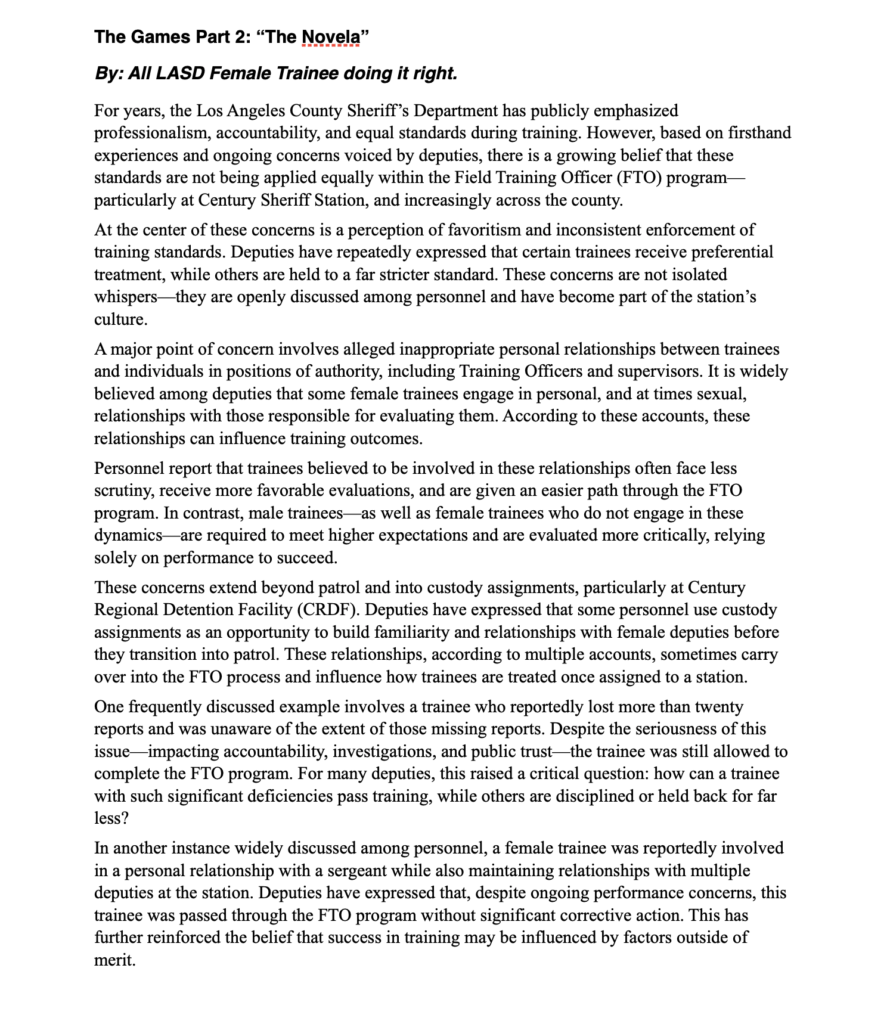
*Editor’s Note: this article was based on the information below submitted to The Current Report by personnel at the Century Station: