
By the time Los Angeles County residents first heard the name “Measure ER” during a February 10, 2026 Board of Supervisors meeting, the political operation behind it was already fully constructed, fully funded, and moving millions of dollars through the County’s labor and political infrastructure.
What voters saw publicly that morning was a proposal framed as an emergency funding mechanism designed to preserve County healthcare services through a new half-cent sales tax expected to generate roughly $1 billion annually. What the public did not see was that nearly $4 million from public safety unions had already been wired into a political committee supporting the measure during a seven-day period in December 2025 – more than eight weeks before the Board publicly voted to place the measure on the ballot.
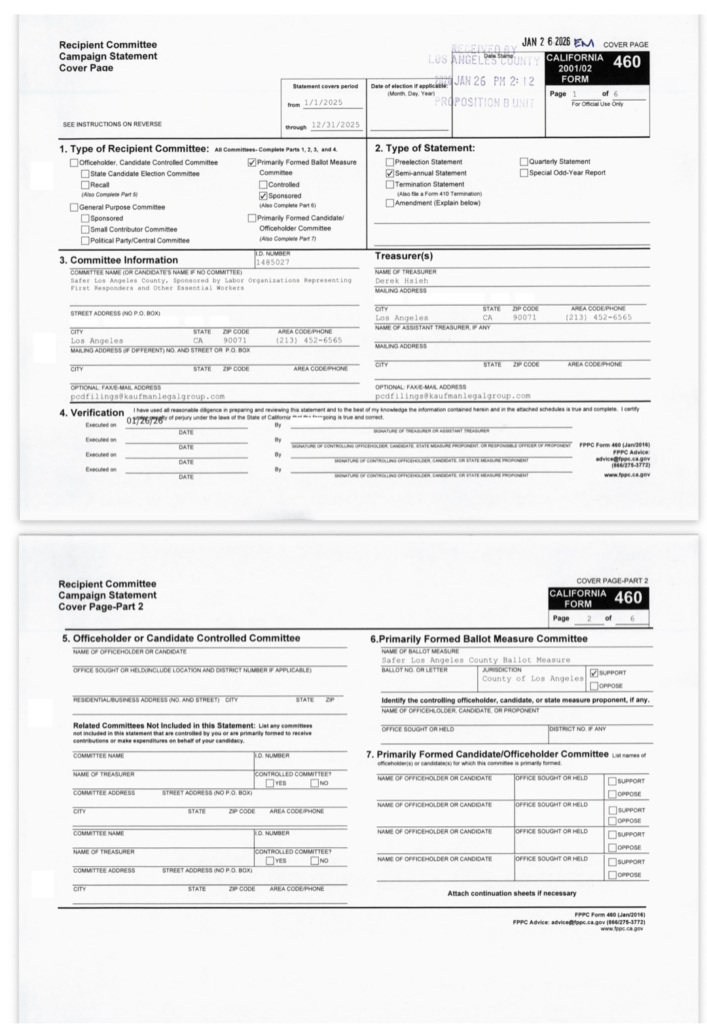
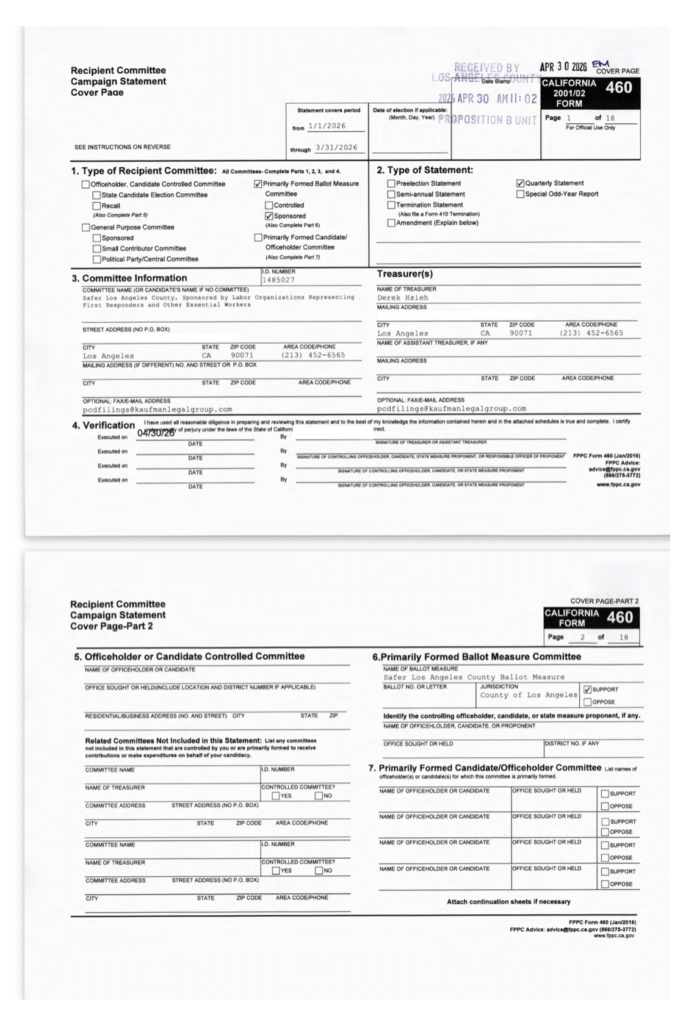
Campaign finance disclosures signed under penalty of perjury establish the timeline with precision. According to Form 460 filings submitted to the Los Angeles County Registrar-Recorder/County Clerk, a committee registered as “Safer Los Angeles County, Sponsored by Labor Organizations Representing First Responders and Other Essential Workers” received $3,950,000 between December 4 and December 11, 2025.
The largest contributor was the Association for Los Angeles Deputy Sheriffs – ALADS – which wired $2.75 million on December 4, 2025. The same day, the Los Angeles County Professional Peace Officers Association added $500,000. The Lifeguard Association followed with $75,000 the next day. On December 11, Firefighters Local 1014 Community Issues wired another $625,000.
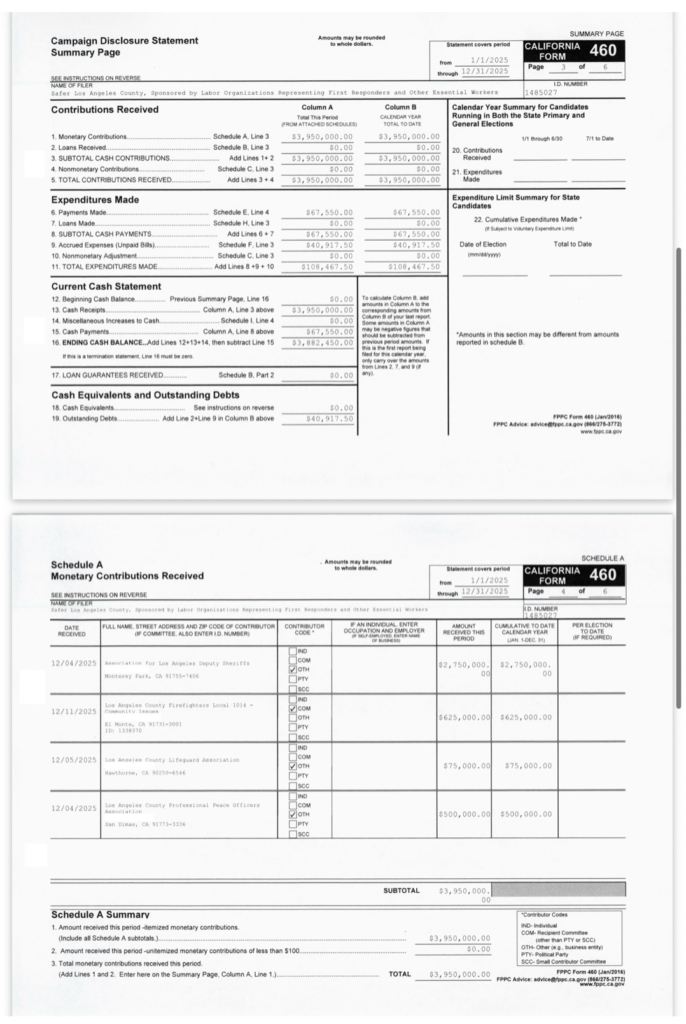
Schedule A of the December 2025 Form 460 – the seven-day wire window. Four contributors. $3,950,000.00 in monetary contributions across seven days.
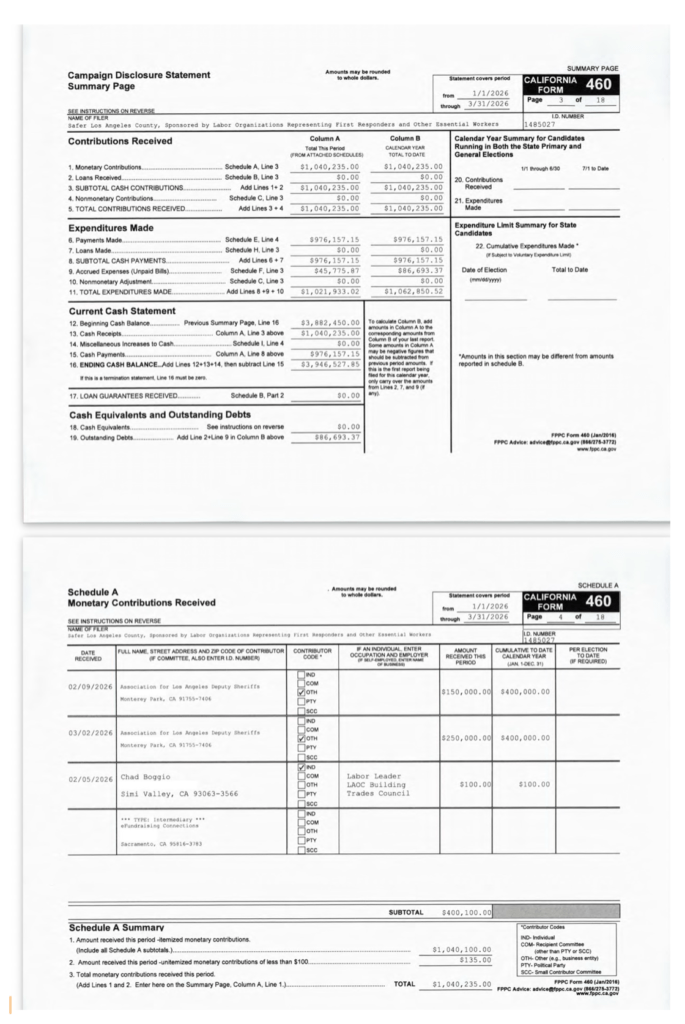
By the end of the first quarter of 2026, the committee’s total funding had climbed to $4,990,235, with approximately $4.925 million originating directly from first responder labor organizations. ALADS returned in Q1 2026 with an additional $400,000 across two tranches – $150,000 on February 9 and $250,000 on March 2 – bringing its total Measure ER contribution to approximately $3.15 million.
The significance of those numbers becomes difficult to ignore when viewed alongside what was unfolding simultaneously inside Los Angeles County Sheriff’s Department labor negotiations. During the same period ALADS was wiring millions of dollars into a political committee backing a measure largely designed to benefit healthcare-related programs and workers, deputies were being told the County had no money available for raises – despite the escalating cost-of-living crisis impacting their own membership.
ALADS leadership’s own public messaging centered on rejecting what members described as a “zero” contract – zero-percent increases through 2026 with a claw-back provision requiring deputies to return funds if the County later declared a budget shortfall. Spectrum News quoted then-ALADS President Richard Pippin describing the stalled negotiations as “quite frustrating.” ALADS Director Jason Zabala publicly confirmed the zero-percent position in December 2025.
Yet while rank-and-file deputies were being told county resources did not exist for compensation increases, ALADS somehow located $2.75 million for a single-day political contribution benefiting a ballot measure that allocated no guaranteed funding to deputies whatsoever.
That contradiction sits at the center of the entire Measure ER structure.
According to Los Angeles County’s own official Measure ER fact sheet, the projected $1 billion in annual tax revenue allocates no guaranteed funding to the Sheriff’s Department, custody deputies, fire suppression, county lifeguards, or sworn first responder operations. The money goes to healthcare-related systems: 45 percent to Department of Health Services care for uninsured residents, 22 percent to public hospitals and clinics, 10 percent to the Department of Public Health, with additional allocations to nonprofit health agencies, school-based healthcare, and Medicaid outreach.
Two labor organizations embedded into the measure’s structural oversight framework – SEIU Local 721 and SEIU Local 2015 – emerged as direct beneficiaries of guaranteed spending allocations through amendments later introduced by Supervisor Lindsey Horvath. SEIU 721 received a dedicated 2.5 percent allocation tied to clinical staffing inside county jails. SEIU 2015 received another 2.5 percent allocation prioritizing wages and benefits for IHSS providers.
The unions representing deputies, firefighters, peace officers, and lifeguards financed the public safety-branded political campaign. The structurally protected beneficiaries inside the measure were healthcare and SEIU-aligned organizations.
And the entire political structure appears to have been assembled before the public knew the measure existed. Campaign filings signed January 26, 2026 – twenty-eight days before the public vote – already identified the committee as primarily formed to support the “Safer Los Angeles County Ballot Measure – County of Los Angeles – SUPPORT.” Not exploratory. Not conceptual. Not conditional. The filings identified the measure by name, jurisdiction, and political purpose weeks before supervisors publicly voted to place any sales tax proposal on a ballot.
Committee 1485027 was not the only fundraising vehicle supporting Measure ER. A parallel architecture of additional ballot-measure committees has been registered separately, each disclosing different contributor sets – including “Yes on ER – Restore Healthcare for Angelenos, Sponsored by St. John’s Community Health and Health Justice Action Fund.”
The parallel committees draw from a distinct contributor pool. St. John’s Community Health – a designated beneficiary of Measure ER’s nonprofit safety-net category – contributed over $4,000,000. SEIU Local 721, a structural beneficiary of the measure, contributed $200,000 to the parallel vehicle but does not appear on Committee 1485027’s contributor list. The California Community Foundation added $200,000; the LA County Medical Association PAC, $50,000.
The contributor pool funding Measure ER is, in operational terms, bifurcated. The first-responder unions funded the committee with the public-safety name on the door. The healthcare and SEIU-aligned entities funded separate vehicles aligned with their own program priorities. SEIU 721 paid into the parallel committee, not the public-safety-branded one.
At the center of the operation sat an unusually interconnected political structure involving labor leadership, campaign finance control, and county governance influence.
The committee treasurer who signed the campaign filings under penalty of perjury – Derek Hsieh – was simultaneously serving as ALADS Executive Director, meaning the same individual oversaw the organization sending the money while signing the disclosures receiving it. Hsieh also sat as a confirmed member of the Los Angeles County Governance Reform Task Force, created through Measure G, the voter-approved November 2024 charter reform that restructured Los Angeles County government itself. He was seated on the Task Force by Board of Supervisors confirmation on May 27, 2025. He also serves as elected Chair of the Coalition of County Unions – approximately 15 labor organizations representing roughly 35,000 County employees – and as Vice President for Budget and Finance on the Executive Board of the Los Angeles County Federation of Labor, AFL-CIO.
In one room, he is the executive of the union that wired the money.
In another room, he is the named treasurer of the political committee that received the money.
In the third room, he is a seated member of the County advisory body that helps shape the governance framework under which the ballot measure that received the money will operate.
Hsieh’s compensation as ALADS Executive Director, drawn directly from member dues, was reported on ALADS’ IRS Form 990 for tax year 2024 at $302,113 – approximately 70 percent above the $177,557 reported for the same position in tax year 2017. His 2023 figure, the most recent peak on file, was $324,178.
The chronology surrounding the Governance Reform Task Force meetings only deepens the appearance of coordination. On December 3, 2025, the Task Force held a publicly noticed meeting at Bob Hope Patriotic Hall. Present were ALADS Executive Director Derek Hsieh and SEIU Local 721 President David Green. The following morning, ALADS wired $2.75 million into the Measure ER committee while PPOA wired another $500,000. On December 10, Hsieh and Green appeared together again at another Task Force meeting. The following morning, Firefighters Local 1014 wired another $625,000.
The Task Force agendas themselves appear compliant with California’s Brown Act and did not list Measure ER as a discussion item. But the public record establishes that two of the most influential labor figures inside Los Angeles County governance repeatedly occupied the same room immediately before millions were wired into a political committee supporting a ballot measure that had not yet been publicly introduced.
Then came February 10, 2026 – the public unveiling.
Item 15 formally placed Measure ER before the supervisors. Supervisors Holly Mitchell and Hilda Solis introduced the measure, but it was Supervisor Lindsey Horvath who introduced the controlling amendment that significantly altered both the spending structure and oversight composition. Horvath’s amendment created dedicated oversight seats for SEIU Local 721 and SEIU Local 2015 while redistributing portions of the spending formula – reducing certain healthcare allocations and adding a new 5 percent category for nonprofit agencies focused on family planning and reproductive health services.
The amendment passed 3-2. The full Measure ER motion passed 4-1, with Kathryn Barger casting the lone dissenting vote.
Immediately afterward, the Board proceeded directly into Item 16 – another labor-related ballot initiative involving binding arbitration for public safety bargaining units, covering deputy sheriffs, firefighters, district attorney investigators, deputy medical examiners, lifeguards, and other public safety classifications. Horvath co-authored that proposal as well. According to ALADS’ own later-written membership communication, binding arbitration was not merely a related issue – it was “ALADS’ initiative.”
Two ballot measures. Same Board meeting. Consecutive agenda items. One already backed by nearly $4 million in first responder union money before the public vote even occurred. The second publicly identified by ALADS itself as its own labor initiative.
One cross-vote signal worth noting: Kathryn Barger, who cast the lone NO vote against Measure ER, voted YES on the binding arbitration measure ALADS publicly identifies as its own initiative. Holly Mitchell, who authored Measure ER, abstained on the binding arbitration measure her colleague Solis co-authored. The pattern of votes across two consecutive items does not reflect simple measure-by-measure alignment.
The political relationships surrounding Lindsey Horvath further complicate the picture.
In 2022, an ALADS-sponsored political committee spent $150,000 opposing Horvath’s campaign for County Supervisor. ALADS continued funding the same sister committee through 2023 and 2024, and that committee then deployed approximately $850,000 in 2024 supporting Kathryn Barger’s re-election – routed through a sub-committee called “Working Families and First Responders for Kathryn Barger for Supervisor 2024,” signed by committee treasurer David L. Gould on July 19, 2024 (Filing ID 211749759).
By 2026, after Horvath carried the controlling amendment on Measure ER and co-authored the binding arbitration measure ALADS publicly identified as its own initiative, the same organization endorsed her for re-election. No public filing or statement reviewed for this report explains the reversal.
In a May 2026 email distributed to its own membership, the ALADS Board openly defended its endorsement philosophy by explaining that “endorsing the likely winner protects organizational relevance” and that “you get more done when you are inside the room rather than fighting outside the building.” The communication emphasized maintaining “constructive relationships with county and state power centers” while acknowledging that portions of the membership disagreed with the strategy.
What the letter did not address was why deputies whose contracts remained unresolved and effectively frozen at zero percent were never publicly consulted before millions in member-funded union money were routed into a political campaign benefiting a ballot measure that allocated nothing directly to them. Nor did it explain why ALADS – according to its own IRS Form 990 filings – operated at an approximately $1.25 million deficit in 2024 while still managing to wire $2.75 million into a political committee in a single day the following year.
ALADS’ member-facing communications have characterized expenditures of this magnitude as requiring board-level authorization. Yet the meeting minutes authorizing the $2.75 million December 4 contribution have not been publicly released and have not been provided to the deputies whose dues financed the payment.
The public record does not establish bribery. It does not establish criminal conduct.
It does, however, establish something else with extraordinary clarity: a deeply interconnected political and labor structure operating with advance knowledge, synchronized funding activity, overlapping leadership roles, and strategically sequenced ballot measures long before Los Angeles County voters — and the deputies whose dues helped finance the effort — were ever invited into the conversation.