
When Los Angeles Police Department (LAPD) Chief Jim McDonnell convened a news conference on January 29, 2026, to release the 2025 citywide crime data analysis and outline public safety initiatives, the presentation was designed to project administrative stability and operational success. However, beneath this polished public relations facade lies a department grappling with deep-seated institutional decay. Far from experiencing a series of isolated administrative hurdles, the nation’s third-largest municipal police force is undergoing a systemic administrative decline. This decline is characterized by a fractured records technology transition, an aggressive retreat from transparency, a self-inflicted staffing bottleneck, a structurally disconnected risk management apparatus, and an insular promotional culture that routinely prioritizes social loyalty over professional merit while systematically retaliating against whistleblowers.
Structural reform represents the only viable path forward to correcting the systemic failures of the current administration. The LAPD is not alone in its rigid adherence to stagnant, obsolete practices that have slowly deteriorated the core of the organization. When executive leadership is marred by histories of domestic controversy, continuous racially insensitive remarks, and a stark lack of the basic operational experience required to manage a major municipal crisis, the result is an ongoing revolving door of failure. Instead of breaking from a compromised past, the department continues to double down on the same broken mechanisms, relies on unproven leaders, and lacks the seasoned, frontline experience necessary to lead. By elevating individuals based on optics rather than merit, the administration operates under the flawed premise that “nothing is broken here; let’s continue.”

Meanwhile, staffing numbers bleed, citizens suffer, and archaic policies remain entrenched. This protective posture extends to biased internal investigations designed to shield favored insiders while systematically punishing internal dissent—leaving many of the operational errors inherited from the previous Chief unaddressed through a system of bought loyalty.
This toxic environment mirrors the current state of Los Angeles City Hall, where a reliance on career politicians has steadily eroded the fundamentals of public safety, municipal cleanliness, emergency response times, and basic duties to constituents. This pattern of governance has led directly to the systemic civic failures Los Angeles experiences today. Central to this decline is a network of elected officials who maintain power through unethical, continuous allocations to favored non-profit organizations. Billions of taxpayer dollars are actively funneled into these entities, inflating their budgets under the guise of failing pet projects that deliver zero accountability and zero tangible results for the city.
Over the last four years, Mayor Karen Bass has delivered unfulfilled promises, failing to root out institutional corruption, significantly reduce homelessness, or address the city’s severe financial deficit. Instead of genuine leadership, City Hall relies on transactional loyalty to maintain its grip on power. Consequently, municipal unions have endorsed her administration not for tangible success in restoring the city, but rather for lucrative side deals designed to pad union financial accounts and secure political allies within the executive branch. Strikingly, critics note that not a single major structural success can be attributed to her tenure, save for the alleged pressured removal of department predecessor highly controversial Chief of Police, Michel Moore.
These lines of administrative pathology are structurally interdependent: technological implementation failures are actively utilized as legal shields to evade public accountability, while a defensive and retaliatory internal culture hollows out the department’s operational capacity. Most critically, an over-engineered and collapsing emergency response pipeline has fundamentally severed the connection between official statistics and the reality of public victimization. A rigorous analysis of the LAPD’s internal operations reveals how these compounding crises threaten the foundational integrity of the department’s public safety mission. These are longstanding, decaying administrative failures initiated under Chief Moore that have now persisted under the watch of Chief McDonnell. His senior management team consists primarily of the same leaders who previously complained about Moore’s micromanagement and biased leadership, yet operational execution remains entirely unchanged.
The department’s technological vulnerabilities are highlighted by Moore’s unfulfilled promises to modernize the agency prior to his departure. For nearly half a century, the LAPD was defined by an archaic mainframe system first implemented on January 1, 1975. This legacy infrastructure, which included the Automated Regional Justice Information System (ARJIS) and related applications, cost $3 million to develop in 1975—equivalent to over $17 million in 2024—and required ongoing maintenance costs of approximately $1 million per year. By the 2020s, the City of Los Angeles no longer employed personnel qualified to maintain these legacy programs, creating a critical single point of failure where a mainframe outage could cause a catastrophic, uncorrectable loss of investigative records.
To host these fragile applications, the city was forced to pay a $3.5 million annual service fee to the California Department of Technology. To replace this mainframe, the LAPD initiated a technology modernization procurement cycle in 2015. The first phase resulted in a three-year contract from 2017 to 2020 with Niche Records Management System for a total of $11,888,800, funded by $2.5 million in grants and $9,388,890 from the City’s General Fund. By 2018, the Niche contract was amended to $12,688,800, drawing $4.8 million from grants and $7,888,800 from the General Fund.
Despite these massive investments, the Niche system struggled to integrate with the department’s core dispatch networks. This required further expenditures, such as the Tenth Amendment to Contract C-123897, which authorized $50,233 for Niche-to-PremierOne Computer-Aided Dispatch (CAD) interface development and $157,346.35 for on-site PremierCAD technical support.
When the Niche integration ultimately proved unfeasible for full-scale operations, the city bypassed competitive bidding under Charter Section 371. In June 2022, the Public Safety Committee approved a sole-source, five-year agreement with Motorola Solutions, Inc. to implement the PremierOne Records software suite at a cost of $13,772,614. This active agreement shifted long-term maintenance costs to the Contractual Services Account to ensure compliance with federal crime reporting under the National Incident-Based Reporting System (NIBRS).
The implementation of Motorola’s PremierOne Records immediately ran into severe deployment and operational bottlenecks. Unlike modern, cloud-native platforms that allow for centralized, remote updates, the PremierOne Mobile Digital Computer (MDC) client software required the LAPD’s IT staff to physically access and configure every single terminal across the department’s vehicle fleet.
To manage this logistical challenge, the department had to purchase additional Mobile Device Management (MDM) software licenses just to push basic updates and patches remotely. Furthermore, on September 28, 2023, the department executed the Twenty-First Amendment to Contract C-123897, authorizing an additional $20,433,974 to Motorola for support, maintenance, cybersecurity monitoring, and hardware replacement for a six-year period ending August 31, 2027—massively inflating the long-term cost of the transition.
Operationally, the PremierOne Records platform has introduced deep structural friction into daily policing because the system lacks real-time NIBRS data validation at the point of entry. In modern law enforcement records systems, the absence of real-time error flagging shifts the administrative burden downstream to records clerks, who must manually review and reject flawed reports. Instead of catching coding errors automatically at the source, incorrect reports bypass initial screens and accumulate in massive administrative queues. This has created a continuous cycle of manual corrections that consumes valuable staff hours, delays active investigations, and directly leads to structural errors and duplicate entries in arrest tracking databases. Currently, the LAPD Information Technology Bureau is spending millions of dollars annually in overtime for police officers to run an internal help desk for personnel experiencing difficulties navigating the flawed Records Management System (RMS).
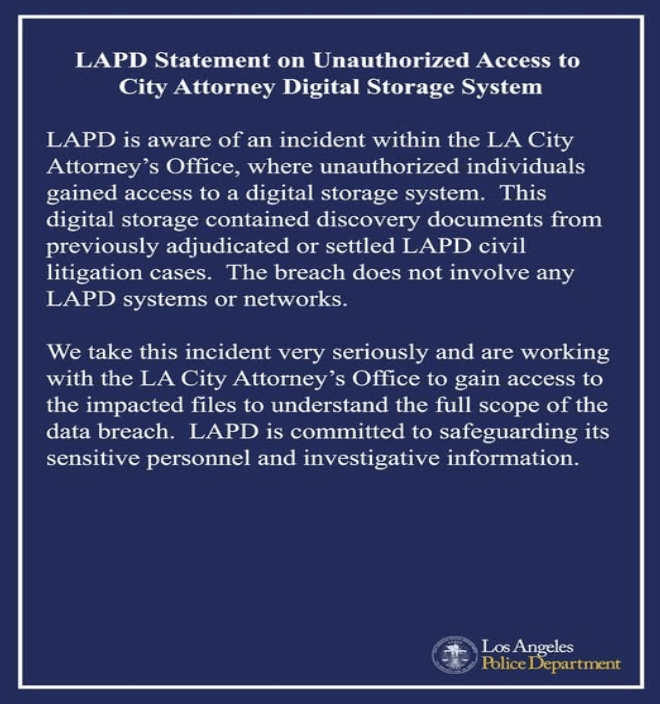
These technological vulnerabilities quickly translated into a crisis of public transparency. On March 7, 2024, the LAPD officially transitioned to the federally mandated NIBRS standard. Rather than executing a parallel, dual-system run to ensure data integrity, the legacy Uniform Crime Reporting (UCR) database was deactivated immediately. Once this transition began, the department stopped updating previously available public crime data and reports for months. In early 2025, the department’s online public crime map went dark, and the LAPD ceased regularly releasing detailed, geolocated block-level crime data on the city’s open data portal.
This abrupt halt in data sharing severely disrupted independent criminal justice research, leaving organizations such as the RAND Corporation waiting for months for basic data. RAND researchers noted that block-level geolocated data is critical for assessing police deployment and evaluating neighborhood safety. In response, the data indexing company SpotCrime filed a lawsuit in late 2025 against the LAPD, alleging wrongful withholding of public records. The department defended its actions by claiming that the raw data was “not user-ready” and required extensive processing—a claim challenged by SpotCrime’s attorney, Paul Nicholas Boylan, who noted that the company had explicitly requested raw data, making additional processing an invalid justification to deny statutory access.
More troubling than the technical delay was the department’s formal legal defense. When media organizations requested COMPSTAT records, Use of Force data, and arrest tracking databases, the LAPD officially denied the requests on October 30, 2025. The department relied on a “catchall” exemption within the California Public Records Act, arguing that disclosing raw or preliminary COMPSTAT data was against the public interest because the information carried the potential to lead to misguided public policy discussions or unjustified public panic. First Amendment advocates and legal experts strongly criticized this justification. David Loy, the legal director of the First Amendment Coalition, warned that accepting this “public panic” argument would profoundly undermine the Public Records Act. Loy noted that under this logic, public agencies could withhold any raw data—whether regarding crime, zoning, or waste management—simply to prevent the public from challenging official narratives.
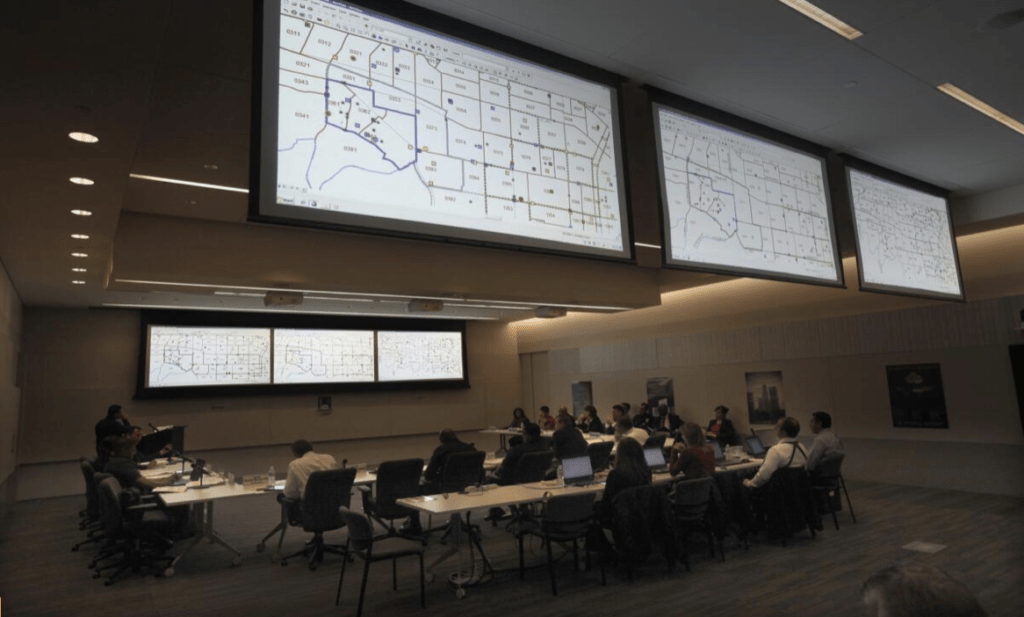
Historically, public oversight has been vital to correcting LAPD’s internal data failures. In 2015, investigative reporting by the Los Angeles Times exposed systemic misclassification errors by the LAPD that had artificially lowered the city’s violent crime statistics for years, a finding later confirmed by the Police Commission’s Inspector General. In 2020, an internal audit revealed that numerous officers had entered false gang affiliation data into a statewide database, and in August 2025, the LAPD admitted that its arrest tracking databases were entirely unavailable due to structural errors and duplicate entries. By invoking the public panic doctrine, the department is not protecting the public but rather insulating its own administrative and technological failures from external validation.
The structural breakdown of the department’s data infrastructure cannot be separated from a parallel collapse in system capacity. When the executive administration points to downward trends in year-end crime statistics as a metric of operational success, it ignores a widening chasm between official data and the actual volume of victimization on the street. A critical analysis of the emergency response pipeline reveals that the reported declines in citywide crime are heavily driven by systemic under-reporting, a severely overburdened 911 communications infrastructure, substantial response delays, and the resulting public frustration.
The intake level of the department’s public safety apparatus is compromised by an acute staffing and retention crisis within municipal emergency dispatch centers. When 911 centers operate with severe vacancy rates, hold times increase exponentially, routinely failing to meet basic state compliance metrics. When an individual attempting to report a lower-priority property crime, commercial burglary, or ongoing vandalism is placed on an extended emergency hold, a substantial percentage of citizens simply hang up. In official police metrics, a dropped or abandoned call effectively does not exist. Because it fails to generate a Computer-Aided Dispatch log, it never triggers a field deployment and is completely lost to the database. The downward shift in crime numbers is therefore partially a reflection of an intake pipeline that lacks the staffing to answer the public’s calls for help.
For the calls that do make it through the dispatch infrastructure, the velocity of the physical police response has deteriorated due to the historic drop in active patrol field staffing. High-priority, in-progress violent crimes naturally consume the vast majority of available patrol units. Consequently, lower-priority calls—such as a finalized theft, vehicle burglary, or trespassing—face extreme delays that frequently stretch into hours. This introduces severe data friction into the system, as patrol units finally arrive hours after a dispatch only to find the victim has frequently left the scene, closed their business, or chosen not to wait.
Without direct physical contact or a formal victim statement, field supervisors or responding officers cannot generate an official investigative file or a verified crime report. Instead, the incident is closed out as a minor non-criminal disposal code within the dispatch logs, erasing the victimization from the final index crime tallies through pure operational delay. From a behavioral standpoint, a citizen’s decision to report a crime is a calculated choice driven by perceived utility and prior institutional interactions. When the public routinely experiences extreme administrative barriers—extended 911 hold times, non-responsive telephone report options, and delayed field arrivals—deep-seated cynicism develops regarding the department’s capabilities. When citizens stop reporting victimizations out of pure frustration, the official tracking systems register a sharp decline in crime. In reality, this statistical reduction represents a collapse in civic trust and systemic capacity, creating a “dirty data” threat where administrative pressure and operational strain minimize the true reporting burden.
The convergence of a broken technology infrastructure, data suppression tactics, and a failing emergency dispatch pipeline underscores a stark reality: the LAPD is managing its decline rather than solving its crises. By treating critical data transparency as an existential threat and deploying legally dubious exemptions to mask structural failures, leadership under both Chiefs Moore and McDonnell has successfully severed official metrics from public reality. This systemic decay cannot be separated from the political environment of City Hall, where transactional loyalty consistently trumps measurable public accountability. For the citizens of Los Angeles, the cost of this administrative rot is measured in abandoned 911 calls, delayed emergency responses, and unrecorded victimizations.
As the department continues on this unchanged trajectory, it is actively accelerating the ongoing sinking of its own ship. To fully understand the depth of this institutional erosion, this analysis must look beyond operational bottlenecks. In Part 2: The Architecture of Corruption, we will dive directly into the severe ethics violations underlying lucrative, non-competitive technology contracts, expose the toxic double standard used to handle internal complaints, and detail how leadership protects favored insiders while systematically dismantling the careers of whistleblowers who dare to challenge the status quo.