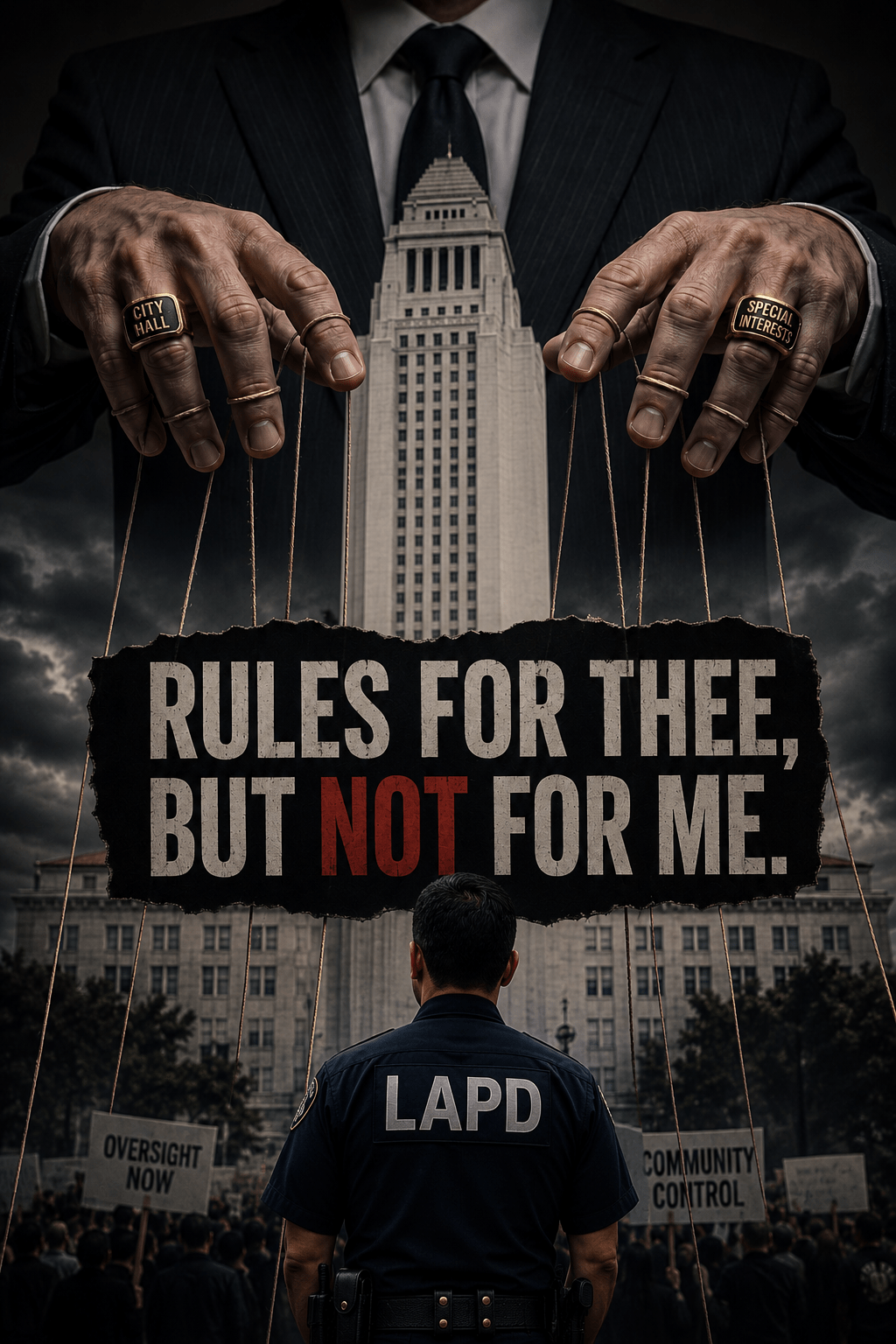
With a City Council that consistently struggles to manage its own internal ethics trying to dictate the management of others, Los Angeles finds itself at a volatile governance crossroads. One of the most persistent concerns and dangerous legacies of former LAPD Chief Michel Moore was the perceived ability to weaponize the Internal Affairs division tool that critics argue has historically enabled instances of institutional abuse. Despite Chief Jim McDonnell now being in office for a year and a half, many of these archaic policies remain unchanged, driving down rank-and-file morale and eroding internal trust within the department. This escalating internal friction arrives at a critical juncture: City Hall is actively squeezing labor and union rules to accelerate sweeping police charter reform, completely overshadowed by the City Council’s own ongoing accountability crisis.
The battle line over rewriting the Los Angeles City Charter has officially shifted to public safety. The Los Angeles Police Protective League (LAPPL), the union representing rank-and-file LAPD officers, has fiercely accused the City Council of sidestepping state labor laws and collective bargaining agreements in a rushed, politically motivated effort to strip oversight power away from the mayoral-appointed Board of Commissioners and centralize it directly within City Hall. In a sweeping vote, the City Council directed the City Attorney’s Office to draft ballot language for a suite of major proposals aimed at shifting oversight of the LAPD. Key elements of these proposed changes include granting the City Council direct veto power over policy decisions enacted by the Board of Police Commissioners and overhauling police discipline to provide the Chief of Police with clearer, unilateral authority to immediately terminate officers for egregious misconduct. However, the LAPPL argues that the city administration committed massive foul play by completely skipping the legally mandated “meet and confer” process required for charter amendments.
Under California Supreme Court precedent and state collective bargaining laws, the city is legally required to notify and formally negotiate with labor unions regarding any changes that directly impact working conditions, disciplinary procedures, and legal representation. According to LAPPL leadership, the city attempted to bypass these obligations via a string of generic emails, culminating in dropping a “Last, Best, and Final Offer” directly to union representatives without engaging in substantive discussions or presenting specific police-reform terms to the full City Council. LAPPL President Ricky Mendoza stated that somebody within the city administration or the Employee Relations Group did not follow the law and failed to formally contact the union to meet and confer over potential changes to the city charter, emphasizing that they simply screwed up. While some councilmembers argue that clarifying high-level policy authority does not fundamentally alter everyday working conditions, others acknowledge that the city’s aggressive approach may have skirted the boundaries of fair bargaining, potentially setting up any voter-approved ballot measures for immediate, costly entanglement in the court system.
While the City Council frames these proposals as a necessary push for transparency and systemic accountability within the LAPD, critics point out a staggering institutional hypocrisy. As City Hall aggressively moves to assume more oversight responsibilities, its own track record raises the glaring question of how a City Council that cannot oversee itself can demand oversee others? The current push for Charter Reform was explicitly born out of deep public disgust with City Hall’s own systemic corruption.
Over the last decade, the Los Angeles City Council has been rocked by an unprecedented wave of scandals, federal indictments, and criminal charges. For instance, José Huizar was sentenced to 13 years in federal prison in 2024 after operating a massive pay-to-play criminal enterprise as chair of the Planning and Land Use Management Committee, extracting over $1.5 million in cash bribes and illicit benefits from developers. Mark Ridley-Thomas was convicted and sentenced to 42 months in prison in 2023 on seven federal felony counts for routing lucrative county contracts to USC in exchange for benefits for his son. Mitchell Englander was sentenced to 14 months in 2021 after pleading guilty to covering up cash envelopes and luxury perks gifted to him in Las Vegas, while Curren Price faced a 10-count criminal complaint alleging perjury, embezzlement, and conflict of interest tied to voting on projects that paid his wife’s consulting firm.
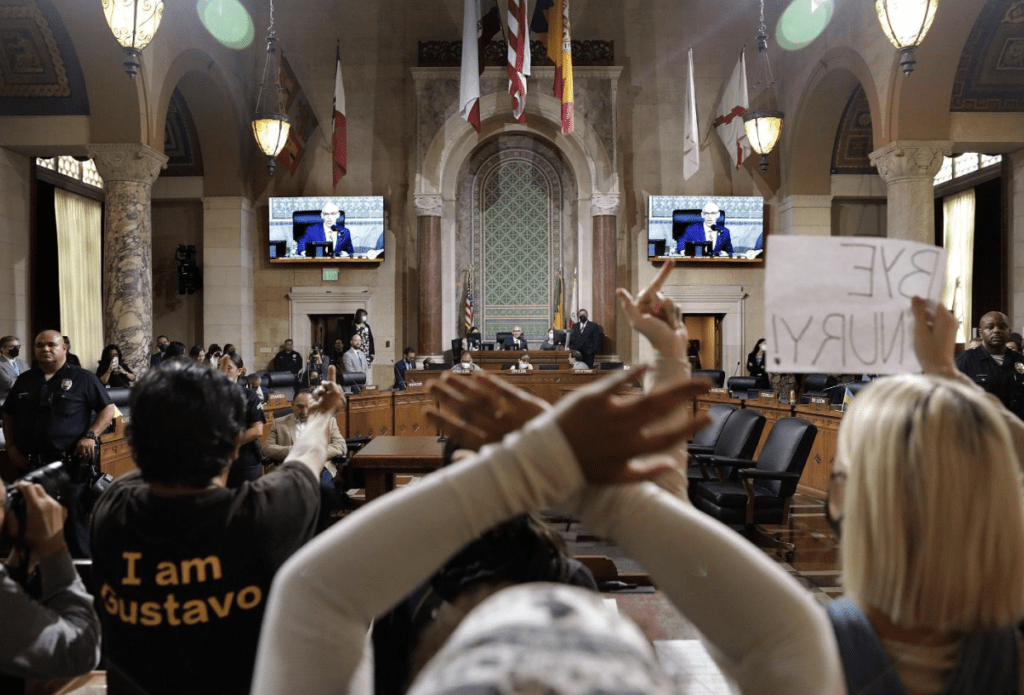
Beyond criminal indictments, the council’s ethical framework suffered a devastating blow when former Council President Nury Martinez was forced to resign, and Councilmembers Gil Cedillo and Kevin de León saw their careers ruined after a secretly recorded meeting exposed them using racist rhetoric to gerrymander council boundaries. For de León, the integrity crisis deepened in 2025 when the LA City Ethics Commission hit him with thousands of dollars in fines for major disclosure violations, revealing he failed to disclose $264,231 in consulting fees from the AIDS Healthcare Foundation and USC while subsequently participating in city council decisions and budget votes in which he held a direct financial interest. Furthermore, California Attorney General Rob Bonta launched an official investigation into the city’s redistricting process following the leaked tape to review potential voting rights violations. Despite running on platforms of self-reform, the council has repeatedly shown that it is structurally and politically incapable of internal policing. Critics note that expanding the council’s scope to directly manage police policy appears less like genuine public reform and more like a political power grab by a governing body that has consistently failed to keep its own house clean.
The issues inside City Hall extend beyond overt criminal corruption, manifesting in selective battles over accountability and deep ideological fractures that actively stoke division within local districts. Councilmember Monica Rodriguez has frequently targeted external agencies or pushed her own transparency motions, yet union representatives argue her version of accountability is highly selective and politically defensive. When true independent oversight mechanisms are proposed that would clip the wings of the council itself—such as giving the City Controller an independent, politically insulated budget, the pushback from established council forces is swift. Rodriguez has consistently fought to protect bureaucratic structures that leave ultimate funding and appointment powers tightly clinched in the council’s hands. By voting against the very structural guardrails needed for genuine City Hall reform, she ensures that the council remains its own judge and jury, demanding absolute compliance from the LAPD while refusing to cede a shred of the council’s own unchecked power.
Representing the council’s progressive bloc, Council members Hugo Soto-Martínez and Eunisses Hernandez have faced intense criticism for alienating large portions of their own constituencies to serve narrow agendas. Rather than focusing on uniform municipal governance, infrastructure, and baseline public safety for all residents, critics argue both members have actively stoked division within their districts. Their heavy-handed approach—treating public safety metrics and municipal reforms as zero-sum ideological warfare—has fractured local communities and eroded the broad-based public trust necessary to effectively lead. Soto-Martínez, who has long targeted the LAPD in his rhetoric, even has his own history of civil disobedience, having been arrested by the LAPD during a chaotic 2023 labor protest blocking traffic near LAX.
The standard playbook for certain entrenched elements within City Hall when facing legitimate scrutiny has long been to deflect by weaponizing identity, a tactic illustrated by City Council President Marqueece Harris-Dawson. As a primary architect pushing aggressive, unnegotiated LAPD charter amendments through the Rules Committee, Harris-Dawson has consistently used the rhetoric of racial equity not as a tool for genuine reform, but as a political shield to evade personal and institutional accountability. This dynamic reached a boiling point when Harris-Dawson himself became the subject of a major public integrity controversy. After being stopped by a Los Angeles Unified School District (LAUSD) police officer for a moving violation in a school zone, Harris-Dawson took to a joint committee meeting to publicly portray the stop as a traumatic, racially biased encounter. However, the police union quickly exposed a glaring lie of omission, revealing that the stop was for a legitimate reckless driving infraction near a high school, and that during the encounter, Harris-Dawson allegedly used his political position to call an elected LAUSD School Board member in an apparent backroom effort to dodge the ticket entirely.
The LAPPL formally requested that District Attorney Nathan Hochman and City Attorney Hydee Feldstein Soto launch an official investigation into Harris-Dawson for a possible violation of California Penal Code Section 148(a)(1) for willfully resisting, delaying, or obstructing a peace officer. When faced with this Public Integrity Unit review, Harris-Dawson’s office immediately pivoted to a narrative of victimization, labeling the calls for basic transparency pointless and baseless, while framing the scrutiny as a politically motivated, racially charged attack on his character. By deliberately conflating a textbook inquiry into political privilege and abuse of office with systemic racial bias, Harris-Dawson demonstrated the ultimate double standard, using the shield of racial victimization to shut down legitimate law enforcement accountability.
The anti-police sentiment within City Hall has found a new focal point in Council member Ysabel Jurado. During her campaign to unseat Kevin de León, a leaked audio recording surfaced from a meeting Jurado held with college students. When asked about her stance on police spending by an abolitionist student, Jurado famously responded by quoting a rap verse expressing explicit anti-police sentiment. The comment sparked immediate, heavy backlash from the LAPPL, interim LAPD leadership, and families of fallen officers, who called her remarks dangerous and disrespectful to law enforcement. Though Jurado defended the comments as merely quoting an N.W.A. lyric, critics argue it exposed the true, unvarnished anti-police bias driving the council’s progressive wing.
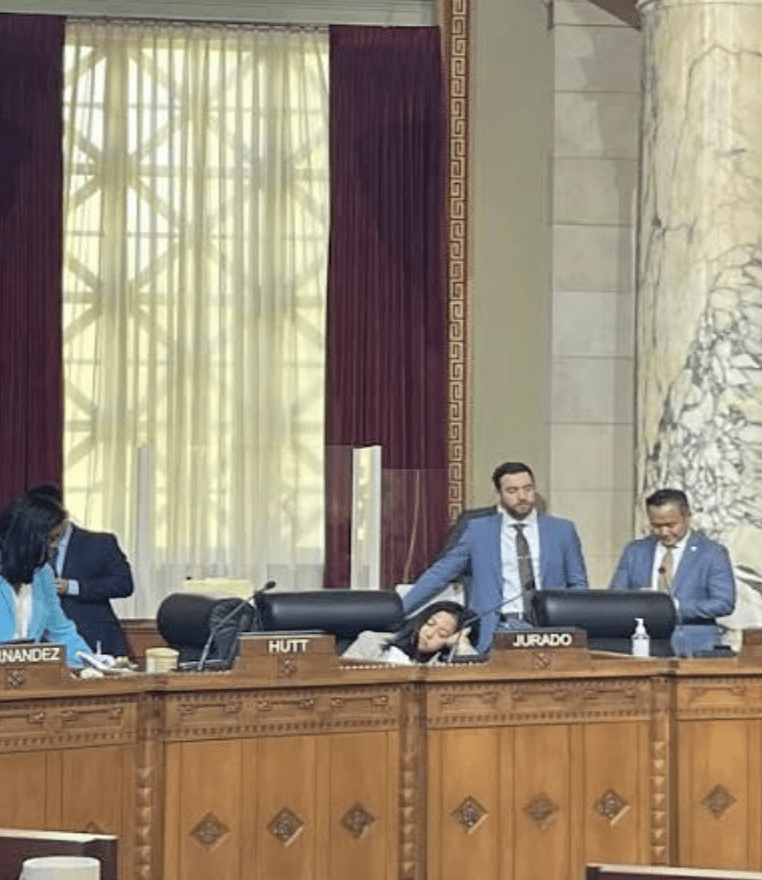
The controversy surrounding her office deepened further when her Deputy for Economic Innovation, Luz Aguilar, was arrested by law enforcement during a demonstration against federal ICE activity in Downtown Los Angeles and booked on suspicion of assaulting a police officer.
This institutional hypocrisy hits a fever pitch when it comes to personal safety. Multiple council members who have built their entire political brands on demonizing rank-and-file officers, cutting department funding, or outright identifying as police abolitionists have faced fierce public backlash for treating law enforcement as their own taxpayer-funded concierge service the moment their own security or property is compromised. Critics point out stark examples of this double standard playing out in real-time. Hugo Soto-Martínez, who ran on an explicit anti-police platform, found his office at the center of a hypocrisy scandal when a senior staffer called the LAPD requesting extra patrols throughout the night to guard a parked staff vehicle that had broken down on a city street. Frontline officers quickly pointed out the profound irony of an anti-police staff utilizing political privilege to secure overnight security assets that an ordinary Angeleno could never access. Similarly, Eunisses Hernandez, who champions a dismantling framework and consistently votes against the city budget over its inclusion of critical LAPD funding, has nonetheless relied on LAPD personnel to provide security for her and her office during contentious public appearances.
This paradox has deeply frustrated rank-and-file officers and the public alike, highlighting a troubling reality where certain councilmembers treat the LAPD as political punching bags in front of their progressive base, yet remain the first to call 911 or demand priority protection when they feel a threat to their own safety.
The crisis of institutional trust looming over City Hall has bled directly into the Los Angeles mayoral election. Council member and mayoral candidate Nithya Raman is locked in a fierce battle against incumbent Mayor Karen Bass, having successfully knocked out candidate Spencer Pratt in the primary. However, the slow, meticulous vote-counting process employed by the Los Angeles County Registrar-Recorder has fueled a firestorm of controversy and allegations of voter fraud among portions of the electorate. The uproar intensified following a highly publicized data lag in automated election night updates during the primary, which briefly showed zero new votes recorded for Pratt while simultaneously adding thousands of votes to the tallies for Raman and Bass. Though the Associated Press and the Registrar’s office clarified that the anomaly was simply a sequential tracking delay—and official county records showed every candidate received votes in every update—voter integrity advocates remain highly skeptical. Critics argue that the prolonged counting of late-arriving mail-in ballots, which break heavily in favor of progressive candidates like Raman, leaves the system vulnerable to manipulation and diminishes public confidence in the final outcome. Local media outlets such as the LA Times have rallied to try and dissuade concerns of fraud. Regardless of ballots being found dumped, questionable actions of pay for votes of unhoused local news continues to play, “nothing to see here”.
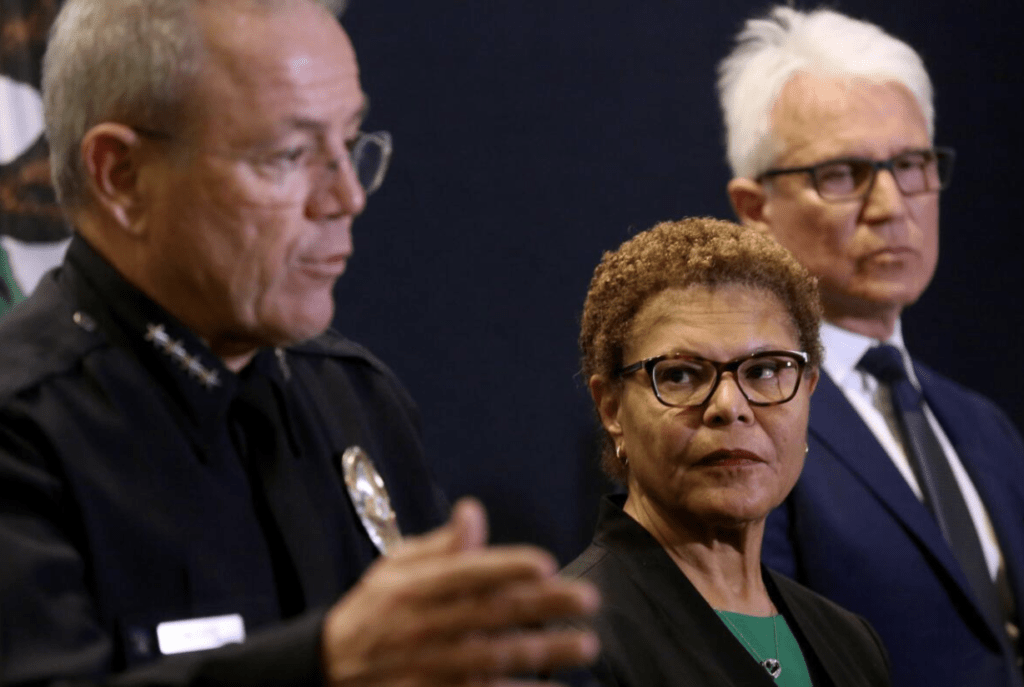
Compounding this crisis of confidence is the extensive ethical and institutional shadow hanging over Mayor Karen Bass herself. Critics frequently highlight her own historic entanglement with the sweeping USC corruption scandal, in which federal prosecutors explicitly labeled her undeclared $95,000 full-tuition master’s degree scholarship from the USC School of Social Work as “critical” to the bribery case involving former Dean Marilyn Flynn and Mark Ridley-Thomas. Federal filings indicated that Bass subsequently sponsored congressional legislation expanding private universities’ access to federal social work funds just as Flynn desired. This shadow extends directly into the upper echelons of the LAPD, where former Chief Michel Moore was heavily implicated in managing and potentially suppressing the department’s internal investigation into the USC connection, triggering a pending lawsuit by internal whistleblowers who allege severe retaliation.
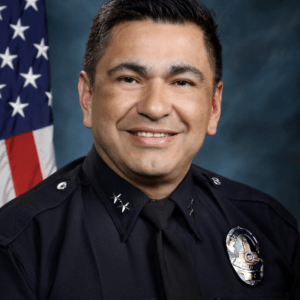
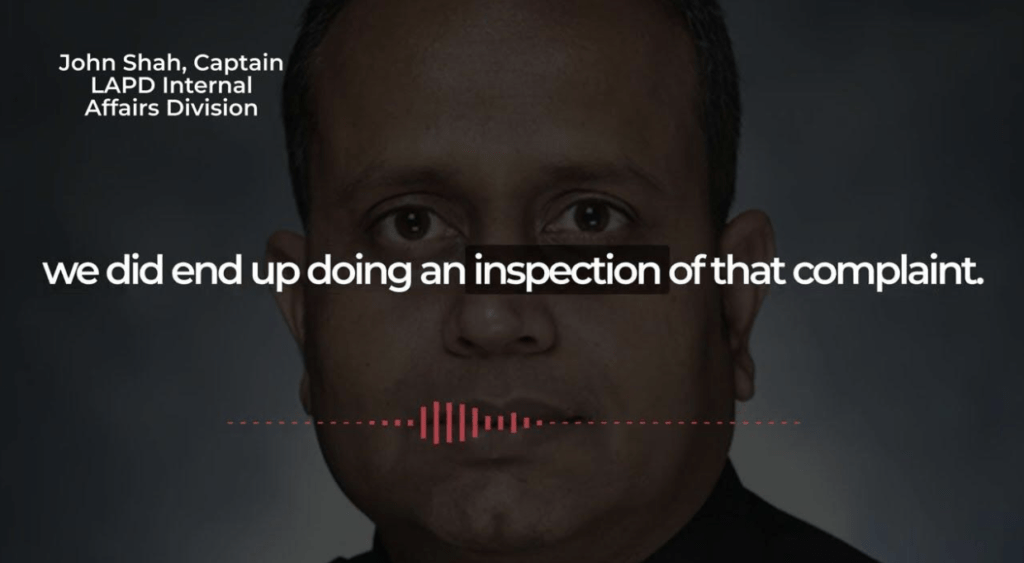
Mirroring the chaos at City Hall, the LAPD itself is falling into similar internal disarray, plagued by a destructive management legacy and widespread allegations of “bought loyalty” among command staff. A toxic culture has taken root where high-ranking supervisors are accused of repeatedly lying and falsifying statements to effectively purchase their executive ranks, completely subverting the merit-based promotional system. Central to these allegations of institutional rot is LAPD Commander John Shah. Shah, who with controversial test taking actions and unstable leadership rose through the department to become a captain of Internal Affairs Division under Chief Moore, faces serious internal allegations of incompetence, selective investigations, and making false statements. Critics point to his tenure in Internal Affairs as a period where the division was weaponized to pursue political and career-elevating agendas—such as a prolonged surveillance operation targeting officers in the Mission Area Gang Enforcement Detail—while administrative favorites were protected. Despite rampant friction with rank-and-file officers, tactical failures in patrol commands, and loud union pushbacks, the department has taken zero action to address these internal failures or question Shah’s truthfulness. Instead, internal sources contend that because Shah was willing to manipulate Internal Affairs to appease the Chief’s office, he was rewarded with a final fast-tracked promotion to Commander by Chief Moore ahead of stronger more competent captains just before Moore was shown the door—the ultimate example of purchased rank masking administrative rot.
This web of protection further compromises Bass’s mayoral administration, which has been severely rocked by structural instability and integrity controversies surrounding her appointed inner circle. Most notably, a profound information vacuum still surrounds an investigation into a hoax bomb threat allegedly tied to her former deputy mayor for public safety, alongside broader municipal alarms regarding deep-seated administrative corruption and fraudulent real estate schemes within the city’s heavily funded homeless oversight mechanisms. Furthermore, critics point to Bass’s foundational political roots in radical left-wing activism—including her early ties to socialist-aligned organizations and leadership within the Venceremos Brigade—arguing that her executive office remains heavily compromised by ideological biases that mirror the council’s own dysfunction.
Compounding these concerns over election integrity is a highly contentious push within Charter Reform discussions to expand voting access to non-citizen and undocumented residents in municipal and neighborhood elections. While proponents frame this expansion as a matter of civic inclusion and democratic representation for all local stakeholders, sharp critics and law enforcement advocates view it as a calculated, partisan strategy to circumvent accountability. By expanding the franchise to include non-citizens, entrenched socialist and abolitionist council members are accused of intentionally expanding the electorate to insulate themselves from the anger of taxpaying, legal voters.
This mechanism shifts the foundational definition of American suffrage, fundamentally diluting the political voice of legal residents and naturalized citizens who have gone through the lawful immigration pipeline. Opponents argue that this expansion creates a transactional ecosystem that incentivizes the blatant “buying of loyalty.” By building an electorate heavily reliant on localized sanctuary policies, non-enforcement directives, and city-funded social services, progressive politicians insulate themselves from conventional accountability. In this structured dependency, non-citizen agendas—which fundamentally favor the dismantling of traditional public safety frameworks and the redirection of municipal funds into progressive handouts—are systematically advanced. This maneuver ensures a permanent, politically dependent voting bloc that will consistently favor radical, anti-police candidates. By drowning out the voices of property owners and legal taxpayers who bear the direct financial and physical consequences of rising neighborhood crime, the council effectively transforms the democratic process into a subsidized tool for their own self-preservation.
The City Council is under a tight deadline to finalize which Charter Reform recommendations will ultimately make it onto the upcoming ballot for voter approval. If the council ignores the legal challenges raised by the LAPPL and continues to push forward without proper negotiation, the city risks a major labor lawsuit that could freeze the implementation of these measures entirely. For Angelenos, the ongoing debate highlights a tense reality: the desperate need for government accountability is being managed by the very politicians who need it most. Ultimately, the typical script of LA City elected officials is not to unite to fix what’s not working, but to ask what changes can be made to secure more control. They completely lack independent oversight, actively refuse to allow transparent auditing, and have proven time and again that they cannot even oversee themselves, yet they continuously demand to control more of our public safety infrastructure. At a time when Los Angeles desperately needed leadership to unite the city, these politicians chose to divide, causing deep community friction while completely failing to see or serve the baseline needs of their own residents.
The final push to place these highly controversial measures on the upcoming November ballot exposed the sharp ideological rifts dividing the City Hall establishment and its progressive fringe. While the council advanced a series of compromised measures, it actively shielded itself from foundational structural oversight.
In a key legislative victory for the progressive faction, the council voted 10-5 to place the radical non-citizen voting initiative on the ballot, a move championed by Councilmember Hugo Soto-Martínez. This measure would grant municipal voting rights to non-citizen and undocumented residents in city and school board elections, over the fierce objections of opponents like Councilmember John Lee, who warned of steep logistical and financial burdens, and Councilmember Imelda Padilla, who cautioned that the policy creates a distinct disincentive for legal citizenship.
Concurrently, the council pushed forward with its aggressive restructuring of public safety oversight, passing amendments to grant City Hall direct policy authority over the LAPD. Progressive members like Eunisses Hernandez aggressively supported the expansion of council powers, explicitly using the platform to attack current LAPD tactics, while Councilmember Lee issued a stark warning to his colleagues against the direct politicization of the department and the erosion of independent civilian oversight.
The staggering reach of this institutional rot becomes even more undeniable when tracking the full scope of the FBI’s multi-year City Hall corruption probe, which ensnared figures like former Council President Pro Tempore Mitchell Englander. Serving on the powerful Planning and Land Use Management Committee, Englander surrendered to federal authorities and was sentenced to 14 months in prison after pleading guilty to scheming to obstruct a federal investigation. Investigators exposed a salacious trail of cash bribes hidden in casino bathrooms, luxury hotel stays, and VIP bottle service in Las Vegas and Palm Springs, gifted by a businessman seeking backroom access to major downtown developers. While Englander took the fall for attempting to coach witnesses and falsify material facts, current Council member John Lee—who went along on that exact same Las Vegas trip as Englander’s chief of staff—managed to evade criminal charges but was subsequently hit with thousands of dollars in City Ethics Commission fines for major disclosure and gift law violations. Meanwhile, figures like former progressive Councilmember Mike Bonin left a legacy of immense controversy, heavily fueling public outrage over administrative backroom deals and the systemic failure to manage the city’s unfolding homelessness crisis. From federal convictions to backroom gerrymandering and unethical self-enrichment, the unceasing parade of scandals confirms that the toxic culture of City Hall isn’t defined by a few bad actors—it is an embedded, structural crisis of power.
Yet, when faced with proposals that would require genuine accountability from the politicians themselves, the council’s reform narrative abruptly collapsed. In a telling show of self-preservation, the City Council completely blocked a sweeping proposal by the Charter Reform Commission to expand the council from 15 to 25 districts—a measure intended to dilute centralized power and curb institutional corruption following years of criminal scandals. Rather than letting the public decide, the council successfully punted the expansion proposal, along with ranked-choice voting initiatives, sending them back to committees for indefinite “further study” and ensuring that the current, entrenched power dynamic remains tightly clinched in their hands.
Los Angeles stands at a precipice where democracy is being bartered for political immunity, and public safety is traded for progressive ideological compliance. When a governing body spends more energy rewriting the rules of the game than keeping its own house clean, it forfeits the moral authority to lead. Angelenos are left with a stark, undeniable truth: true reform will never come from a City Hall that treats the police department as a political punching bag, taxpayers as a bottomless bank account, and the concept of accountability as a weapon meant only for others.
The structural decay consuming Los Angeles will not be cured by shifting deck chairs from the Police Commission to a compromised City Council, nor by letting dishonest command staff control the destiny of rank-and-file officers. And make no mistake, this article has focused on the systemic overreaches of City Hall and the upper ranks of the LAPD—we haven’t even dived into the scandalous fraud, gross mismanagement, and deep-seated corruption quietly simmering within the City Attorney’s Office. Until the culture of bought loyalty is entirely rooted out from every corner of municipal governance and law enforcement, any talk of “charter reform” remains an absolute sham—a hollow political theater designed to protect the corrupt, silence the whistleblowers, and leave the baseline safety of everyday Angelenos completely out in the cold.