
The narrative surrounding the Los Angeles mayoral primary has taken a familiar, deeply frustrating turn for those who watch the city from its streets rather than its political headquarters. On election night, City Councilmember Nithya Raman trailed significantly behind challenger Spencer Pratt, leaving many to believe her progressive platform had hit an absolute ceiling. Yet, as mail-in ballots slowly trickled in over the next six days, the tally dramatically shifted. Raman climbed the rankings to seize the second-place spot, positioning herself for a November runoff against incumbent Mayor Karen Bass. To many outside observers, this sudden surge was a surprise, but to those who have managed the day-to-day operations of Los Angeles public safety, it reads like a carbon copy of a script we have already seen play out across the country. Still, for residents living with the daily realities of local collapse, this late-stage uptick in votes triggers immediate skepticism. Although there are countless, well-documented stories of deep civic frustration, growing resentment from neighborhood coalitions, and intense anger from rank-and-file law enforcement over a complete lack of legislative support, Raman is somehow showing an uptick in votes. To the average citizen watching their neighborhood decline, it remains entirely unclear where these late-arriving votes are originating.
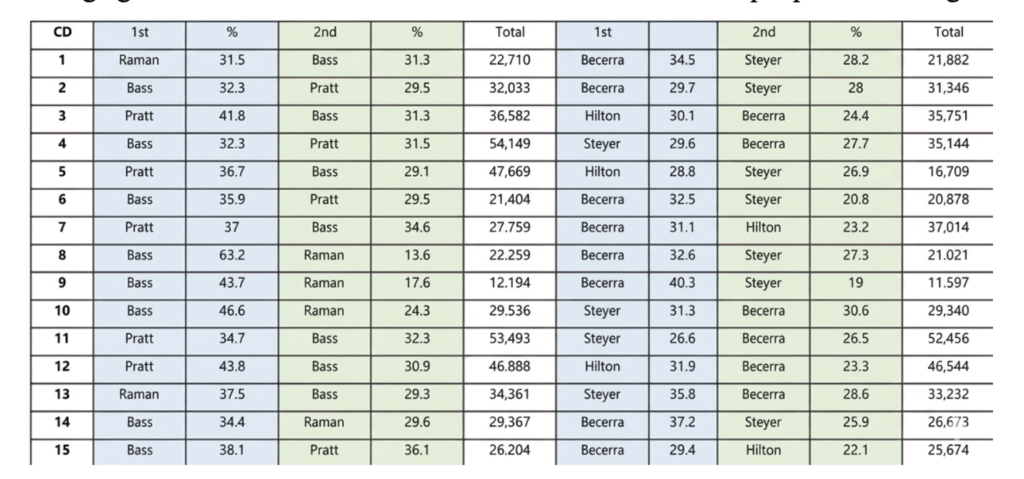
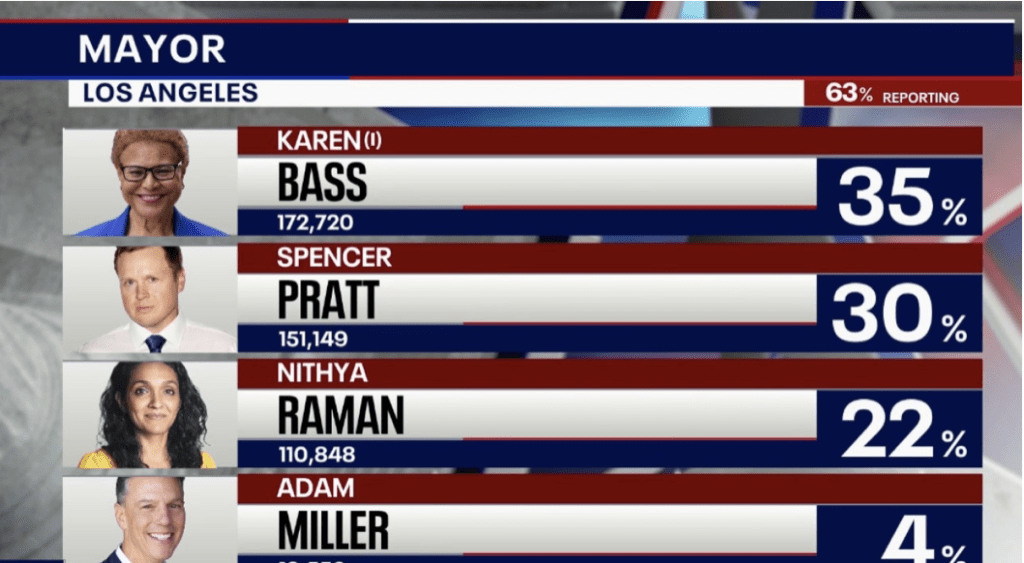
When the polls initially closed on Tuesday night, early walk-in and immediate drop-box returns heavily favored Pratt, putting Raman at a steep deficit of roughly seven percentage points. Over the next several days, however, the counting of late-arriving mail-in ballots triggered a massive net swing of more than 43,000 votes against Pratt. By the time 83.2% of the expected vote was tallied by Sunday night, Raman had completely erased the gap, overtaking Pratt with 27.1% of the total vote (196,198 votes) to his 26.7% (193,085 votes).
The phenomenon where election-night margins shift dramatically as mail-in ballots are processed is a well-documented pattern in modern elections, often referred to by political scientists as the “blue shift.” Because every mail-in ballot requires rigorous signature verification, opening, and flattening before it can be fed into counting machines, the processing timeline is inherently slower than processing in-person votes. Data consistently shows distinct partisan splits in voting habits: conservative or independent voters tend to favor in-person voting on Election Day or dropping off ballots early, which are processed quickly. Conversely, progressive and Democratic voters disproportionately utilize mail-in voting and submit ballots closer to the deadline, leading to large shifts in the later counts.
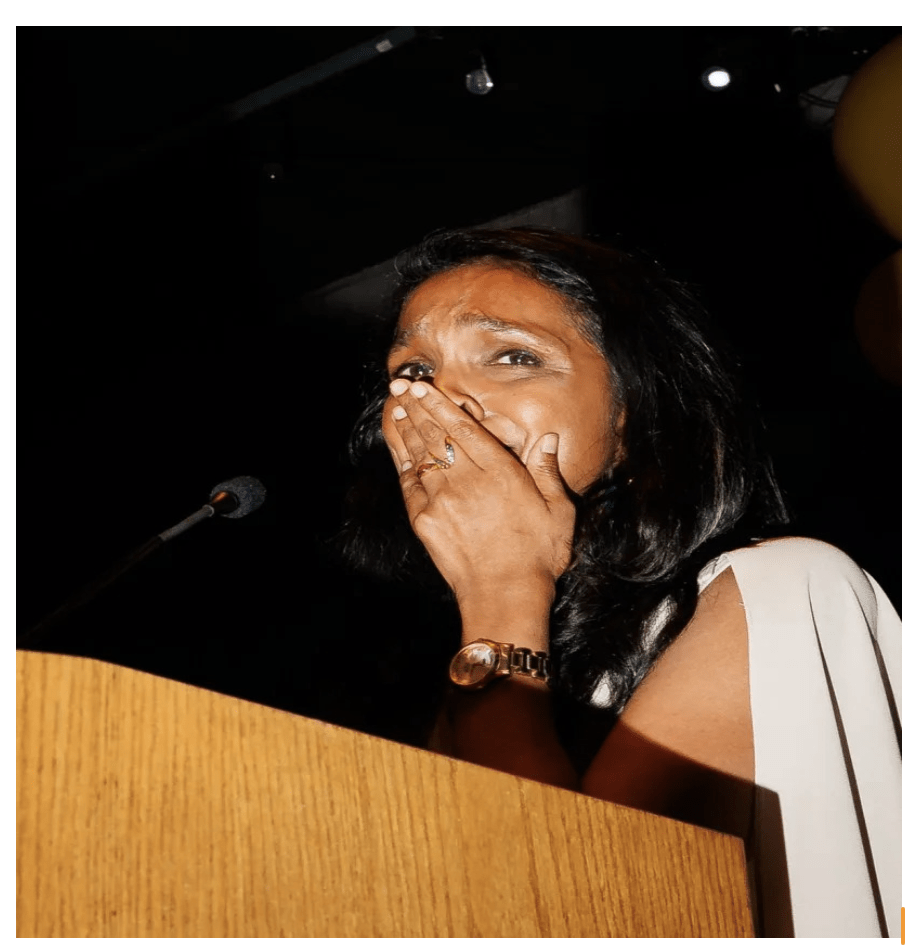
Following the dramatic shift in the Los Angeles mayoral primary returns, where early frontrunner Spencer Pratt dropped into third place behind Councilmember Nithya Raman as late mail-in ballots were tallied, the Republican candidate faces a critical decision on whether to legally challenge the outcome. For a candidate looking to contest the validity of what supporters describe as unorthodox “ballot dumps”—which data experts attribute to the standard processing of late-arriving, signature-verified mail-in votes—the California Elections Code provides rigid legal frameworks. To escalate his challenge beyond rhetoric, Pratt’s campaign must ground its strategy in explosive, specific allegations that have begun circulating among his base, including claims of “skid row elections” targeting vulnerable unhoused populations, illegal voter registrations utilizing false addresses, and the alleged counting of deceased voters. Pratt cannot simply point to a shifting vote share as proof of malfeasance; he must actively choose between demanding a voter-funded administrative recount or filing a high-stakes election contest lawsuit in the Los Angeles County Superior Court to halt the certified matchup between Raman and incumbent Mayor Karen Bass.
To challenge the physical validity of these late mail-in batches under the weight of these specific fraud allegations, Pratt’s first operational step would be requesting a formal recount within five calendar days of the official canvass certification. Filed with the Los Angeles County Registrar-Recorder/County Clerk, this measure would allow his campaign to scrutinize the signatures, voter registration logs, and processing records of the heavily progressive mail-in ballots that ultimately erased his seven-percentage-point lead. This administrative route would give Pratt’s legal team the opportunity to cross-reference voter rolls against death certificates and investigate whether localized “ballot harvesting” rings manipulated vulnerable voters in the Skid Row district or utilized commercial and non-residential addresses to cast fraudulent votes. However, because California does not feature automatic recounts, Pratt would be required to personally finance the daily labor costs of the recount—a massive financial gamble that is only refunded if the process uncovers enough uncounted or mistabulated votes to propel him back into the top two slots.
Alternatively, if the campaign intends to argue that these late-released ballot totals constitute systemic fraud or organized administrative manipulation rather than a legal tallying of late voters, Pratt would need to bypass the recount and file a formal election contest lawsuit. Under Elections Code Section 16100, the threshold for a court challenge is incredibly high, demanding concrete, admissible evidence rather than social media speculation regarding dead voters or fraudulent registrations. Because this was a primary election, the timeline is fiercely accelerated, giving Pratt just five days from the completion of the official canvass to file his petition in Superior Court. In front of a judge, the burden of proof rests entirely on Pratt to demonstrate not just that the late ballot influx was unusual or that address discrepancies exist, but that actual illegal activity occurred on a scale large enough to have altered the final trajectory of the runoff ticket.
This political trajectory mirrors the civic debacles seen in cities like New York, where progressive mandates have consistently run counter to basic community maintenance and public safety. In Los Angeles, this ideology has slowly dismantled confidence in municipal governance, alienating both working-class neighborhoods and wealthy civic supporters alike who are tired of odd financial choices and the rapid dismantling of public order. For years, the political establishment has favored policies that treat public spaces as permanent, unregulated shelters while ignoring the immense strain put on the law-abiding constituents living next door. As the former Central Bureau chief, I had countless dealings with deeply frustrated residents, as well as the defensive Raman staff trying to justify a hands-off approach to the city’s growing crises. It was a constant, exhausting battle between communities begging for safe, walkable streets and a political philosophy that treated gang-entrenched encampments as untouchable social experiments.
There is perhaps no clearer example of this systemic failure than the battle over the Berendo Street encampment, a crisis that plagued the neighborhood for nearly nine years. What began as a complex humanitarian issue rapidly deteriorated into a neighborhood’s worst nightmare: a gang-run encampment directly impacting the safety of local families. Rather than enforcing municipal codes to reclaim the sidewalk for the public, the council office’s primary response was to institutionalize the site, supplying porta-potties and daily meal deliveries.
Critics point out a glaring double standard in Councilmember Nithya Raman’s approach to the city’s homelessness crisis. Under her watch, the notorious Berendo Street encampment was permitted to remain for years, enabling ongoing public safety and health issues despite exhaustive law enforcement interventions and relentless complaints from local residents. Raman repeatedly favored a delayed, long-term bureaucratic strategy that left community concerns largely unaddressed. Yet, when a staged homeless encampment appeared directly outside her own million-dollar mansion as a form of political satire, her standard patience vanished; she immediately dispatched the LAPD and took to national media to express how traumatized her family was by the incident. This sharp contrast between the urgent protection she demanded for her own home and the prolonged exposure to public disruption she expected of her constituents exposes a frustrating hypocrisy at the core of her leadership.
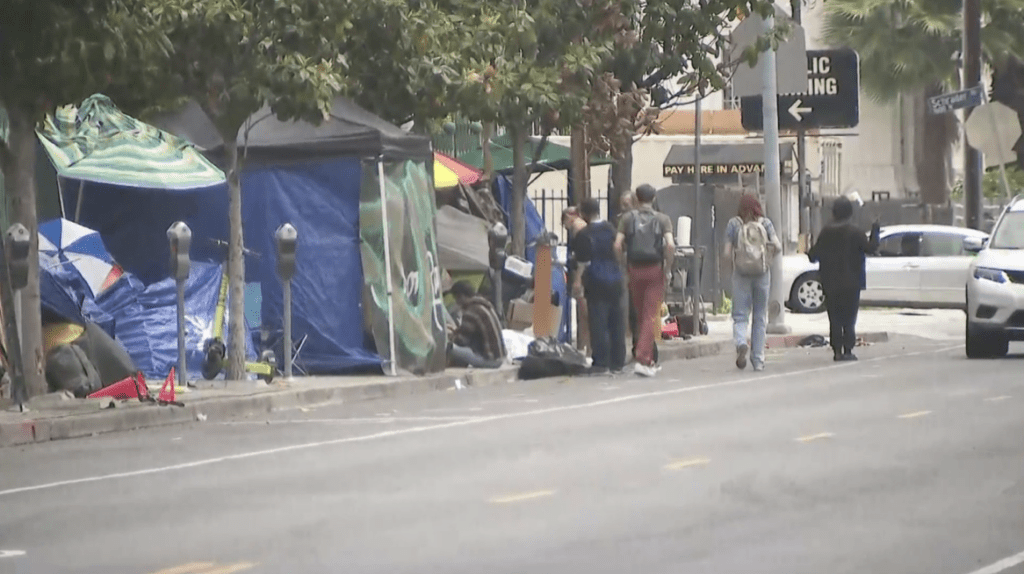
Meanwhile, the reality on the ground was stark. Handguns were openly passed around, narcotics were distributed in plain view, sex trafficking and prostitution operations were established, a dangerous drug lab explosion occurred within the perimeter, and schoolchildren from nearby Los Feliz Elementary were forced to walk off the curb and directly into active traffic lanes just to bypass the tents.
The resolution of the Hollywood Boulevard and Berendo Street encampment required a unique dual strategy because the location had evolved from a standard unhoused site into a heavily co-opted hub for organized criminal activity. Because the encampment sat right along the border of operational jurisdictions, personnel from both LAPD Hollywood Division and LAPD Northeast Division had to work in tandem to address the crisis. According to joint police briefings and local council reports, the notorious La Mirada Locos street gang had embedded operations within the tents, establishing an open-air narcotics distribution market and fueling a sharp rise in violent crime, firearms violations, and dangerous arson fires that threatened nearby structures. While a singular historical crime tally for the site’s nine-year existence was not released as a standalone statistic, the location became one of the area’s highest-frequency public safety flashpoints.
To dismantle this infrastructure, LAPD Hollywood and Northeast executed targeted enforcement sweeps alongside long-term investigative work, resulting in hundreds of contacts and arrests over the lifespan of the camp. During the peak of the multi-agency push in 2021, localized 30-day enforcement windows yielded a dense concentration of felony arrests specifically targeting illegal weapons possession, narcotics sales, and the apprehension of violent offenders with outstanding out-of-state and local warrants. This aggressive law enforcement effort to peel back the criminal exploitation was critical, as it cleared the way for outreach workers to safely conduct the intensive case management necessary to transition the vulnerable, genuinely unhoused individuals into stable indoor housing.
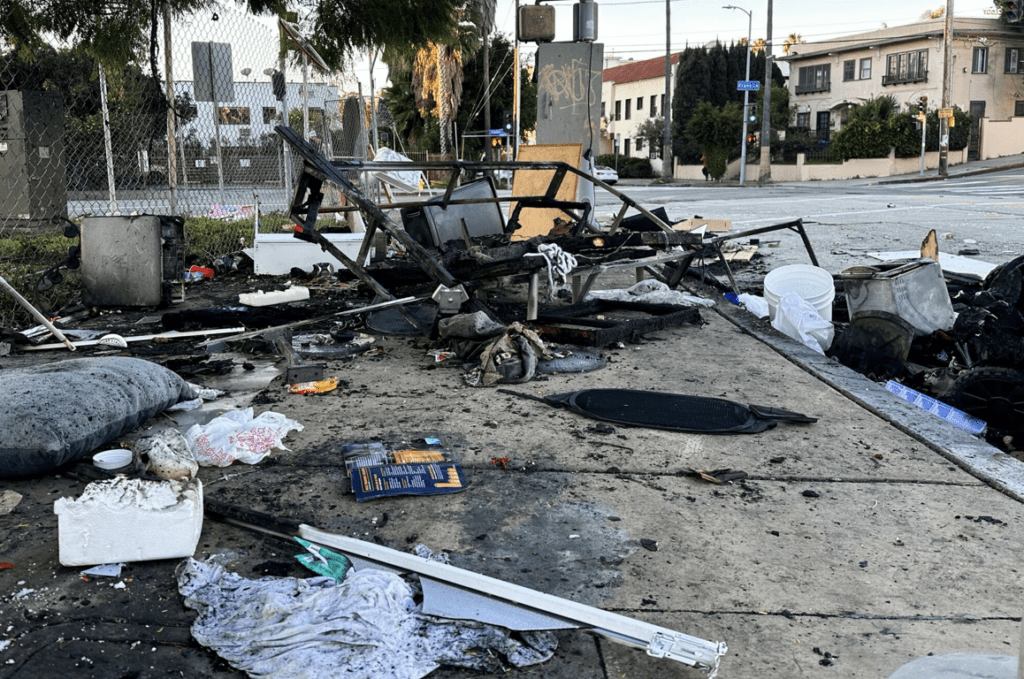
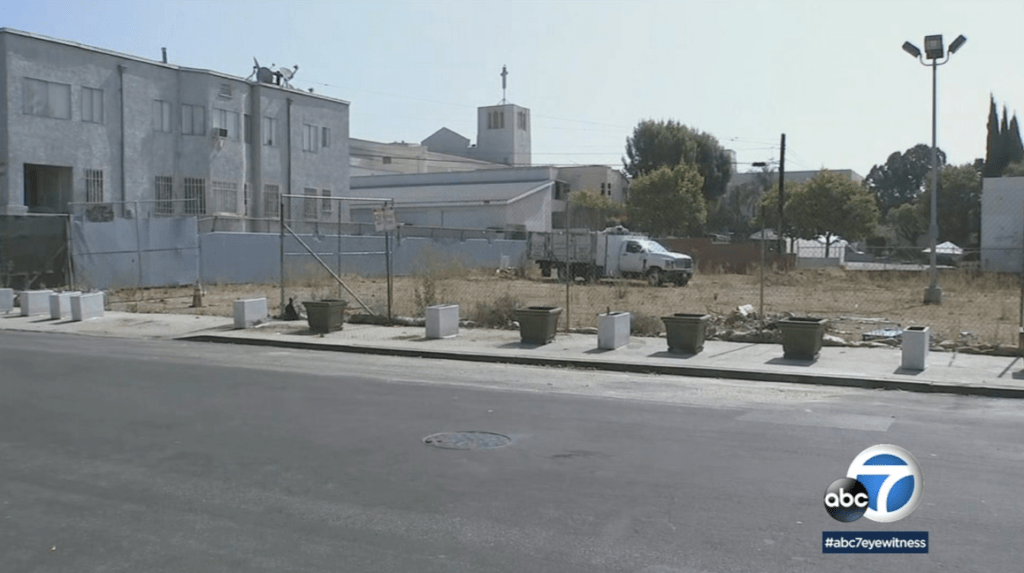
Despite daily evidence showing flagrant criminal activity and constant threats to neighbors, it took a seven-month targeted operation from December 2020 to July 2021—mired in bureaucratic friction and community outrage—to finally clear the Berendo encampment and transition residents to housing. The true irony of the city’s governance materialized the very morning after the location was removed; hoping to permanently secure their sidewalks and beautify their neighborhood, local residents immediately paid out of their own pockets to install large planters. While it took nearly a decade of crime and community destruction to address the encampment, city departments coordinated within 48 hours to issue removal orders against the neighbors’ planters, complete with forklifts deployed by Public Works to clear the sidewalk.
This striking double standard came to a head when residents physically stood in front of the planters to block city workers from moving them, sparking a tense standoff that exposed the deep rot of political hypocrisy at City Hall. As the situation escalated, Councilmember Nithya Raman’s staff phoned law enforcement, aggressively demanding the immediate arrest of the neighbors who were merely standing ground to protect the street they had just paid to beautify. Refusing to let the badge be weaponized for political cover, a captain was dispatched to investigate, and the city workers on the scene openly confirmed that the council office itself had personally directed the sweep. Law enforcement flatly refused to make the arrests, advising the council staff that a minor administrative permit dispute was a matter for the City Attorney’s office, not a row of squad cars.
Though the city ultimately deployed its heavy machinery to confiscate the planters under the guise of unpermitted obstructions, the incident left a bitter, undeniable truth in its wake: the council office was willing to tolerate an environment of crime and community destruction for years, yet demanded immediate handcuffs for tax-paying neighbors who bypassed a bureaucratic permit office. It is particularly jarring to see Raman now claiming a definitive mandate from the voters, considering she couldn’t even win her own district and only secured her seat by surging in other parts of the city—leaving the local residents who actually endure her policies entirely abandoned by the people elected to represent them.

When the mainstream press chalks up public frustration to “misinformation” or hyperbole, they insult the intelligence of the people living with these daily realities.
Rather than investigating legitimate public concerns with objective facts, mainstream mouthpieces like the Los Angeles Times operate as institutional shields for the ruling establishment, deploying a highly biased format designed to advance their own ideological agenda. Instead of examining the operational vulnerabilities of a system that allows margins to flip entirely after the polls close, the L.A. Times regularly spews pre-packaged damage control disguised as reporting. In article after article, including active live-tracker updates explicitly labeling public concerns as “nonsense” or fringe conspiracy theories—the paper focuses its ink on sheltering progressive politicians from accountability. When a localized data lag occurred over the AP wire on election night, the Times immediately rushed out a patronizing explainer to mock voter anxiety, trivializing deep-seated institutional distrust as the work of “voter fraud enthusiasts.”
By weaponizing their platform to dismiss authentic civic panic as mere uneducated noise, the Times relies on protective opinions rather than unbiased investigative journalism. While their columnists work tirelessly to frame the agonizingly slow ballot-tabulation process as a flawless display of meticulous competence, they deliberately look away from the concrete irregularities occurring on the ground. True investigative reporters—operating outside the bubble of corporate media protection—have filled this vacuum by uncovering systemic gaps that the establishment paper refuses to touch. Independent watchdogs have verified countless instances of individuals registered to vote at completely vacant lots, commercial buildings, and abandoned properties across Los Angeles County. Furthermore, mainstream outlets have downplayed or ignored direct law enforcement intervention, such as federal indictments exposing organized rings targeting vulnerable individuals on Skid Row with cash and food incentives to harvest fraudulent voter registration forms.
When the so called gatekeepers of local news treat voter roll vulnerabilities with the same passive, dismissive philosophy that council offices applied to the Berendo street encampment, public trust breaks down entirely.
The extended counting window, paired with a media apparatus that actively bullies anyone demanding transparency, remains an active point of intense civic friction. Under both federal and California state law, noncitizens—including undocumented immigrants—are strictly prohibited from voting in mayoral, statewide, or federal elections, and the registration system requires an applicant to affirmatively state eligibility under penalty of perjury. Furthermore, under California law, individuals with past felony convictions have their voting rights restored only after completing their prison term; those currently serving a state or federal prison term remain legally disqualified and are removed from the active rolls.
Under current election laws, citizens experiencing homelessness have a legal right to vote and are permitted to register using non-traditional addresses, such as a local park, a street intersection, or the address of a designated homeless shelter. However, this flexibility creates a massive administrative disconnect when it comes to maintaining accurate voter rolls. Because unhoused populations are highly transient, thousands of individuals remain registered at shelters, transitional housing facilities, or navigation centers where they no longer reside or may have only stayed for a single night. Since federal and state laws make removing names from voter registries a notoriously slow process to prevent disenfranchisement, these temporary locations effectively become permanent “ghost addresses” on the rolls. This gap between a voter’s registered paperwork and their actual physical location creates a deeply flawed data pool that politicians frequently exploit, claiming a localized “voter mandate” based on registration numbers that bear no resemblance to the actual, current population living on those streets.
However, the rule is only as strong as its enforcement. As Los Angeles prepares to take the world stage for the upcoming Olympic Games, it stands at a critical crossroads. The city cannot afford to follow a trajectory that values progressive political theory over safe streets, secure voter rolls, and a fair, transparent electoral process.
If the current playbook remains unchanged—and the press continues to cover for administrative failures rather than exposing them, L.A. risks looking less like a global metropolis and more like a cautionary tale of a city sliding into permanent disruption.
To understand why Raman’s legislative record creates such intense friction among public safety officials and local neighborhood coalitions, one only has to look at her actual voting record on the City Council floor. While her rhetoric has evolved on the mayoral campaign trail, her voting history reflects a consistent pattern of voting against traditional enforcement mechanisms and municipal police funding.
The defining legislative dividing line on public order in Los Angeles is Los Angeles Municipal Code Section 41.18, the city’s anti-camping ordinance that bans tents and encampments near schools, daycare centers, and major public transit portals. Raman has consistently been one of the most vocal opponents of the ordinance on the council floor, voting “No” 69 times on resolutions to enforce 41.18 restrictions at 463 specific locations across the city. When voting against an expansion of the law to protect school perimeters, Raman explicitly argued from the floor that the city should stop “making promises that the city simply cannot deliver on,” claiming that restrictions merely force individuals to move 500 feet down the street rather than solving the root crisis. To frustrated homeowners and parents, this “No” vote was viewed as a formal refusal to secure public spaces for local families.
In August 2023, Mayor Karen Bass championed a major, multi-year contract with the Los Angeles Police Protective League aimed at addressing the LAPD’s severe staffing shortages. The deal increased starting salaries by 14% and offered substantial retention bonuses to stop the pipeline of officers retiring or transferring to outside agencies. Raman was one of only three council members who voted against the LAPD contract. She justified her vote by citing the massive fiscal impact on the city budget, claiming that the significant funding required for police retention would directly impede the city’s ability to fund alternative, unarmed civilian response teams for non-violent 911 calls.
Even as response times lagged and staffing deficits worsened, Raman maintained her defensive positioning against expanding the physical size of the force. Just weeks prior to launching her mayoral bid, she voted against the city budget’s provision to hire 170 additional police officers requested by Mayor Bass. While Raman now argues that the city shouldn’t lose any more active personnel, her historical voting pattern tells a different story to rank-and-file officers, reinforcing her early, public alignment with the “Defund the Police” movement during her initial 2020 campaign.
The political alignment between New York City’s newly elected mayor, Zohran Mamdani, and LA mayoral challenger Nithya Raman highlights a highly coordinated ideological framework. Both are prominent figures backed by progressive movements, sharing a governance philosophy that shifts municipal focus away from traditional law enforcement and market-rate urban management.
Regarding homelessness and encampments, Mamdani pledged a complete end to homeless encampment removals (“sweeps”) and advocates for immediate, permanent social housing and municipal support services directly on the street. This closely mirrors Raman’s historical emphasis on treating homelessness strictly as a housing supply crisis, favoring civilian outreach over municipal code enforcement, which frequently results in the institutionalization of long-term sites. In the realm of public safety and policing, Mamdani historically supported defunding the NYPD and currently advocates for creating a civilian-led emergency response department to divert mental health and social-welfare 911 calls entirely away from armed officers. Similarly, Raman backed the “Participatory Budget Pledge” to divert police funding and advocates for an approach to public safety that replaces police response with civilian mental health teams. For housing and rent control, Mamdani pledged to freeze rents across one million rent-stabilized apartments in New York City and aggressively tax the wealthy to fund public housing infrastructure, matching Raman’s platform built on strict tenant protections, expanded eviction defense, and fighting market-rate development in favor of subsidized affordable units.
The connection between Mamdani and Raman is built entirely upon their shared roles within the Democratic Socialists of America (DSA) pipeline. Rather than a localized anomaly, their campaigns represent a unified bicoastal strategy. Both candidates rely heavily on the same national progressive donor networks, grassroots activist endorsements, and digital organizing infrastructure. Raman’s initial 2020 upset in LA and her current mayoral push serve as the structural model for the DSA’s expansion into major city executive offices—a blueprint that Mamdani successfully rode all the way to Gracie Mansion in New York late last year. As these progressive networks target securing more power on the Los Angeles City Council and pushing Raman into Room 300 at City Hall, their shared policies on public space, policing, and municipal spending represent a deliberate, unified effort to reshape America’s two largest metropolitan centers.
Ultimately, this deliberate erosion of institutional accountability leaves Los Angeles at a dangerous, highly volatile crossroads. When a city’s leadership routinely prioritizes protective political theories over basic municipal code enforcement, and its leading press apparatus serves as an ideological gatekeeper rather than a transparent watchdog, the foundational covenant of civic trust is shattered. By continuously ignoring authentic community outrage, smoothing over severe voter roll vulnerabilities, and treating gang-entrenched encampments as untouchable social experiments, the establishment has conditioned the public to drastically lower its expectations of public safety.
The “smoking gun” claim by Pratt regarding recorded conversations suggests a critical turning point that could carry severe legal and organizational consequences. If these recordings conclusively depict criminal activity by either Bass or Raman, they transition the matter from an internal dispute or political controversy into a high-stakes criminal investigation. For the individuals implicated, verified evidence of illicit conduct opens the door to immediate federal or state indictments, potential felony charges, and substantial prison time. Beyond individual criminal liability, the revelation of such recordings would trigger devastating institutional fallout—shattering public trust, forcing immediate leadership resignations or terminations, and exposing the parent organization to massive civil lawsuits, independent federal oversight, and a prolonged process of structural reform.
As the city rapidly barrels toward the global spotlight of the upcoming Olympic Games, it faces a stark, structural deficit: a severely depleted police force burdened by hiring freezes and a city budget crippled by a massive structural deficit. If this current trajectory of passive governance and institutional denial remains unchecked, L.A. will be entirely unprepared to secure its streets on the world stage. Instead of showcasing a thriving, orderly global metropolis, the city risks delivering a real-world cautionary tale—presenting an environment that mirrors the lawless, fractured degradation of Mad Max rather than the safe, functional community its citizens have begged for and deserve.