

Plaintiff Anica Barbosa, previously featured in The Current Report’s investigation into Ventura County’s alleged “judicial playbook,” has taken her case to federal court, accusing judges, court employees, Ventura County and sheriff’s personnel of civil-rights violations, conspiracy and obstruction.
For the last year, The Current Report has documented allegations of a disturbing pattern inside Ventura County Superior Court: evidence buried or blocked, litigants denied meaningful hearings, court filings allegedly refused, questionable ex parte communications and judicial decisions that appear to materialize through procedure rather than evidence.
Now one of the litigants at the center of that reporting has taken those allegations directly to federal court.
On September 14, Anica A. Barbosa, representing herself, filed a federal complaint for damages in the United States District Court for the Central District of California. The filing names Ventura County Superior Court Judge Michael S. Lief among a sweeping list of defendants that includes Judges Denise Bellefeuille, Charmaine Buehner and JoAnn Johnson; attorneys Stephanie White and Jessica Zylak; several court clerks; Ventura County; the Ventura County Sheriff’s Office; unidentified sheriff’s deputies and bailiffs; the California Commission on Judicial Performance and CJP staff counsel Tania Schrag.
The case was assigned number CV26-10403-CAS-KES, according to the federal court filing stamped September 14, 2026.
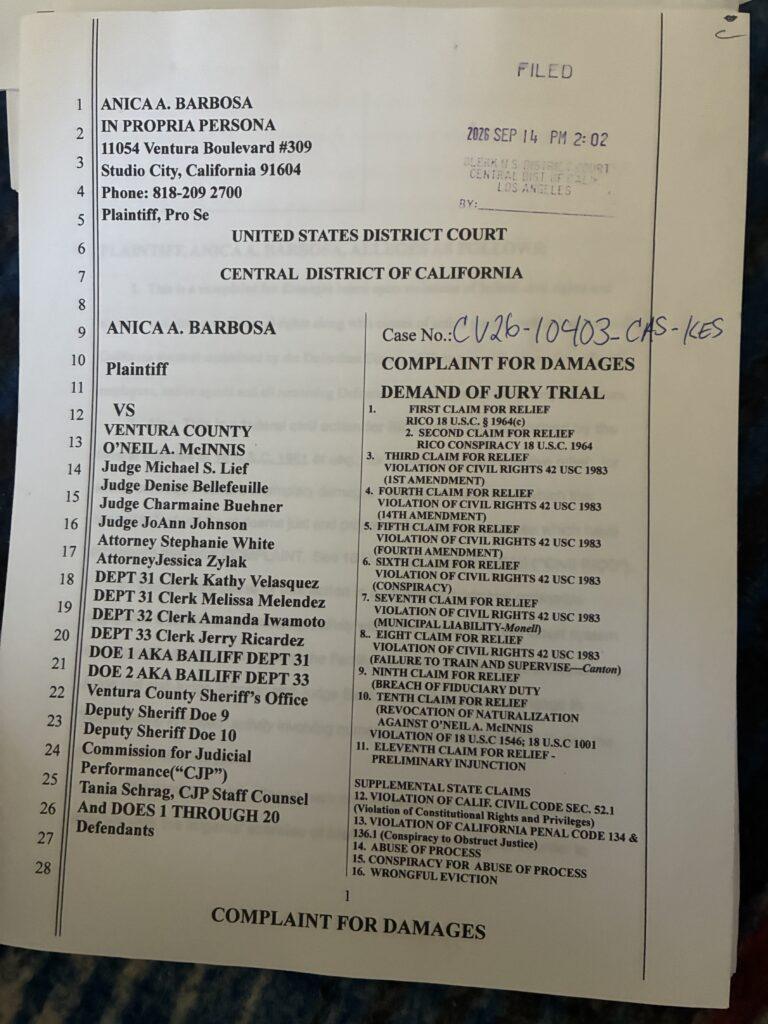
Barbosa is alleging far more than disagreement with a judge’s ruling. Her complaint lists federal claims under RICO, 18 U.S.C. §1964(c); RICO conspiracy; multiple claims under 42 U.S.C. §1983 alleging violations of the First, Fourth and Fourteenth Amendments; a §1983 conspiracy claim; municipal liability under Monell; failure to train and supervise; breach of fiduciary duty; and additional claims.
She is also seeking preliminary injunctive relief and asserting supplemental California claims including alleged violations of Civil Code §52.1, conspiracy to obstruct justice, abuse of process, conspiracy to commit abuse of process and wrongful eviction.
Those claims remain allegations. No court has determined their merits, and the defendants are entitled to respond.
But Barbosa’s name — and Judge Lief’s — are not new to readers of The Current Report.
THE BARBOSA CASE WAS ALREADY ON OUR RADAR
Months before this federal lawsuit was filed, The Current Report identified Barbosa as one of three unrelated litigants whose experiences raised questions about whether what was happening inside Ventura County’s courthouse could still be dismissed as isolated judicial error.
In our investigation, “The Ventura County Playbook: Inside the Coordinated Machine of Judicial Abuse Targeting Three Unrelated Litigants,” we examined the cases of Barbosa, professional MMA fighter Amir Rahnavardi and Sherri LaZelle. Although the three litigants entered the Ventura County system through unrelated disputes, the similarities in what they described were difficult to ignore.
Barbosa’s case was particularly troubling.
According to the records and allegations previously reviewed by The Current Report, Barbosa appeared for an April 23 proceeding only to later discover what she alleged was an undisclosed hearing conducted outside her presence. She alleged that an 11 a.m. minute order effectively sent her away before another proceeding occurred and that Judge Denise Bellefeuille said the court file was missing before the courtroom was cleared.
At the center of Barbosa’s allegations was Judge Michael Lief.
Barbosa alleged that the proceeding ultimately resulted in an eviction process moving forward without the notice and opportunity to be heard she maintains she was constitutionally entitled to receive. When she attempted to challenge what had happened, according to our previous reporting, a court clerk allegedly refused to accept her paperwork and told her she had been instructed not to take anything from Barbosa.
That allegation was significant then.
It is considerably more significant now.
Because Barbosa is no longer simply accusing Ventura County officials of denying her access to their own court. She is asking a federal court to determine whether what happened violated federal law.
LIEF’S NAME KEEPS APPEARING
Michael Lief did not arrive on the bench without substantial legal experience. He spent years as a Ventura County prosecutor before becoming a Superior Court judge. When he was installed in 2015, Lief spoke publicly about “tradition, values, impartiality and justice” and the importance of equal treatment before the law.
A decade later, those words deserve another look.
Barbosa’s federal lawsuit does not exist in isolation from the questions The Current Report has already raised about Lief’s conduct in other cases.
Our investigation into Amir Rahnavardi’s years-long family-court battle documented allegations that Lief suppressed or excluded significant evidence, including journals, videos and forensic material; disregarded numerous supervised-visitation reports; terminated sanctions motions without a hearing; and continued restrictions that Rahnavardi maintains were unsupported by the underlying evidentiary record.
Another investigation examined what happened after private discovery referee Leon Bennett became involved in Rahnavardi’s case. Evidence reviewed by The Current Report raised serious questions about how crucial material was filtered before reaching the court and about communications involving Bennett and opposing counsel.
Then something even more extraordinary happened.
After the case moved to Judge JoAnn Johnson, Johnson stated on the record that she had spoken with Lief before issuing a consequential ruling involving evidence that had finally made its way into the case. Minutes after acknowledging that communication, Johnson issued her decision.
Johnson is now also named as a defendant in Barbosa’s federal lawsuit.
That does not establish wrongdoing by either judge. It does, however, make the federal complaint impossible to view as merely another disgruntled litigant objecting to a single adverse ruling.
There is now history.
FROM FAMILY COURT ALLEGATIONS TO FEDERAL CIVIL-RIGHTS CLAIMS
State judges routinely make decisions that one party hates. Losing a case is not evidence of corruption, and a bad ruling by itself does not create a federal civil-rights conspiracy.
But that isn’t the question The Current Report has been asking.
The question is what happens when different litigants in unrelated cases begin describing the same mechanisms.
Blocked evidence.
Filings allegedly refused.
Proceedings allegedly conducted without adequate notice.
Ex parte communications.
Court employees allegedly acting on instructions that prevent litigants from accessing the court.
Sheriff’s personnel enforcing orders whose legitimacy the affected litigant is simultaneously trying to challenge.
And judges whose names repeatedly surface across those allegations.
That was precisely why Barbosa mattered in our original investigation. Her case did not mirror Rahnavardi’s factually. It didn’t need to. What appeared similar was the machinery.
Now Barbosa is attempting to convert those allegations into federal causes of action.
Her complaint invokes RICO, a statute ordinarily associated in the public mind with organized criminal enterprises but which also provides a civil remedy under specific circumstances. Pleading RICO, however, is not the same as proving it. Barbosa will have to satisfy demanding legal requirements to establish such a claim.
Her §1983 allegations similarly require proof that defendants acting under color of state law deprived her of federally protected rights.
And her Monell claim takes the case another step further: toward Ventura County itself. A municipality is not automatically liable merely because one of its employees allegedly violated someone’s rights. A successful Monell theory generally requires connecting the constitutional injury to a governmental policy, custom or practice.
That makes the pattern particularly important.
THE PATTERN IS NOW THE STORY
When The Current Report first connected Barbosa, Rahnavardi and LaZelle, we wrote that the significance was not that three people were unhappy with Ventura County judges. Courthouses are filled every day with people unhappy with judges.
It was the repetition.
Our previous reporting identified allegations involving secret or undisclosed proceedings, ex parte communications, blocked filings, suppressed evidence, disputed court documents, enforcement activity and orders allegedly imposed without meaningful evidentiary review.
Rahnavardi’s case provided another layer.
The Current Report subsequently documented allegations that forensic evidence concerning unauthorized access to Rahnavardi’s electronic accounts was never meaningfully considered, despite a law-enforcement investigation documenting unauthorized computer access. Expert evidence challenging one of the allegations used against him was also allegedly excluded.
Again and again, the issue came back to the same fundamental question:
What happens when the evidence capable of challenging the court’s original narrative never gets heard?
Barbosa is now asking a federal judge a version of that same question.
Only this time, Ventura County isn’t controlling the courtroom.
A FEDERAL COURT WILL NOW HAVE THE OPPORTUNITY TO LOOK INSIDE
That may ultimately be the most important development.
For years, complaints about family court are easily dismissed as the grievances of people who lost custody disputes, restraining-order proceedings, property disputes or other emotionally charged cases.
Sometimes that criticism is justified.
But institutional accountability requires something more sophisticated than assuming every litigant is right — or assuming every judge is.
It requires records.
It requires comparing cases.
It requires identifying patterns.
And when multiple unrelated litigants begin making materially similar allegations involving some of the same judicial officers, court employees and enforcement mechanisms, those allegations deserve scrutiny rather than reflexive dismissal.
Barbosa has now put hers in federal court.
Judge Michael Lief, whose conduct has repeatedly surfaced in The Current Report’s investigation into Ventura County’s family court, is no longer simply the subject of investigative reporting or complaints by litigants appearing before him. He has been named as a defendant in a federal civil-rights action.
So have other judges.
So have court employees.
So has Ventura County.
So has the Ventura County Sheriff’s Office.
And even the state agency charged with judicial oversight — the Commission on Judicial Performance — appears among the defendants identified on the face of Barbosa’s complaint.
None of that proves Barbosa’s case.
But it does something Ventura County has been remarkably successful at avoiding.
It puts the allegations in another courthouse.
And after everything The Current Report has uncovered about what allegedly happened inside Ventura County’s own, that may be exactly where they belong.