
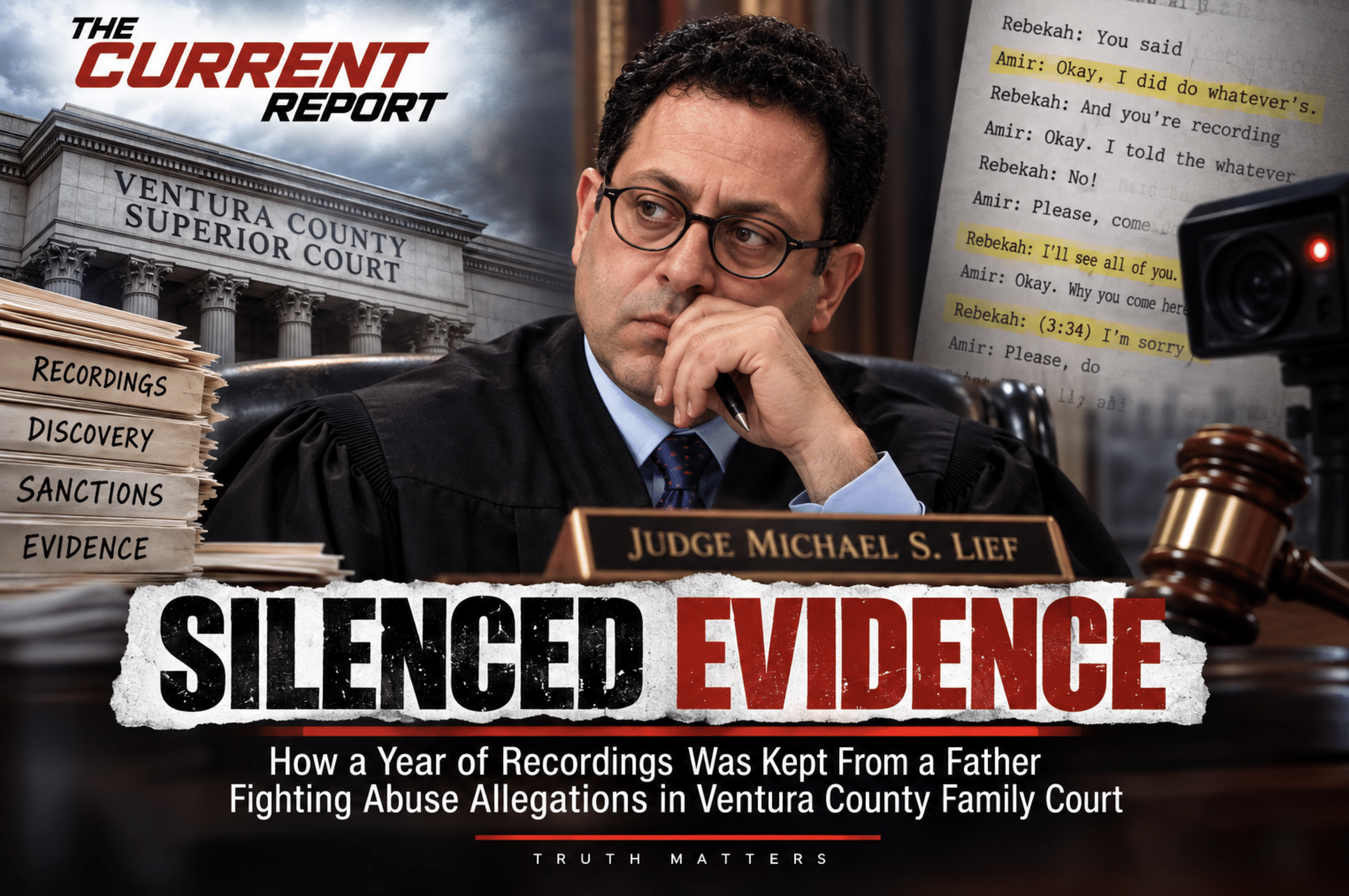
For nearly a year, Amir Rahnavardi says he recorded his interactions inside his own home for one reason: he believed he needed evidence to protect himself.
He says the recording was not covert. Signs were posted throughout the house. Rahnavardi says his then-wife, Rebekah, knew he was recording. And as their relationship deteriorated, the cameras accumulated something potentially invaluable in a family-court case that would eventually turn on competing allegations of abuse: a contemporaneous record of what was actually happening when no judge, attorney or court-appointed referee was present.
When the case reached family court, no independent factfinder sat down and watched a year’s worth of recordings to determine whether Rahnavardi’s account was true, whether Rebekah’s was true, or whether the reality was somewhere in between.
Instead, Rahnavardi says he was ultimately prevented from using those videos to contest the central findings imposed by discovery sanctions. The appellate opinion confirms that the sanctions barred him from arguing or presenting evidence that he did not conduct clandestine post-judgment surveillance, publish resulting recordings, or abuse the litigation process. It also says he testified at trial and was allowed to explain why he recorded. The scope of the restriction matters. [Opinion, pp. 4, 6, 12.]
That is the part of this case The Current Report is now examining. Because there is a profound difference between a court reviewing evidence and rejecting it – and a litigant being prevented from presenting evidence that he contends would have contradicted the allegations used against him. And one recording from August 22 may provide a window into exactly how that happened.
WHAT WAS ON THE AUGUST 22 RECORDING?
According to Rahnavardi, the August 22 recording became particularly significant because of how its contents were characterized during the litigation. Rebekah alleged that the recording contained sexual activity. Rahnavardi disputes that characterization as applied to the recorded argument. He acknowledges that the couple had been intimate beforehand, but says the encounter had ended before the exchange in question: he was in the kitchen, Rebekah was in the living room, and the recording captured an argument.
The appellate opinion recounts Rahnavardi’s testimony that he recorded sexual relations without advising Rebekah, and that he later uploaded a video of a subsequent argument to YouTube and sent links to others. That account should not be conflated with a determination that the subsequent argument itself depicted sexual activity. [Opinion, p. 6.]
Rahnavardi retained a transcript excerpt of the August 22 exchange. The excerpt should be compared against the complete recording, any certified transcript, and the precise language in the court record before a definitive characterization is published.
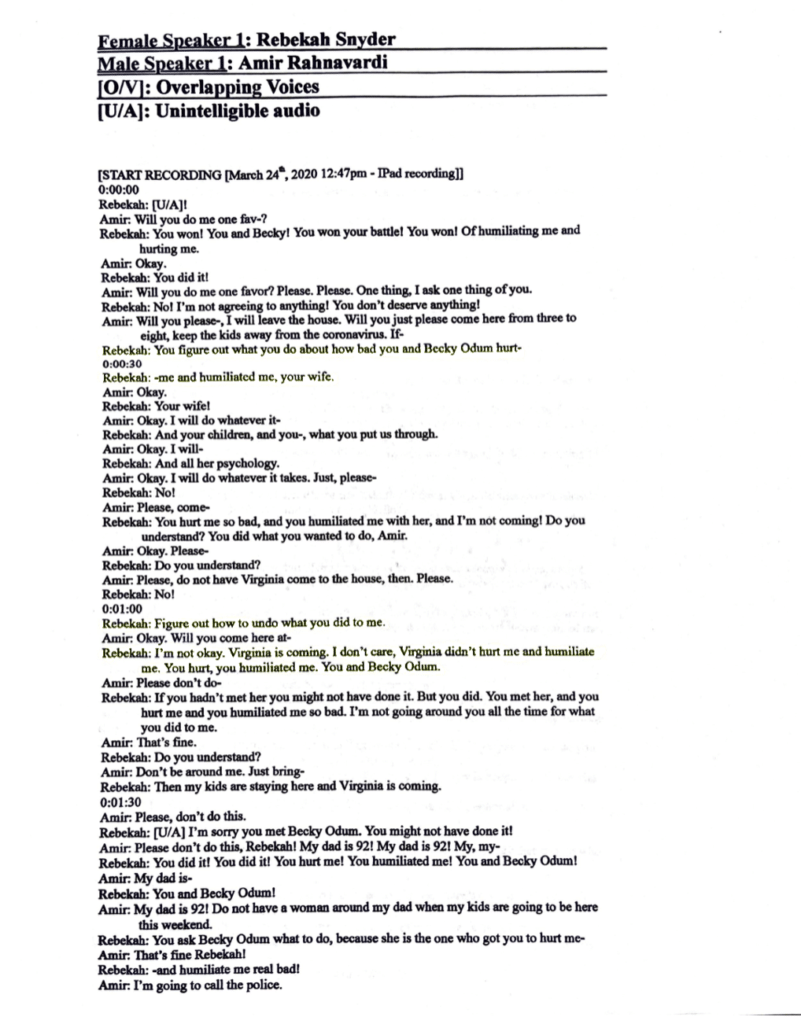
EVIDENCE 1 — March 24, 2020 transcript excerpt, opening portion.
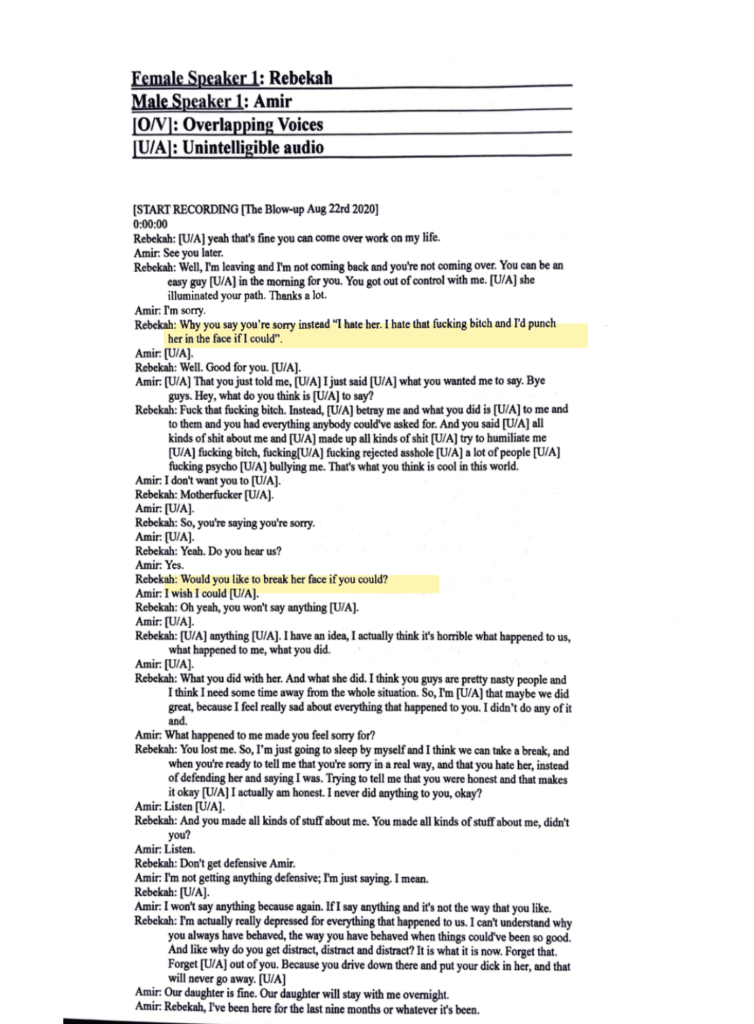
EVIDENCE 2 — August 22 transcript excerpt, later exchange.
Who first characterized the video as sexual activity? Was the recording itself reviewed? Did discovery referee Leon F. Bennett personally examine it? Did Judge JoAnn Johnson? Does the full surviving transcript support each description? Those questions should have factual answers.
A YEAR OF RECORDINGS THAT THE COURT NEVER HEARD
The August 22 recording was not an isolated piece of evidence. Rahnavardi says he accumulated approximately a year of video documenting his interactions with Rebekah. He also says he maintained a contemporaneous journal exceeding 900 pages alongside the recordings. The journal has not been included in this evidence package, and its entries still need to be matched to the dates and events described in the videos.
Rahnavardi says signs notifying occupants of recording were displayed throughout the residence and that Rebekah knew cameras were operating. The appellate opinion, however, reports the trial court’s contrary account and Rahnavardi’s testimony that Rebekah told him to stop. The parties’ competing accounts of consent should be reported as disputed. [Opinion, pp. 2, 6.]
Discovery referee Leon F. Bennett played a central role in the electronic-evidence dispute. Bennett was appointed to oversee electronically stored information and discovery disputes. His recommendations became the basis for issue sanctions adopted by the trial court. [Opinion, pp. 3–4.]
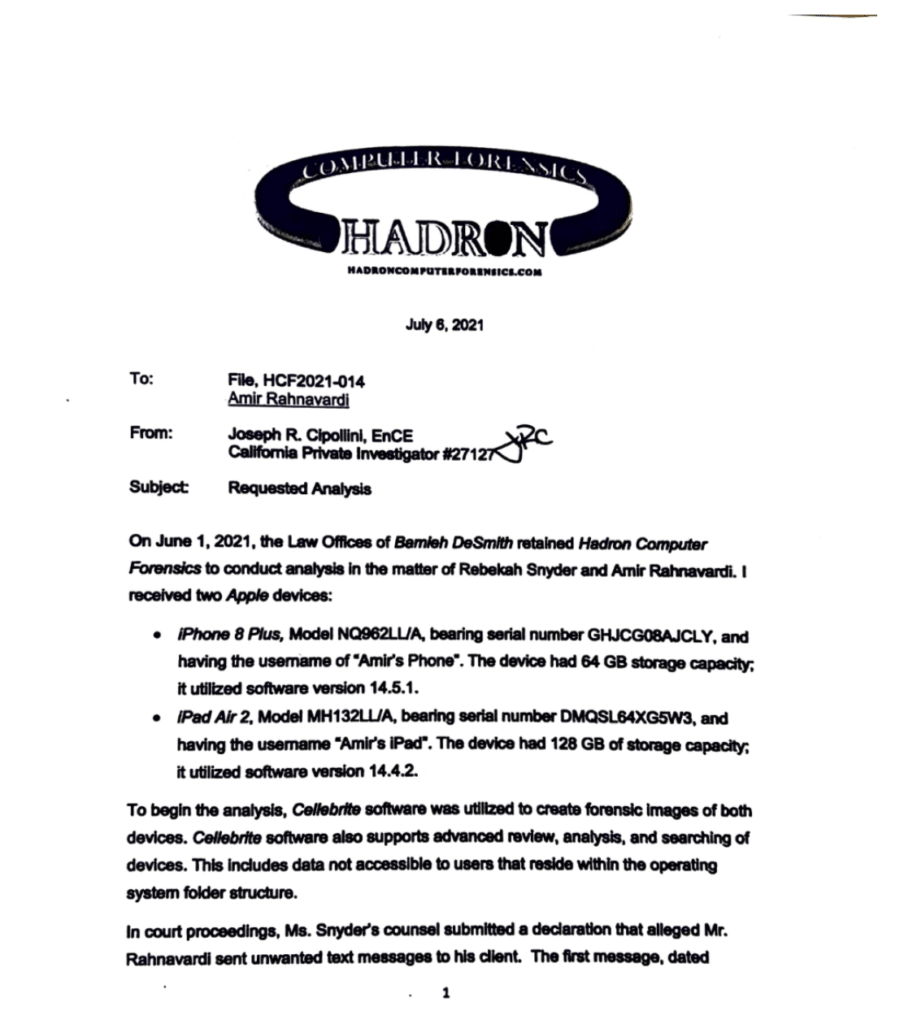
The opening brief describes efforts to provide devices and mapping information to court-appointed ESI expert John Troxel, including material from forensic expert Cipollini. Those descriptions are Amir’s appellate arguments; the opinion concludes that he failed to produce court-ordered devices and ESI. Both accounts must be compared with the underlying production records. [Opening Brief, pp. 12–13; Opinion, pp. 11–13.]
EVIDENCE 3 — Joseph R. Cipollini, Hadron Computer Forensics report, pages 1 and 2.
The reply brief also cites Troxel’s sworn testimony in challenging Bennett’s assessment of cooperation. The quoted excerpt is part of an appellate filing; the original testimony should be checked for context. [Reply Brief, p. 24.]
The practical consequence deserves scrutiny: Rahnavardi could not introduce evidence to dispute the three issues fixed by the sanctions. The appellate court nonetheless concluded that he could testify about his justification for recording and contest whether Rebekah’s peace was disturbed. [Opinion, pp. 4, 12.]
THE QUESTION IS NOT WHETHER THE COURT RULED AGAINST HIM
The trial court imposed sanctions, issued a domestic violence restraining order, and Rahnavardi’s contact with his children was restricted. In June 2026, the California Court of Appeal affirmed the judgment. [Opinion, pp. 1, 14.]
The appellate court did not conduct a new trial or reweigh the evidence. It declined Rahnavardi’s request to inspect each device. The opinion addressed the discovery dispute through the record and the applicable standards of appellate review. The panel rejected his due-process arguments, concluded that the referee appointment and adoption of recommendations did not warrant reversal, and held that several objections had been forfeited. [Opinion, pp. 5–13.]
Rahnavardi’s briefs disputed those conclusions. His reply argued that an existing fee waiver established inability to pay and that prior monetary sanctions influenced Bennett’s recommendation; the opinion held that the referee-fee order had not been shown prejudicial and distinguished earlier unpaid monetary sanctions from unpaid referee fees. [Reply Brief, pp. 12–15; Opinion, pp. 8–9.]
What, precisely, did the appellate judges have before them? The opening brief, reply brief, and opinion can be compared against the trial transcripts and underlying exhibits to identify which questions were resolved on their merits, which were rejected under standards of review, and which were deemed forfeited.
THE APPELLATE PANEL DESERVES A CLOSER LOOK
Rahnavardi’s appeal was decided by Justices Hernaldo J. Baltodano, Kenneth R. Yegan and Tari L. Cody of the Second District Court of Appeal, Division Six. Baltodano authored the opinion; Yegan and Cody concurred. [Opinion, p. 14.]



Yegan and Cody previously served on the Ventura County bench. Their past service does not establish bias or misconduct. Whether either justice had prior involvement in Rahnavardi’s litigation, or whether a disclosure or disqualification obligation arose, requires separate documentary verification.
NOW WE GO BACK TO THE EVIDENCE
The August 22 transcript should be compared line by line against material descriptions of the recording in the trial-court and appellate record. Bennett’s reports should be compared against the underlying forensic evidence. The sanctions order should be examined to determine precisely which arguments and evidence Rahnavardi could not present and why.
The June 2025 opening brief, January 2026 reply brief, and June 11, 2026 opinion permit a documented comparison of the arguments and the appellate court’s responses. But those filings do not substitute for the complete videos, original transcript, underlying forensic report, referee’s recommendations, sanctions order, or the journal.