
New campaign filings reveal the Weingart Center Association itself contributed to a political action committee chaired by its own CEO — a PAC that spent money supporting Los Angeles politicians. Meanwhile, City Hall continued directing millions of taxpayer dollars to Weingart through sole-source and no-bid arrangements.
The deeper we dig into the Weingart Center Association, the less the story looks like one questionable $27 million real-estate transaction and the more it looks like an interconnected political ecosystem where the same nonprofit executives, elected officials, political organizations, developers and publicly funded projects continue crossing paths.
And this time, the money trail isn’t coming from individual executives.
It is coming directly from Weingart Center Association.
Campaign finance records reviewed by The Current Report identify Weingart Center Association, Inc. as making monetary contributions to the Central City Association Political Action Committee in three consecutive years: $600 in 2024, $600 in 2025 and $1,000 in 2026.
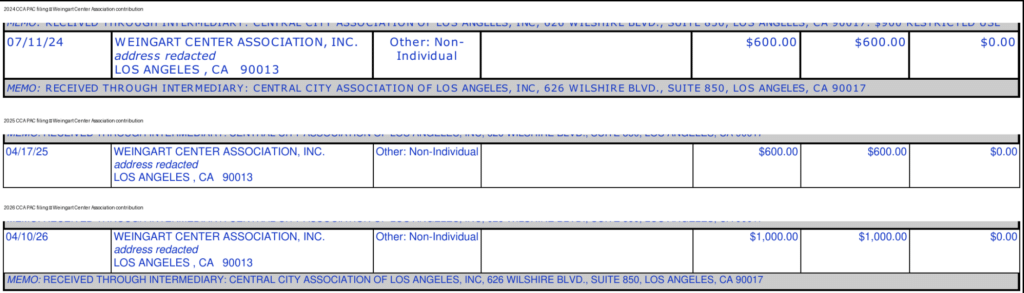
The 2024 filing records a $600 contribution from Weingart Center Association on July 11, 2024. The filing is particularly notable because the committee’s name for that election cycle was the “Central City Association Political Action Committee, Supporting Nazarian and Hutt for Los Angeles City Council 2024.”

The following year, another CCA PAC filing records a $600 contribution from Weingart Center Association on April 17, 2025.
Then, on April 10, 2026, Weingart increased its contribution to $1,000.
That is where this story becomes far more serious.
Weingart Center Association is not a conventional corporation with a political department. It is a federally tax-exempt 501(c)(3) charitable organization. Federal tax records identify it as a charitable homeless-services organization.
And the IRS is remarkably clear about what a 501(c)(3) can and cannot do politically.
According to the IRS, a Section 501(c)(3) organization may not contribute to a political organization described under Section 527, expressly including a political action committee. The IRS states unequivocally that a 501(c)(3) organization cannot make a contribution to a candidate committee, political party committee or PAC.
That makes the Weingart contributions more than another interesting entry in a campaign-finance spreadsheet.
They demand an explanation.
THE CEO WAS ALSO CHAIRING THE PAC
The conflict questions become even more pronounced when another name is added to the equation: Kevin Murray.
At the time of the 2024 contribution, Murray was Weingart’s president and CEO.
He was also one of the 2024 chairs of the Central City Association PAC.
That isn’t speculation. CCA announced it itself.
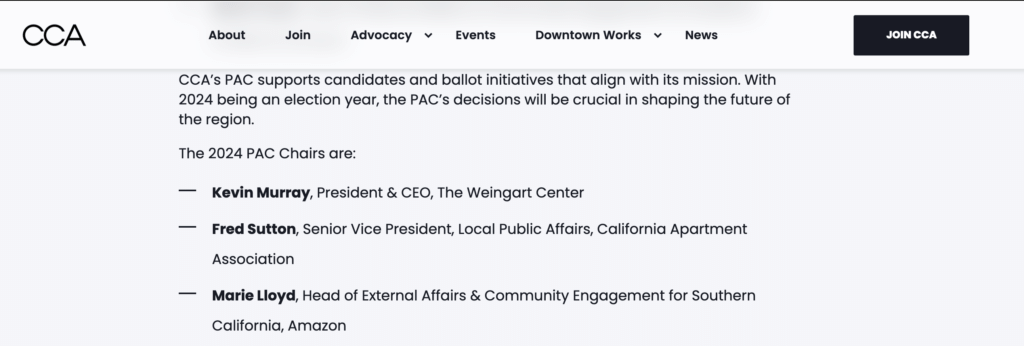
In its announcement of its 2024 leadership, CCA identified “Kevin Murray, President & CEO, The Weingart Center” as one of three PAC chairs. CCA simultaneously explained that its PAC supports candidates and ballot initiatives aligned with the organization’s mission and said the committee’s decisions would be especially important during the 2024 election year.
Think about what the public record therefore shows.
A tax-exempt charitable organization headed by Kevin Murray contributed money to a political action committee that Kevin Murray himself was helping chair.
That committee then spent money supporting political candidates.
The 2024 filing reviewed by The Current Report identifies the PAC itself as supporting City Council candidates Adrin Nazarian and Heather Hutt. Another expenditure in the filing paid $3,500 for digital advertising supporting Nazarian, Imelda Padilla and John Lee. The committee also reported a $900 contribution to Lee’s officeholder account.
The following year, the PAC reported $5,900 supporting Mark Gonzalez for Assembly, $1,000 supporting Jessica Caloza for Assembly and $1,500 to Supervisor Janice Hahn’s officeholder committee.
And in 2026, the political activity expanded again.
The CCA PAC reported a $1,000 contribution supporting Assessor Jeffrey Prang, $1,000 supporting Jose Ugarte for Los Angeles City Council, $1,800 supporting Mayor Karen Bass’ reelection campaign and $1,000 supporting Tim Gaspar for City Council. It also reported $50,000 supporting the Los Angeles Cost of Living Relief Initiative and $1,000 opposing the recall of Councilmember Imelda Padilla.
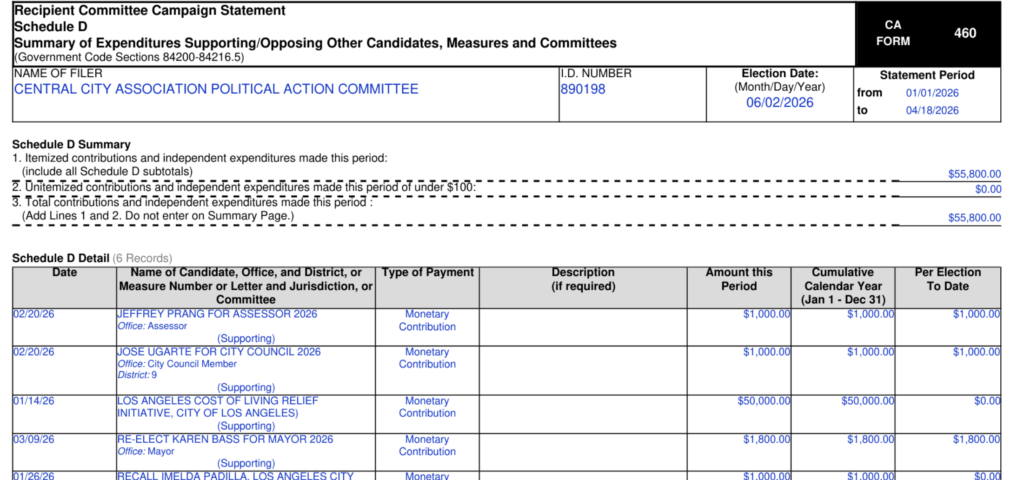
The significance is not that every dollar leaving the CCA PAC can legally be characterized as Weingart’s dollar. Money entering a PAC becomes part of the committee’s funds, and the filings do not establish that Weingart directed particular expenditures.
The significance is the network.
And the network keeps leading back to Weingart.
WEINGART, BASS AND THE $60 MILLION SHELBY DISASTER
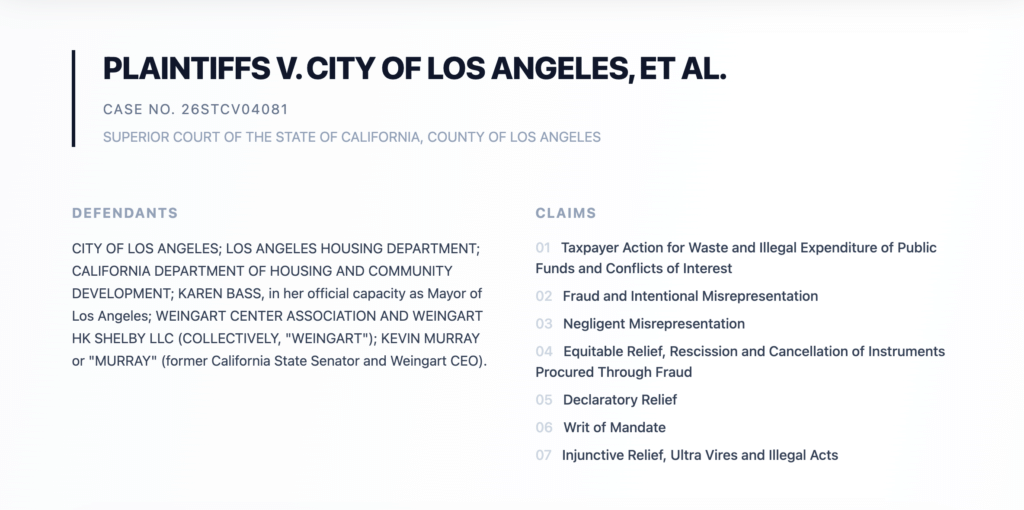
This new information comes after extensive reporting by The Current Report concerning the Weingart Center’s controversial Shelby Drive Homekey project.
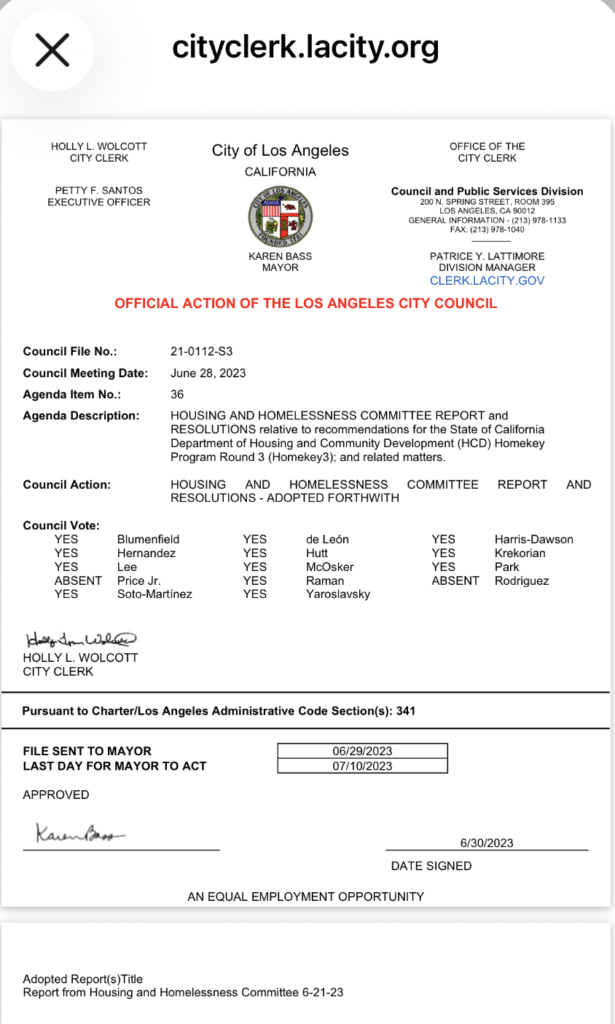
In December 2025, The Current Report exposed the political and financial relationships surrounding the $27.3 million purchase of the former senior-living property at 3340 Shelby Drive. A middleman connected to developer Steven Taylor had acquired the same property for approximately $11.2 million before it was sold to Weingart for $27.3 million using public money.
By March 2026, additional records revealed an even larger public commitment approaching $60 million when acquisition, operations and renovation costs were included. The Current Report also reported that approximately $20 million in City money was moved into the Shelby project after funding decisions involving Mayor Karen Bass’ administration.
Now place that history alongside the newly reviewed CCA records.
On March 9, 2026, the CCA PAC contributed $1,800 to Re-Elect Karen Bass for Mayor 2026.
The CCA connection to Bass extended beyond the $1,800 contribution. In a May 18, 2026 public comment filed with the Los Angeles City Clerk, the author cited Los Angeles Ethics Commission independent-expenditure records reporting that Angelenos for Progress, a separate independent-expenditure committee sponsored by the Central City Association of Los Angeles, had spent approximately $429,000 on television and digital advertising supporting Bass.
Angelenos for Progress is separate from the CCA PAC that received Weingart’s contributions, and the records reviewed do not establish that Weingart funded those independent expenditures. But the spending provides additional context about CCA-sponsored political activity in the 2026 mayoral race.
One month later, on April 10, Weingart Center Association contributed $1,000 to the CCA PAC.
Again, those dates alone do not prove Bass received Weingart money or that there was any agreement between the parties. They do, however, establish another financial and political connection involving an organization receiving enormous amounts of public funding from a city whose mayor’s campaign was supported by the same PAC to which Weingart contributed.
The connection deserves scrutiny, so does the need for transparency.
THEN THERE IS NITHYA RAMAN
The political overlap doesn’t stop at the Mayor’s Office.
In August 2025, Councilmember Nithya Raman moved to install Weingart as the operator of the 100-bed A Bridge Home facility at 3248 Riverside Drive in Council District 4 after PATH stopped operating the facility.
But there was no competitive bidding process.
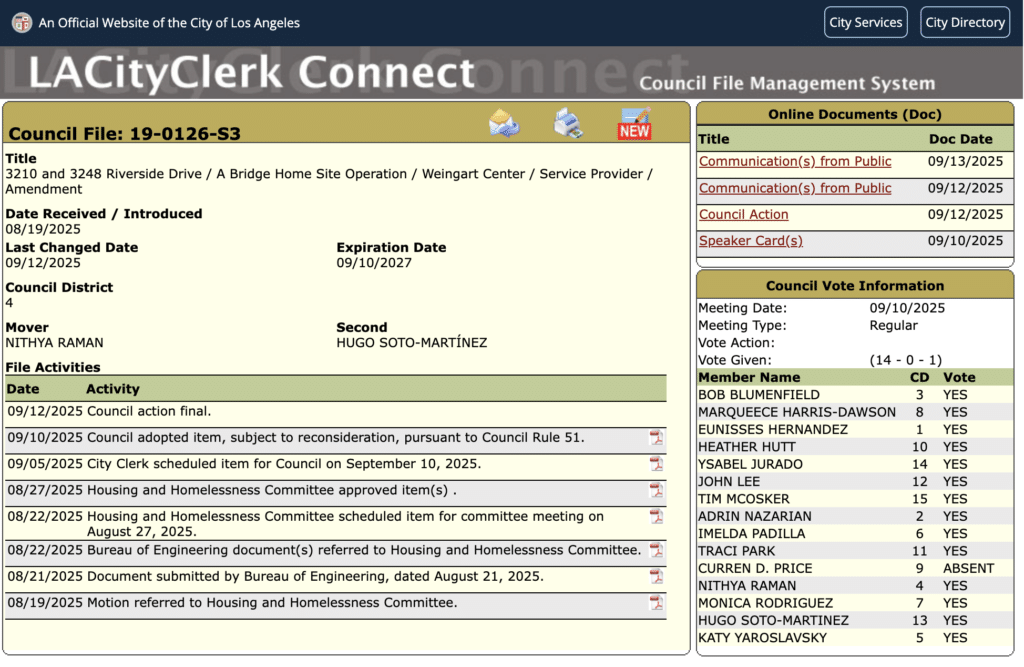
Raman’s motion asked the City Council to formally find that competitive bidding would be “undesirable and impractical” and requested that LAHSA execute a new or amended sole-source agreement with Weingart.
The amount?
A pro-rata share of $3,248,500 through June 30, 2026.
The justification was urgency. The Riverside facility had been without a permanent service provider since July 1, according to the motion, and Weingart had experience operating comparable facilities and was already on LAHSA’s qualified interim-housing-provider list.
Those are legitimate considerations.
But they do not answer every procurement question.
The committee report expressly states that neither the City Administrative Officer nor the Chief Legislative Analyst had completed a financial analysis of the proposal.
So a $3.248 million sole-source arrangement was advanced without a completed CAO or CLA financial analysis.
The public record reviewed by The Current Report also does not show, within Raman’s motion itself, a comparative price analysis explaining why $3.248 million represented the best available price, a documented comparison with other qualified providers, or a detailed explanation of why another competitive or expedited procurement process could not be used.
The Council nevertheless approved the arrangement.
THREE WEEKS. TWO WEINGART DEALS.
Riverside wasn’t the only Weingart sole-source matter moving through Raman’s Housing and Homelessness Committee.
A separate City Council matter sought to continue Weingart’s operation of the 232-bed Hilda L. Solis Care First Village through June 30, 2026.
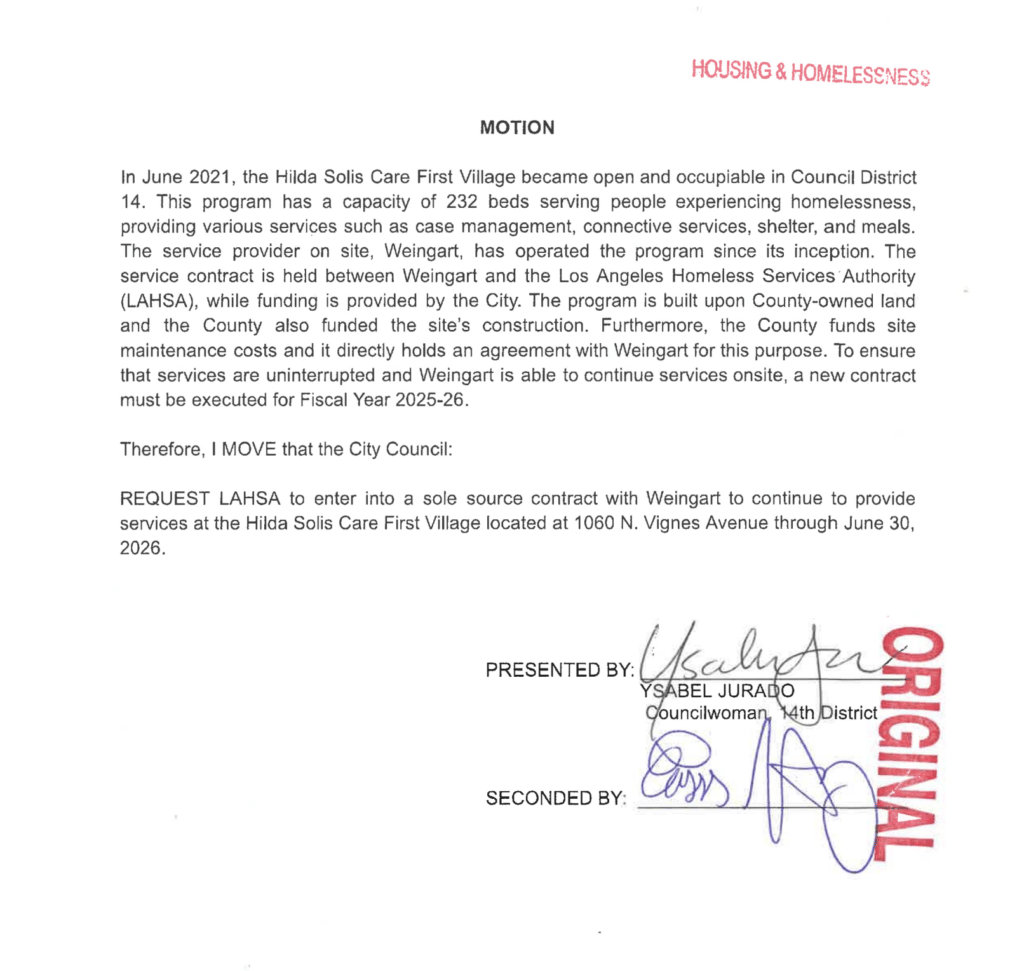
That motion was introduced by Councilmember Ysabel Jurado, not Raman, an important distinction.
But Raman chaired the Housing and Homelessness Committee through which the request traveled.
The underlying City motion specifically requested that LAHSA enter into a sole-source contract with Weingart to continue operating the facility. Its stated justification centered on continuity: Weingart had operated the program since the site opened in 2021 and a new agreement was needed to prevent an interruption in services.
Continuity can be a legitimate procurement consideration.
But continuity is not a magic phrase that eliminates every other question about public spending.
The motion itself does not identify a competing proposal, a price comparison, alternative qualified providers or, on its face, the particular written LAHSA procurement exception supporting the sole-source selection. Whether those materials exist elsewhere in LAHSA’s procurement file is precisely the type of documentation that should now be produced.
The issue isn’t whether a sole-source contract can ever be lawful.
It can.
The issue is why Weingart repeatedly emerges as the recipient of exceptions to ordinary competitive processes while its executives and organization are simultaneously embedded in Los Angeles’ political and governmental infrastructure.
MURRAY AND RAMAN WERE SITTING ON THE SAME GOVERNMENT BOARD
There is another overlap.
During this period, both Raman and Murray served on the Los Angeles County Affordable Housing Solutions Agency — LACAHSA, the regional agency responsible for affordable-housing funding and Measure A resources.
Official LACAHSA records list Raman as a Los Angeles City Councilmember on the board and Murray as president and CEO of the Weingart Center Association.
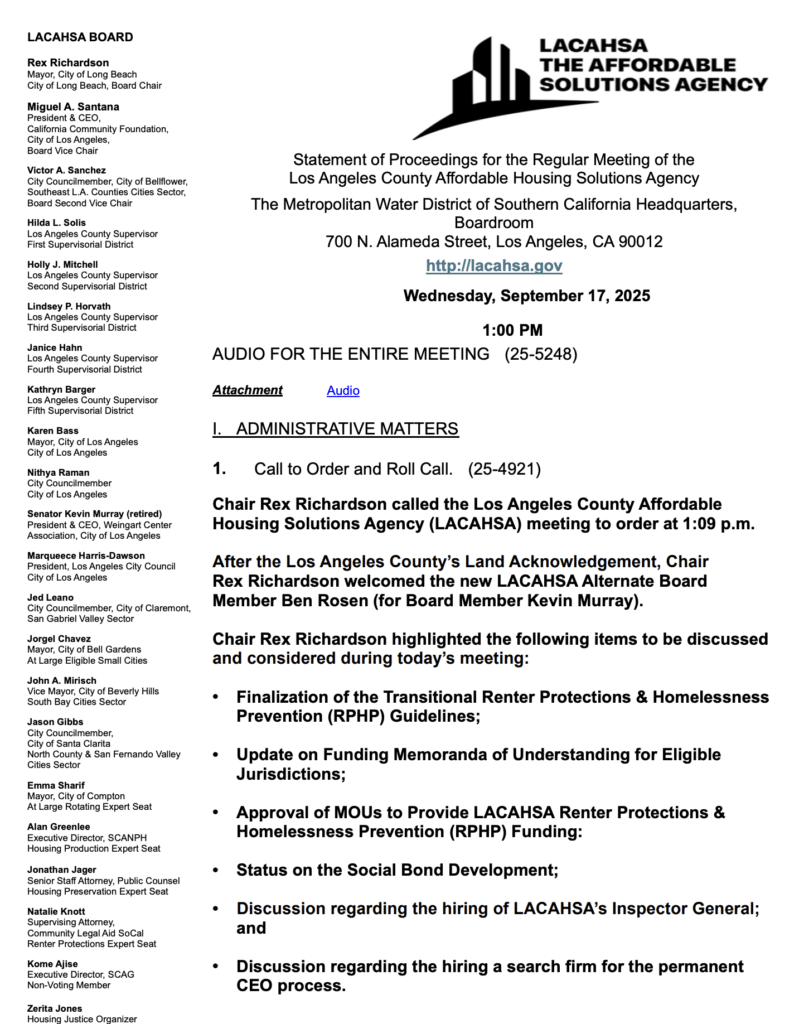
Murray wasn’t merely running a nonprofit seeking and receiving government contracts.
He was sitting inside a government housing agency.
And he got there through Mayor Bass.
The Los Angeles Times later reported that Bass had appointed Murray to LACAHSA. Murray resigned from that board in late November 2025 amid the federal investigation surrounding Weingart’s real-estate activities.
That means the public is entitled to know exactly what disclosures were made regarding Murray’s outside interests, what matters involving Weingart came before LACAHSA while he served, whether he participated in any discussions or votes affecting Weingart or competing providers, and what conflict-screening procedures were used.
Because the appearance problem is impossible to ignore.
AND THEN MURRAY DISAPPEARED
Perhaps the strangest part of the Weingart story remains Kevin Murray himself.
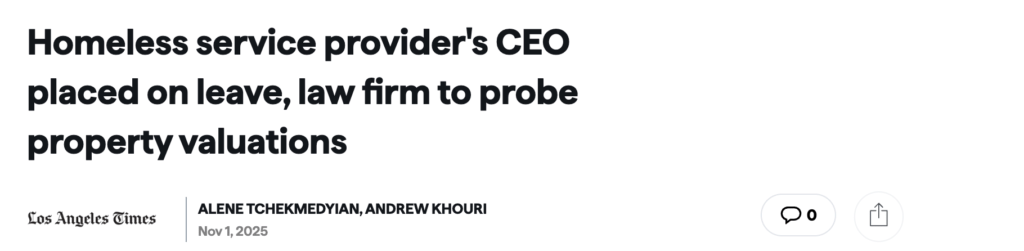
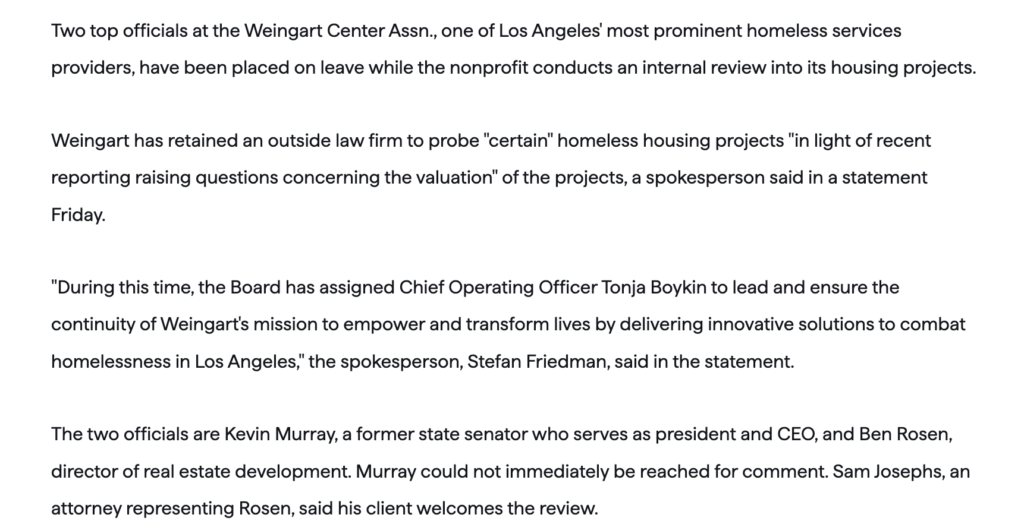
In late 2025, Weingart placed Murray and real-estate executive Ben Rosen on leave while an outside law firm reviewed certain housing projects following questions about property valuations. The organization announced that COO Tonja Boykin would lead operations during the review.
Months later, the questions remain.
What did Weingart’s internal investigation find?
Why exactly was its CEO placed on leave?
What did investigators determine regarding Rosen?
Was disciplinary action taken?
Did either executive return?
Were any findings referred to law enforcement?
And who is currently exercising the authority Murray previously held?
Weingart has never publicly released a detailed accounting of the investigation identified in the reporting reviewed for this article.
The silence becomes even more remarkable in the context of the Shelby litigation previously covered by The Current Report. Murray is individually named as a defendant in that litigation, yet according to the docket review supplied to The Current Report, neither Murray nor counsel appearing separately on his behalf has filed an answer, opposition or response to the motions reviewed.
For a man who once sat simultaneously at the center of Weingart, CCA’s political operation and a regional government housing authority, his public disappearance from the story is extraordinary.
THE QUESTION WEINGART NOW HAS TO ANSWER
There is no need to speculate about a secret quid pro quo when the documented relationships themselves raise enough questions.
The records establish that Weingart Center Association is a 501(c)(3). They establish that the organization contributed to the CCA PAC in 2024, 2025 and 2026. They establish that Kevin Murray, Weingart’s CEO, chaired that PAC in 2024. They establish that the PAC spent money supporting elected officials and candidates. They establish that Los Angeles continued awarding or extending major Weingart agreements, including sole-source arrangements. And they establish that Murray simultaneously occupied a seat on a government housing agency alongside elected officials involved in Los Angeles housing policy.
None of those facts, standing alone, proves bribery, pay-to-play or an illegal quid pro quo.
But taken together, they create a set of questions that City Hall, Weingart, CCA and the elected officials involved should answer publicly.
Most immediately, Weingart should explain why a federally tax-exempt 501(c)(3) organization made monetary contributions to a political action committee at all.
The IRS says a 501(c)(3) cannot contribute to a PAC. It also warns that prohibited campaign intervention can result in excise taxes and, in serious cases, revocation of tax-exempt status.
CCA should explain how the Weingart contributions were classified, whether any restrictions were placed on the funds, whether the committee knew Weingart was a 501(c)(3), and whether the money was ever refunded.
Murray should explain his role in approving Weingart’s contributions while simultaneously serving as a CCA PAC chair.
And Los Angeles officials should explain why an organization operating inside this extraordinarily interconnected political network continued receiving millions of dollars through sole-source arrangements without the level of independent financial scrutiny taxpayers should expect.
Because after Shelby, after the federal investigation, after Murray and Rosen were placed on leave, after the LACAHSA resignations, and now after the discovery that the charity itself was putting money into a political PAC, the question is no longer whether these relationships deserve scrutiny.
The question is why it took this long for anyone to follow all of them at once.
And there is one question in particular that deserves an answer from every politician involved:
When Weingart came before government asking for millions of dollars in public money, did anyone making those decisions know that the nonprofit itself had been contributing money to a PAC helping elect and re-elect Los Angeles politicians?
If they didn’t know, they should want to know now.
And if they did, the public deserves to know that too.