
In Los Angeles County, the line between justice and politics has blurred beyond recognition. The prosecution of Rebecca Grossman, once a respected philanthropist and community leader, for the tragic deaths of two children in a Westlake Village crosswalk has evolved far beyond a criminal case. It now stands as a case study in how public outrage, prosecutorial ambition, and media manipulation can converge to distort the very pursuit of justice.
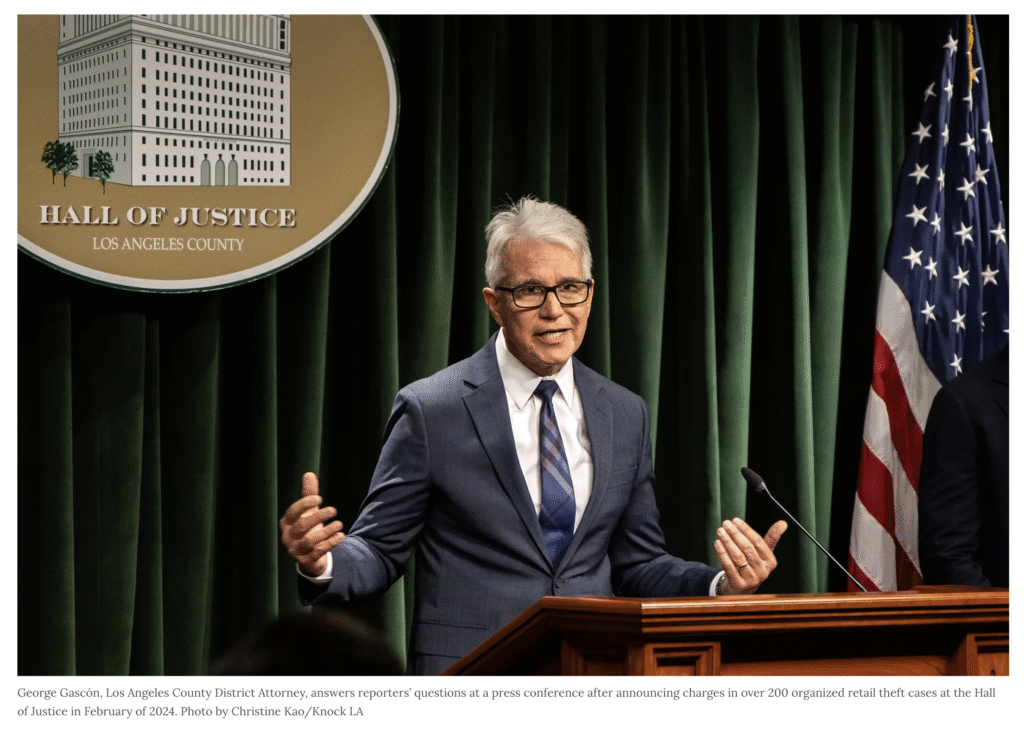
Under former District Attorney George Gascón, Los Angeles became ground zero for what many legal scholars call the “tyranny of overcharging.” Instead of focusing on proportional justice, prosecutors under Gascón’s administration repeatedly leveraged the most severe charges possible to satisfy a media-fed appetite for punishment and to counter accusations that the DA was “soft on crime.” Grossman’s prosecution exemplifies this phenomenon. While Gascon is no longer the District Attorney, and newly elected District Attorney Nathan Hochman is taking a much harder line, many of Gascon’s prosecutors remain and the overcharging plague still lingers.
In 2020, following a tragic collision that killed Mark and Jacob Iskander, Grossman was charged not with vehicular manslaughter, the typical filing for a fatal accident involving speed or negligence, but with two counts of second-degree murder under the doctrine of implied malice. This is a charge almost never applied outside repeat DUI cases, where a prior court warning establishes a driver’s knowledge of life-threatening risk. Grossman had no such history. No DUI, no “Watson admonition,” no prior incident suggesting intent or conscious disregard for human life.
Yet the DA’s office escalated the charges to murder, a textbook example of “vertical overcharging.” The message was clear: Gascón wanted headlines that said “Tough on Crime,” not another case that might be framed as lenient. Behind the scenes, insiders described the Grossman filing as a politically calculated response to growing criticism from police unions, victims’ rights groups, and conservative media, who were already circulating recall petitions against him. A high-profile case involving a wealthy, white woman became the perfect stage to reassert prosecutorial strength.
The tragedy was undeniable. Two young brothers lost their lives; a community was shattered. But almost immediately, the case became a morality play rather than an impartial legal process. Mainstream media seized on a narrative of privilege and excess: “a socialite speeding through suburbia, indifferent to consequences.” The DA’s office capitalized on that narrative, using press releases and public statements to frame Grossman as emblematic of “reckless disregard” and calling for “accountability for all.”
The problem: the evidence never matched the rhetoric. Grossman’s blood alcohol content was below the legal limit. She had no prior record, and eyewitness accounts were inconsistent about whether she was “racing” another vehicle. In fact, the driver three seconds ahead of Grossman, Scott Erickson, the former Dodgers pitcher, was never charged, despite vehicle evidence and witness statements suggesting both cars were involved in the same sequence of events. The selective targeting of Grossman alone raises troubling questions about selective prosecution, optics, and narrative control.
As trial proceedings unfolded, defense attorneys and legal analysts pointed out that the murder theory simply didn’t fit. Implied malice requires proof of awareness of deadly risk and conscious disregard of human life, a far higher threshold than mere recklessness or negligence. By stretching that doctrine to its outer limits, prosecutors created a case that would appease public anger but risk undermining due process.
What happened in the Grossman case isn’t an anomaly, it’s emblematic of a prosecutorial culture where discretion equals dominance. As former prosecutor-turned-reform advocate Mark Godsey has warned, prosecutors’ decisions are “virtually unreviewable,” and career incentives often reward conviction rates over fairness. In Los Angeles, where the DA’s office operates under intense political scrutiny, those incentives are magnified by media cycles and election dynamics.
Charging Grossman with murder served dual political purposes: it satisfied public outrage over a heartbreaking tragedy and allowed Gascón to posture as a hard-liner just as recall efforts and internal dissent among deputy DAs were peaking. In essence, Grossman became collateral in a PR campaign. The case was never just about two children lost, it was about a District Attorney desperate to rehabilitate his public image through the optics of retribution.
No institution amplified the distortion more than the media itself. Television coverage and tabloid headlines transformed the story into click-bait melodrama. Footage of the crash aftermath ran on repeat, often stripped of legal context or nuance. Commentators called for life sentences before a jury was even seated. Few outlets mentioned that Grossman stayed at the scene, that she expressed horror and concern for the victims, or that key forensic evidence tied to a second vehicle went missing after being logged into evidence.
The court of public opinion rendered its verdict long before the actual trial, and the prosecution leaned into that perception. It’s an increasingly familiar pattern: prosecutors exploit media attention to bolster public perception of “justice,” while defendants are vilified before the facts are tested in court. In doing so, justice itself becomes performance art.
Behind the Grossman spectacle lies the broader machinery of Los Angeles County’s politicized prosecution system. George Gascón’s tenure was defined by contradictions—preaching reform while engaging in the same punitive optics he once condemned. His office’s handling of the Grossman case mirrored a national trend where elected prosecutors use high-profile tragedies as political theater, selectively overcharging to appear balanced after backlash from prior leniency.
It’s a cynical cycle: the public demands accountability; politicians weaponize that demand; prosecutors respond with symbolic overreach. In the process, the distinction between justice and political survival evaporates.
The Grossman case underscores a deeper truth about the American justice system: prosecutorial discretion has become a form of unchecked power. When wielded for politics instead of principle, that power erodes faith in the rule of law. As with the notorious Fraser Bohm case, where another tragic Malibu crash led to similarly inflated murder charges, the DA’s office appears more concerned with optics than with jurisprudence.
Legal scholars from the Northern California Innocence Project and the Veritas Initiative have long warned that prosecutorial overreach and lack of accountability are among the leading causes of wrongful convictions. Yet even proven misconduct rarely results in discipline. Prosecutors hide behind absolute immunity, shielded from personal consequences while their defendants face ruin. Until that imbalance is corrected, overcharging will remain a political tool masquerading as justice.
Rebecca Grossman’s case was never just about one night on Triunfo Canyon Road. It became a referendum on power, privilege, and perception in Los Angeles County. The DA’s office turned a tragedy into a campaign message, the media turned grief into ratings, and the law itself bent under the weight of emotion.
If the justice system is to mean anything, it must resist the seduction of spectacle. Prosecutors must answer not to the mob or the media cycle, but to the Constitution—and to the principle that punishment should match proof, not politics. Anything less is not justice at all.
DISCLAIMER: Investigative reporting in high-profile litigation cases published by The Current Report is non-commercial, fact-based journalism; any project fees compensate research and reporting labor only, sources participate solely in accuracy verification, and final publication is approved exclusively by The Current Report after fact-checking is confirmed.